
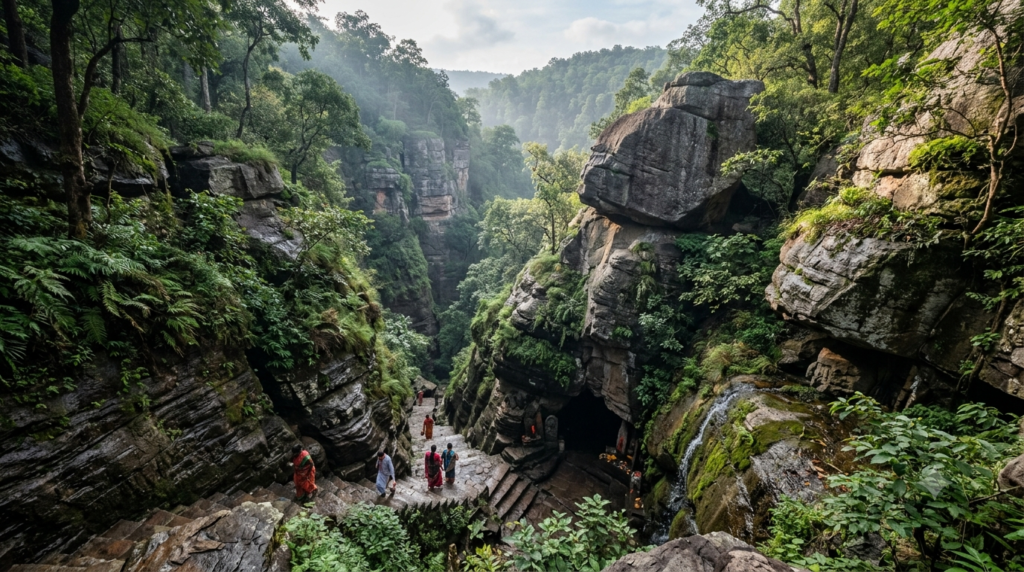
A Jatashankar Temple Darshan takes you deep into a natural Shiva cave hidden in the Satpura hills near Pachmarhi, Madhya Pradesh. The shrine sits inside a cool limestone cavern where dripping water has shaped rock into what devotees revere as 108 Shivlings. Pilgrims come for the stillness, the sacred spring called Gupt Ganga, and the legend that Lord Shiva once hid here from a demon. This guide gives you accurate timings, the real cost, how to reach the cave, and the one permit detail that most websites get wrong.
Gokshetra is an independent temple travel guide. We are not affiliated with, endorsed by, or the official website of any temple trust or government body, and we do not take bookings, donations, or payments. Please use the official sources linked below for the latest details.
Jatashankar Temple Darshan at a Glance
- Location: About 1.5 km north of Pachmarhi town, Narmadapuram district, Madhya Pradesh.
- Deity: Lord Shiva, worshipped as natural rock lingams inside a cave.
- Entry fee: Free. There is no ticket for general darshan.
- Timings: Commonly reported as 7 AM to 7 PM daily; confirm locally before you go.
- Access: A short walk plus a descent of roughly 150 steps into the cave.
- Permit: None needed. Jatashankar is a non-forest sightseeing point.
- Best time: October to March for pleasant weather.
What Makes a Jatashankar Temple Darshan Special
Jatashankar, also spelt Jata Shankar, is a natural cave shrine dedicated to Lord Shiva. It lies in a deep ravine with huge boulders perched overhead. The name joins two words, because jata means matted hair and Shankar is another name for Shiva. The rock strands hanging from the ceiling look like the god’s tangled locks, so the cave earned its name.
Inside, water drips endlessly over stone. Over thousands of years this formed stalactites and stalagmites that devotees worship as 108 naturally shaped Shivlings. A perennial stream also flows through the cave from a source no one has traced. Locals call it Gupt Ganga, the hidden Ganga, and treat the water as sacred.
Two spring-fed ponds sit near the cave, and this is where nature turns strange. One pond stays cold while the other runs warm, even though they lie close together. The cave ceiling holds another wonder, since one long formation resembles Sheshnag, the hundred-headed serpent of Hindu myth. Together these details make a Jatashankar Temple Darshan feel like walking through a living piece of geology and faith at the same time.
Jatashankar Temple Darshan Timings and Entry Fee
General darshan at Jatashankar is free, and no ticket is required to enter the cave. Most sources report the shrine open from around 7 AM to 7 PM every day. However, a few listings show slightly different hours, so treat the exact closing time as flexible and confirm it in Pachmarhi town before heading out.
There is no official online booking for a Jatashankar Temple Darshan. You simply reach the cave during open hours and join the queue. If a website asks you to pay for an online darshan slot here, treat it as a red flag, because no such system exists. For any special puja such as an abhishek, ask at the small counter near the entrance and confirm the rate on the spot.
Since the cave lies below ground level, natural light fades early inside. Priests generally align worship with daylight, so a morning or midday visit is safest for a clear darshan. Reaching before 8 AM also helps you beat both the heat and the crowd.
Do You Need a Permit or Gypsy for Jatashankar?
No. This is the single most useful fact for planning, and most guides skip it. Jatashankar is a non-forest sightseeing point in Pachmarhi, so you can reach it by auto, taxi, private car, or on foot straight from town. You do not need the Bison Lodge day-permit or a hired gypsy to visit.
That permit-and-gypsy system does exist in Pachmarhi, but it applies to the forest-zone attractions instead. Sights like Bee Falls, Dhoopgarh, Rajat Prapat, Reechgarh, and Apsara Vihar sit inside the Satpura reserve boundary. For those, private vehicles are barred, and you must buy a permit at the Bison Lodge Museum and travel by an authorised gypsy. The Madhya Pradesh Forest Department manages that reserve and its permits.
Several travel pages wrongly bundle Jatashankar into that forest circuit and tell readers to book a gypsy for it. That advice can cost you money and time you do not need to spend. Keep the two categories separate, since it changes how you plan your day and your budget.
How to Reach Jatashankar Temple in Pachmarhi
Pachmarhi is the only hill station in Madhya Pradesh, and it connects to the plains by road and rail. Once you reach the town, the cave sits just a short hop away. Here is the practical breakdown for each mode of travel.
| Mode | Nearest hub | Approx. distance |
|---|---|---|
| By air | Raja Bhoj Airport, Bhopal | ~200–230 km |
| By rail | Pipariya Railway Station | ~50–52 km |
| By road | Pachmarhi bus stand | ~1.5 km to the cave |
By air, the nearest airport is Raja Bhoj Airport in Bhopal, roughly 200 to 230 km away. From there a cab to Pachmarhi takes about four to five hours through scenic countryside. By train, the closest railhead is Pipariya, around 50 km from Pachmarhi, and taxis and buses wait outside the station.
By road, regular buses run to Pachmarhi from Bhopal, Pipariya, Nagpur, and Jabalpur. After you arrive, the cave is only about 1.5 km from the bus stand. You can walk it, hire an auto, or take a local taxi to the drop-off point near the approach path.
The Walk, the 150 Steps, and Safety
From the parking area you walk a short forested stretch, and then the descent begins. Roughly 150 stone steps lead down into the ravine toward the cave mouth. A few visitors count closer to 180, so the exact number matters less than knowing there is a real climb involved.
The path feels like a mini-trek, and that is part of the charm. Yet it also demands basic fitness because you must climb back up the same steps afterward. Wear sturdy shoes with grip, since the stone stays damp near the cave and can get slippery.
A quick safety note: the steps and dripping cave floor turn genuinely slick during the monsoon. Elderly pilgrims, pregnant women, and anyone with knee, heart, or breathing trouble should pace the climb slowly and carry water. If the steps feel unsafe on a wet day, it is fine to skip the descent. Treat any faith or ritual as devotion, and never as a substitute for medical care or a doctor’s advice before a strenuous climb.
Best Time for a Jatashankar Temple Darshan
The ideal window runs from October to March, when Pachmarhi’s weather stays cool and pleasant. Daytime temperatures sit in a comfortable 10°C to 25°C range, which suits the walk and the steps. Winter also brings clear skies that make the surrounding Satpura ranges look their best.
Monsoon, from July to September, turns the hills lush and fills nearby waterfalls to full flow. The scenery is stunning, though the steps grow slippery and demand extra care. If you love greenery and mist, plan a monsoon trip, but move slowly on the wet stone.
One planning tip helps if you want to combine sights. The Satpura Tiger Reserve core safari zone closes from 1 July to 30 September and reopens on 1 October. Jatashankar and the town stay open through the monsoon, so the cave remains reachable even when the safari is shut. For a similar cool-season plan, our guide to the best time to visit Ujjain Mahakaleshwar covers another Madhya Pradesh Shiva shrine worth pairing.
Festivals at Jatashankar
Maha Shivaratri, which falls in February or March, is the biggest event here. A large fair fills the area, and thousands of devotees pour in for darshan of Lord Shiva. The cave and its approach path grow crowded, so plan early and allow extra time.
The month of Sawan, or Shravan, also draws heavy footfall on Mondays. Many pilgrims trek through the forest fringe to worship the naturally seated Shiva during this holy month. If you prefer a quiet, contemplative Jatashankar Temple Darshan, avoid these festival peaks and choose an ordinary weekday morning instead.
Insider Tips Most Guides Skip
A few practical pointers make the visit smoother, and they come from how the site actually works on the ground. Use them to save time, money, and hassle.
- Skip the gypsy booking: reach Jatashankar directly from town, because it needs no forest permit.
- Go early: arrive before 8 AM for a calmer darshan and cooler steps.
- Carry cash: small vendors and any puja counter rarely take cards, and network can be patchy.
- Mind the vendors: stalls along the path sell ayurvedic oils, shilajit, and herbs, so buy only if you know the product.
- Ask before you click: photography is fine outside, yet it is often restricted inside the sacred cave, so check with staff.
Plan roughly 60 to 90 minutes for the whole visit. That covers the walk down, the darshan, a pause by the spring pools, and the climb back. For a broader Shiva circuit, you can also read our Ujjain Mahakaleshwar darshan guide before you plan a longer Madhya Pradesh trip.
Places to Visit Near Jatashankar
Pachmarhi packs many sights into a small area, so you can easily build a one or two-day trip around the cave. Several spots lie only a few kilometres away. The table below lists the popular ones with rough distances from Jatashankar.
| Place | Type | Approx. distance |
|---|---|---|
| Christ Church | Colonial-era church | ~1.9 km |
| Pandav Caves | Ancient rock-cut caves | ~3.1 km |
| Rajat Prapat (Silver Falls) | Waterfall viewpoint | ~3.2 km |
| Bee Falls | Waterfall | ~3.8 km |
| Dhoopgarh | Highest peak in MP, sunset point | ~5.7 km |
Bee Falls, Dhoopgarh, and Rajat Prapat sit inside the forest zone, so remember they need the Bison Lodge permit and a gypsy. Pandav Caves and Christ Church, like Jatashankar, are easier non-forest stops. Shiva devotees can also add Gupt Mahadev and Chauragarh, another hill shrine where pilgrims carry trishuls up the climb.
The Legend Behind the Cave
The story of Jatashankar links directly to Lord Shiva and a demon named Bhasmasura. According to tradition, Bhasmasura pleased Shiva through fierce penance and won a dangerous boon. He could reduce anyone to ash by placing a hand on their head.
Pride soon corrupted the demon, and he decided to test the power on Shiva himself. To escape, Shiva fled through the Satpura forests and hid inside this remote cave in deep meditation. Devotees believe the shrine marks that refuge, which is why the cave carries such spiritual weight even today.
Before You Go
A Jatashankar Temple Darshan rewards you with a rare mix of nature, myth, and quiet devotion. Keep three things in mind: entry is free, no gypsy or forest permit is needed, and the roughly 150 steps ask for basic fitness. Aim for an early October-to-March morning for the best experience.
For official travel and tourism details on the region, check the Madhya Pradesh Tourism website, and always confirm live timings once you reach Pachmarhi. If you enjoy cave and hill shrines, our Parli Vaijnath temple guide covers another sacred Shiva site.
Frequently Asked Questions
Is there an entry fee for a Jatashankar Temple Darshan?
No, general darshan is free of cost. You only pay if you choose a special puja or a guided ritual, and you should confirm that rate at the counter near the entrance. There is no ticket to enter the cave itself.
What are the Jatashankar Temple timings?
Most sources list the cave open from about 7 AM to 7 PM daily. A few listings vary slightly, so confirm the exact hours in Pachmarhi town before you set out. A morning visit gives the clearest darshan inside the dim cave.
Do I need a gypsy or forest permit to reach Jatashankar?
No. Jatashankar is a non-forest sightseeing point, so you can reach it by auto, taxi, or on foot from Pachmarhi town. The Bison Lodge permit and gypsy are only for forest-zone sights such as Bee Falls and Dhoopgarh.
How many steps lead down to the cave?
You descend roughly 150 stone steps after a short walk from the parking area. Some visitors count a few more. Wear shoes with good grip, because the steps stay damp near the cave and turn slippery in the monsoon.
Can I book a Jatashankar Temple Darshan online?
No official online booking exists for general darshan. You simply arrive during open hours and join the queue. Be cautious of any website claiming to sell online darshan slots, since no such system operates at this cave.
What is the best time to visit Jatashankar?
October to March offers the most pleasant weather for the walk and the steps. The monsoon looks beautiful and green, though the stone gets slippery. Maha Shivaratri and Sawan Mondays are spiritually charged but very crowded.
Is Jatashankar suitable for elderly visitors?
It involves about 150 steps down and back up, so it suits those with basic fitness. Elderly pilgrims and anyone with knee, heart, or breathing issues should climb slowly, carry water, and rest as needed. Skip the descent if the wet steps feel unsafe.
How much time does a Jatashankar Temple Darshan take?
Plan about 60 to 90 minutes for the full visit. That includes the walk down, darshan inside the cave, a short rest by the spring pools, and the climb back up. Festival days need extra time for the crowds.