
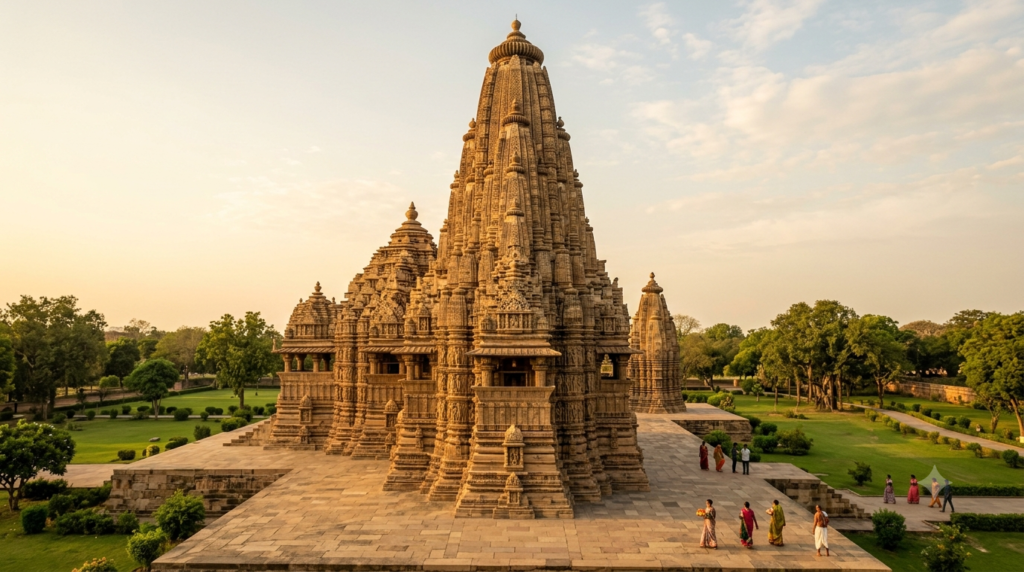
A Kandariya Mahadeva Temple darshan is less a queue-and-pooja ritual and more a walk through the finest stone carving India produced a thousand years ago. This towering Shiva shrine in Khajuraho, Madhya Pradesh, is the largest and most ornate temple in the UNESCO-listed Khajuraho Group of Monuments. It is protected today by the Archaeological Survey of India, so you enter it on a single Western Group ticket rather than through any devotional booking. That one distinction trips up most visitors, and getting it right changes how you plan the whole trip.
Go Kshetra is an independent pilgrimage and heritage guide. We are not affiliated with the Archaeological Survey of India (ASI), Madhya Pradesh Tourism, or any official body, and we do not sell tickets or take bookings. Buy your entry ticket only at the ASI gate or on the official ASI portal linked below.
Kandariya Mahadeva Temple Darshan at a Glance
Before the details, here are the numbers most travellers search for. Keep them handy, because a few of them changed recently.
- Location: Western Group of Temples, Khajuraho, Chhatarpur district, Madhya Pradesh.
- Timings: roughly 8:00 AM to 6:00 PM daily (sunrise to sunset).
- Entry fee: ₹40 for Indians and SAARC/BIMSTEC visitors, ₹600 for foreign nationals, free for children under 15.
- Managed by: Archaeological Survey of India (ASI), not a temple trust.
- Payment: mainly QR scan-and-pay at the gate, or an advance e-ticket online.
- Best time: October to March, when Khajuraho is cool.
| Attribute | Details |
|---|---|
| Main deity | Lord Shiva (Shiva Linga in the sanctum) |
| Built | Around 1025–1050 CE, Chandela dynasty |
| Architecture | Nagara (North Indian) style; ~31 m shikhara |
| Ticket type | Single Western Group ticket (covers several temples) |
| Nearest airport | Khajuraho Airport (HJR) — about 5–6 km |
| Nearest railway | Khajuraho Railway Station — about 6–9 km |
| UNESCO status | World Heritage Site, inscribed 1986 |
Is a Kandariya Mahadeva Temple Darshan a Monument Visit or a Temple Puja?
This is the single biggest point of confusion, so let us settle it first. Kandariya Mahadeva is a protected ancient monument, not a living temple with priests, daily aarti, or seva bookings. You will not find a pooja counter, a prasadam line, or an online darshan slot here, because none exists.
There is a Shiva Linga inside the garbhagriha, and many visitors do pause quietly before it. Still, the experience is a heritage visit governed by ASI rules, since active worship is not organised the way it is at a functioning shrine. If you specifically want a living Shiva temple nearby, head to the Matangeshwar Temple in Khajuraho, which stays open longer and welcomes regular puja.
Because it is a monument, anyone can visit regardless of faith. That makes a Kandariya Mahadeva Temple darshan equally rewarding for pilgrims, historians, and first-time travellers who simply love old architecture.
Kandariya Mahadeva Temple Darshan Timings and Entry Fee
The Western Group of Temples, which includes Kandariya Mahadeva, opens from about 8:00 AM to 6:00 PM every day. These are effectively sunrise-to-sunset hours, so they shift slightly with the season. Most people plan their Kandariya Mahadeva Temple darshan around these hours. So arrive by opening time if you want soft morning light and thin crowds.
The entry fee is set by ASI and applies to the whole Western Group, not to this temple alone. Indians and SAARC or BIMSTEC nationals pay ₹40 per person, while foreign nationals pay ₹600. Children under 15 enter free, and the ticket stays valid for the same day.
One ticket also covers the ASI-managed Southern Group monuments, such as Duladeo and Chaturbhuj. Fees do change from time to time, so confirm the current amount on the official ASI Khajuraho page before you travel. Treat any figure quoted by a hotel or agent as indicative only.
How to Book a Kandariya Mahadeva Temple Darshan Ticket
Ticketing at Khajuraho has quietly modernised, and the old advice is now wrong. The cash-and-card window has largely been replaced by a QR scan-and-pay system at the new entry gate. You scan the displayed QR code with GPay, PhonePe, or any UPI app, pay, and walk in.
This trips up two groups in particular. Foreign visitors without a UPI-linked Indian account often cannot pay at the gate. Anyone with a dead phone or weak signal also gets stuck. So plan ahead if either applies to you.
The safest fix is to book an advance e-ticket on the official ASI monument portal before you arrive. Then you carry the ticket on your phone and skip the payment fuss entirely. Avoid unofficial “darshan booking” sites, because there is no such thing as a booked darshan here — only the ASI entry ticket.
Quick Ticket Checklist
- Carry a UPI app, or book the ASI e-ticket in advance.
- Keep a photo ID, since staff may check it at entry.
- Skip agents who offer to “arrange” tickets for a markup.
- Remember one ticket covers the Western and Southern groups.
History and Architecture Behind the Temple
The temple was built by the Chandela dynasty around 1025–1050 CE, at the height of their power. It is usually credited to King Vidyadhara, although ASI attributes it to King Ganda, who ruled from 1017 to 1029. Either way, it represents the artistic peak of the Chandela era, a status confirmed by its UNESCO World Heritage listing.
Architecturally, it follows the Nagara style and rises on a high stone platform that a steep flight of steps climbs to. The main tower, or shikhara, climbs to about 31 metres and is ringed by 84 smaller replica spires. This deliberate design echoes the rising peaks of Mount Kailash, the mythical home of Shiva.
Inside, the plan unfolds through a sequence of halls: an entrance porch, a pillared hall, a grand hall, a vestibule, and finally the dark sanctum holding the Shiva Linga. This five-part layout is what makes the building feel like a mountain of stone rather than a single room. Since it faces east, the morning sun lights the carvings beautifully.
What the Famous Carvings Actually Depict
Kandariya Mahadeva carries roughly 800 to 900 sculptures across its inner and outer walls. Most people arrive expecting only the erotic panels, yet those form only a fraction of the whole. The vast majority show gods, goddesses, celestial dancers, musicians, and everyday medieval life.
The famous mithuna, or amorous couples, appear mainly on the junction walls between the halls. Scholars read them as symbols of union, fertility, and worldly life, placed just before the sacred inner sanctum. Seen in that context, they are art and philosophy rather than mere spectacle.
A local guide genuinely helps here, because the symbolism is easy to miss on your own. If you prefer to explore quietly, at least read up on the main panels beforehand so the detail means something.
How to Reach Khajuraho
By Air
Khajuraho Airport (IATA: HJR) sits just 5 to 6 km from the temple complex. It has seasonal and regular flights to cities like Delhi, Varanasi, and Bhopal, though schedules thin out in the low season. Taxis and auto-rickshaws wait outside the terminal, so reaching the Western Group takes only minutes.
By Train
Khajuraho Railway Station lies roughly 6 to 9 km away and connects to Delhi, Agra, and Jhansi. From the station you can hire a taxi, auto, or cycle-rickshaw for the short ride. Because train frequency is limited, book your seats early during the October-to-March peak.
By Road
Good highways link Khajuraho to Jhansi (about 175 km), Chhatarpur (about 47 km), and Panna (about 43 km). State buses, private coaches, and taxis all run these routes. Once you are in town, the temple complex is a short e-rickshaw hop or an easy walk from most hotels.
Best Time for a Kandariya Mahadeva Temple Darshan
The ideal window runs from October to March, when daytime temperatures stay pleasant. Summers here can climb past 45°C, which makes open-air sightseeing exhausting by mid-morning. So aim for winter, and start early even then.
February adds a special draw: the Khajuraho Dance Festival. This week-long celebration brings India’s finest classical dancers to the floodlit temples. It usually falls in the third week of the month. The 2026 edition ran from 20 to 26 February, and Madhya Pradesh Tourism announces fresh dates each year.
If you can time your trip to the festival, do it, because the setting is unforgettable. Otherwise, any cool-season weekday morning gives you the calm, uncrowded visit most travellers hope for.
Khajuraho Light and Sound Show
After the monument closes, the Western Group hosts an evening Light and Sound Show run by Madhya Pradesh Tourism. Narrated in the voice of Amitabh Bachchan, it tells the story of the Chandela kings and their temples in about 50 minutes. Shows run in both Hindi and English on separate slots, and the show pairs naturally with a daytime Kandariya Mahadeva Temple darshan.
Timings follow the sunset, so the first show starts around 6:30 PM in winter and about 7:30 PM in summer. Tickets are separate from the daytime entry and cost roughly ₹250 for Indians and ₹700 for foreign nationals, though prices vary by season and year. You buy them at the show’s own counter, since they are not part of the ASI ticket.
Insider Tips for Your Kandariya Mahadeva Temple Darshan
What surprises many visitors first is how quiet the site feels just after opening. If you arrive by 8 AM, you catch gentle light on the sandstone and beat the tour groups that pour in later. Photographers should also return near closing, when the low sun deepens every carving.
Wear comfortable shoes, because the platform steps are steep and the stone is uneven underfoot. Carry water and a hat, since there is little shade around the temples. Keep some cash as a backup even though you will likely pay by QR, just in case your phone fails.
Give yourself at least two to three hours to enjoy the Western Group properly. Rushing a Kandariya Mahadeva Temple darshan in twenty minutes wastes the very detail you came to see. A guide or a good guidebook turns a pretty building into a readable story.
Where to Stay Near the Temples
Khajuraho is small, so most hotels sit within a couple of kilometres of the Western Group, an easy base for your Kandariya Mahadeva Temple darshan. Budget guesthouses typically run in the ₹800–₹1,500 range, mid-range hotels around ₹2,000–₹4,000, and heritage or resort properties higher still. These are indicative ranges only, and rates rise sharply during the February festival.
Book early if you travel in peak season, because the better-located rooms fill fast. Always reserve through the hotel’s own channel or a well-known platform rather than an unknown agent. That keeps your booking safe and your money traceable.
Nearby Attractions With Distances
- Vishvanatha Temple — about 50 m: another Nagara masterpiece in the same group.
- Lakshmana Temple — about 200 m: famous for its complete, layered plan.
- Devi Jagdambi Temple — about 150 m: a graceful shrine linked to the Goddess.
- Khajuraho Archaeological Museum — about 300 m: sculptures recovered from the site.
- Raneh Falls — about 20 km: a striking canyon on the Ken river.
- Panna National Park — about 25–30 km: tiger safaris and forest drives.
A Quick Safety Note Before You Go
A steep flight of steps leads up to the temple platform, and the ancient stone can turn slippery. Travellers who are elderly, pregnant, or unsteady should take the climb slowly and use the handrails where available. Because shade is scarce, carry water and sun protection, especially outside the winter months. Anyone with a heart or mobility condition should pace the visit and rest as needed.
Final Thoughts
A Kandariya Mahadeva Temple darshan rewards travellers who plan around what the site actually is: a world-class ASI monument, not a booking-driven shrine. Verify the entry fee on the official ASI page, carry a UPI app or an advance e-ticket, and visit on a cool-season morning for the best experience. Do that, and you get the finest hour of stone carving India has to offer, with none of the avoidable hassle. If temple architecture moves you, the neighbouring Jatashankar Temple in Madhya Pradesh is worth adding to the trip.
Frequently Asked Questions
Do I need a separate ticket for a Kandariya Mahadeva Temple darshan?
No. A single Western Group of Temples ticket covers Kandariya Mahadeva along with the other shrines in that cluster. There is no separate ticket for this temple alone, and the same ticket also admits you to the ASI-managed Southern Group monuments the same day.
Can I book a Kandariya Mahadeva Temple darshan online?
There is no devotional darshan booking, because this is a protected monument rather than a living temple. What you can book online is the ASI entry e-ticket through the official monument portal. Any site claiming to sell a “darshan slot” here is misleading you, since the ASI entry ticket is all your Kandariya Mahadeva Temple darshan actually needs.
What are the Kandariya Mahadeva Temple darshan timings and entry fee?
The complex opens roughly 8:00 AM to 6:00 PM daily. Indians and SAARC/BIMSTEC visitors pay ₹40, foreign nationals pay ₹600, and children under 15 enter free. Always confirm the current fee on the official ASI page before travelling.
How is the entry fee paid at the gate?
Payment is now mainly by QR scan-and-pay using a UPI app such as GPay or PhonePe. The old cash-and-card window has largely been discontinued. Foreign visitors without UPI should book the ASI e-ticket online in advance to avoid problems.
Is photography allowed?
Yes, general photography is allowed across the open complex. Tripods, drones, or commercial filming need prior ASI permission, and flash is discouraged near the delicate carvings. Ask staff on arrival if you are unsure about a specific spot.
How much time should I keep for the visit?
Plan for at least two to three hours to enjoy Kandariya Mahadeva and the surrounding Western Group temples. If you add the Archaeological Museum or the evening Light and Sound Show, set aside most of a day.
Is the temple suitable for elderly visitors?
It is accessible, but the platform is reached by steep steps and the stone is uneven. Elderly or less mobile visitors should climb slowly, use handrails, and rest as needed. Carrying water and visiting in the cooler morning hours makes the trip far easier.
Which other temples are worth seeing here?
The Lakshmana, Vishvanatha, and Devi Jagdambi temples stand within a few hundred metres and are covered by the same ticket. For a living Shiva temple experience, the nearby Matangeshwar Temple welcomes active worship and keeps longer hours.