
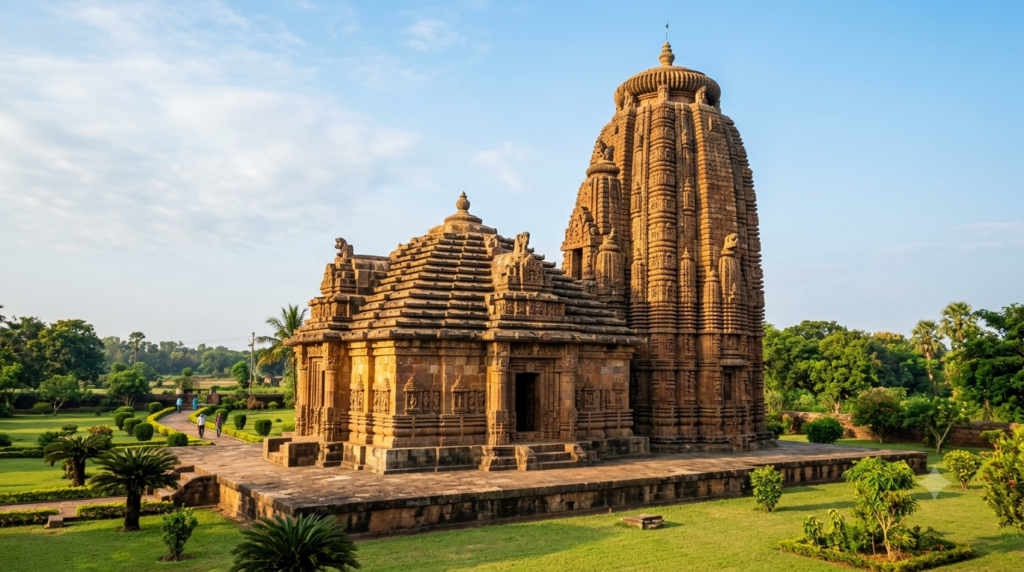
A Raja Rani Temple Darshan is unlike almost any other temple visit in Bhubaneswar. There is no deity in the sanctum here, and no puja to attend. Instead, you buy a small entry ticket and walk into an 11th-century sandstone masterpiece. The Archaeological Survey of India protects it as a national monument.
So the darshan people search for is really a heritage visit. This guide gives you the accurate timings, the current entry fee, and how to reach the site. It also clears up the one fact most other pages get wrong.
Go Kshetra is an independent temple and travel guide. We are not affiliated with the Archaeological Survey of India, Odisha Tourism, or any government body. We do not sell tickets or take bookings. Always confirm the latest fees and timings on the official ASI channels linked below before you travel.
Raja Rani Temple Darshan at a Glance
Here are the essentials for a quick Raja Rani Temple Darshan, checked against the ASI’s own monument-ticketing information. Because the temple is a ticketed monument, these details differ from a normal working shrine.
| Detail | Information |
|---|---|
| Location | Tankapani Road, Kedar Gouri Vihar, Rajarani Colony, Bhubaneswar, Odisha 751002 |
| Visiting hours | Sunrise to sunset (roughly 6:00 AM to 6:00 PM); confirm on arrival |
| Entry fee | Indian / SAARC / BIMSTEC visitors ₹20; foreign visitors ₹250; children below 15 free |
| Managed by | Archaeological Survey of India (ASI), Bhubaneswar Circle |
| Deity / worship | None — no idol in the sanctum, so no active puja or aarti |
| Best time to visit | October to March; early morning for soft light and fewer crowds |
What a Raja Rani Temple Darshan Really Involves
This is the point almost every other page skips. The Rajarani Temple has no presiding deity and no image inside its sanctum. So there is no darshan of a god, no priest, and no puja. You are visiting a protected archaeological monument, not a functioning place of worship.
That single fact changes how you should plan. Because the shrine is inactive, you do not queue for a deity and you do not wait for opening rituals. Instead, you pay a modest entry fee and explore the carvings and gardens at your own pace.
Many visitors still call it a Raja Rani Temple Darshan out of habit, and that is fine. Just arrive expecting a heritage experience rather than devotional worship.
Why It Is Called “Raja Rani”
The name has nothing to do with any king or queen. The temple was built from a local dull red and yellow sandstone that masons called “rajarania.” That stone gave the monument its name.
A popular local story links the name to the carved Naga and Nagini at the entrance. Yet historians do not accept this serpent king-and-queen theory. So the sandstone explanation, not the folk tale, is the accurate one.
History Behind the Monument
Historians date the Rajarani Temple to the mid-11th century CE, during the later years of Somavamsi rule. Many attribute its construction to the Somavamsi king Indraratha. Older texts call it the Indreshvara Temple, likely after him or after Lord Shiva. The exact patron and year remain debated, since no founding inscription survives.
By the early 1900s the structure had fallen into disrepair. It was carefully restored in 1903, and the repaired sections still blend closely with the original stonework. Today the monument stands as one of the finest surviving examples of Kalinga temple architecture in Odisha’s capital.
The Architecture You Come to See
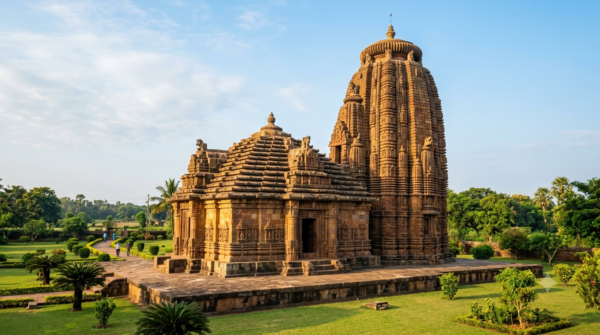
The Rajarani Temple follows the Kalinga “pancharatha” plan and sits on a raised platform. It has two parts: the vimana, or sanctum tower, and the jagamohana, the viewing hall in front of it. The vimana carries a curvilinear spire that rises to about 18 metres. The jagamohana, meanwhile, has a stepped, pyramidal roof.
What makes the tower special is its cluster of smaller replica turrets, which give it a layered, almost sculptural silhouette. Many scholars believe this design influenced later Central Indian temples, including the famous Khajuraho group. If you enjoy temple design, our overview of Hindu temple architecture explains these Kalinga features in more depth.
Look closely at the walls and you will find tall, graceful female figures known as nayikas. Couples, guardian nagas, and carvings of Lord Shiva and Parvati appear alongside them.
A figure of Lakulisa sits above the doorway, and the eight dikpalas guard the directions. Together they hint at the temple’s broadly Shaivite character, despite the empty sanctum. Because of its sensuous carvings, locals also call it the “love temple.”
Raja Rani Temple Darshan Timings and Entry Fee
As an ASI monument, the site is open from sunrise to sunset every day. That works out to roughly 6:00 AM to 6:00 PM for most of the year.
A few tourism listings quote 6:30 AM to 7:00 PM. So treat the exact minutes as approximate, and confirm at the gate. There is no separate “darshan time,” since the whole complex is simply open during daylight hours.
The entry fee is deliberately low. Indian citizens, along with SAARC and BIMSTEC visitors, pay ₹20 per person, while foreign visitors pay ₹250. Children below 15 enter free.
These figures come from the ASI’s official monument ticketing. The ASI can revise them, so check the current rate before you go.
How Tickets Work (and What to Watch Out For)
You can buy your ticket at the counter near the entrance, and most visitors do exactly that. The ASI also issues online e-tickets for its ticketed monuments through its official system. So you can pay in advance if you prefer a cashless entry. Keep the ticket until you leave, because staff may check it inside.
Here is the reader-protective part. No website can sell you a Raja Rani Temple Darshan booking, a special pass, or a puja slot. None of those exist for this monument.
If a page asks for an inflated “processing fee” or personal details to arrange darshan here, treat it as a scam. Buy only from the ASI counter or the official ASI portal.
Planning Your Raja Rani Temple Darshan: How to Reach
The temple sits on Tankapani Road in the old-town area of Bhubaneswar, close to several other monuments. Because the city is compact, you can reach it easily from the airport or the railway station.
By Air
The nearest airport is Biju Patnaik International Airport in Bhubaneswar, about 4 to 5 km away. From there, take a prepaid taxi, an app cab, or an autorickshaw. You will reach the temple in roughly 10 to 20 minutes, depending on traffic.
By Train
Bhubaneswar Railway Station is the closest railhead, around 4 km from the temple. After you arrive, an autorickshaw or cab covers the distance in about 10 to 15 minutes. Local buses run to nearby stops too, although you may need a short walk to finish the trip.
By Road
Bhubaneswar connects well to towns across Odisha and neighbouring states. Buses reach the Central Bus Stand at Baramunda and other city stops. From there, a taxi or autorickshaw brings you to Rajarani Colony within 20 to 30 minutes. Ride-hailing apps work reliably across the city, so getting a cab is rarely a problem.
What to Expect on the Ground
A relaxed Raja Rani Temple Darshan needs about one to two hours. The main draw is the carving detail, which comes alive in low-angle morning or late-afternoon light. Since the temple is inactive, you generally do not need to remove your footwear to walk the grounds. Still, it is polite to be quiet and respectful near the shrine.
Photography is usually fine in the gardens and around the exterior, which is where the best sculptural views are anyway. The lawns are well kept, so many visitors simply sit and take in the amber glow of the sandstone. For a fuller day, pair the visit with the nearby working temples in the old town.
The Rajarani Music Festival
Once a year the quiet monument turns into a stage. The Rajarani Music Festival is organised by the Odisha Tourism Department, and has run since 2003. It fills the temple grounds across three days, usually in January. Musicians from across India perform Hindustani, Odissi, and Carnatic classical music, with the floodlit temple as a backdrop.
If your trip falls in January, this is the best time to come. The setting and the music together create something no ordinary visit can match. Dates shift slightly each year, so check the Odisha Tourism site closer to your travel.
Insider Tips Most Guides Miss
Early on a winter morning, the first surprise is how the rising sun sets the red sandstone glowing. The carvings gain real depth in that light, so aim to arrive between 7:00 and 8:00 AM.
A local guide can point out details most visitors would walk straight past, such as the eight dikpalas carved into the base. Hiring a guide or carrying a good guidebook genuinely lifts the visit.
The ground is uneven in places, and the site is not wheelchair-friendly, so wear solid, flat shoes rather than sandals. Carry water in summer. If you are travelling with elderly family members, plan a slower pace and a shaded break in the garden.
Nearby Attractions Worth Adding
One of the best reasons to visit is how many landmarks sit within a short ride. You can easily build a half-day heritage circuit around the temple.
- Mukteswara Temple — about 0.8 km, a 10-minute walk. A jewel-like 10th-century shrine famous for its carved torana gateway.
- Brahmeswara Temple — about 1.2 km. A quieter Shiva temple with fine wall carvings and far fewer visitors.
- Lingaraj Temple — about 3.5 km. Bhubaneswar’s grandest working temple; see our Lingaraja Temple timings and darshan guide before you go.
- Odisha State Museum — about 2 km. Strong on Odishan sculpture, palm-leaf manuscripts, and tribal art.
- Udayagiri and Khandagiri Caves — about 8 km. Ancient Jain rock-cut caves with sweeping city views.
If you have a second day in Odisha, the state’s most famous shrine is only a short journey away. Our Jagannath Temple Puri guide covers that pilgrimage in detail.
Before You Go
Treat a Raja Rani Temple Darshan as a heritage visit, not a religious one, and it will exceed your expectations. Arrive early, carry ₹20 for the ticket, and wear comfortable shoes. Then spend an unhurried hour with some of the finest stone carving in eastern India.
Confirm the current fee and hours through the official ASI and Odisha Tourism pages linked below. For anything beyond information, always rely on those official sources rather than third-party booking pages.
Official Resources
- Archaeological Survey of India (ASI) — the temple’s official custodian and ticketing authority.
- Odisha Tourism (Government of Odisha) — festival dates and destination information.
- Incredible India — Rajarani Temple — official national tourism listing.
Frequently Asked Questions
Is a Raja Rani Temple Darshan an actual deity darshan?
No. The Rajarani Temple has no idol in its sanctum, so there is no deity darshan, priest, or puja. A Raja Rani Temple Darshan is a visit to a protected ASI monument. People value it for its 11th-century Kalinga architecture and carvings rather than for worship.
What is the entry fee for Raja Rani Temple?
Indian, SAARC, and BIMSTEC visitors pay ₹20 per person, and foreign visitors pay ₹250. Children below 15 enter free. The ASI sets and occasionally revises these fees, so confirm the current rate before travelling.
What are the Rajarani Temple timings?
The monument is open from sunrise to sunset daily, roughly 6:00 AM to 6:00 PM. Some listings show 6:30 AM to 7:00 PM. So treat the exact closing time as approximate, and check at the entrance.
Is online booking available for Raja Rani Temple Darshan?
You can buy tickets at the counter, and the ASI also offers online e-tickets for its monuments through its official portal. No site sells a special darshan pass or puja slot, because the temple holds no active worship. Avoid any page charging extra “darshan booking” fees.
Is there a dress code, and do I remove my shoes?
There is no strict religious dress code, since the temple is inactive. Modest clothing is still appreciated at a heritage site. Because it is not a working shrine, you usually do not need to remove footwear to walk the grounds. Wear solid shoes, as the ground can be uneven.
Can I take photographs at the temple?
Yes, photography is generally allowed around the exterior and gardens, which offer the best views of the carvings. Be considerate of other visitors, and follow any signs the ASI staff display on the day.
Is Raja Rani Temple worth visiting with children?
Yes. The open garden and short visiting time suit families, and entry is free for children below 15. Keep younger children supervised, because the stone platforms and uneven paths can be slippery.
How much time should I plan for the visit?
Plan one to two hours to enjoy the carvings, stroll the garden, and take photos. If you add nearby sites like Mukteswara Temple or the Odisha State Museum, set aside a relaxed half-day.