
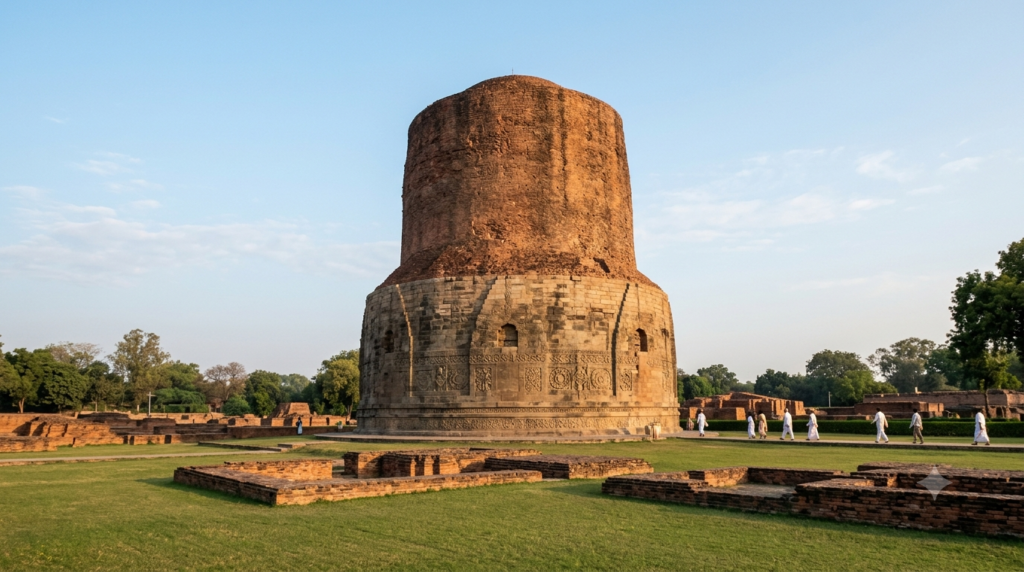
Your Dhamek Stupa Sarnath visit will feel effortless once you know a few key things first. You need the real timings, the current entry ticket, and the one thing most guides get wrong. Sarnath sits about 10 kilometres northeast of Varanasi. The towering Dhamek Stupa, also spelled Dhamekh, marks the exact spot where Gautama Buddha gave his first sermon.
This is one of Buddhism’s four holiest sites, so it draws pilgrims from Thailand, Sri Lanka, Japan, and across India. Yet many online pages describe it as a worship temple with a pooja schedule. That is simply not true, and this guide gives you the accurate, on-the-ground picture instead.
GoKshetra is an independent pilgrimage guide. We are not affiliated with the Archaeological Survey of India or any government body, and we take no bookings or payments. For tickets and official information, use the ASI portal linked below.
Dhamek Stupa Sarnath Visit at a Glance
- What it is: An Archaeological Survey of India (ASI) protected monument, not an active worship temple.
- Height: About 43.6 metres tall and roughly 28 metres in diameter, making it Sarnath’s largest structure.
- Site timings: Sunrise to sunset, roughly 6 AM to 6 PM, open every day including Friday.
- Entry ticket: Around ₹25 at the counter for Indians, ₹20 online, and ₹300 for foreign visitors.
- Best months: October to March, when the weather stays cool and pleasant.
- Location: Sarnath, Varanasi district, Uttar Pradesh, roughly 10 to 13 kilometres from the city.
Dhamek Stupa Sarnath Visit: Timings and Entry Fee
The Sarnath archaeological site is open daily from sunrise to sunset. That works out to roughly 6 AM until 6 PM. Unlike the museum next door, the open site does not close on Fridays.
For Indian nationals the entry ticket is about ₹25 at the counter, or ₹20 if you book through the official ASI e-ticketing portal. Foreign visitors pay ₹300, while children under 15 enter free.
These fees are set by the ASI and can change. So treat the figures as indicative, and confirm the current rate on the official portal or at the counter. Many older blogs still quote ₹5 or ₹10 for Indians, and that number is outdated. The Dhamek Stupa Sarnath visit ticket covers the whole fenced archaeological area, not the stupa alone.
Site ticket versus museum ticket
People often confuse the two, because they sit right next to each other. The archaeological site and the Sarnath Museum are separate tickets with different hours. This table makes the split clear before you plan your Dhamek Stupa Sarnath visit.
| Attraction | Timings | Indian fee |
|---|---|---|
| Archaeological site (Dhamek Stupa) | Sunrise–sunset, daily | ~₹25 counter / ₹20 online |
| Sarnath Archaeological Museum | 9 AM–5 PM, closed Fridays | Nominal (~₹5) |
Because the museum shuts on Fridays, plan carefully if that is your only free day. The site itself stays open, so a Friday trip still works for the stupa and the ruins. You just save the museum, which holds the original Ashokan Lion Capital, for another visit.
What the Dhamek Stupa Actually Is (And What It Isn’t)
This is the correction that competing pages miss, and it changes how you approach the whole trip. The Dhamek Stupa is a solid cylindrical monument built from brick and stone. You cannot enter it, and there is no idol, sanctum, or shrine inside. So there is no darshan queue, no daily pooja schedule, and no evening aarti at this monument.
Several websites list a morning prayer at 5:30 AM and an evening prayer at 7 PM here, along with online darshan booking. None of that applies to the stupa, because it is an archaeological ruin rather than a functioning temple. What pilgrims actually do is walk clockwise around the base in quiet circumambulation. That practice, called pradakshina, is the traditional way to honour a stupa.
If you want temple worship in the area, the modern Mulagandha Kuti Vihara nearby holds regular chanting. Keeping this distinction straight saves you from searching for booking portals that were never real. It also sets the right expectations, so your Dhamek Stupa Sarnath visit feels peaceful instead of confusing.
How to Plan Your Dhamek Stupa Sarnath Visit
Getting to Sarnath is easy, since it sits so close to Varanasi. The nearest airport is Lal Bahadur Shastri International Airport, about 20 to 25 kilometres away. The nearest major railway stations are Varanasi Junction and Varanasi Cantt, both within roughly 10 kilometres. From either point you have several simple options for the final stretch.
- Hire a taxi from Varanasi, which costs around ₹300 to ₹500 and takes about 30 minutes.
- Take a shared auto-rickshaw, a budget favourite at roughly ₹60 per head.
- Book a cab through any ride app if you prefer a fixed fare.
- Buy your ASI ticket online in advance, then scan the QR code at the gate to skip the counter queue.
Most travellers base themselves in Varanasi and treat Sarnath as a half-day trip. Many pair it with the Kashi Vishwanath Temple and the nearby Kaal Bhairav Temple in the old city. Allow three to four hours if you want to cover the stupa, the ruins, the museum, and a couple of the international temples. Because the ruins spread across a large lawn, wear comfortable shoes for plenty of walking.
Best Time for a Dhamek Stupa Sarnath Visit
The best months for a Dhamek Stupa Sarnath visit run from October to March. Daytime temperatures then stay in a comfortable 10 to 25°C range. Summer, from April to June, turns brutally hot and often crosses 40°C, so outdoor walking becomes tiring. The July to August monsoon brings heavy rain that can disrupt plans, although the gardens look lush afterward.
Within the day, early morning and late afternoon are ideal. The light is soft for photography, the crowds are thinner, and the heat is manageable. Buddha Purnima usually falls in May and draws huge pilgrim crowds. So expect long lines, and arrive very early if you visit then.
A quick safety note matters here, because the site is open and exposed. Carry water and sun protection, since there is little shade among the ruins. Elderly visitors and anyone with health conditions should pace the walking and rest in the shaded museum lawn when needed. Sensible preparation keeps the day comfortable for everyone.
What to See on Your Dhamek Stupa Sarnath Visit
Sarnath rewards a slower pace, because the Dhamek Stupa is just one part of a rich complex. Building these stops into your Dhamek Stupa Sarnath visit turns a quick photo stop into a proper heritage walk. The ruins around it include ancient monastery foundations and the Ashoka Pillar.
That pillar once carried the famous Lion Capital, which today serves as India’s national emblem. The broken shaft now stands protected near the stupa, behind a small railing.
The Sarnath Archaeological Museum sits by the main gate and houses the original Lion Capital sculpture. A short distance away, the Chaukhandi Stupa marks where Buddha is believed to have met his five disciples. Its Gupta-era mound is topped by a later Mughal tower, so the layers of history are easy to spot.
International Buddhist communities have built temples across Sarnath as well. You can visit Thai, Tibetan, Japanese, Sri Lankan, and Chinese temples, each in its own architectural style. The Mulagandha Kuti Vihara, run by the Mahabodhi Society, holds vivid murals and a Bodhi tree sapling grown from the tree at Bodh Gaya. For more Buddhist heritage, the coastal Thotlakonda Buddhist Complex makes a fine follow-up trip.
History Behind the Dhamek Stupa
The story of this monument stretches back more than two thousand years. An earlier stupa was raised here under Emperor Ashoka around 249 BCE, marking the site of Buddha’s first sermon. The present structure was largely rebuilt around 500 CE during the Gupta period. That is why its carvings show Gupta craftsmanship.
Stone facing wraps the lower part of the tower up to about 11 metres. Look closely and you will see delicate floral and geometric patterns, figures of birds and humans, and even Brahmi script etched into the surface.
This first sermon is remembered as the Dharma Chakra Pravartana, the turning of the wheel of law. That single event, at this exact spot, launched Buddhism as an organised tradition. You can cross-check the site’s heritage listing through Uttar Pradesh Tourism.
Insider Tips for Your Dhamek Stupa Sarnath Visit
A few practical pointers will make the trip smoother and help you avoid common traps. These come from repeated visitor experience rather than brochure copy.
- Beware unofficial “guides”: Some touts near the gate try to steer visitors toward saree or handicraft shops for commission. Hire only ASI-authorised guides, or explore using the printed boards inside.
- Skip the queue: Book your ticket online beforehand, then scan the QR code at the entrance, since the counter line can get long on weekends.
- Dress modestly: While the open site has no strict code, covered shoulders and knees show respect at this sacred spot and at nearby temples.
- Photography is fine: Recent visitors report no camera fee at the site, so bring your phone or camera for the striking stupa shots.
- Carry ID: You may be asked to show photo identity proof at the entry, and edibles are not allowed inside the monument.
Before You Go
A Dhamek Stupa Sarnath visit works best as a calm, unhurried half-day from Varanasi. Go in the cooler months, arrive early, and buy your ASI ticket online to save time at the gate. Treat the stupa as the profound archaeological landmark it is, not as a booking-based temple. Pair it with the museum and a nearby temple or two, and you will leave with a full picture of where Buddhism began.
Frequently Asked Questions
Is there an entry fee for the Dhamek Stupa?
Yes, the Sarnath archaeological site charges a ticket that covers the Dhamek Stupa and the surrounding ruins. Indians pay about ₹25 at the counter or ₹20 online, and foreign visitors pay ₹300. Confirm the current rate on the official ASI portal, since fees can change.
Can I book darshan online at the Dhamek Stupa?
No. The Dhamek Stupa is an ASI monument, not a worship temple, so there is no darshan booking or pooja schedule. You simply buy an entry ticket, either online through ASI e-ticketing or at the gate, and then walk around the site freely.
What are the Dhamek Stupa timings?
The site is open daily from sunrise to sunset, roughly 6 AM to 6 PM. Unlike the Sarnath Museum, the open archaeological site does not close on Fridays. Early morning is the most peaceful and photogenic time to arrive.
How far is Sarnath from Varanasi?
Sarnath lies about 10 to 13 kilometres northeast of Varanasi. A taxi takes around 30 minutes and costs roughly ₹300 to ₹500, while a shared auto-rickshaw is far cheaper at about ₹60 per head. It makes an easy half-day trip.
Is the Sarnath Museum open on Fridays?
No, the Sarnath Archaeological Museum stays closed every Friday. It otherwise runs from around 9 AM to 5 PM. If you visit on a Friday, focus on the stupa, the ruins, and the international temples, and save the museum for another day.
How much time do I need at Sarnath?
Plan for three to four hours to cover the Dhamek Stupa, the archaeological ruins, the museum, and a couple of nearby temples. If you only want the stupa itself, an hour is enough. Add time if you plan to explore the wider Buddhist circuit.
What is the best time to visit the Dhamek Stupa?
October to March offers the most pleasant weather for a Dhamek Stupa Sarnath visit, with cool days ideal for walking. Avoid the harsh summer heat of April to June and the heavy monsoon of July and August. Early morning or late afternoon light is best.
Is the Dhamek Stupa worth visiting?
Yes, especially if you have any interest in history, Buddhism, or peaceful heritage sites. It marks the exact place where Buddha gave his first sermon, so it is a landmark of world spiritual history. Paired with Varanasi, it rounds out a deeply meaningful trip.