
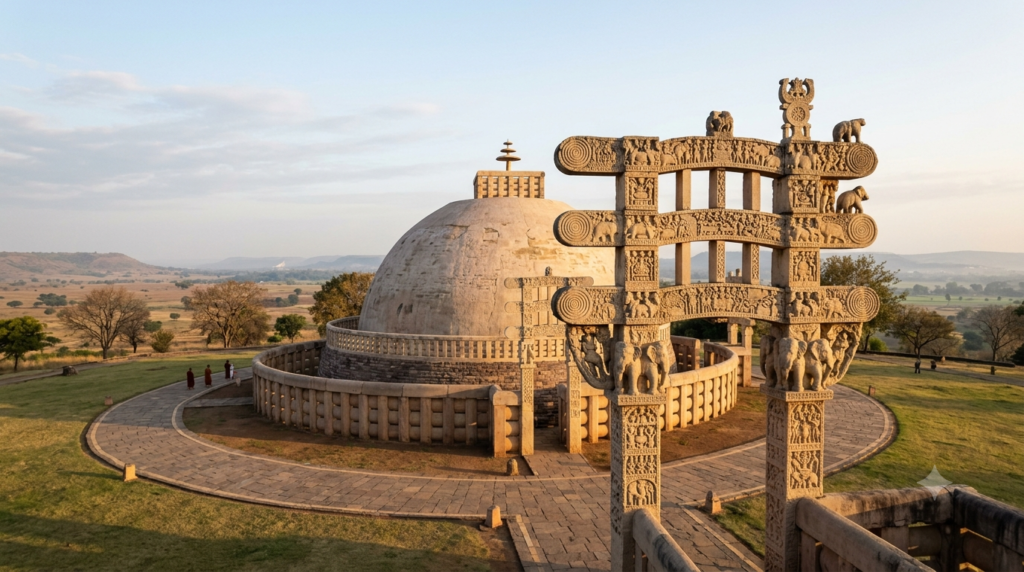
If you plan to visit Sanchi Stupa, the entry ticket now costs ₹40 at the counter and just ₹35 online, so the ₹30 figure still printed across dozens of travel blogs is simply out of date. This hilltop in Madhya Pradesh holds the oldest stone Buddhist monument in India, and it rewards a slow, unhurried morning.
Because so many pages repeat old prices and invented opening hours, this guide sticks to what the Archaeological Survey of India (ASI) actually publishes. You will find the real fee, the correct timings, how to reach the site, the best season, and the nearby ruins worth adding when you visit Sanchi Stupa.
Go Kshetra is an independent travel guide. We are not affiliated with the ASI or any official body, we take no bookings, and we handle no payments. For tickets and official updates, use the official ASI monument page and its booking link.
Sanchi Stupa at a Glance
- Location: Sanchi town, Raisen district, Madhya Pradesh, about 46 km north-east of Bhopal.
- Built by: Mauryan emperor Ashoka in the 3rd century BCE, then enlarged by later dynasties.
- Status: UNESCO World Heritage Site since 1989, maintained by the ASI.
- Entry fee: ₹40 cash or ₹35 online for Indian and SAARC/BIMSTEC visitors; ₹600 cash or ₹550 online for other foreign nationals.
- Timings: Sunrise to sunset, open every day.
- Best season: November to April.
Sanchi Stupa Entry Fee: What You Actually Pay
The current fee for the monument complex is ₹40 in cash and ₹35 if you book online, as listed on the ASI ticketing page. Foreign nationals pay ₹600 in cash or ₹550 online. A higher “ticket with facilities” band of ₹850 cash or ₹800 online also exists, though most visitors never need it.
Many aggregator sites still quote ₹30 for Indians and ₹500 for foreigners. That was an older rate, so treat those numbers as outdated. Since the online ticket is cheaper than the counter one, booking ahead saves both money and queue time.
| Visitor type | Cash | Online |
|---|---|---|
| Indian / SAARC / BIMSTEC | ₹40 | ₹35 |
| Other foreign nationals | ₹600 | ₹550 |
| Ticket with facilities | ₹850 | ₹800 |
Before you visit Sanchi Stupa, decide whether to book online or pay at the gate, because the online rate is lower. Children up to 15 years are generally admitted free at ASI monuments, although it helps to confirm this at the gate. Fees can change, so check the official ASI portal before you travel and avoid any private website that asks for booking charges.
Sanchi Stupa Timings: Open Every Day, Sunrise to Sunset
The ASI lists the complex as open from sunrise to sunset on all seven days of the week. You will see blogs claiming precise hours like 6:30 AM to 6:30 PM or 8 AM to 7 PM, yet these clock times are unofficial guesses that contradict each other. In practice the gate opens around dawn and closes near dusk, which shifts a little with the season.
Plan on roughly two hours for the main stupas and the toranas. Add another hour if you want to walk down to the museum. Arriving early gives you soft light on the carvings and far fewer people on the circular path.
Best Time to Visit Sanchi Stupa
The best time to visit Sanchi Stupa runs from November to April, when the central Indian air stays cool and dry. Winter mornings are crisp, so the reliefs on the gateways read beautifully in low sunlight. Summers push past 40°C on the exposed hilltop, which makes April to June uncomfortable for slow sightseeing.
Monsoon months bring greenery, although the stone paths turn slippery after rain. If you travel in July or August, walk carefully and use the railings. For most pilgrims and history lovers, a winter morning remains the clear pick.
How to Reach and Visit Sanchi Stupa
Sanchi sits about 46 km from Bhopal, so the city works well as your base. Most travellers who visit Sanchi Stupa stay a night in Bhopal and drive out in the morning. You can reach the site by air, train, or road, and the last leg is a short hop from Sanchi town.
By air
The nearest airport is Raja Bhoj Airport in Bhopal, roughly 55 km away. From there, taxis and cabs run directly to Sanchi in about 90 minutes. Bhopal connects to Delhi, Mumbai, Hyderabad, and other major cities.
By train
Sanchi has its own small railway station, barely 1.5 km from the monument. Not every train stops there, so many travellers alight at Bhopal Junction or nearby Vidisha and continue by road. Autos and taxis wait outside both stations.
By road
Regular buses link Bhopal and Vidisha with Sanchi, since the site lies on the Bhopal–Vidisha–Sagar route. A hired cab is the easiest option if you want to club Sanchi with Udayagiri and Vidisha in one day. The drive from Bhopal takes a little over an hour.
What to See When You Visit Sanchi Stupa
The Great Stupa, also called Stupa 1, is the heart of the complex. This solid hemispherical dome rises around 16 metres high and spans roughly 37 metres, and it once held relics linked to the Buddha. Ashoka began it as a simple brick mound, while later rulers cased it in stone and added the railings.
Its four carved gateways, or toranas, are the real showstoppers. Each one tells stories from the Buddha’s past lives and the Jataka tales in dense, lively relief. Because the Buddha is shown only through symbols here, look for the wheel, the empty throne, and the footprints rather than a human figure.
Beyond Stupa 1, you can explore the smaller Stupa 2 and Stupa 3, the ruined Temple 40, and monastery foundations. The lower shaft of an Ashokan pillar still stands near the southern gateway. Its famous four-lion capital, the model for India’s national emblem, now sits inside the museum for safekeeping.
Sanchi Archaeological Museum
Just below the hill, the ASI museum holds the finest loose sculptures recovered from the site. The star exhibit is that four-lion capital from Ashoka’s pillar, displayed in the main hall. You will also see a colossal Nagaraja, an early yakshi figure, and a meditating Buddha.
The museum keeps different hours from the monument. It opens around 10 AM and shuts at 5 PM, and it stays closed on Fridays, although one official listing notes a 9 AM start. A small separate ticket applies, which the ASI has listed at a nominal ₹5 with children under 15 free, so confirm the current amount at the counter. Photography inside the galleries is usually restricted.
Common Myths About Sanchi, Corrected
Several claims about Sanchi circulate widely, yet they do not hold up. Clearing them helps you plan better and understand the site.
Myth 1: The Buddha visited Sanchi. He did not. UNESCO and the ASI both note that no event in the Buddha’s life happened here, though the site later became a major Buddhist centre.
Myth 2: Entry costs ₹30. That rate is outdated. The current ASI fee is ₹40 in cash or ₹35 online for Indian visitors.
Myth 3: The complex closes on Fridays. The monument stays open every day; only the museum shuts on Fridays, which is where the confusion starts.
Myth 4: The lion capital stands on the pillar. Only the pillar’s lower shaft remains at the site. The capital itself moved to the museum long ago.
Nearby Places to Explore
Sanchi pairs naturally with a cluster of ancient sites, so a full day trip makes sense. Most lie within easy driving distance.
- Udayagiri Caves (about 13 km): Gupta-era rock-cut shrines famous for a dramatic Varaha panel, carrying their own modest ASI ticket.
- Vidisha (about 10 km): An ancient town on the Betwa river, once a thriving trade hub tied to Sanchi’s story.
- Heliodorus Pillar (near Vidisha): A 2nd-century BCE column raised by a Greek envoy to Vishnu, locally revered as Khamba Baba.
- Bhimbetka Rock Shelters (about 90 km): Another UNESCO site, with prehistoric paintings tens of thousands of years old.
Sanchi also hosts the Chetiyagiri Vihara festival, held on the last Sunday of November. On that day, relics of the Buddha’s disciples Sariputta and Mahamoggallana are brought out for public viewing, and visitors arrive from across Asia.
Health and Safety on the Hilltop
The site sits on a rise, so you will climb gentle slopes and a few stone stairways. The hilltop offers little shade, and summer sun can be harsh, so carry water and a cap. Wear comfortable shoes because the paths are uneven in places.
Older visitors, young children, and anyone with a heart or knee condition should take the steps slowly and rest as needed. After rain the stone gets slick, so hold the railings near the stupa stairs. These are simple precautions, not reasons to skip a rewarding walk.
Insider Tips Most Guides Miss
When you visit Sanchi Stupa, reach the gate soon after sunrise, since the morning light rakes across the carvings and reveals detail you miss at noon. Walk the circular pradakshina path around the Great Stupa clockwise, the way pilgrims have for centuries. Give the eastern and northern gateways extra time, because their reliefs are the best preserved.
Book your ticket online to save ₹5 and skip the counter line. Do not touch or climb the toranas, as they are fragile and protected. Finally, keep the museum for the end, so the lion capital caps your visit rather than starting it.
Before You Go
A trip to visit Sanchi Stupa is easy to plan once you ignore the outdated numbers online. Pay ₹40 at the counter or ₹35 online, arrive at a cool winter dawn, and give yourself two to three hours for the stupas and museum together. Combine it with Udayagiri and Vidisha for a rich day of Gupta and Mauryan history.
If your route continues across the state, the Mahakaleshwar temple in Ujjain makes a natural next stop, while heritage lovers often extend the journey to Kashi Vishwanath in Varanasi. You can map a wider circuit through Madhya Pradesh Tourism as well. Above all, verify the current fee and timings on the official ASI portal before you set out, since details do change.
Frequently Asked Questions
What is the entry fee to visit Sanchi Stupa?
The fee is ₹40 in cash or ₹35 online for Indian, SAARC, and BIMSTEC visitors. Foreign nationals pay ₹600 in cash or ₹550 online. The older ₹30 figure seen on many blogs is no longer correct.
What are the Sanchi Stupa timings?
The monument complex is open from sunrise to sunset, every day of the week. Precise clock times quoted on some sites are unofficial. Plan to arrive early for the best light and smaller crowds.
Is the Sanchi museum open on Fridays?
No, the Archaeological Museum stays closed on Fridays. The stupa complex itself remains open all seven days, so you can still see the monuments on a Friday.
How do I reach Sanchi from Bhopal?
Sanchi lies about 46 km from Bhopal. You can take a taxi, a bus, or a train, and the drive takes a little over an hour. Bhopal’s Raja Bhoj Airport is the nearest airport, roughly 55 km away.
How much time do I need at Sanchi?
Allow about two hours for the main stupas and gateways. Add another hour for the museum below the hill. History enthusiasts often spend a relaxed half day at the site.
Did the Buddha ever visit Sanchi?
No, the Buddha never came to Sanchi. UNESCO and the ASI confirm that no event in his life took place here. The hill still grew into one of India’s most important Buddhist centres.
Can I book Sanchi Stupa tickets online?
Yes, you can book through the official ASI ticketing portal, and the online rate of ₹35 is cheaper than the counter. Avoid third-party sites that add booking fees. Carry a valid photo ID during your visit.
What is the best time to visit Sanchi Stupa?
November to April offers the most comfortable weather. Winter mornings are cool and clear, which suits the walking and photography. Avoid the peak summer heat of April to June.