
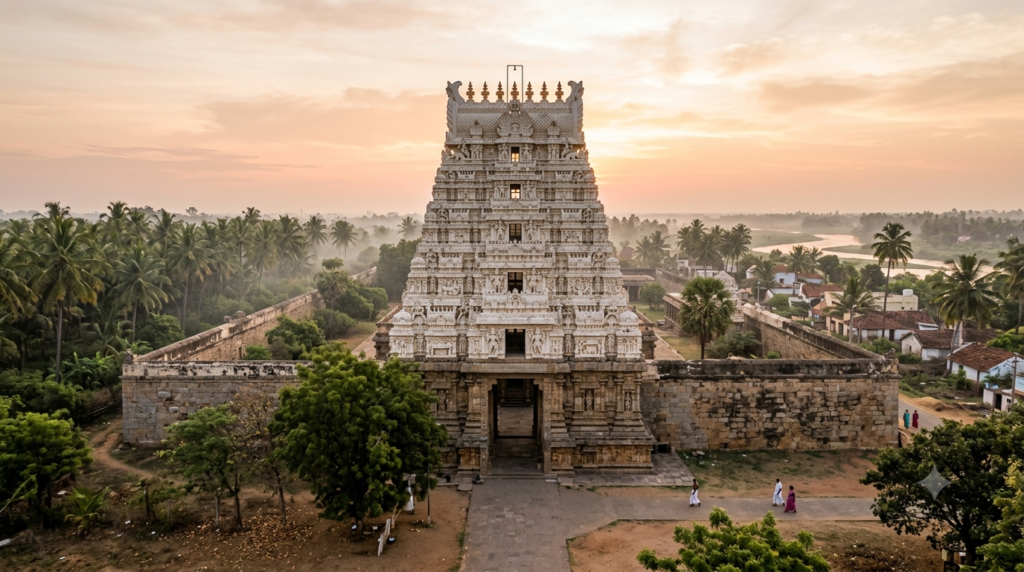
A visit to the Kanjanur Agneeswarar Temple is unlike any other stop on the Navagraha circuit. This is the one Sukran (Venus) shrine with no separate idol for the planet. Instead, devotees believe Sukra resides inside the main Shiva lingam here. So worshipping Lord Agneeswarar directly means worshipping Sukran.
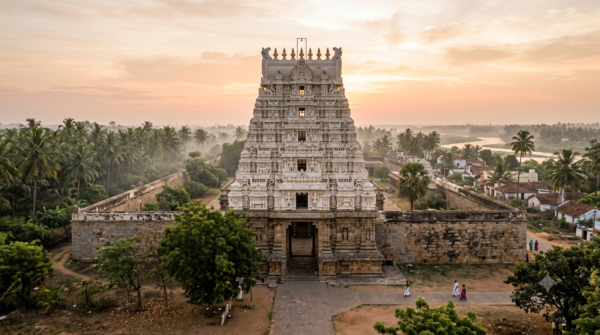
That single idea shapes the whole visit, from the parihara rituals people request to the crowds on Fridays. This guide gathers verified timings, the free-entry facts, travel routes, the full nine-temple map, and the corrections most competing pages still get wrong.
Go Kshetra is an independent pilgrimage guide. We are not the official website of the temple or the Tamil Nadu HR&CE Department, and we hold no affiliation with them. We do not take bookings, donations, or payments. Please use the temple counter and official portals for any reservation or ritual.
Kanjanur Agneeswarar Temple at a Glance
First, here is the quick snapshot most visitors want. Keep it handy while you plan, since a few figures shift on festival days.
| Detail | Information |
|---|---|
| Temple name | Sri Agneeswarar (Agneeswaraswamy) Temple |
| Navagraha | Sukran (Venus), the 6th of the nine planets |
| Main deity | Lord Shiva as Agneeswarar, in lingam form |
| Goddess | Karpagambal (also written Karpagavalli) |
| Location | Kanjanur, Thiruvidaimarudur Taluk, Thanjavur District, Tamil Nadu – 609804 |
| Distance | 18 km north-east of Kumbakonam; about 2–3 km from Suryanar Kovil |
| Timings | Around 6:00 AM–12:00 noon and 4:00 PM–9:00 PM (mornings often extend on Fridays and weekends) |
| Entry fee | Free; special poojas are paid at the counter |
| Most auspicious day | Friday, the day of Sukran |
| Managed by | Tamil Nadu HR&CE Department |
Why Devotees Come to Worship Sukran Here
People travel to the Kanjanur Agneeswarar Temple mainly for Sukra dosha pariharam. Specifically, it is the ritual remedy for afflictions of Venus in a birth chart. In Vedic tradition, Sukran governs marriage, love, wealth, comfort, vehicles, and artistic talent. So devotees facing delays in marriage or strain in relationships often come here first among the nine planetary temples.
These benefits are matters of faith and Vedic astrology, not guaranteed outcomes. So this guide presents them as tradition rather than fact. Similarly, white is the colour linked to Venus. That is why offerings such as white cloth, white flowers, and mochai (field beans) are common.
Because Friday is Sukran’s own weekday, it carries special weight for these prayers. Even so, any day of the year is open to devotees.
What Makes the Kanjanur Agneeswarar Temple Unique
Every other Navagraha temple in the delta has a distinct shrine for its planet. Kanjanur does not, and that absence is the point. Instead, Shiva himself takes the position of Sukran here. So devotees believe the planet sits within the stomach of the Agneeswarar lingam.
The lingam is a tall, self-manifested (swayambhu) form with an unusually elongated shaft. Priests also point to a striking detail during abhishekam. They say the lingam absorbs the oil and ghee poured over it, rather than letting it run off. Whether you read that as legend or observation, it is the kind of on-the-ground particular that a generic listing misses.
Kanjanur Agneeswarar Temple Darshan Timings
The temple generally opens around 6:00 AM and closes by about 9:00 PM, with a long midday break. Morning darshan runs roughly from 6:00 AM to 12:00 noon. Then the evening session runs from about 4:00 PM to 9:00 PM. Because this is a Sukran shrine, morning hours often stretch to about 2:00 PM on Fridays and weekends, when crowds peak.
Sources differ by up to half an hour on the exact open and close times. Festival days change them further. So treat these as a planning guide, and confirm locally before you travel. The temple follows the traditional six-time daily worship, from early morning to the night pooja.
Best hours for a peaceful darshan
Arrive before 9:00 AM if you want a calm darshan and short queues. Early mornings stay quiet on most weekdays. Fridays fill up fast because of Sukran worship. When you plan a parihara pooja, reach the counter early, since ritual slots are limited.
Entry Fee, Poojas and the Online-Booking Myth
General darshan at the Kanjanur Agneeswarar Temple is completely free. So you need no ticket to enter and worship. This is one fact every source agrees on, and it is worth stating plainly.
Special rituals are a different matter. For example, Sukran abhishekam, archanai, and dosha parihara poojas carry a nominal fee. You pay that fee in cash at the temple counter on arrival. Many small temples in this region still work on cash, so carry enough with you.
Now the correction that competing pages keep getting wrong. There is no official online booking portal for darshan or poojas at Kanjanur. Claims that you can book darshan tickets through the temple’s official website are simply inaccurate for this shrine.
As a result, this kind of misinformation pushes pilgrims toward fake portals. So always arrange rituals in person at the counter. Never pay an upfront “processing fee” to a private website that offers to book on the temple’s behalf.
History of the Kanjanur Agneeswarar Temple
The medieval Cholas built the temple, and Vijayanagara-era kings later renovated it. Inscriptions on its walls record endowments from the reign of Kulothunga Chola I (1070–1122 CE) and Vikrama Chola. Therefore, that dates the temple’s documented growth to the 11th and 12th centuries.
Some older write-ups wrongly credit Raja Raja Chola I and the 9th century. Because the inscriptions point to the later Chola kings instead, that dating no longer holds. It is a small correction, yet it matters for anyone researching the temple’s real history.
Architecturally, the Kanjanur Agneeswarar Temple follows the Dravidian style, with a five-tier rajagopuram and two prakarams (enclosures). The shrine stands on the northern bank of the Kaveri, in the fertile Chola heartland. It is also a Padal Petra Sthalam, revered in the Tevaram hymns of the Saivite saint Appar (Tirunavukkarasar).
The legends behind the name
The name Agneeswarar means “Lord of Agni.” Tradition says Agni, the fire god, worshipped Shiva at this spot. In addition, several other legends deepen the site’s fame. Devotees hold that Shiva granted sage Parasara a vision of his cosmic dance, the Mukthi Thandavam, in the hall now called the Mukthi Mandapam.
Another tradition says Lord Brahma witnessed the celestial wedding of Shiva and Parvati here. A third legend links the temple to Vishnu. He is said to have prayed at Kanjanur to be freed from a curse by Sukracharya. These stories, passed down through the Sthala Purana, explain why the shrine sits at the heart of Sukran worship.
The Nine Navagraha Temples Circuit
Kanjanur is one of the nine Navagraha temples clustered around Kumbakonam. Many pilgrims complete all nine in a single circuit for graha shanti. Since you are already in the area, mapping the full set helps you plan a route. So the table below shows each planet and its temple.
| Planet | Navagraha Temple | Broadly for |
|---|---|---|
| Surya (Sun) | Suryanar Kovil | Health, authority |
| Chandra (Moon) | Thingalur | Mind, calm |
| Angaraka (Mars) | Vaitheeswaran Koil | Courage, healing |
| Budha (Mercury) | Thiruvenkadu | Intellect, speech |
| Guru (Jupiter) | Alangudi | Wisdom, growth |
| Sukran (Venus) | Kanjanur (this temple) | Marriage, comfort |
| Sani (Saturn) | Thirunallar | Discipline, relief |
| Rahu | Thirunageswaram | Removing hurdles |
| Kethu | Keezhaperumpallam | Detachment, moksha |
Suryanar Kovil sits just 2–3 km away, so pairing it with Kanjanur is easy. For deeper guides to the neighbours, see our pages on Sooriyanar Kovil, the Mars shrine at Vaitheeswaran Koil, and the Jupiter temple at Alangudi.
Best Time to Visit the Kanjanur Agneeswarar Temple
Overall, the pleasant months run from October to March. During this window, Tamil Nadu’s weather stays cool enough for comfortable temple-hopping. Try to avoid April to June, since summer temperatures in the delta can climb toward 40°C. The monsoon from July to September brings heavy rain that can disrupt road travel.
For the strongest Sukran connection, plan around a Friday. Sukra Peyarchi is the transit of Venus into a new zodiac sign, and it happens roughly every two and a half years. It is the temple’s biggest draw, and it pulls very large crowds. So if you prefer a quiet visit, keep clear of that window and major festival days.
Festivals worth planning around
Maha Shivaratri in February or March is the grandest celebration, with night-long worship. Arudra Darshan falls in the Tamil month of Margazhi (December–January) and is special for Shiva shrines. Aadi Pooram (July–August) honours the goddess Karpagambal. Navaratri and the Haradatta Sivachariar festival in Thai also fill the calendar.
Kanjanur Agneeswarar Temple Dress Code and Etiquette
The Kanjanur Agneeswarar Temple expects modest, traditional attire, as at most Tamil Nadu shrines. For instance, men wear a dhoti or veshti with an upper cloth, or formal trousers and a shirt. Women, likewise, wear a saree, half-saree, or churidar.
Avoid shorts, mini-skirts, sleeveless tops, and low-waist jeans on the temple grounds. You will remove footwear before entering, so wear something easy to slip off. Photography inside the sanctum is generally not allowed, so ask temple staff first.
How to Reach Kanjanur Agneeswarar Temple
The temple lies on the Kumbakonam–Aduthurai road, about 18 km north-east of Kumbakonam. Because the Kanjanur Agneeswarar Temple is a small village shrine, most visitors route through Kumbakonam or Aduthurai. You then cover the last stretch by road.
By road
Regular buses run from Kumbakonam, Aduthurai, Thiruvidaimarudur, and Mayiladuthurai toward Kanjanur. Taxis and autos are also easy to hire from Kumbakonam. The drive then takes roughly 30–40 minutes. Since Suryanar Kovil is only 2–3 km away, many drivers cover both in one trip.
By train
Kumbakonam Railway Station is the nearest major railhead, about 18 km away. Trains also reach it from Chennai, Tiruchirappalli, and other hubs. Aduthurai is a smaller station closer to the temple. From either station, you can take a bus, auto, or taxi for the final leg.
By air
Tiruchirappalli (Trichy) International Airport is the closest airport, roughly 90–100 km away. After you land, hire a taxi or take a bus to Kumbakonam. From there, continue to Kanjanur by road. So the journey usually takes under three hours.
Attractions Near the Kanjanur Agneeswarar Temple
The Kanjanur Agneeswarar Temple pairs well with the wider Kumbakonam temple trail, so allow extra time if you can. These stops are all within easy reach for a fuller day out.
- Suryanar Kovil (about 3 km) – the Sun temple of the Navagraha circuit.
- Mahalingaswamy Temple, Thiruvidaimarudur (about 10 km) – a revered, atmospheric Shiva shrine.
- Kumbakonam town (about 18 km) – a historic temple town with Sarangapani and other ancient temples.
- Airavatesvara Temple, Darasuram (about 22 km) – a UNESCO World Heritage Chola masterpiece.
Practical Tips for a Smooth Visit
A little preparation goes a long way at a village temple like this one. So the tips below cover the things travellers most often forget.
- Carry enough cash, because ATMs near temple towns can run dry during festivals, and card payments are rare at the counter.
- Reach early for parihara poojas, since ritual slots are limited and fill quickly on Fridays.
- Stay hydrated and protect yourself from the sun, especially if you visit between April and June.
- Consult the temple priests for the correct Sukran remedy, rather than relying on generic online descriptions.
- Treat astrological and ritual benefits as matters of faith; they are not a substitute for medical or professional advice.
Before You Go
The Kanjanur Agneeswarar Temple rewards visitors who understand what makes it special. It is a Sukran shrine where the planet lives within Shiva himself, with free darshan for all and no online booking to worry about.
Plan a Friday morning if the Venus connection matters to you, and carry cash for any pooja. Pair the trip with nearby Suryanar Kovil for an easy double visit. Verify the current timings and any ritual fee at the temple itself. For authoritative background, see the temple’s Wikipedia entry and the Tamil Nadu HR&CE department that runs such shrines.
Frequently Asked Questions
Is there an entry fee for the Kanjanur Agneeswarar Temple?
No, general darshan is free for all devotees. Instead, you only pay for special rituals such as abhishekam or a Sukran parihara pooja. The temple collects those nominal fees in cash at the counter.
What are the Kanjanur Agneeswarar Temple darshan timings?
The temple is generally open around 6:00 AM to 12:00 noon and 4:00 PM to 9:00 PM. Morning hours often extend on Fridays and weekends, and festival days vary. So confirm locally before you travel.
Can I book poojas online at Kanjanur?
No, there is no official online booking portal for this temple. Instead, you arrange special poojas in person at the counter. Be cautious of any private website that offers to book darshan or rituals here for an advance fee.
Why is there no separate Sukran shrine here?
Kanjanur is unique among the Navagraha temples. Devotees believe Sukra resides within the main Shiva lingam. Shiva, worshipped as Agneeswarar, takes the position of Sukran, so no separate planetary idol exists.
Which day is best to visit for Sukran worship?
Friday is the most auspicious day, since it is Sukran’s own weekday. Sukra Peyarchi, the transit of Venus every two and a half years, is the biggest occasion. It is also the most crowded.
How far is Kanjanur from Kumbakonam?
The temple is about 18 km north-east of Kumbakonam on the Aduthurai road. Buses, taxis, and autos cover the distance in roughly 30–40 minutes.
What can I combine with a Kanjanur visit?
Suryanar Kovil, the Sun temple, is only 2–3 km away and pairs naturally with Kanjanur. Many pilgrims also continue on the wider nine-temple Navagraha circuit around Kumbakonam.
Is the temple suitable for elderly visitors?
Yes, the temple sits on flat ground with no strenuous climb, so it suits most visitors. Elderly pilgrims should still prefer cooler morning hours and carry water, especially in summer.