
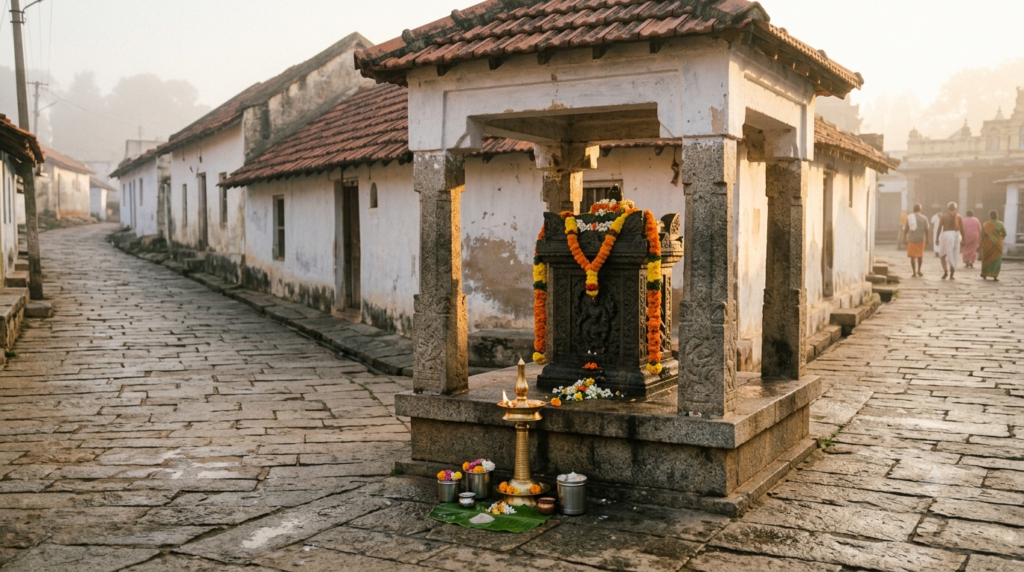
Vengamamba Brindavanam Tirumala marks the sajeeva samadhi — the living burial shrine — of Matrusri Tarigonda Vengamamba, the only woman saint-poet who merged with Lord Venkateswara on these hills. Most pilgrims walk straight past it, simply because nobody told them it was there. Yet the shrine sits barely 200 metres from the main temple, right opposite the Varaha Swamy temple. Her harati still closes the Lord’s day every single night, so her presence never truly left Tirumala.
This guide gives you the exact location, timings, entry rules and the real story behind the samadhi. It also clears up a stubborn myth that competing pages keep repeating.
Vengamamba Brindavanam Tirumala at a Glance
Before the detail, here are the quick facts every visitor asks about. Read this box first, then plan the walk around it.
- What it is: the jeeva (living) samadhi and memorial of saint-poet Tarigonda Vengamamba (1730–1817)
- Where: North Mada Street, opposite Varaha Swamy temple, about 200 metres north of the main Srivari temple
- Entry: free, and no ticket or online booking is needed
- Best time: early morning, right after Srivari darshan, while the streets are calm
- Managed by: Tirumala Tirupati Devasthanams (TTD)
| Detail | Information |
|---|---|
| Saint | Matrusri Tarigonda Vengamamba |
| Born | 1730, Tarigonda village, Chittoor district |
| Samadhi year | 1817, at Tirumala |
| Location | North Mada Street, near Varaha Swamy temple |
| Distance from Srivari temple | Roughly 200 metres (a short walk) |
| Ticket | None — open and free |
What Is Vengamamba Brindavanam Tirumala?
Vengamamba Brindavanam Tirumala is the memorial built over the spot where Tarigonda Vengamamba entered jeeva samadhi in 1817. A brindavanam is a raised, tulasi-topped structure that honours a saint’s resting place. Because she chose a living merger with the divine, devotees treat this ground as sacred rather than as an ordinary grave.
The word “sajeeva” means she was interred while still in deep yogic union, not after death in the usual sense. Tradition holds that she willed her own departure through yoga marga, the yogic path. So devotees come here to bow to a yogini, not to mourn a person.
The shrine keeps a silver face of the saint and a dark cut-out image of Govinda before her. Pilgrims light a small lamp, recite her verses, and sit quietly for a few minutes. Although it is modest in size, the atmosphere carries a settled, prayerful calm.
Who Was Tarigonda Vengamamba?
Tarigonda Vengamamba was an 18th-century poet and an intense devotee of Lord Venkateswara. She was born in 1730 in Tarigonda, a village near Vayalpadu in the old Chittoor district. Her father Krishnayamatya and mother Mangamamba were scholars, so she grew up steeped in Bhagavata and Ramayana recitals.
She married young, as was the custom, and lost her husband while still a child. Society expected a widow to fade into white cloth and silence. Vengamamba refused, because she considered Lord Venkateswara alone as her husband. She kept wearing the marks of a married woman and turned fully toward devotion.
From Tarigonda to Tirumala
She studied yoga under an acharya named Subrahmanyudu and became a practising yogini. Her open defiance of custom angered the local priest at Tarigonda, so she moved up to Tirumala. There the descendants of Annamacharya welcomed her, since her fame as a devotee had already reached the hills.
On the hill she wrote prolifically. She is credited with 18 major works, including Sri Venkatachala Mahatmyam and the Dwipada Bhagavatam. Her very first work was the Tarigonda Nrusimha Satakam, written before she ever left her village.
The Muthyala Harati Story
The most beloved legend links her directly to the Lord’s nightly ritual. Devotees say the Lord let her enter the temple after closing hours to hear her poems. Each night she waved harati and offered pearls as her fee, so priests kept finding pearls inside the sanctum.
Today the final camphor waving before the temple doors shut is still called her harati. It forms part of the Ekanta Seva, the Lord’s rest ritual, and is known as the Muthyala Harati, or pearl harati. Because of this daily honour, she remains a living presence in temple worship, not a distant memory.
The Truth About the “School Playground” Claim
Here is where many websites, and even older guides, get it wrong. For years, pages described the samadhi as sitting inside the S.V.B.N.R. High School playground. That description is now outdated, and repeating it misleads pilgrims about what they will actually find.
The land around the brindavanam stayed under private occupation for a long time. TTD resolved the issue through a long legal and negotiation process, and it reclaimed the ground. The board then announced a 1.5-acre memorial plan to develop the site properly as Vengamamba Brindavanam.
So do not expect a school ground with a tucked-away shrine. Instead, treat it as a TTD-maintained memorial on the mada street, with the samadhi as its heart. Because details evolve as construction progresses, check the official TTD website for the latest on facilities and access.
How to Reach Vengamamba Brindavanam Tirumala
Reaching Vengamamba Brindavanam Tirumala is easy, because it lies within the temple’s own mada streets. After your Srivari darshan, walk out and head toward the Varaha Swamy temple on the northern side. The samadhi sits opposite Varaha Swamy, about 200 metres from the main shrine.
You do not need a bus or a taxi for this stretch, since everything is walkable. If you are staying in TTD cottages near the temple, the whole route takes only a few minutes on foot. When in doubt, ask any TTD staff member for the Varaha Swamy temple, and the brindavanam is right there.
Many pilgrims combine this stop with a wider walk of the hill’s sacred spots. You can easily tie it in with a visit to the Akasha Ganga waterfall at Tirumala or the Papavinasanam sacred waterfall, both reachable by TTD buses.
Vengamamba Brindavanam Tirumala Timings and Entry
Vengamamba Brindavanam Tirumala stays open to pilgrims for worship, and there is no entry ticket. Because it is an open memorial rather than a ticketed seva, you can simply walk in during daytime hours. Early morning works best, since crowds are thin and the mada streets are quiet.
There is no online booking for this shrine, so ignore any site that asks you to pay for “Vengamamba samadhi tickets”. No such ticket exists. Beware of fake portals, because scam booking pages often invent fees for free temple spots. For any genuine paid seva or room, use only the official TTD booking portal, and close any page that demands payment for a free darshan.
Dress modestly, as you would for the main temple, before you visit. Traditional attire is expected across Tirumala, and this shrine is no exception. For the full rules, see our guide to the Tirumala temple darshan dress code.
Other Vengamamba Sites at Tirumala
The brindavanam is not the only place tied to the saint on the hill. TTD has honoured her at several spots, so a devotee can trace her footprints across Tirumala. Below is a quick map of where her memory lives on.
| Place | Significance |
|---|---|
| Vengamamba Brindavanam | Her jeeva samadhi, opposite Varaha Swamy temple |
| Matrusri Tarigonda Vengamamba Annaprasadam Complex | TTD’s huge free-meal complex named in her honour |
| Nearby mandapams | Spots where she stayed and composed her works |
The Annadanam link matters, because tradition credits her with launching free food distribution at Tirumala. That is why her name carries the title “Matrusri”, meaning revered mother. Today the complex named after her feeds huge numbers of pilgrims daily, so her legacy of service continues in a very concrete way. When you visit Vengamamba Brindavanam Tirumala, you are really tracing the start of that same tradition of seva.
Her literary legacy is just as striking. She composed yakshaganams, dwipada kavyas and padya prabandhams, all centred on Lord Venkateswara. Because she wrote as a woman in a rigidly orthodox age, her voice stands out sharply in Telugu devotional writing. Scholars still study her works for both their bhakti and their bold, personal tone.
Jayanti and Vardhanti Observances
TTD marks two main days in her memory each year. Her Jayanti, or birth celebration, falls around Narasimha Jayanti in the summer, since she was born on that day. In 2026 the board observed her 296th Jayanti at Vengamamba Brindavanam Tirumala with floral tributes and devotional singing, as reported in TTD’s official press releases.
Her Vardhanti, the death anniversary, falls in the Sravana month, usually in August. On both days, priests perform pushpanjali at the brindavanam, and Sri Malayappa Swamy is often taken in procession. If you visit around these dates, you may catch special rituals and her compositions rendered live by TTD artists.
What Most Pilgrims Miss
A few practical points can turn a rushed stop into a meaningful one. These come from how devotees actually experience the shrine on the ground.
- Go right after darshan: because the shrine is so close, you save a second trip up the mada street.
- Carry a small lamp or ghee: lighting a diya here is a cherished custom, so many devotees come prepared.
- Read a verse: reciting even one line of her poetry deepens the visit far more than a quick glance.
- Pair it with Varaha Swamy: since both shrines face each other, visit the Varaha Swamy temple first, as tradition advises before Srivari darshan.
- Don’t rush: sit for a minute, because the calm here is the whole point.
Above all, treat the spot as a place of stillness, not a photo stop. The shrine rewards patience, so give it a few unhurried minutes.
Before You Go
Vengamamba’s story is one of quiet defiance turned into lasting devotion. She refused the limits her age placed on a widow, and she poured that fire into 18 works for the Lord. Her samadhi lets you stand where that journey ended in yogic union.
Make the short walk to Vengamamba Brindavanam Tirumala a fixed part of your trip, because few spots on the hill carry such a personal story. Light a lamp, whisper a line of her verse, and you honour a saint whose harati still ends the Lord’s day.
Frequently Asked Questions
Where exactly is Vengamamba Brindavanam in Tirumala?
It stands on North Mada Street, opposite the Varaha Swamy temple, about 200 metres north of the main Srivari temple. You can walk there in a few minutes after darshan. No bus or taxi is needed for this short stretch.
Is there any entry fee or ticket for the samadhi?
No, there is no entry fee and no ticket. The shrine is open and free for all pilgrims during daytime hours. Any website charging for “Vengamamba samadhi booking” is a scam, so avoid it.
Who was Tarigonda Vengamamba?
She was an 18th-century Telugu poet and devotee of Lord Venkateswara, born in 1730. A child-widow who took the Lord as her husband, she wrote 18 devotional works. She entered jeeva samadhi at Tirumala in 1817.
What is the Muthyala Harati linked to her?
The Muthyala Harati is the final camphor waving before the temple doors close each night. Legend says Vengamamba offered pearls as her fee during this harati. It now forms part of the Lord’s Ekanta Seva at Tirumala.
Was her samadhi really inside a school playground?
That is an outdated description. The surrounding land was under private occupation for years, but TTD reclaimed it after a legal process. The board is developing the 1.5-acre site as a proper Vengamamba Brindavanam memorial.
Why is she called Matrusri Tarigonda Vengamamba?
“Matrusri” means revered mother, a title honouring her role in Tirumala’s tradition. She is credited with launching Annadanam, or free food distribution, on the hill. TTD’s free-meal complex is named after her for this reason.
When is Vengamamba Jayanti celebrated at Tirumala?
Her Jayanti falls around Narasimha Jayanti in summer, because she was born on that day. TTD observed her 296th Jayanti in 2026 with tributes at the brindavanam. Her Vardhanti, or death anniversary, falls in the Sravana month, usually August.
Can I visit the brindavanam along with other Tirumala spots?
Yes, and many pilgrims do. Since it sits within the mada streets, you can pair it with the Varaha Swamy temple easily. You can then continue to spots like Akasha Ganga or Papavinasanam by TTD bus.