
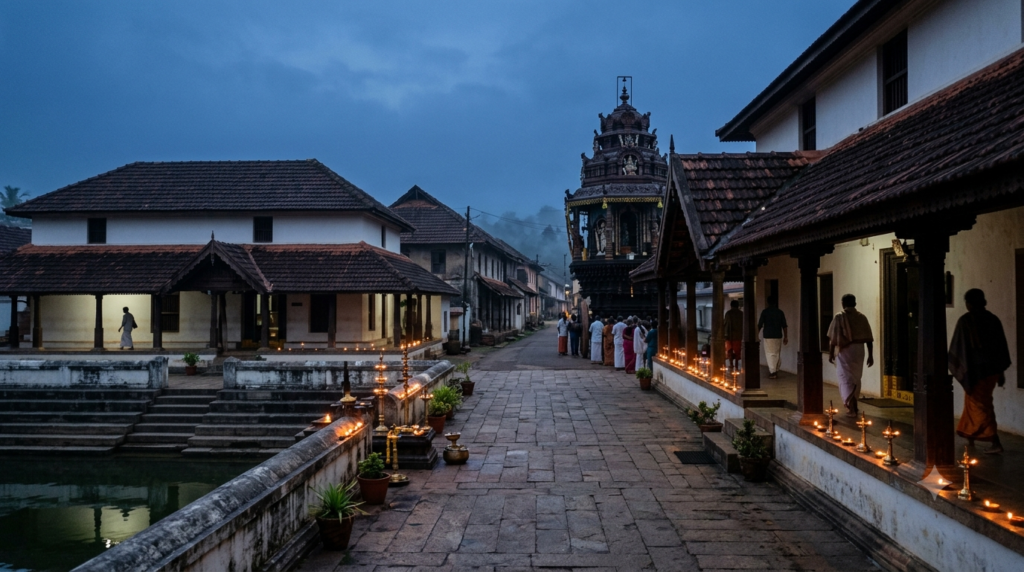
Search for Udupi Krishna temple timings and you will find at least four different schedules, each presented as official. One page says the first pooja starts at 4:50 AM, another insists on 5:30 AM. Mahapooja appears as 9:45 AM on some sites and 11:00 AM on others.
Both camps are partly right. The clock shifts with each Paryaya administration, while the fixed sequence of fourteen poojas never changes. Once you grasp that, the published Udupi Krishna temple timings stop looking like a contradiction.
Go Kshetra is an independent pilgrimage guide. We are not affiliated with, endorsed by, or the official website of Sri Krishna Matha, Udupi, or any of the Ashta Mathas. We accept no bookings, sevas, or donations of any kind. Every seva request and payment must go through the official Paryaya Matha portal linked in this guide.
Udupi Krishna Temple Timings at a Glance
Here is what a first-time visitor actually needs before reaching Car Street. Udupi Krishna temple timings run from well before dawn until late evening. Treat every clock time below as indicative, because the Matha adjusts it seasonally and during festivals.
- Temple open: roughly 5:00 AM to 9:00 PM daily, with a midday interval of about two hours
- Daily poojas: fourteen, in a fixed order laid down centuries ago
- Darshan: through the Navagraha Kindi, the nine-holed silver window
- Entry: free; ordinary darshan needs no ticket
- Current administration: Paryaya Sri Shiroor Matha, from 18 January 2026 to 18 January 2028
- Annadana: free meals served daily at the Bhojana Shala
- Seva booking: only through the serving Paryaya Matha’s official portal
Why Udupi Krishna Temple Timings Differ Across Websites
This is the single most useful thing to understand about the place. Sri Krishna Matha is not run by a permanent devasthanam board. Instead, eight mathas founded by Sri Madhvacharya take turns administering it, two years each, in a rotation called Paryaya.
Each incoming pontiff brings his own daily routine. So the Mahapooja that ran at 9:45 AM under one Paryaya may settle at 11:00 AM under the next. Aggregator sites copy a schedule once and never revisit it. That is why Udupi Krishna temple timings on the internet look like a contradiction.
The practical rule is simple. Trust the order of poojas, because tradition fixes it permanently. Verify the clock on the day you arrive, either at the Matha office or on the serving Matha’s website.
A notice board inside the complex carries the current day’s schedule. Anyone quoting Udupi Krishna temple timings to the minute, without naming the Paryaya, is repeating stale data.
Udupi Krishna Temple Timings: The Fixed Order of 14 Poojas
Sri Vadirajaru, the sixteenth-century saint who set the Paryaya cycle at two years, also composed a devaranama listing the fourteen daily poojas. That sequence still governs the day, and it anchors every version of Udupi Krishna temple timings you will read. The table below gives the order along with the approximate window each ritual has traditionally occupied.
| Order | Pooja | What happens | Typical window |
|---|---|---|---|
| 1 | Nirmalya Visarjana | Previous day’s flowers and ornaments removed | Around 5:00 AM |
| 2 | Ushah Kala Pooja | First worship of the new day | Around 5:30 AM |
| 3 | Akshaya Patra Gopooja | Worship of the sacred vessel and cow | Around 6:00 AM |
| 4 | Panchamruta Abhisheka | Bathing with five sacred substances | Around 6:30 AM |
| 5 | Udvartana Pooja | Fragrant paste applied, butter offered | Around 7:00 AM |
| 6 | Kalasha Pooja | Consecrated water pot worship | Around 7:30 AM |
| 7 | Teertha Pooja | Holy water sanctified for devotees | Around 7:40 AM |
| 8 | Alankara Pooja | Deity adorned with gold and tulasi | Around 8:30 AM |
| 9 | Avasara Sanakadi Pooja | Worship offered to attendant sages | Late morning |
| 10 | Mahapooja | Main pooja, performed by the Paryaya swamiji | Late morning |
| 11 | Chamara Seva | Ceremonial fanning of the deity | Around 7:00 PM |
| 12 | Ratri Pooja | Night worship with naivedya | Around 7:30 PM |
| 13 | Ranga Pooja | Lamps lit in rows before Mukhyaprana | Around 7:45 PM |
| 14 | Ekanta Seva | Deity placed in the golden cradle | Around 8:50 PM |
Morning Rituals: Udupi Krishna Temple Timings Before Mahapooja
If you want atmosphere rather than a quick queue, arrive before the Panchamruta Abhisheka. The abhisheka and the Alankara Pooja that follows are the two most visually striking rituals of the morning. Devotees often wait through both.
Mahapooja is the day’s centrepiece, and the serving Paryaya pontiff performs it personally. Two country guns were traditionally fired to announce it, signalling the town that the midday meal could begin. Plan to be inside at least ninety minutes earlier, since the queue thickens sharply beforehand.
Evening Udupi Krishna Temple Timings and the Closing Sequence
Evening worship starts with Chamara Seva around 7:00 PM. Ratri Pooja and Ranga Pooja follow within the hour, and lamps are lit in rows before Sri Mukhyaprana. Ekanta Seva closes the day when the utsava murti is laid in a golden cradle and lullabies are sung.
A conch blown at the end marks the close of rituals. After that the complex empties quickly, so do not plan a late arrival expecting a relaxed darshan.
Udupi Krishna Temple Seva List by Sannidhi
The seva list follows shrine order rather than price, which surprises most first-time devotees. The official Paryaya portal groups its offerings under these headings.
- Sevas offered to Lord Sri Krishna Sannidhi
- Lord Sri Mukhyaprana Sannidhi sevas
- Lord Sri Garuda Deva Sannidhi sevas
- Bhojana Shala Mukhyaprana Sannidhi sevas
- Bhageerathi Sannidhi sevas
- Navagraha Sannidhi sevas
- Lord Sri Subrahmanya Sannidhi sevas
- Other sevas and general offerings
- Special sevas tied to festivals and utsavas
Familiar names within these groups include Annadaana, Go Seva or Gograsa, Veda Parayana, Sahasranamarchana, Ashtottara Archana, Ksheerabhisheka, Nandadeepa and Karpoora Mangalarathi. You book larger festival sevas such as Laksha Deepotsava, Saptotsava, Brahma Rathotsava and Vasantotsava separately.
Seva rates are not published as a permanent public price list, because each Paryaya sets its own. We have deliberately not printed figures here. Check the current amount on the official Paryaya seva page before you plan a budget.
How Seva Booking Works Under the Shiroor Paryaya
This is where a lot of pilgrims lose money to lookalike websites. Seva booking follows the Paryaya, so the portal changes every two years when administration passes to the next matha. The same rotation explains why Udupi Krishna temple timings also shift on schedule.
- Identify which matha is currently serving the Paryaya before you search for anything
- Open the serving matha’s own website rather than a search advertisement
- Pick the seva under the correct sannidhi heading
- Complete payment on that official domain only
- Carry the confirmation and report at the seva counter inside the Matha
Several aggregator pages still list a portal spelled “udipikrishnamutt” as the official booking site. That spelling is not the Matha’s own domain, and we could not verify it as an official channel. Avoid any site that asks for an advance fee without a matha’s verifiable identity behind it.
What the January 2026 Paryaya Changed
On 18 January 2026, Sri Vedavardhana Theertha Swamiji of Shiroor Matha ascended the Sarvajna Peetha at 5:55 AM. Sri Sugunendra Theertha Sripadaru of Puthige Matha handed over charge after completing the 2024–26 term. Shiroor Matha now administers Sri Krishna Matha and performs the daily pooja until January 2028. The Sri Krishna Matha official site reflects the handover.
Two things follow from this. Seva bookings that once ran through the Puthige Matha portal now route through Shiroor Matha’s channels. Any Udupi Krishna temple timings dated before 2026 reflect a different pontiff’s routine.
The swamiji is the thirtieth seer of the Shiroor lineage, which traces to Sri Vamana Tirtha, a direct disciple of Sri Madhvacharya. He is also the youngest among the current Ashta Matha pontiffs. His stated emphasis for this Paryaya is Vedic study, which is why Veda Parayana Seva features prominently among current offerings.
Planning Your Visit Around Udupi Krishna Temple Timings
Most devotees underestimate how much the day compresses around two peaks. Mornings before Mahapooja and evenings after Chamara Seva carry the heaviest footfall. Weekdays outside Dhanurmasa stay noticeably calmer, so build your route around Udupi Krishna temple timings rather than around meal breaks.
Darshan on an ordinary weekday takes roughly thirty to forty-five minutes. On weekends and festival days, budget one to two hours instead. During Krishna Janmashtami, Vaikuntha Ekadashi and the Paryaya festival itself, crowds run into lakhs.
If you are combining shrines, Udupi sits comfortably in a coastal circuit. Many pilgrims pair it with the Dharmasthala Manjunatha darshan and with Kudroli temple in Mangalore, both within a comfortable drive.
A brief note on physical comfort
Coastal Karnataka stays humid for most of the year, and queue halls get warm by mid-morning. Carry water and take any regular medication on schedule. Elderly devotees and pregnant women should avoid the pre-Mahapooja rush, since standing time can stretch.
If you intend to fast before darshan and have a medical condition, speak to your doctor first. Ritual observances belong to faith and tradition, not to medical treatment.
Dress Code, Kanakana Kindi and Annadana
Staff enforce the dress code, so plan clothing before you travel. Men wear a dhoti or full-length trousers with a shirt, while the entrance turns away shorts, lungis and sleeveless vests. Women wear a saree, half-saree, salwar-kameez or a long skirt with a blouse.
The Navagraha Kindi is the nine-holed silver window through which priests worship Sri Krishna. Beside it sits the Kanakana Kindi, which devotees link to Kanakadasa. Both are small openings, so the darshan is intimate rather than sweeping. First-time visitors are often startled by how close and how brief it feels.
Annadana at the Bhojana Shala is free and open to everyone. Servers use plantain leaves during the midday and evening service windows. Reach the hall early, because seating runs in batches and the queue forms before serving begins.
What First-Time Visitors Get Wrong
- Assuming a fixed clock. Timings printed online may predate the current Paryaya by years
- Booking through a search advertisement. Always reach the official portal directly
- Arriving at noon. The midday interval catches many day-trippers off guard
- Expecting a paid fast-track by default. Ordinary darshan is free; ask at the office about any quick-darshan arrangement currently running
- Skipping the surrounding shrines. Ananteshwara and Chandramouleeshwara sit within the same precinct and are older than the Krishna shrine
- Photographing inside restricted zones. Follow the posted signage and the staff’s instructions
One more thing that guides rarely mention. The Goshala inside the complex shelters a large herd, and Go Seva contributions there are among the most requested offerings at the Matha.
Before You Go: Udupi Krishna Temple Timings in Short
Udupi Krishna temple timings are best treated as a rhythm rather than a rigid timetable. The fourteen poojas run in the same order every single day, and that order is what you can plan around. The clock attached to each one belongs to the serving Paryaya, so confirm it close to your travel date.
Book sevas only on the current Paryaya Matha’s own portal, and treat any other site asking for payment with suspicion. If you are visiting between now and January 2028, that portal belongs to Shiroor Matha. Devotees who also want a temple-seva comparison across Karnataka may find our Sringeri seva list guide a useful companion.
Frequently Asked Questions
Are Udupi Krishna temple timings the same every day?
The order of the fourteen daily poojas is identical every day. The clock times shift with the serving Paryaya administration and during festivals. Confirm the current day’s schedule at the Matha notice board or the serving matha’s official website before planning around a specific ritual.
What are the opening and closing Udupi Krishna temple timings?
The complex generally opens around 5:00 AM and closes around 9:00 PM, with a midday interval of roughly two hours. Published figures vary between sources. Because the serving Paryaya sets the routine, verify on arrival rather than relying on a dated web page.
Is darshan at Udupi Sri Krishna Temple free?
Yes. Ordinary darshan through the Navagraha Kindi carries no ticket charge. Some Paryaya administrations have offered a paid quick-darshan arrangement alongside the free queue. Ask at the Matha office about what is running during your visit rather than booking through a third-party site.
Which matha is performing the pooja in 2026?
Sri Shiroor Matha holds the Paryaya from 18 January 2026 to 18 January 2028, under Sri Vedavardhana Theertha Swamiji. Sri Puthige Matha held the previous 2024–26 term. Administration rotates among the eight mathas in a fixed order beginning with Palimaru and ending with Pejavara.
How do I book a seva at Udupi Sri Krishna Matha?
Book only through the serving Paryaya Matha’s official portal, which is currently Shiroor Matha. Sevas sit under shrine headings rather than price bands. Each Paryaya sets its own rates, so check the current amount on the official page before committing to a booking.
What is the dress code at the temple?
Men wear a dhoti or full-length trousers with a shirt, and the temple does not permit shorts or lungis. Women wear a saree, half-saree, salwar-kameez or a long skirt with a blouse. Staff turn away sleeveless and short clothing at the entrance.
How long does darshan usually take?
Roughly thirty to forty-five minutes on an ordinary weekday. Weekends stretch this to one or two hours. Festival days such as Krishna Janmashtami and Vaikuntha Ekadashi draw very large crowds, so arrive well before dawn if you are visiting then.
Is food available free at the Matha?
Yes. The Matha serves Annadana free to every devotee at the Bhojana Shala during the midday and evening windows. Meals stay simple and vegetarian, and servers use plantain leaves. Devotees may also contribute towards Annadaana as a seva through the official portal.
What is the Navagraha Kindi?
It is a silver-plated window with nine openings, and priests worship Sri Krishna through it rather than from an open sanctum. Tradition holds that the deity turned to face this direction for the devotee Kanakadasa. The adjacent Kanakana Kindi commemorates that episode.