
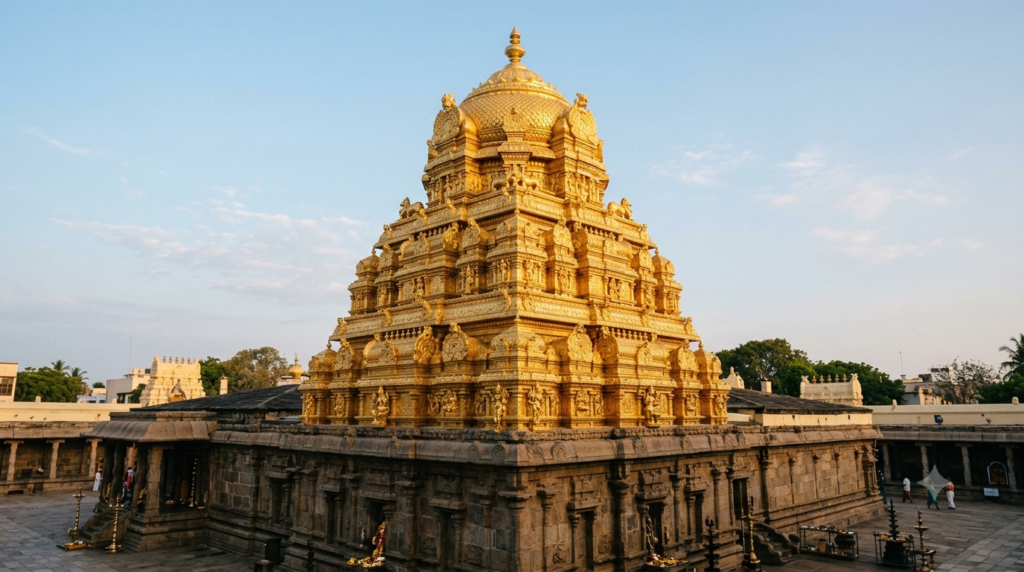
High on Tirumala’s golden tower sits Vimana Venkateswara Swamy. It is the small idol nearly every pilgrim salutes without knowing its full story. You glimpse it for only a few seconds while the darshan queue edges past the sanctum.
Yet that quick glance carries centuries of devotion and a saint’s liberation. It also carries a belief that this little image holds the same power as the main deity inside. This guide explains who the idol is, where it sits, and why looking up at it matters so much.
Go Kshetra is an independent pilgrimage guide. We are not affiliated with, endorsed by, or the official website of the Tirumala Tirupati Devasthanams (TTD). We take no bookings, donations, or payments. Use the official TTD website for darshan tickets and official information.
Vimana Venkateswara Swamy at a Glance
Before the details, here are the quick facts pilgrims most often ask about.
- What it is: a small replica idol of Lord Venkateswara carved on the temple’s golden vimana.
- Where: on the Ananda Nilayam, the gilded tower directly above the sanctum sanctorum.
- How to spot it: look for the silver frame and marker that set it apart from the surrounding carvings.
- Why it matters: devotees believe its darshan carries the same merit as darshan of the main deity.
- The story behind it: tied to the great saint Vyasaraya, who worshipped this image in the 16th century.
- Cost to view: nothing extra, because you pass it naturally on the darshan route.
Who Is Vimana Venkateswara Swamy?
Vimana Venkateswara Swamy is a small, exact replica of the main Venkateswara idol. It is carved into the golden Ananda Nilayam vimana, high above the sanctum.
Temple tradition treats it as a second, visible form of the Lord. It sits high on the tower so devotees can see and salute it. A silver frame marks it out from the other carvings.
The word “vimana” means the tower or canopy that rises over a temple’s innermost shrine. So the name simply means “the Venkateswara on the vimana.” The main idol stands in near-darkness deep inside the sanctum. So this outer replica gives pilgrims a second focus for their prayers.
Most people fold their hands toward it out of instinct as the queue moves. Few know they are looking at one of the most spiritually charged spots in the whole complex.
The Real Story of Vimana Venkateswara Swamy
The special status of Vimana Venkateswara Swamy traces back to Sri Vyasaraya. He is also called Vyasa Teertha, a revered saint and scholar of the 16th century. Tradition holds that he attained moksha, or spiritual liberation, by meditating steadily on this small image on the vimana. Because of that association, the idol carries a significance far beyond its size.
Vyasaraya spent long years in service at Tirumala during the Vijayanagara era. Devotees of the Madhwa and Kannada traditions have praised this form in their hymns. Because of that, the memory of the saint’s devotion keeps the spot sacred even today.
The Vyasaraya connection
Vyasaraya’s link to the vimana idol is the thread most temple records agree on. He is remembered as a guru who guided kings while never losing his own devotion. He fixed his mind on the little Venkateswara above the sanctum. That act of focus is why later generations single the image out for worship.
The legend of the closed temple
A popular legend adds more colour, although it should be read as tradition rather than documented history. As the story goes, a royal order during the Vijayanagara period led to the death of nine temple priests. To cleanse the sin, the temple reportedly stayed closed for twelve years of penance.
During that closure, devotees could not enter the sanctum. So the outer image on the vimana became the focus of their prayers. Tellings differ on the names and the details, and no single version is confirmed by primary records. Treat it as a devotional legend that explains why the outer idol grew so beloved.
The Kubera version
Another telling links the idol to Kubera, the treasurer of the gods. In this version, the Lord promised to stay visible on the vimana as reassurance to Kubera. He had borrowed from Kubera for his celestial wedding.
Like the closed-temple story, this too is tradition, not a verified event. Both legends survive because they capture the same idea. The Lord chose to stay in plain sight above his own shrine.
Where Exactly Is the Idol on the Ananda Nilayam?
Here is where online guides often disagree, so it pays to know the reliable marker. Detailed temple descriptions place Vimana Venkateswara Swamy on a corner of the vimana’s second tier. It appears there as an exact replica of the main idol. Some articles say the northeast corner, others the northwest or the south side, and this confusion spreads across aggregator pages.
The dependable way to find it is not the compass direction. Instead, look for the silver frame and name marker fixed beside it. Temple staff added these so pilgrims could identify the image at a glance.
When you reach the open pradakshina area, look up at the gilded tower. Then scan for that bright silver outline against the gold.
If a page states one exact corner with total certainty, treat it with caution. After all, the sources themselves do not agree. The silver marker is the detail that actually helps you on the ground. Before your trip, it also helps to read up on the Tirumala darshan dress code so nothing slows you at the entrance.
Why Devotees Believe Its Darshan Equals the Main Deity
Many pilgrims hold that seeing the vimana idol earns the same blessing as darshan of the moola virat. That is the main deity inside the sanctum.
This belief rests on a simple idea. The replica shares the sanctity of the original, since priests consecrated it as a true form of the Lord. It is a matter of faith and long tradition, not a claim that can be measured.
The practical comfort behind the belief is real, though. Inside the sanctum, the crowd is dense and the moments are brief. So a clear view of the main idol can be hard to hold. The outer image gives every pilgrim a calm, unhurried second darshan while they wait or walk the corridor.
Framing it honestly matters here. The merit devotees describe is a spiritual belief rooted in Vaishnava tradition. The temple presents it as such, never as a guaranteed outcome.
How to See Vimana Venkateswara Swamy During Darshan
You do not need a separate ticket to see Vimana Venkateswara Swamy, because the darshan route passes right below it. After the main sanctum darshan, the queue leads through the pradakshina corridor that circles the shrine. Look upward at the golden tower along this path and search for the silver-framed image.
The pathway also passes several sub-shrines known together as the Chuttu Gullu, the small temples encircling the main shrine. Priests and guards keep the line moving, so you get only a short window to look up. Because the queue rarely stops, decide in advance where to glance so you are not caught off guard. If you have extra time on the hill, the nearby Sri Venkateswara Museum explains much of this temple history in depth.
A brief practical note for older pilgrims and anyone with mobility concerns. The corridor involves standing and steady walking in a packed crowd. So pace yourself, carry water, and avoid stopping abruptly in the moving line.
If you travel with elderly family members, tell them where to look in advance. That way the moment stays calm rather than rushed.
Ananda Nilayam: The Golden Vimana That Holds the Idol
Vimana Venkateswara Swamy cannot be understood apart from the tower that carries it. Ananda Nilayam, meaning “Abode of Bliss,” is the gold-plated, three-tiered vimana that rises directly over the sanctum sanctorum. The main idol of Lord Venkateswara stands beneath it, so the tower sits at the literal heart of the temple.
Temple lore says the vimana was first raised by the legendary devotee-king Thondaman Chakravarthy. Over the centuries, Pallava, Chola, Pandya and Vijayanagara rulers added to its gold. The TTD then carried out major renovation work in the 1950s and 1960s.
A grand sanctifying ceremony called Ashta Bandhana Maha Samprokshanam was held in 1964 for the renewed tower. Since then the ceremony has recurred roughly once every twelve years. Each round allows careful repair and repolishing of the structure.
These dated milestones are among the few facts here tied to a specific year. Meanwhile, the tower’s meaning and role stay constant across generations.
Myths and Facts About Vimana Venkateswara Swamy
Plenty of half-truths circulate online, so this quick comparison clears up the most common ones.
| What you may hear | What is actually true |
|---|---|
| It is just a decorative carving. | It is a consecrated replica of the main idol, worshipped daily by pilgrims. |
| Everyone agrees on its exact corner. | Sources differ on the corner; the silver marker is the reliable identifier. |
| You need a special ticket to see it. | It is visible free on the normal darshan route below the tower. |
| The legends are proven history. | The stories are devotional tradition, not documented record. |
| It is a modern addition. | Its significance traces to the 16th-century saint Vyasaraya. |
Keeping these straight helps you appreciate the idol for what it genuinely is. It clears away the exaggerations that spread across copycat pages.
What Most Pilgrims Miss at the Vimana
A little preparation turns a rushed glance into a meaningful moment. These are the practical points seasoned devotees pass on.
- Know the direction first. Since the queue keeps moving, decide where to look before you reach the corridor.
- Follow the silver frame. Because carvings cover the whole tower, the silver marker is your fastest guide to the right image.
- Visit in daylight if you can. The gold and silver stand out far better under morning light than at night.
- Do not block the line. Guards move pilgrims along quickly, so look up while you walk rather than stopping.
- Read the sub-shrines too. While you pass the Chuttu Gullu, notice the smaller temples that ring the sanctum.
None of this needs money or a special pass. It simply needs a little awareness before you join the queue.
Before You Look Up
Vimana Venkateswara Swamy rewards the pilgrim who knows to look for it. The image ties together a real 16th-century saint, a golden tower, and a living belief. All of it meets at one small point above the sanctum. Learn the silver marker, glance up as the queue passes, and let the moment settle before you move on.
For darshan tickets, timings, and any official update, always rely on the TTD portal rather than unofficial pages. If you want more of Tirumala’s quiet mysteries, the reason behind Lord Venkateswara’s half-closed eyes is a fascinating place to go next.
Frequently Asked Questions
What is Vimana Venkateswara Swamy?
It is a small replica idol of Lord Venkateswara. It sits on the Ananda Nilayam, the golden tower above the Tirumala sanctum. Devotees worship it as a visible form of the Lord and salute it during darshan.
Is Vimana Venkateswara Swamy darshan equal to the main deity?
Many devotees believe so, and this is a long-held matter of faith and Vaishnava tradition. It is a spiritual belief rather than a measurable claim, and the temple presents it in that spirit.
Where is the idol located on the tower?
It sits on a corner of the vimana’s second tier as an exact replica of the main idol. Sources disagree on the precise compass direction, so use the silver frame and marker to find it.
Do I need a special ticket to see it?
No. You pass below the vimana on the normal darshan route, so no extra ticket is needed. Book your darshan slot only through the official TTD booking portal.
Who was Vyasaraya and why does he matter here?
Vyasaraya, also called Vyasa Teertha, was a 16th-century saint and scholar. Tradition says he attained liberation by meditating on this vimana image, which is why the idol carries special significance.
What does Ananda Nilayam mean?
Ananda Nilayam means “Abode of Bliss.” It is the gold-plated, three-tiered vimana that rises directly over the sanctum. The main idol of Lord Venkateswara stands directly beneath it.
When is the tower’s Samprokshanam ceremony held?
The Ashta Bandhana Maha Samprokshanam was performed in 1964 and has recurred roughly every twelve years since. It allows careful repair and repolishing of the golden vimana.
Can I take photos of the vimana idol?
Photography is generally prohibited inside the temple, so cameras and phones are not allowed in the darshan queue. Simply look up and take in the image as you pass.