
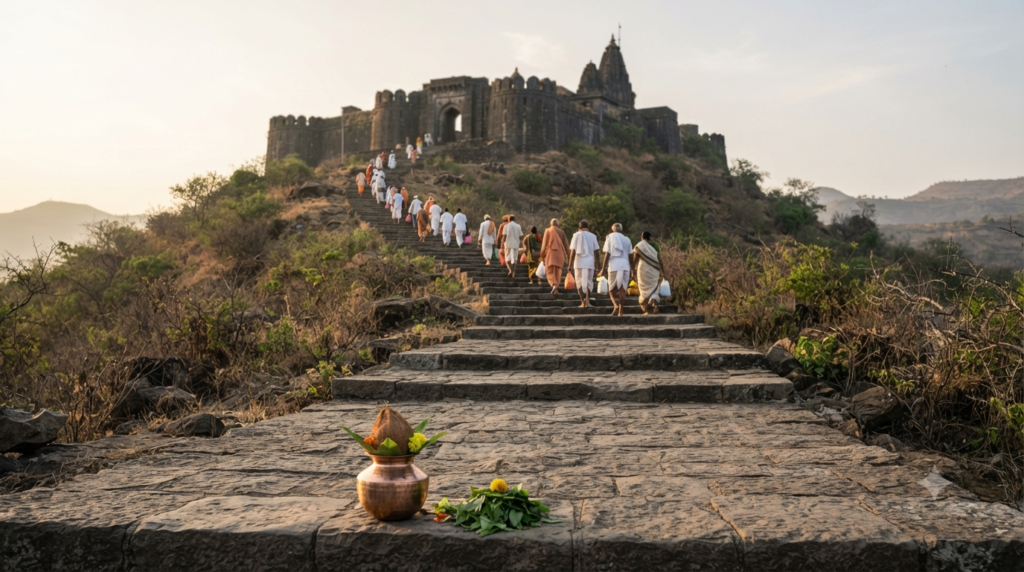
Parli Vaijnath Temple Darshan is free, unticketed, and — unusually for a Jyotirlinga — lets ordinary devotees place their own hands on the linga. That single detail sets Parli apart from almost every other major Shiva shrine in India. Yet dozens of travel pages still sell a “VIP darshan ticket” and an online abhishek slot that the temple trust does not actually offer. This guide sticks to what the Shree Vaijnath Devasthan Trust and the Maharashtra government publish, so you can plan without paying a stranger for a pass that does not exist.
Go Kshetra is an independent pilgrimage guide. We are not affiliated with the Shree Vaijnath Devasthan Trust, and this page is not the temple’s official website. We take no bookings, donations, or payments — for anything official, use the trust portal linked further down.
Parli Vaijnath Temple Darshan at a Glance
Before the detail, here is the short version of Parli Vaijnath Temple Darshan. If you only read one section, read this one.
- Where: Parali Vaijnath town, Beed district, Maharashtra, pincode 431515
- Deity: Shri Vaijnath (Vaidyanath), one of the twelve Jyotirlingas
- Opens: 5:00 AM daily, after the trust priest’s abhishek, aarti and naivedya
- Closes: 10:00 PM after shejarti — but midnight on Mondays
- Entry fee: none; darshan is free for everyone
- Online booking: not available for darshan or abhishek
- Touching the linga: allowed, which is rare among Jyotirlingas
- Managed by: Shree Vaijnath Devasthan Trust, Parali Vaijnath
The Booking Myth Every Guide Repeats
Search for Parli Vaijnath Temple Darshan booking and you will find confident instructions: open the trust website, pick a VIP slot for around ₹150, pay by card, download your ticket. None of that works. On the trust’s own site, the “Darshan Pass Booking” and “Bhakt Niwas Booking” links are placeholders that lead nowhere.
What the trust does run online is a donation page and a live darshan stream. Both sit on the Shree Vaijnath Devasthan Trust website. A donation is not a darshan ticket, though, and nobody needs one to enter.
Special darshan passes do exist, but only on two occasions — Mahashivratri and the Shravan Mondays. The temple committee issues them locally at Parli, not through any website. So if a page asks for your card details in exchange for a Parli darshan slot, close it.
Parli Vaijnath Temple Darshan Timings and Abhishek Windows
The temple opens at 5:00 AM every day. Trust-appointed priests perform the first abhishek, aarti and naivedya on the nijling, and public darshan begins straight after. At night the shejarti closes the shrine at 10:00 PM.
Mondays run longer because Shiva’s own weekday draws bigger crowds. Between 10:00 PM and midnight the trust holds chhabina, bhajan and kirtan, and carries the palkhi of Shri Vaijnath Prabhu around the complex. The doors then shut at 12:00 midnight.
| Window | Darshan | Abhishek |
|---|---|---|
| 5:00 – 7:00 AM | Sparsha darshan of the nijling | Open to devotees |
| 7:00 AM – 12:00 noon | Sparsha darshan of the nijling | Closed |
| 12:00 noon – 3:00 PM | Sparsha darshan of the nijling | Open to devotees |
| Until 10:00 PM | Darshan continues | Varies by day |
One caveat matters here. This schedule applies on ordinary days only, because Mondays, Pradosh and Shivratri follow a different ritual order. Festival days shift everything again, so confirm on the trust site before a long journey.
Why You Can Actually Touch the Linga at Parli
Very few Jyotirlingas permit physical contact with the linga. Parli does, and devotees here traditionally embrace it with both arms rather than merely bowing. The sanctum and the sabha mandap sit at the same floor level, so the linga stays visible even from the hall.
The custom traces back to the sage Markandeya. Local tradition holds that he clasped the linga while Yama came for him, and that Shiva spared him. Because of that story, pilgrims still hold the linga with both hands during Parli Vaijnath Temple Darshan.
The linga itself is smooth black Shaligram stone rather than the usual granite. Maharashtra Tourism describes it plainly as a shrine where devotees may touch the Jyotirlinga while praying, which is why Parli Vaijnath Temple Darshan feels so different from Trimbakeshwar or Grishneshwar.
How Abhishek Works Here
Abhishek at Parli is unusually hands-on, since devotees perform it themselves instead of watching a priest do it. Bilva leaves come from the stalls outside the complex, not from inside. Water for the ritual traditionally comes from the Harihar Teerth pond just south of the temple.
Men must remove clothing above the waist for abhishek, which is a long-standing rule at this shrine. Women are not required to do so. Nobody enforces a fee, though a dakshina to the officiating purohit is customary if you engage one.
During Shravan, many devotees offer 108 bilva leaves in a single sitting. Some commit to a lakh of bilva leaves across the month. Others walk from the Godavari banks carrying river water on a kanwar, a practice the trust calls the Jyotirlinga Vaijnath kanwar.
What Parli Vaijnath Temple Darshan Costs
Nothing. Parli Vaijnath Temple Darshan carries no entry fee, no VIP tier, and no paid queue. Anyone may walk in during opening hours and take darshan, regardless of caste, community or religion.
Costs that are real come from elsewhere — travel, a room, bilva leaves, prasad, and an optional dakshina. Budget for those rather than for a darshan ticket. If you want to give to the temple, the trust accepts donations through its own online donation link, and that is the only payment channel it publishes.
Bhakt Niwas accommodation run by the Devasthan does exist at Parli. Since the online booking link is inactive, treat it as an on-arrival enquiry rather than a reservation you can lock in from home.
Shravan Somvar and Mahashivratri: What Changes
These are the two periods when the temple stops behaving normally. Lakhs of pilgrims arrive, and the ordinary schedule bends around crowd control.
On Shravan Mondays the trust arranges special darshan passes for faster entry. The third Shravan Monday draws the heaviest crowd of the month. Expect the queue to run for hours even with a pass, so start before dawn if you can.
Mahashivratri brings the annual yatra and runs across five days. Queues form from midnight on the first night. On the second day the District Collector performs the government mahapuja, after which the public may perform limited pooja and abhishek.
Here is the detail almost no guide mentions: on Mahashivratri day itself, darshan happens as mukh-darshan from the kasav (tortoise) platform rather than as sparsha darshan at the linga. If touching the linga is the reason you are travelling, Mahashivratri is the wrong day to come.
If the Queue Defeats You: Real Fallbacks
Free entry does not guarantee a comfortable Parli Vaijnath Temple Darshan. Peak days genuinely overwhelm the complex, so plan a fallback before you need one.
- Shift the hour, not the day. The 5:00–7:00 AM window is the calmest and also an abhishek window.
- Shift the day. A Tuesday or Wednesday outside Shravan gives you an unhurried sparsha darshan.
- Use the live stream. The trust runs an online darshan feed for anyone who cannot travel.
- Do the Meru pradakshina. Locals circle the Meru hill around the temple after darshan, and it stays open when queues do not.
- Visit the teerthas. Harihar Teerth, Narayan Kund and Markandeya Teerth sit within the complex area and rarely get crowded.
If the shrine queue is closed for a government pooja, there is no alternative entry for that slot. Wait it out or return the next morning — no payment or contact gets you in sooner.
Is Parli the Real Vaidyanath Jyotirlinga?
Three temples claim the Vaidyanath Jyotirlinga: Parli in Maharashtra, Deoghar in Jharkhand, and Baijnath in Himachal Pradesh. All three have long traditions behind them, and no single authority has settled the question.
The argument for Deoghar rests on the Dwadasa Jyotirlinga stotra, which places Vaidyanath in the north-east at a “chitabhoomi” or cremation ground. Parli sits in west-central India instead. The argument for Parli rests on the Parali Mahatmya, the Ravana legend told locally, and the temple’s continuous Jyotirlinga tradition.
Maharashtra Tourism and the Beed district administration both describe Parli as one of the twelve Jyotirlingas. The dispute stayed visible as recently as 2018, when Deoghar priests objected to Parli priests being invited to a Jyotirlinga gathering in Ujjain. Treat it as a matter of tradition rather than a settled fact.
How to Reach Parli Vaijnath
By train
Parli Vaijnath is a junction on the South Central Railway, on the Parbhani–Hyderabad line. The station sits roughly 2–3 km from the temple, and autos wait outside. Trains connect it to Mumbai, Hyderabad, Nagpur, Latur and Nanded.
By road
National Highway 161 passes through Parli, so road access is straightforward. MSRTC buses run from Chhatrapati Sambhajinagar, Nanded, Latur, Beed and Ambajogai. Private taxis cover the same routes if you want flexibility.
By air
Chhatrapati Sambhajinagar Airport — the airport formerly called Aurangabad — is about 225 km away, according to the Beed district administration. Nanded Airport is closer at roughly 130 km, with limited regional flights. Most pilgrims find the train simpler than either option.
Where to Stay and What to Carry
Parli is a working town with a thermal power station and a cement plant, so it has basic lodges rather than tourist hotels. The Devasthan’s Bhakt Niwas is the closest option to the shrine. Ambajogai, about 25 km away, offers a few more choices.
Carry cash, because small-town ATMs run dry during festival weeks. Keep ID handy for security checks, and expect mobile phones to stay out of the inner sanctum. Wear clothes you can move in — traditional attire is the norm, and the complex involves a long flight of steps.
A health note: the climb, long queues and Marathwada heat are demanding. If you are elderly, pregnant, or managing a heart or joint condition, plan a cool early slot and carry water and medication. Vaidyanath means “lord of physicians” and devotees pray here for healing, but that is a matter of faith — it is not a substitute for medical treatment, so keep your doctor’s advice first.
Nearby Teerthas and Temples
Parli rewards a slow visit because the sacred geography extends well past the sanctum. Several teerthas cluster around the temple itself.
- Harihar Teerth – just south of the temple; the largest of the ponds, reached by the south-gate ghat
- Narayan Kund – north of the temple, beside the newer ghat, with a small Narayaneshwar shrine
- Markandeya Teerth – east of the old ghat on the Saraswati bank
- Someshwar, Jirewadi – about 3 km away on a hill above the Brahma river
- Yogeshwari Devi, Ambajogai – roughly 25 km; linked to Vaijnath by local marriage legend
- Aundha Nagnath – roughly 118 km; another Jyotirlinga in Hemadpanthi style
Pilgrims doing all twelve Jyotirlingas often pair Parli with Aundha Nagnath first. Trimbakeshwar near Nashik and Grishneshwar near Verul are the other Maharashtra Jyotirlingas, though both sit several hundred kilometres away.
What Guides Get Wrong About Parli Vaijnath Temple Darshan
After cross-checking the trust’s own pages against the top-ranking travel articles, a clear pattern of errors emerges. These are the ones worth knowing before you travel.
- “Book VIP darshan online for ₹150.” No such online booking exists. Darshan is free.
- “Abhishek costs ₹599 and can be booked on the website.” Devotees perform abhishek themselves within the open windows.
- “You cannot touch the linga.” You can, on ordinary days — that is the temple’s signature practice.
- “Temple closes at 9:30 PM.” The trust puts closing at 10:00 PM, and midnight on Mondays.
- “Contact the temple on 02451 numbers.” Parli’s STD code is 02446; the trust publishes 02446-222909 on its own contact page.
One more that catches people out: the tradition here reverses the usual offerings. Devotees offer tulsi to Shiva and bilva to Vishnu at Parli, especially on Vaikuntha Chaturdashi, because this is where Hari and Hara are said to meet.
Best Time to Visit for Parli Vaijnath Temple Darshan
October to February is the comfortable window for Parli Vaijnath Temple Darshan, when Marathwada cools down and queues stay manageable. Avoid April and May unless heat does not bother you. The monsoon between June and September is pleasant enough, though rural roads can slow you down.
For atmosphere rather than comfort, Shravan and Mahashivratri are unmatched. Gudi Padwa, Dussehra, Tripurari Pournima and Makar Sankranti also bring alankar poojas and palkhi processions. Shravan usually falls across July and August, while Mahashivratri lands in February or March — confirm the exact dates on the trust’s panchang, since lunar dates shift each year.
Before You Go
Parli is one of the easiest major Jyotirlingas to visit and one of the most misrepresented online. Nothing is ticketed, nothing is bookable in advance, and the thing that makes it special — placing your hands on the linga — costs nothing at all. Arrive between 5:00 and 7:00 AM on a weekday outside Shravan and you will get an unhurried darshan with an abhishek window open.
Verify Parli Vaijnath Temple Darshan timings on the trust site close to your travel date, especially around festivals. If you are planning a wider Shiva circuit, our guides to Mahakaleshwar at Ujjain and Shani Shingnapur cover two more stops that pair well with Maharashtra’s Jyotirlingas.
FAQs About Parli Vaijnath Temple Darshan
Is there an entry fee for Parli Vaijnath Temple Darshan?
No. Darshan at Parli Vaijnath is completely free, and the trust runs no paid or VIP queue. The only official payment channel the trust publishes is a voluntary online donation link. Anyone may enter during opening hours.
Can I book Parli Vaijnath Temple Darshan online?
No. The trust’s website lists darshan pass and Bhakt Niwas booking as menu items, but neither link is active. Abhishek happens on a walk-in basis within the daily windows. Special darshan passes appear only on Mahashivratri and Shravan Mondays, issued locally.
What are the Parli Vaijnath Temple Darshan timings?
The temple opens at 5:00 AM daily and closes at 10:00 PM after shejarti. On Mondays it stays open until midnight because of the chhabina and palkhi parikrama. Timings change on festival days, so check before you travel.
Can devotees touch the Jyotirlinga at Parli?
Yes, on ordinary days. Sparsha darshan of the nijling is the temple’s defining practice, and pilgrims traditionally embrace the linga with both hands. On Mahashivratri, however, darshan is limited to mukh-darshan from the kasav platform.
Is there a dress code for Parli Vaijnath Temple Darshan?
Traditional attire is expected for Parli Vaijnath Temple Darshan, and modest clothing is the norm throughout the complex. For abhishek, men must remove clothing above the waist as per temple tradition. Shorts, sleeveless tops and revealing outfits are best avoided.
Is Parli Vaijnath the same as Baidyanath Dham in Deoghar?
No, they are different temples, and both claim to be the Vaidyanath Jyotirlinga. Baijnath in Himachal Pradesh makes a third claim. The Maharashtra government lists Parli among the twelve Jyotirlingas, while many devotees hold Deoghar to be the original.
How far is the railway station from the temple?
Parli Vaijnath railway station sits about 2–3 km from the temple complex. Autos and taxis wait outside the station throughout the day. The station is a junction on the Parbhani–Hyderabad route.
Which is the busiest day for Parli Vaijnath Temple Darshan?
Mahashivratri brings the heaviest Parli Vaijnath Temple Darshan crowd, followed by the third Monday of Shravan. Ordinary Mondays are busier than other weekdays, since Monday is Shiva’s day. For a quiet visit, pick a mid-week morning outside Shravan.
Are cameras allowed inside the sanctum?
Cameras and mobile phones stay outside the inner sanctum as a rule, and security staff check bags at the gates. Photography in the outer complex is usually tolerated. Follow whatever the staff on duty tell you on the day.