
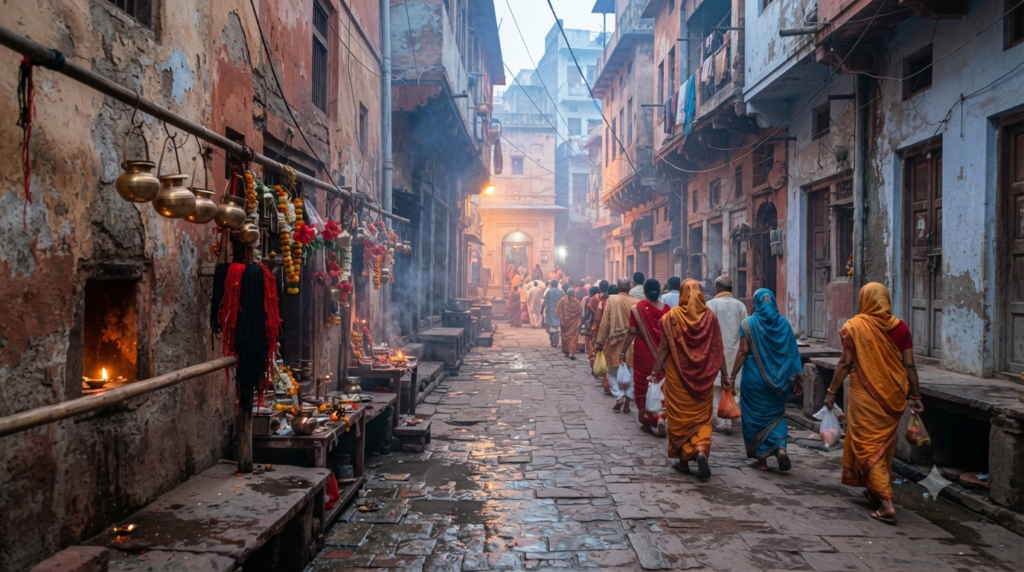
Kaal Bhairav Temple Darshan is the one stop in Varanasi that local families treat as non-negotiable. Tradition holds that the guardian of Kashi grants permission before any pilgrimage in the city truly begins. Yet most guides online still get three basic things wrong about this shrine.
Those three errors are the afternoon timings, the famous liquor offering, and the question of online booking. Because this page corrects all three against the Varanasi district administration’s own listing, you arrive knowing what really happens at the gate.
Disclaimer: Go Kshetra is an independent pilgrimage guide. We are not affiliated with, endorsed by, or the official website of the Kaal Bhairav Temple or any temple trust. We accept no bookings, donations, or payments. Use the official sources linked below for verification.
Kaal Bhairav Temple Darshan at a Glance
Kaal Bhairav Temple Darshan is free, needs no ticket, and has no online booking system. The Kashi official portal lists the temple open from 5:00 AM to 9:30 PM, with a midday break. Most devotees finish in 30 to 45 minutes, though Tuesdays and Sundays can stretch that to two hours.
| Detail | Verified information |
|---|---|
| Temple | Shri Kaal Bhairav Mandir, Vishweshwarganj |
| Address | Bhatt ki Gali, Golghar, Ghasi Tola, Varanasi 221001 |
| Timing window | 5:00 AM to 9:30 PM (Kashi official portal) |
| Midday break | Approximately 1:30 PM onward; reopening varies |
| Entry fee | Free, no ticket counter |
| Online booking | None exists |
| Busiest days | Tuesday and Sunday, plus every Ashtami |
| From Kashi Vishwanath | About 1 km, roughly 15 minutes on foot |
| Time needed | 30 to 45 minutes off-peak |
Kaal Bhairav Temple Darshan Timings and the Midday Break
The Kashi official web portal, run by Varanasi Smart City, lists the temple timing simply as 5:00 AM to 9:30 PM. That single line is accurate as an outer envelope, yet it hides the afternoon closure. So a pilgrim who turns up at 2:30 PM can find the sanctum shut.
Here is where competing pages disagree, and none of them cites a source. The morning session consistently ends around 1:30 PM. Reopening, however, gets reported variously as 3:00 PM, 3:30 PM, and 4:30 PM.
Because no official schedule publishes that reopening time, treat roughly 1:30 PM to 4:30 PM as an uncertain window. Arrive before 1:00 PM, or wait until after 5:00 PM. That one adjustment removes the most common wasted trip in a Varanasi itinerary.
| Session | Approximate hours | What to expect |
|---|---|---|
| Early morning | 5:00 AM to 7:30 AM | Quietest darshan, mangala aarti energy |
| Late morning | 7:30 AM to 1:30 PM | Steady queue, heavy on Tuesday and Sunday |
| Afternoon break | From about 1:30 PM | Sanctum closed; reopening time unconfirmed |
| Evening | Around 5:00 PM to 9:30 PM | Sandhya aarti, calmer after 8:30 PM |
Aarti timings and how they shift
Kaal Bhairav Temple Darshan runs alongside three aartis: a pre-dawn mangala aarti near opening, a bhog aarti around midmorning, and the sandhya aarti at dusk. Exact clock times move with sunrise and sunset through the year. During Sawan, Ashtami, and festival days, priests often extend the ritual well past the usual finish.
If the aarti matters to you, arrive 20 minutes early and stand toward the side of the sanctum doorway. The crowd compresses forward once the bells start, so an early position beats a late scramble.
Entry Fee, Offerings, and What You Actually Pay For
Kaal Bhairav Temple Darshan costs nothing at all. There is no entry fee, no ticket, and no VIP darshan line here. Nobody should charge you for admission or for a faster queue. What you may spend money on are offerings, and those come from stalls outside rather than from the temple itself.
The Kashi portal names the traditional offerings plainly: oil, black sesame, and flowers. Mustard or sesame oil for the lamp is the classic offering, since Bhairav worship is associated with oil and black til. Stalls near the entrance sell small combination baskets, and prices vary by season and by how well you bargain.
Treat any quoted rate as indicative rather than fixed. Nobody publishes an official rate card, so agree the price before handing over money. Also keep small notes ready, because change is a genuine friction point in these lanes.
The Liquor Myth: Ujjain Is Not Varanasi
No, liquor is not the standard offering at the Varanasi temple. That famous ritual belongs to the Kal Bhairav Temple in Ujjain, Madhya Pradesh, where devotees hand a bottle to the priest and the deity appears to drink it. Several travel pages copy that detail onto Varanasi, and pilgrims then arrive holding a bottle they have no use for.
The distinction is documented. At Ujjain, madya is the surviving one of five tantric panchamakara offerings, and the Madhya Pradesh government even set up licensed liquor counters outside that temple in 2015. At Varanasi, both the Kashi district portal and the Ministry of Tourism’s Incredible India listing describe oil, black sesame seeds, and flowers instead.
So if you have read about the drinking deity and want to see it, that trip belongs on a Ujjain and Mahakaleshwar itinerary, not a Kashi one. Carry oil, til, and flowers to Varanasi. Both traditions are genuine; they simply belong to two different temples separated by roughly a thousand kilometres.
The Bhairav Raksha Sutra: The Black Thread People Come For
Many people book a trip for Kaal Bhairav Temple Darshan purely for this. The black thread tied at the temple is called the Bhairav Raksha Sutra, and it is the single most requested item here. Priests tie it around the wrist after darshan, and devotees wear it as protection from fear and the evil eye. Both the Kashi official portal and Incredible India describe the practice, so this is documented tradition rather than a tourist invention.
You obtain it inside the temple after darshan, not from a website. Countless online sellers list “Kaal Bhairav dhaga” for delivery, yet a mail-order thread is not the same as one received at the shrine. If the sutra is your reason for coming, factor a few extra minutes at the sanctum into your plan.
Tuesdays and Sundays are considered the most auspicious days to receive it, which is precisely why those days are also the most crowded. Devotees treat the thread as a faith practice, not a medical or financial remedy, and it should never replace professional advice on either front.
Is There Online Booking for Kaal Bhairav Temple Darshan?
No official online booking exists for Kaal Bhairav Temple Darshan. There is no slot system, no VIP ticket, and no temple app. You simply walk in during open hours and join the queue, which is why the temple never appears on any government booking portal.
This matters because private websites do sell “online puja” and “e-darshan” packages using the temple’s name. Those are third-party commercial services, not temple trust facilities. Anyone demanding an advance payment for general darshan here is selling something the temple does not offer.
What if your darshan plan fails on the day
Darshan is not guaranteed at any fixed hour, since timings shift with rituals, festivals, and civic restrictions in the old city. The realistic failure modes are a closed sanctum during the afternoon break, a two-hour queue on Ashtami, or blocked lanes during a VIP movement. None of these gets fixed by paying someone.
- Sanctum closed on arrival: walk to Kashi Vishwanath or the ghats, then return after 5:00 PM.
- Queue over an hour: return the same evening, when crowds thin noticeably after 8:30 PM.
- Festival crush: shift to the following morning, because Ashtami crowds fall away sharply the next day.
- Only one day in Varanasi: come at opening, since the 5:00 AM to 7:30 AM window almost never disappoints.
Before or After Kashi Vishwanath? The Sequence Nobody Agrees On
Both sequences are traditional, and you will find respected sources on each side. The Kashi district portal says devotees seek Bhairav’s blessings before beginning their spiritual journey in the city. Incredible India, meanwhile, describes it as customary to visit after darshan at Kashi Vishwanath.
The underlying belief is the same in both readings. Kaal Bhairav is the Kotwal of Kashi, and no one stays in or leaves the city without his acknowledgement. Whether you seek that permission on arrival or confirm it on departure is a matter of family custom.
Practically, the two temples sit about a kilometre apart, so pairing them in one outing is easy. Many pilgrims do the Kashi Vishwanath darshan at dawn and reach Bhairav by mid-morning. Either order works; only the walking route really changes.
How to Reach Kaal Bhairav Temple Darshan in Varanasi
Every route to Kaal Bhairav Temple Darshan ends on foot. The temple sits in Vishweshwarganj, deep inside the old city lanes near Bhatt ki Gali. Vehicles cannot enter these lanes at all. Plan for that final stretch rather than expecting a door-to-door drop.
By air
Lal Bahadur Shastri International Airport at Babatpur is the only airport serving Varanasi. It lies roughly 25 kilometres from the old city, and the drive typically takes 45 to 60 minutes rather than the half hour many pages claim. Traffic thickens badly as you approach the temple quarter, so add buffer during evening peak and festival days.
By train
Varanasi Junction, known locally as Varanasi Cantt with station code BSB, is the closest major railhead at about 5 kilometres. Banaras station at Manduadih and DDU Junction are the other common arrival points. From Cantt, an auto or app cab takes 20 to 30 minutes depending on traffic.
By road and the last stretch
State and private buses connect Varanasi with Allahabad, Gorakhpur, Lucknow, and Patna. Once inside the city, autos drop you at the edge of the Vishweshwarganj lanes. From there it is a walk of a few hundred metres through a narrow, busy market where cows, cycles, and porters share the same space.
Best Time for Kaal Bhairav Temple Darshan
October to March is the comfortable season, because Varanasi’s summer heat makes lane walking punishing. Within any day, the 5:00 AM to 7:30 AM window gives the quietest Kaal Bhairav Temple Darshan. Evening after 8:30 PM is the second-best slot, since the sandhya rush has passed by then.
The crowd calendar matters more than the weather here. Tuesdays and Sundays are Bhairav’s days, and every Ashtami draws extra devotees. Monsoon months bring slick, uneven lanes, so grip matters more than style in your footwear.
| Occasion | When | Crowd level |
|---|---|---|
| Regular weekday | Monday, Wednesday to Saturday | Moderate |
| Tuesday and Sunday | Weekly | Heavy |
| Masik Kalashtami | Ashtami of every Krishna Paksha | Heavy |
| Kaal Bhairav Jayanti | Tuesday, 1 December 2026 | Very heavy |
| Mahashivratri and Sawan Mondays | Seasonal | Very heavy |
Kaal Bhairav Jayanti, also called Bhairava Ashtami, falls on the Ashtami tithi of Krishna Paksha in Margashirsha. For 2026 that lands on Tuesday, 1 December. Since the date is lunar, it moves every year, so any guide quoting a fixed calendar date is repeating an error.
Dress Code, Photography, and Safety Notes
There is no formally published dress code, though modest traditional clothing is the local norm. Footwear comes off before entry, and stalls outside hold shoes for a small charge. Wear slip-on sandals, because laces are genuinely awkward in a moving queue.
Photography is generally restricted inside the inner sanctum, and darshan itself is brief. Keep your phone pocketed near the doorway unless a priest indicates otherwise. Bags are best left at your hotel, since the lanes are tight and hands are better kept free.
Safety note: the approach involves uneven stone lanes, dense crowds, and long standing in the queue. Elderly pilgrims, pregnant visitors, and anyone with mobility or cardiac concerns should choose the early morning slot and carry water and regular medication. If you plan a fast alongside your visit, consult a doctor first. Devotional practices are matters of faith and are not a substitute for medical treatment.
Nearby Temples and the Ashta Bhairav Circuit
Kaal Bhairav sits within easy reach of the city’s main pilgrimage cluster. Distances below are approximate straight-line figures, and lane walking always adds a little.
- Kashi Vishwanath Temple — about 1 km
- Dashashwamedh Ghat — about 1.6 km, for the evening Ganga aarti
- Manikarnika Ghat — about 2.1 km
- Sankat Mochan Hanuman Temple — about 3.5 km
- Assi Ghat — about 4 km
Serious Bhairav devotees go further and attempt the Ashta Bhairav yatra, a circuit of eight Bhairav shrines across Varanasi. Many complete it around Kaal Bhairav Jayanti over successive days. Because these shrines sit scattered through dense old-city neighbourhoods, a local guide saves considerable wandering.
What Most Guides Get Wrong About This Temple
- The afternoon gap: pages quoting one continuous 5:00 AM to 9:30 PM window ignore the midday closure entirely.
- The airport drive: 25 to 30 minutes is optimistic, since 45 to 60 minutes is the realistic figure.
- The liquor offering: that ritual is Ujjain’s, and repeating it for Varanasi sends pilgrims shopping for the wrong thing.
- Fixed festival dates: Kaal Bhairav Jayanti follows the lunar calendar, so a hard-coded December date will be wrong most years.
- Booking language: mentions of cancellation policies and advance slots are copy-paste leftovers, because none of that exists here.
One more practical detail rarely mentioned: only the silver face of the deity is visible through the doorway. The rest of the icon stays covered with cloth, and Kaal Bhairav is shown with a garland of skulls and a trident. Knowing this in advance prevents the confusion first-time visitors feel during a darshan that lasts seconds.
Before You Go
Keep the plan for your Kaal Bhairav Temple Darshan simple. Come between 5:00 AM and 7:30 AM, carry oil, black sesame, and flowers, and expect to walk the last few hundred metres. Skip anyone offering paid darshan or advance booking, because neither exists at this temple.
Verify current timings locally on the day, especially during Sawan and around Kaal Bhairav Jayanti on 1 December 2026, when schedules stretch. For a wider plan across the city, our Varanasi pilgrimage guide covers the ghats and the surrounding shrines in sequence.
Frequently Asked Questions
Is there an entry fee for Kaal Bhairav Temple?
No, entry is completely free and there is no ticket counter. Offerings such as oil, black sesame, and flowers are optional purchases from stalls outside. Nobody at the temple is authorised to charge you for admission or for faster access.
Can I book Kaal Bhairav Temple Darshan online?
No official online booking exists for Kaal Bhairav Temple Darshan. The temple runs no slot system, no VIP queue, and no app. Websites selling e-darshan or online puja packages are private commercial operators rather than temple trust facilities.
How long does Kaal Bhairav Temple Darshan take?
Plan 30 to 45 minutes for a complete visit during quiet hours, including the queue and a few minutes at the offerings counter. On Tuesdays, Sundays, and Ashtami days the total can reach two hours. The 5:00 AM to 7:30 AM window is consistently the fastest.
Is liquor offered at Kaal Bhairav Temple in Varanasi?
No, that ritual belongs to the Kal Bhairav Temple in Ujjain, not the Varanasi shrine. Official Varanasi sources list oil, black sesame seeds, and flowers as the customary offerings. Carrying a liquor bottle to the Varanasi temple serves no purpose.
What is the black thread given at the temple?
It is the Bhairav Raksha Sutra, a protective thread tied around the wrist after darshan. Devotees wear it for protection from fear and the evil eye. You receive it at the temple itself, and Tuesdays and Sundays are considered especially auspicious.
Should I visit Kaal Bhairav before or after Kashi Vishwanath?
Both orders are traditional and both are documented by official sources. The Kashi portal describes seeking Bhairav’s blessings before starting the Kashi journey, while Incredible India describes visiting after Vishwanath darshan. Follow your family custom, since the temples are only a kilometre apart.
When is Kaal Bhairav Jayanti in 2026?
Kaal Bhairav Jayanti falls on Tuesday, 1 December 2026, on the Ashtami tithi of Krishna Paksha in Margashirsha. Because the observance follows the lunar calendar, the Gregorian date shifts annually. Expect very heavy crowds and extended rituals that day.
Is the temple accessible for elderly pilgrims?
Access is difficult, since vehicles cannot reach the entrance and the final approach runs through narrow, uneven lanes. Elderly and mobility-limited visitors should come at opening, when crowds are thinnest. Carry water and medication, and allow extra time for the walk in.