
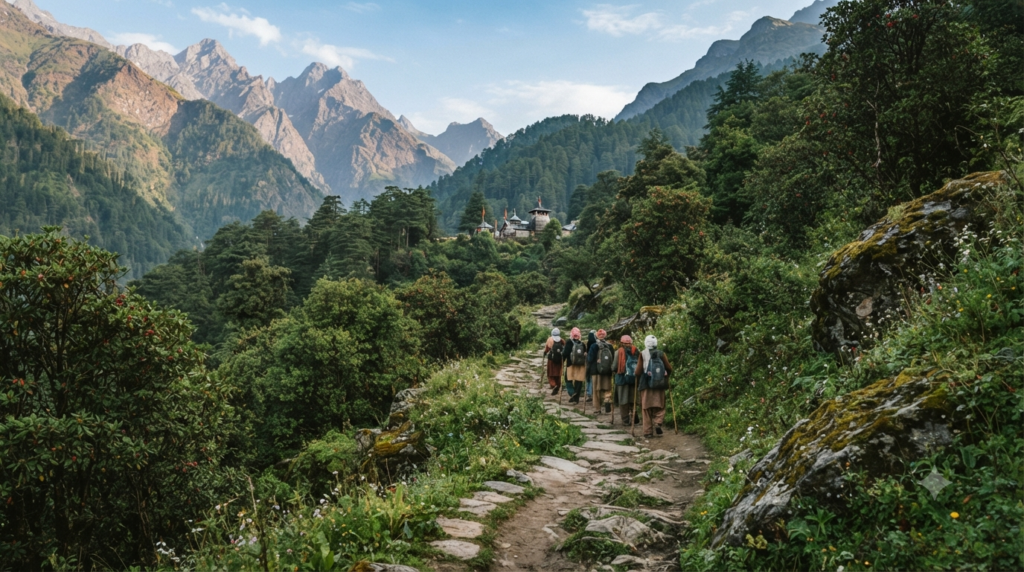
Bhavishya Badri Darshan Timings are not published as fixed daily hours on the current Uttarakhand government pages. Several travel sites repeat 5:00 AM–12:00 PM and 2:00 PM–9:00 PM, but the official sources reviewed do not confirm those hours. The safer plan for Bhavishya Badri Darshan Timings is to start early, verify local access in Joshimath, and allow enough daylight for the trek.
Go Kshetra is an independent pilgrimage guide, not the official website of Bhavishya Badri, Uttarakhand Tourism, or the temple committee. We do not take bookings, donations, or payments; use the official sources linked below for current information.
Bhavishya Badri Darshan Timings: What Is Officially Confirmed?
The official position is clearer on the season than on daily hours. Uttarakhand Tourism says Bhavishya Badri stays closed during winter and opens along with Badrinath Temple. However, neither Uttarakhand Tourism nor the Chamoli district page currently publishes a fixed morning-and-evening darshan timetable for this shrine.
That distinction matters because the widely copied 5:00 AM–12:00 PM and 2:00 PM–9:00 PM schedule appears on independent travel websites, not on the current government pages. Therefore, do not build a tight itinerary around those hours. Confirm the same-day opening with local authorities or temple staff before beginning the uphill walk.
For the current season, the Shri Badarinath Kedarnath Temple Committee listed Badrinath Dham as opening on 23 April 2026. Uttarakhand Tourism says Bhavishya Badri opens with Badrinath, yet the sources reviewed show no separate Bhavishya Badri notice. Trail access can still vary because weather and road conditions change quickly.
Quick Facts for Planning the Visit
| Planning point | Current verified guidance | What to do |
|---|---|---|
| Location | Subain/Subhain area, east of Joshimath in Chamoli | Use Joshimath as the main travel base |
| Altitude | About 2,744 metres | Allow for uphill effort and cooler weather |
| Daily darshan hours | No fixed hours published on current government pages | Verify locally before starting the trek |
| Winter status | Closed in winter | Plan within the Badrinath open season |
| Road access | Motorable road reaches Saldhar; final approach is on foot | Check the latest road and trail condition in Joshimath |
| Online ticket | No dedicated Bhavishya Badri darshan ticket page found | Do not pay private agents for a claimed darshan ticket |
The Chamoli District Administration places Bhavishya Badri at about 2,744 metres. It describes the shrine near Subain and confirms that the final approach involves trekking. The state tourism page also says the temple itself is not connected by road.
Where Is Bhavishya Badri and Why Is It Important?
Bhavishya Badri is one of the sacred Badri shrines dedicated to Lord Vishnu in Uttarakhand. It lies beyond Tapovan, east of Joshimath, in the Dhauliganga valley. Uttarakhand Tourism includes it in the Panch Badri circuit and identifies Lord Vishnu here in the form of Narasimha.
The name means “Future Badri.” According to Hindu tradition, Badrinath will one day become inaccessible, and worship will continue at Bhavishya Badri. This is a religious belief rather than a scientific prediction, so readers should understand it within the pilgrimage tradition.
The shrine is especially meaningful when combined with other Badri temples. Pilgrims can also read Go Kshetra’s Vriddha Badri guide and Yogadhyan Badri guide while planning a wider circuit.
Bhavishya Badri Darshan Timings and Seasonal Opening
Pilgrims should treat Bhavishya Badri Darshan Timings as locally variable rather than a guaranteed two-slot schedule. The state tourism authority confirms a seasonal closure in winter and says the shrine opens with Badrinath. It does not publish exact daily opening, break, aarti, or closing hours for Bhavishya Badri.
This corrects a common problem in older guides. Many pages present 5:00 AM–12:00 PM and 2:00 PM–9:00 PM as official. Others add precise aarti times without naming a primary source. Unless temple management publishes those hours, independent guides should not present them as guaranteed.
When planning Bhavishya Badri Darshan Timings, an early start remains practical because the visit includes a mountain trek. Morning travel also gives you more daylight if the road is slow or the trail takes longer than expected. However, never continue onto an unsafe trail simply to reach a presumed darshan slot.
Bhavishya Badri Darshan Timings and Trek Distance from Saldhar
The exact trek distance needs a caution because the current Chamoli government page contains two different figures. Its introduction mentions about 3 km from the motor road, while its road section states a 6 km trek from Saldhar. Because the official page itself is inconsistent, plan conservatively for the longer figure.
The same district page says a motorable road connects Joshimath and Saldhar over about 19 km. Meanwhile, Uttarakhand Tourism says pilgrims must walk the final approach to Bhavishya Badri. This means the old claim that visitors must trek all the way from Joshimath is incorrect.
Allow several hours for the round trip, especially with children or older pilgrims. Trail time depends on fitness, weather, surface condition, and where your vehicle actually stops. Since mountain access can change after rain or road work, ask locally in Joshimath or Saldhar before setting out.
Bhavishya Badri Darshan Timings and the Route from Joshimath
- Reach Joshimath first. It is the practical base for transport, accommodation, food, and weather checks.
- Continue toward Tapovan and Saldhar. The Chamoli district page describes Saldhar as connected to Joshimath by road.
- Confirm the current road head. Landslides, repairs, or seasonal conditions can change how far vehicles can proceed.
- Begin the final trek on foot. Carry water, a light snack, rain protection, and a warm layer.
- Verify temple access before relying on a timetable. Bhavishya Badri Darshan Timings are not currently published as fixed official hours.
- Return before poor light or bad weather. Do not assume the trail will be easy after sunset.
If you are also visiting Badrinath Dham, check the state’s official Tourist Care registration portal for the current Char Dham registration rules. Do not confuse a Badrinath requirement with a dedicated Bhavishya Badri ticket.
How to Reach Joshimath
By Air
Jolly Grant Airport near Dehradun is the nearest airport used for this route. The Chamoli district page gives the airport-to-Joshimath road distance as about 268 km. From Dehradun, travellers continue by road through the Garhwal region toward Joshimath.
By Train
Rishikesh is the nearest railhead cited by the Chamoli district administration. It gives the Rishikesh-to-Joshimath distance as about 251 km. Buses, shared vehicles, and taxis may be available, but mountain travel times can be much longer than the distance suggests.
By Road
Joshimath connects by road with Rishikesh and other major Uttarakhand pilgrimage gateways. Road conditions can change during monsoon or after landslides, so check the latest local advisory before departure. Build extra time into the day because delays are common on mountain roads.
Is Online Booking Required for Bhavishya Badri?
The current Uttarakhand Tourism, Chamoli district, and BKTC pages reviewed for this refresh show no dedicated official online darshan booking page for Bhavishya Badri. Therefore, do not assume that a private website selling “Bhavishya Badri tickets” has official authority. Use official portals only for services they clearly list.
The older version of this guide incorrectly suggested booking Bhavishya Badri darshan through the Badrinath-Kedarnath committee. BKTC does provide online services for major shrines and pujas, but that does not prove a separate paid Bhavishya Badri darshan ticket exists.
Likewise, the current government pages reviewed do not publish a formal Bhavishya Badri entry fee. Travel practice suggests ordinary access does not use tickets, yet the reviewed official pages show no formal fee notice. Offerings, if made, should remain voluntary and handled only through legitimate temple channels.
Dress Code, Pooja Schedule and Temple Etiquette
No current official source reviewed publishes a mandatory dhoti, saree, or salwar-only dress code for Bhavishya Badri. The older page stated such a rule as strict fact, but no reviewed official source supports that claim. Wear modest clothing that is also practical for a cold, uphill Himalayan walk.
Similarly, the reviewed official pages publish no daily pooja timetable for Mangala Aarti, Abhishek, Bhog Aarti, Sandhya Aarti, or Shayan Aarti at this shrine. Therefore, treat precise ritual times copied across older sites with caution. Ask the priest or local temple staff after arrival if you want to attend a specific ritual.
Keep footwear outside the sacred area as directed, avoid blocking the path, and follow local photography instructions. Since this is a small mountain shrine, quiet behaviour and flexibility matter more than trying to follow a rigid metropolitan temple schedule.
How Bhavishya Badri Darshan Timings Affect Your Day Plan
Because Bhavishya Badri Darshan Timings are not officially fixed online, build the itinerary around daylight and trail safety. Start from Joshimath early, confirm road access, and leave enough time to trek without rushing. A flexible plan works better here than a timetable built around unverified evening closing hours.
For most visitors, Joshimath is the sensible overnight base. It gives you better access to transport and basic services than relying on a remote trailhead. If the road or weather looks poor, postpone the trek rather than gambling on conditions.
Do not combine too many distant attractions on the same day. Bhavishya Badri is best treated as the main outing because road delays and walking time are unpredictable. You can keep nearby Badri shrines for separate stops on the wider pilgrimage route.
Bhavishya Badri Darshan Timings and the Best Time to Visit
The key official rule is simple: Bhavishya Badri closes during winter and opens with Badrinath. Therefore, the practical visiting season falls within the broader Badrinath pilgrimage period. Spring and post-monsoon weeks often offer easier walking than heavy monsoon conditions, but daily weather still decides trail safety.
Uttarakhand’s monsoon can bring landslides, slippery paths, and road interruptions. Winter snow closes the shrine, so do not treat cold-season access as a normal sightseeing trek. Always place local road and weather information above a generic “best month” list.
If your trip is flexible, choose a clear-weather day and begin early. The mountains can cloud over quickly, while afternoon rain can make the return harder. Seasonal opening does not guarantee that every road and trail is trouble-free on every day.
Safety Notes for the Trek
- Wear shoes with good grip because the trail can become slippery after rain.
- Carry drinking water, simple food, rain protection, and one warm layer.
- Do not depend on continuous mobile coverage in a remote mountain area.
- Avoid starting late because the return can take longer than expected.
- Turn back if local authorities or residents warn of landslides, snow, or trail damage.
- At about 2,744 metres, the walk can feel demanding, especially if you are not used to altitude.
Older adults and people with heart, breathing, mobility, or other medical concerns should assess the physical demand before trekking. A clinician can advise whether a steep high-altitude walk is suitable. Religious importance should never override a genuine health or weather risk.
Bhavishya Badri Darshan Timings: What If the Road or Temple Is Closed?
Darshan is not guaranteed because access depends on the seasonal opening, road condition, trail condition, and local temple operations. If authorities close the road to Saldhar or shut the shrine, do not attempt an unofficial shortcut. Return to Joshimath and wait for reliable local guidance.
A useful fallback is Vriddha Badri at Animath. Uttarakhand Tourism says Vriddha Badri remains open throughout the year, although road conditions can still affect travel. This makes it a more practical Badri-circuit alternative when winter or trail conditions prevent a Bhavishya Badri visit.
If you planned Bhavishya Badri as part of a Badrinath journey, keep the next day flexible. Mountain itineraries fail when every hour is pre-booked. One buffer day protects the rest of the pilgrimage from a single road closure.
Before You Go
Bhavishya Badri rewards careful planning because it is a seasonal mountain shrine, not a city temple with a fixed online schedule. Use official Uttarakhand sources when checking Bhavishya Badri Darshan Timings and access facts, and verify local conditions before walking. Most importantly, treat repeated exact timing claims as unconfirmed unless the temple authority publishes them directly.
Keep the existing page bookmarked, but check the official links again close to travel. Road work, landslides, snowfall, and seasonal temple decisions can change faster than an evergreen article. A safe visit depends more on current local conditions than on a copied timetable.
FAQs About Bhavishya Badri Darshan Timings
What are the official Bhavishya Badri Darshan Timings?
The current Uttarakhand Tourism and Chamoli district pages do not publish fixed daily Bhavishya Badri Darshan Timings. They do confirm seasonal winter closure and trekking access. Therefore, verify the day’s opening locally before starting from Joshimath or Saldhar.
Is the 5:00 AM–12:00 PM and 2:00 PM–9:00 PM schedule official?
No current government source reviewed for this refresh confirms that exact two-slot schedule. It appears on several independent temple and travel websites, so it may reflect a commonly repeated local schedule. Still, independent guides should not label it official without a primary temple notice.
Is Bhavishya Badri open in winter?
No. Uttarakhand Tourism states that Bhavishya Badri stays closed during winter and opens along with Badrinath Temple. Snow and difficult access make winter travel unsuitable. Check the official tourism and temple committee websites before planning near the seasonal opening or closing period.
How far is the Bhavishya Badri trek?
The official Chamoli page currently gives two different figures. One section mentions about 3 km from the motor road, while another says 6 km from Saldhar. Since those figures conflict, plan for the longer walk and confirm the active road head locally.
Can a private vehicle go beyond Joshimath?
Yes, the old claim that private vehicles cannot go beyond Joshimath is incorrect. Chamoli District Administration states that a motorable road connects Saldhar with Joshimath. The final approach to Bhavishya Badri still requires walking, so check current road conditions locally.
Do I need an online ticket for Bhavishya Badri darshan?
The government and BKTC sources reviewed show no dedicated official Bhavishya Badri darshan ticket page. Do not pay an agent simply because a website claims a ticket is compulsory. If authorities introduce an official system later, use only the linked government or temple committee portal.
Is there a strict traditional dress code?
No current official source reviewed publishes a strict dhoti-and-saree-only rule for Bhavishya Badri. Wear modest clothing and choose layers suitable for changing mountain weather. Good walking shoes matter because the pilgrimage includes a trek.
Where should I stay for a Bhavishya Badri visit?
Joshimath is the most practical base for most pilgrims because it offers better transport and services. Staying there also makes it easier to check road conditions before departure. Avoid relying on unverified private accommodation contacts or agents near the trail.