
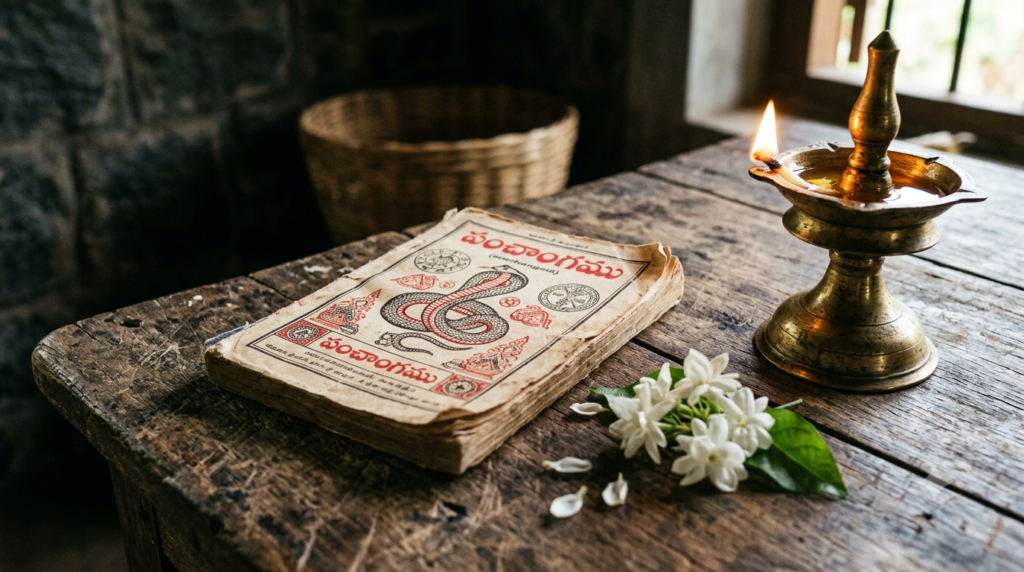
The Asal Pambu Panchangam is the classic Tamil almanac families still open before fixing a wedding, a housewarming, or a new venture. Most people know it simply as the “Pambu” book, named for the snake on its cover. The “No 28” and “Asal” labels are not random, though.
They matter when you want the genuine edition. This guide covers what the almanac contains, why its dates differ from a phone app, which edition is current for 2026, and where to buy the real thing.
Go Kshetra is an independent temple and pilgrimage guide. We are not affiliated with, endorsed by, or the publisher of the Asal Pambu Panchangam. We do not sell the almanac or host download copies. Buy the original from the authorised sellers linked below.
Asal Pambu Panchangam at a Glance
- Publisher: Manonmani Vilasam Press, Chennai — in print since 1883.
- Current edition: Parabhava Varusham, the Tamil year 2026–2027.
- Format: a pocket-size Tamil print booklet, usually around 64 pages.
- Calculation system: Suddha Vakya, the traditional sentence-formula method.
- Typical price: roughly ₹80–₹250, depending on edition and format.
- Tamil New Year (Puthandu) 2026: falls on 14 April 2026.
What Is the Asal Pambu Panchangam?
The Asal Pambu Panchangam is a yearly Tamil almanac. It lists daily star positions, festival dates, fasting days, and auspicious timings for the full Tamil year. It is one title within the long-running Pambu Panchangam family.
Among older astrologers and traditional homes, it stays near the top of the list. The name is a brand as much as a description, so the cover wording tells you which lineage you hold.
“Pambu” means snake in Tamil. The cover carries a coiled serpent because the Moon’s path loops like a snake’s track on sand, pushed and pulled by the planets. Inside that snake sit 27 small circles. Each one marks a day the Moon takes to cross the 27 nakshatras.
“Asal” means original or authentic. “No 28” is the publisher’s own catalogue number for its genuine Suddha Vakya edition. Cheaper imitations do circulate. So these two words are how buyers signal they want the real Manonmani Vilasam book.
History Behind the Asal Pambu Panchangam
The Pambu Panchangam tradition began in Chennai in 1883. Konnur Manicka Mudhaliar started publishing it that year. A press called Manonmani Vilasam was set up specifically to print it.
The press first stood on Seven Wells Road. It now works from Kondithope in Chennai.
Over more than a century, the book earned trust for its eclipse points and lunar tables. Tamil families leaned on it to mark Puthandu and plan temple festivals. They also used it to pick dates for marriages and other big moments.
Because that habit passed down through generations, the almanac became a household fixture. It still anchors Tamil New Year decisions in many homes today.
How the Asal Pambu Panchangam Uses the Vakya System
This is the most important thing to understand, and most online guides skip it. The Asal Pambu Panchangam is a Vakya almanac. It computes star positions from traditional memorised formulae, not from modern astronomy software. “Vakya” means sentence, since the old masters stored planetary motion as easy-to-recite verses.
Modern apps and newer calendars use the Drik method instead, also called Thiruganita. Drik reads planetary positions from precise, observed astronomical data. Both systems share the same rules for building a date.
They simply reach the numbers differently. As a result, the two can disagree by a few hours on when a nakshatra or tithi begins.
That small gap sometimes shifts a muhurtham or a festival by a day. Many Tamil Nadu temples keep to the Vakya reckoning for rituals. Families in Thanjavur, Trichy, and Tirunelveli often do the same. Srirangam and Arcot almanacs sit in the same camp, and the Pambu book is the best known of them.
Should You Trust Vakya or Drik Dates?
Neither system is “wrong” — they answer different questions. Drik matches what a telescope would see today, so it suits precise horoscope work. Vakya matches centuries of temple practice, so it keeps rituals in step with tradition. It also stays aligned with the local temple calendar.
The practical rule is simple. Follow whichever system your family and temple already use. Do not mix the two for one event. If your elders consult the Pambu book, stay with it for that wedding rather than second-guessing the date against an app.
What the Parabhava 2026–2027 Asal Pambu Panchangam Covers
The current edition is the Parabhava Varusham book. It covers the Tamil year running from April 2026 to April 2027. This correction is worth noting.
Several older web pages still label the present year “Shobhakruth”. That was the 2023–2024 year, and it is now out of date. Tamil New Year 2026 lands on 14 April, when the Parabhava year begins.
Each yearly edition refreshes its daily tables while keeping the same trusted structure. The core sections stay consistent from one print run to the next. So a reader who knows last year’s layout can navigate the new one quickly.
The publisher typically releases the new book shortly before Puthandu each year. The Parabhava edition is a compact, pocket-size volume of roughly 64 pages in Tamil. Its small size is deliberate, so families can keep the Asal Pambu Panchangam handy for quick reference all year.
Astrological and Lunar Data
The almanac lists the five Panchanga limbs for every day. These are Tithi (lunar day), Nakshatram (star), Yogam, Karanam, and Vaaram (weekday). It also marks moon phases such as Amavasai and Pournami.
The daily positions of the planets appear alongside. These daily rows are the working heart of the book.
Festivals and Fasting Days
Major Tamil observances appear with their dates. These include Puthandu, Deepavali, Thai Pongal, and Navaratri. The almanac also flags recurring vratham days such as Ekadasi, Pradosham, Amavasai, and Pournami. So families can plan fasts and pooja through the year without missing them.
Muhurtham and Rasi Palan
A dedicated muhurtham section maps auspicious windows for weddings, griha pravesam, and other ceremonies. Alongside it sits the Rasi Palan. This is a year-ahead outlook for all twelve moon signs, covering health, work, and money. Families planning events months ahead lean heavily on these two sections.
How to Read the Asal Pambu Panchangam
The book is dense and printed in Tamil. So a first-time reader benefits from a simple approach. Work through it step by step, rather than absorbing every column at once.
Step 1: Start From the Tamil Month
The almanac follows the Tamil solar calendar. It begins with Chithirai around mid-April and runs twelve months to Panguni. Find the current Tamil month first, because every daily table hangs off it. For this edition, that clock starts on 14 April 2026.
Step 2: Locate the Section You Need
Decide what you actually want — a daily star, a festival date, a muhurtham window, or a rasi forecast. Then turn straight to that block. The book is organised as reference tables, not as a story, so reading front to back wastes time.
Step 3: Read the Symbols Carefully
Traditional shorthand marks planets, nakshatras, and timings. Each symbol carries a fixed meaning. If you are new to it, keep a plain-language astrology primer beside you. Cross-check until the notation feels familiar.
Step 4: Confirm Before Any Big Decision
For a wedding or house-warming, check the muhurtham block first. Then confirm with your family priest or astrologer. The almanac guides the choice, yet a personal consultation catches details a printed table cannot.
Treat the astrological guidance as tradition and belief, not a guarantee. For decisions that carry real stakes, seek professional advice.
Where to Buy the Asal Pambu Panchangam
The genuine Asal Pambu Panchangam is a printed booklet. Buying the physical copy is the safest route. Local Tamil bookstores stock it heavily around Tamil New Year, while trusted online sellers ship it nationwide. Reputable religious-book retailers such as Giri Trading Agency carry authentic Tamil panchangams every year.
Prices shift by edition, size, and seller. So treat the figures below as indicative. Confirm the current amount at the counter or listing before you pay.
| Format | Typical price | Where to find it |
|---|---|---|
| Standard print edition | Around ₹230 | Bookstores and online listings |
| Compact / plain edition | Around ₹80–₹100 | Local Tamil bookshops |
| Two-book set | Varies by seller | Online marketplaces |
You can also cross-reference a modern computed calendar. A Drik source such as Drik Panchang’s Tamil calendar works for a quick sanity check. Remember that a Drik app and the Vakya Pambu book may show different timings. So use the app for reference, not as a replacement.
Spotting a Fake Asal Pambu Panchangam PDF
Search results are full of free “download” copies. This is where readers get burned. A scanned or retyped PDF of an old year is worse than useless, because muhurtham and festival dates change every year. Planning a wedding on last year’s tithi table is a real mistake, not a minor one.
Watch for a few warning signs. A file that does not name the current Parabhava year is stale. So is one that recycles an old cover.
Avoid sites demanding a “processing fee” for a public almanac, or asking for personal details before a download. When dates matter for a real ceremony, the small price of the current printed book buys certainty a random PDF cannot.
Tips and Common Mistakes to Avoid
- Buy a fresh edition every year, because each year’s celestial data is unique.
- Do not mix Vakya and Drik dates for one event — pick one system and stay with it.
- Cross-check the Tamil date against the English date, since the two are easy to confuse.
- Consult elders, a family astrologer, or your temple priest before finalising a muhurtham.
- Store the book respectfully, a small habit many Tamil households keep by tradition.
For related planning, see our guides to the Pidaparthi Gantala Panchangam 2026 and the Mulugu Gantala Panchangam. Our note on Rahu Kalam and Yamagandam timings also pairs well with daily panchangam reading.
Before You Buy
The Asal Pambu Panchangam remains a trusted Tamil almanac. It carries generations of Vakya tradition into each new year. For 2026–2027, look for the Parabhava Varusham edition.
Buy the genuine “Asal No 28” printed copy from a reputable seller, and skip outdated free PDFs. Above all, treat it as a planning companion. Confirm important dates with a knowledgeable priest or astrologer before you commit.
FAQs About the Asal Pambu Panchangam
What does “Pambu” mean in the name?
“Pambu” means snake in Tamil. The name comes from the serpent on the cover, which represents the Moon’s winding path. The 27 circles along the snake stand for the Moon’s 27-day cycle through the nakshatras.
Why is it called “No 28 Asal”?
“Asal” means original or authentic. “No 28” is the publisher’s catalogue number for its genuine Suddha Vakya edition from Manonmani Vilasam Press. Together the words help buyers separate the real book from imitations.
Which edition is current for 2026?
The current book is the Parabhava Varusham edition. It covers the Tamil year from April 2026 to April 2027. Any copy still labelled “Shobhakruth” is the 2023–2024 year and is out of date.
Is the Pambu Panchangam a Vakya or Drik almanac?
It is a Vakya almanac. It uses traditional sentence-formula calculations rather than modern computed positions. This is why its timings can differ slightly from a Drik-based phone app.
Can I rely on a free PDF version?
It is risky. Many free PDFs are old editions with outdated dates, and stale muhurtham data can spoil planning. Buying the current printed copy is the safer choice for any real ceremony.
Is the almanac useful outside Tamil Nadu?
Yes. Tamil families worldwide use it for festivals and rituals. For very precise local timings abroad, a small regional adjustment may be needed, so cross-check with a local calendar.
How often should I replace it?
Once a year. Each Tamil year has its own celestial data. An older edition loses relevance the moment the new year begins at Puthandu. Buying the fresh Parabhava copy each April keeps your dates accurate.