
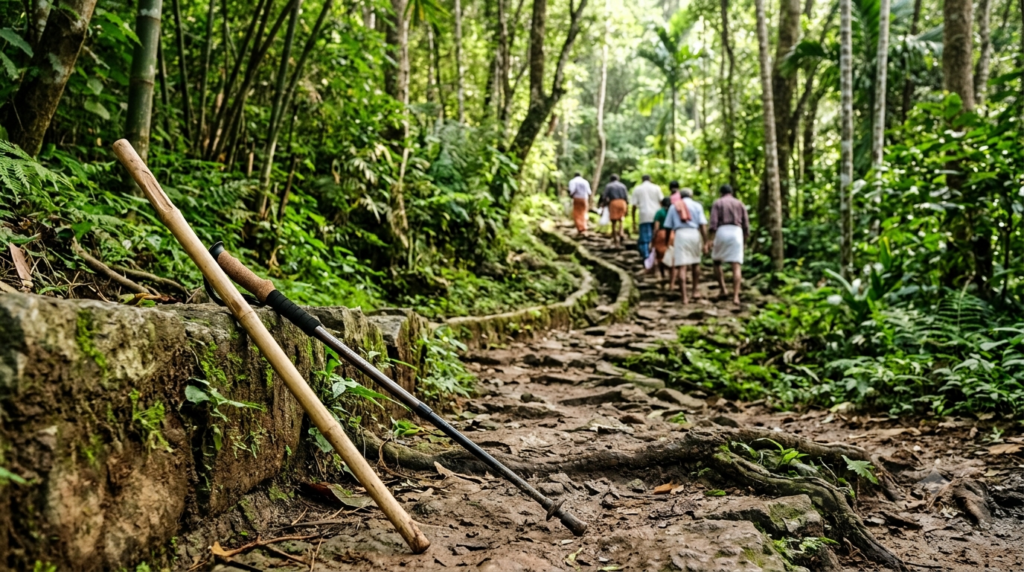
A Sabarimala walking stick may give you extra balance on the uphill path from Pamba, but that does not establish permission to carry it into every temple area. A wooden staff, trekking pole and medical cane can serve different needs. The important task is to prepare for the walk while checking entry instructions separately.
Independent-guide notice: Gokshetra is not the official Sabarimala Temple or Travancore Devaswom Board website. We are not affiliated with these authorities and accept no bookings, rentals, payments or donations. Use official channels for current instructions.
Sabarimala walking stick: key points at a glance
- A walking staff or trekking pole may offer balance on uneven ground. It cannot remove the physical demands of a steep climb.
- Kerala Tourism describes an uphill walk from Pamba to Sannidhanam of about 5 km. Route and crowd conditions still matter.
- Published official do’s and don’ts require cooperation with security checks. They do not explicitly state a blanket walking-stick permission rule.
- No current official counter, hire price, stick-deposit fee or collection arrangement was verified for this guide.
- Ask authorised Devaswom or police staff before relying on any aid for the final temple approach.
Why the Pamba climb changes the equipment decision
The Sabarimala pilgrimage involves more than reaching the roadhead. Kerala Tourism’s route guide places Pamba at the foot of the hill, around 5 km from the temple. Pilgrims then continue uphill towards Sannidhanam, the shrine area.
A Sabarimala walking stick may be useful during the ascent, yet its value depends on your footing and fitness. The route can involve slopes, paved stretches and crowded movement. A pole that helps on loose ground may become awkward on steps or inside a dense queue.
Kerala Tourism also describes longer traditional approaches through forest terrain. Do not assume advice for the Pamba climb covers an extended route from Erumeli. Before starting, check which path authorities currently permit and how demanding it will be for your group.
The official visitor guidance advises rest during the ascent and cooperation with staff. It also warns pilgrims not to proceed when the shrine area is overcrowded. Those instructions matter more than maintaining a particular walking pace.
Walking staff, trekking pole or cane: which is different?
These items look similar from a distance, but their intended use differs. A traditional walking staff provides a single handhold. A trekking pole usually has a shaped grip and adjustable or fixed shaft. A medical cane may support a specific mobility need.
| Walking aid | Possible benefit on the path | Point to check |
|---|---|---|
| Wooden walking staff | A simple third point of contact | Length, tip grip and handling in queues |
| Single trekking pole | Adjustable support for varied ground | Tip, strap and control on steps |
| Pair of trekking poles | Support for both hands on open sections | Space needed in crowded areas |
| Medical walking cane | Mobility support prescribed or chosen for a personal need | Fit, medical suitability and staff instructions |
For a Sabarimala walking stick, a useful design does not amount to a temple approval category. In particular, a foldable trekking pole is not automatically allowed because it becomes shorter. Likewise, an ordinary wooden staff does not gain official permission merely through tradition.
If you need a cane to walk safely, treat that as a separate accessibility enquiry. Explain your need to authorised personnel instead of assuming that rules for hiking gear apply unchanged to medical aids.
Choosing a Sabarimala walking stick or trekking pole
Choose a Sabarimala walking stick you can control on a climb, not the longest or heaviest staff you can find. For ordinary trekking use, the grip should feel secure and the tip should meet the ground without sliding. Test the aid on gentle slopes before your pilgrimage.
With an adjustable trekking pole, start from a comfortable height and adjust it for your own stance. Avoid a position that forces your shoulder upward or makes you lean forward. Check that every locking joint stays firm under light testing.
A broad rubber tip may behave differently from a narrow metal tip on hard, wet surfaces. Check grip rather than assuming one tip works everywhere. Never use a sharp end in a moving crowd, and keep the pole close to your body when others are nearby.
For footwear decisions, see our Sabarimala footwear guide; footwear instructions are also separate from pole permission. Carry weight matters too. A pair of poles occupies both hands, while an irumudi or other essential items may already demand care. A single simple aid may be more manageable for some walkers, but it is not automatically better for everyone.
Can you carry a Sabarimala walking stick to the temple?
The official sources reviewed do not give a clear, universal yes-or-no rule for carrying a walking stick or trekking pole into every Sabarimala temple area. Kerala Tourism requires pilgrims to cooperate with security checks and follow officials’ directions. Therefore, ask authorised staff about your particular aid before entering controlled areas.
The Sabarimala walking stick question has two parts: support on the hill and permission near the shrine. This is the key distinction: equipment advice explains how a pole may help you walk; only the responsible authorities can confirm where you may carry it. A useful trekking tool is not an entry pass, and a general safety webpage is not a shrine-specific permit.
The Kerala Tourism do’s and don’ts prohibit weapons and explosives. That warning does not, by itself, classify every walking stick as a weapon. Nor does silence about trekking poles mean they are approved. Security personnel must apply the instructions in force.
Rules may also differ between the walking route, an inspection point and a queue near the holy steps. Treat each as a separate enquiry. Do not rely on a social-media photograph showing someone holding a stick as proof of current permission.
Where should you ask about carrying a stick?
Begin before the uphill climb, when it is easier to change your plan. Use the Travancore Devaswom Board’s official contact page to find an authorised enquiry channel. At Pamba, seek directions from clearly identified Devaswom staff or police.
Make your Sabarimala walking stick enquiry specific rather than simply asking, “Are sticks allowed?” Show the item if staff request it. Explain whether it is a wooden staff, a folding trekking pole or a medical mobility aid. Then ask how the answer changes near the shrine.
- May I use this specific aid on the currently open uphill route?
- May I retain it at the next security checkpoint and in the darshan queue?
- If not, where must I stop using it, and what is the approved next step?
- Does staff guidance differ for a medically necessary cane?
- If a deposit arrangement exists, who operates it and how can I reclaim the item?
Do not expect advance enquiries to guarantee a decision at the checkpoint. Follow current signs and the instructions of the officials responsible for that area, even if an earlier answer sounded different.
Using a walking aid safely on the uphill route
A walking stick is most useful when it adds stability without distracting you from the path. If your Sabarimala walking stick slips, stop and check its tip. Place the tip where you can see the surface. Test the grip gently before shifting weight, especially when stone or paving looks wet.
On steps, do not plant a long staff across another pilgrim’s route. Keep enough space to avoid catching a foot, garment or bag. Where a handrail exists, use it if safe and follow the movement of the queue.
Wrist straps can help retain some trekking poles, but they may also catch when movement is tight. Learn how to release your hand quickly before the journey. If a strap creates a snag risk in a crowd, do not depend on it.
Walking downhill deserves equal care. Fatigue can affect balance after darshan, so do not rush simply because the hardest climb is over. Stay with the authorised return route, and pause at permitted resting points when needed.
Is renting or storing a walking stick guaranteed?
No verified current official source reviewed for this guide establishes a Sabarimala walking-stick rental counter, an approved pole-deposit point, a rental fee or a storage charge. Therefore, do not plan your journey around hiring a staff at Pamba or leaving one near the shrine. Confirm any claimed facility directly with authorised personnel.
A Sabarimala walking stick cannot automatically go into a general baggage service, even if one operates. The item’s dimensions, sharpness and handling may raise separate questions. Ask exactly what the operator will take before handing anything over.
Gokshetra’s Sabarimala luggage cloakroom guide explains why a past storage record cannot guarantee a current service. This distinction is especially important when a stick is essential for your safe return walk.
Do not leave a pole in an unmarked corner, beside a path or with an unknown vendor. If someone offers paid storage, first ask the official information point whether the operator has approval. Never treat an informal promise as secure custody.
What if officials will not let you proceed with your aid?
Permission for a Sabarimala walking stick through every controlled section is not guaranteed. If security staff refuse an item, stop and ask for the approved next step. Do not conceal it, argue in the moving queue or assume that a storage counter must exist. Your safe return matters too.
- Clarify the limit. Ask whether the restriction applies to the current checkpoint, the entire queue or another defined area.
- Ask about an authorised option. If staff identify a deposit service, confirm that it accepts your item and explain the return arrangement.
- Reassess your mobility. If you cannot safely walk without the aid, ask officials for suitable assistance rather than continuing unsupported.
- Change the plan if necessary. Step aside where permitted. You may need to delay or abandon that attempt rather than risk a fall.
Do not assume special entry, an exemption or a replacement aid will be available. A refusal at a security point does not make it safe to leave your support behind and struggle through the remaining route.
Older pilgrims, mobility needs and medical safety
A Sabarimala walking stick is not a substitute for the strength needed to climb a hill. Older pilgrims and people with joint, heart, breathing or balance conditions should assess the demands with a healthcare professional before travel. Bring prescribed medicines and walk with a trusted companion where practical.
Kerala Tourism advises pilgrims to rest during the climb and seek medical assistance when needed. Its published guidance also refers to a dolly service, with payments made only at the authorised Devaswom counter. Gokshetra’s Sabarimala dolly-service guide explains the assistance option in more detail. It does not follow that a dolly will always be available when you arrive.
If you need mobility assistance, enquire about current official arrangements before setting out. Gokshetra’s Pamba medical facilities guide explains how to plan for help along the route. A trekking pole should never encourage you to continue through chest pain, faintness or severe breathlessness.
For children and group members who need extra support, agree on a meeting plan before entering a busy section. If you feel unsafe, seek help from police or medical staff rather than pushing to keep your place.
Common mistakes with staffs and trekking poles
The first mistake is buying a pole on the assumption that it gives automatic access to the shrine. Entry instructions require a separate check. Another is choosing a heavy, tall staff that becomes difficult to control near other pilgrims.
A new Sabarimala walking stick can create problems when you have not tested its grip or lock. Try it during ordinary walks before the pilgrimage. If an adjustable shaft slips, repair or replace it instead of trusting it on the hill.
People also confuse a folding mechanism with permission. A pole can fold neatly and still face a restriction at an inspection point. Equally, a traditional-looking staff is not proof of an exemption.
Finally, never rely on a supposed hire desk, fixed rental price or free storage facility from an undated post. Confirm the operator and terms with the authorities, or make a plan that does not require the service.
Sabarimala walking stick: pre-climb checklist
- Read current official instructions. Check Kerala Tourism’s visitor advice and the Travancore Devaswom Board’s updates. Use Gokshetra’s Sabarimala pilgrimage guide for the broader journey plan.
- Choose for the terrain. Test your staff, pole or cane on safe ground before departure.
- Inspect the equipment. Check the grip, tip, shaft and any folding locks for damage.
- Keep the load manageable. Plan how you will hold essential items without losing your balance.
- Enquire at Pamba. Ask authorised staff about the walking route and any item restrictions ahead.
- Check before the final approach. Follow local signs, security checks and instructions about carrying the aid.
- Prepare a safe fallback. Do not continue without necessary support or count on unverified storage.
If you are still uncertain, seek an official answer before joining a tightly controlled queue. The right time to solve an equipment problem is when you can still change your plan safely.
The sensible approach before darshan
Prepare your Sabarimala walking stick for the terrain, but treat temple permission as a separate question. A simple staff may be easier to handle than two poles in some crowded sections, yet neither has guaranteed entry. Check official notices, speak to authorised staff and accept the directions at each controlled point.
Above all, do not compromise your balance to preserve a place in the queue. A safe climb and a workable return plan matter more than any piece of trekking gear.
Frequently asked questions
Are walking sticks allowed at Sabarimala?
The official guidance reviewed does not establish a blanket permission or ban for all walking sticks at every part of Sabarimala. Its published advice requires security checks and cooperation with officials. Ask Devaswom or police staff about your exact item and the area you wish to enter.
Can I use trekking poles from Pamba to Sannidhanam?
Do not assume trekking poles have approval for the full route. They may be useful as walking equipment, but official instructions govern where you can carry them. Confirm current guidance with authorised staff at Pamba, then obey any further checkpoint restrictions near Sannidhanam.
Can I take a wooden staff through the holy steps?
No verified rule in the reviewed guidance confirms permission to carry a wooden staff through Pathinettampadi, the sacred eighteen steps. Staff and security officers direct queue movement there. Ask before joining the approach, and do not use a long staff in a way that obstructs other devotees.
Is a folding trekking pole more likely to be accepted?
A folding pole is easier to pack, but that does not give it an automatic entry exemption. A checkpoint may consider the item and current instructions rather than its folded size. Choose compact gear for convenience only, and confirm what authorities permit before travel.
Can older pilgrims carry a medical walking cane?
Older pilgrims should explain their mobility needs to authorised staff and ask what assistance is available. The sources reviewed do not confirm a universal medical-cane exemption. If walking without the cane would be unsafe, seek official guidance and medical advice rather than continuing without support.
Is there a walking-stick rental counter at Pamba?
No current official rental-counter location or service was verified for this guide. Do not rely on a stall, hire fee or advance reservation described by an unofficial page. Ask the Travancore Devaswom Board or authorised staff whether any approved option exists during your visit.
Where can I deposit a trekking pole before darshan?
No current pole-specific deposit location, acceptance policy or charge was verified in the reviewed official information. A luggage facility, if operating, may not take a long pole. Ask authorised personnel about an approved arrangement, and do not leave equipment unattended near security areas.
Can a walking stick make the Sabarimala trek safe for someone with poor mobility?
A walking stick may improve balance, but it cannot guarantee safety on a strenuous uphill walk. People with significant mobility, heart or breathing problems should consult a healthcare professional before travel. If you cannot safely proceed, ask officials about assistance or change your pilgrimage plan.