
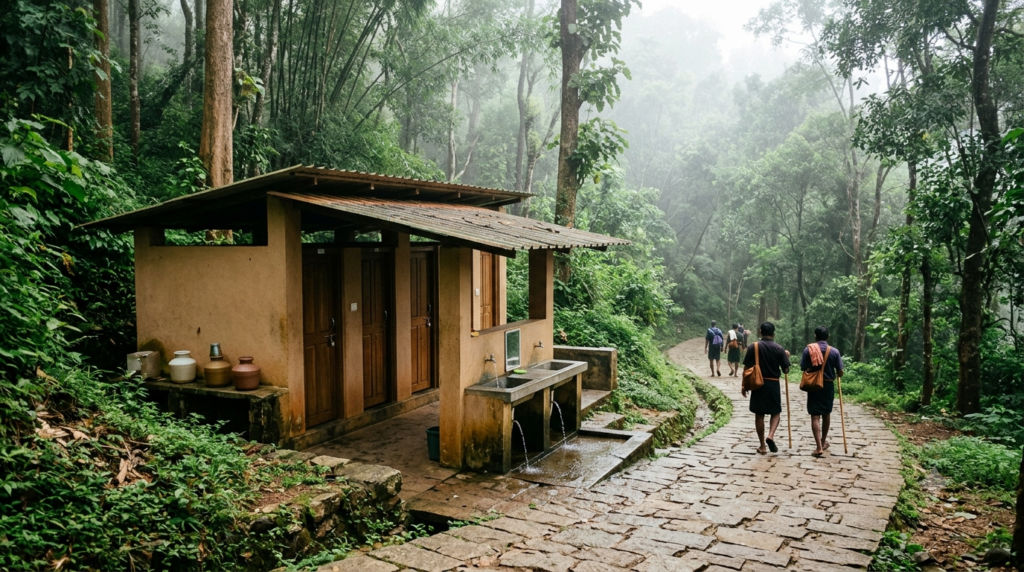
Sabarimala toilet facilities are listed at Nilakkal, Pamba, along the pilgrimage climb and near Sannidhanam, but a published list cannot tell you which cubicle is open when you arrive. The safest plan is to use a designated toilet before each busy stretch, check conditions locally and allow extra time for queues. This guide explains the likely service areas, hygiene essentials and how to ask about accessible facilities without assuming they exist everywhere.
Independent guide: Gokshetra is not the official Sabarimala website and is not affiliated with the Travancore Devaswom Board. We accept no bookings, payments or donations. Use the official sources linked below for current instructions.
Sabarimala toilet facilities at a glance
- Main service areas: The government Sabarimala facilities pages describe toilets at Nilakkal, Pamba and Sannidhanam, with bio-toilets along the traditional path.
- Route planning: Check the last suitable toilet before entering a long climb or managed queue.
- Charges: Published free and pay-and-use listings are not a live price notice. Check current signs and authorised staff.
- Access needs: Request exact details about ramps, doors, support rails and toilet access before setting out.
- Hygiene: Use only designated facilities, carry basic cleaning supplies and dispose of waste correctly.
The central rule is simple: a toilet that appears in an official inventory is not necessarily a toilet you can use right now. Crowd controls, cleaning and repairs can change access during your pilgrimage.
Where are Sabarimala toilet facilities located?
Sabarimala toilet facilities appear in official information for Nilakkal, Pamba, the trekking approach and Sannidhanam. These are useful planning zones, not a verified live map of individual stalls. The best place to stop depends on your route, mobility needs and the queue arrangements on your day of travel.
| Area | What official guidance identifies | Best on-the-day check |
|---|---|---|
| Nilakkal | Toilets, bathing facilities and urinals | Find a usable block before your onward journey |
| Pamba | Toilets, including women’s and bio-toilet facilities | Use a designated facility before the ascent |
| Trekking path | Bio-toilets and bio-urinals on the traditional approach | Ask which units serve your chosen route |
| Sannidhanam | Toilets, bathrooms and urinals near the pilgrimage destination | Locate an open block before joining a long queue |
The Kerala government’s Sabarimala toilet facility page identifies these broad areas. It does not certify that every listed unit is functioning today. Therefore, do not travel on the assumption that each service point will be open.
Nilakkal: prepare before the onward trip
Nilakkal is a key place to check Sabarimala toilet facilities before proceeding towards Pamba. The government Sabarimala list mentions toilets, bathrooms and urinals here. Yet it does not provide a reliable, current status for every individual facility.
If you are travelling with children or older relatives, locate a clean, usable toilet while your group is still together. Check where you can wash your hands, too. Do not postpone a necessary stop simply because you expect an easier facility uphill.
Pamba: make a deliberate stop before climbing
Pamba is the important decision point before the final uphill pilgrimage section. Official material names toilet facilities here, including provision for women. Still, a listed women’s block does not guarantee an empty, open or accessible cubicle on your visit.
Use this stage to ask where the next suitable toilet is located. If your group has different needs, agree on a meeting point before anyone leaves to find a restroom. For drinking-water preparation, see our Sabarimala drinking water guide.
Traditional trek: do not rely on fixed toilet intervals
Official guidance lists Sabarimala toilet facilities such as bio-toilets and bio-urinals along the traditional path from Pamba. However, the listing does not establish operating hours, accessibility features or a precise spacing between usable blocks. A facility shown for one approach may not be convenient for another route.
Ask authorised staff which restroom lies ahead on the path you are actually using. Do not take forest shortcuts to reach a toilet. If a unit is closed, follow the designated path and seek guidance at the next staffed point.
Sannidhanam and queue areas: plan before entry
Sannidhanam also features in the government toilet listings. Kerala Tourism additionally mentions toilets near the Marakkoottam–Saramkuthi road and queue complex. However, crowd barriers or queue rules may make a nearby facility difficult to reach from your current position.
Before joining a long managed queue, ask whether you can reach a designated restroom without leaving your assigned route. Do not assume you can exit and re-enter at the same place. Follow police and Devaswom staff directions rather than separating from your group without a plan.
Are Sabarimala toilet facilities free?
Do not assume every Sabarimala toilet is free or that a payment board reflects the latest policy. Kerala Tourism’s published facilities page distinguishes free toilets from pay-and-use units. However, that listing does not establish the charges at every currently operating facility, so check current official instructions and signs on site.
The Kerala Tourism facilities page lists 1,005 toilets, including 885 marked free and 120 marked pay-and-use. These are published estimates, not today’s operating count or fee schedule. The page itself warns that seasonal crowds and emergencies can change its figures.
Other official listings give different area-by-area totals. That does not mean you can add all the numbers into one dependable live count. The pages may describe different scopes or periods, so an exact current total remains unconfirmed. Check the latest official notice and on-site sign before paying any charge.
If someone requests payment, ask an authorised attendant for the current rule and receipt procedure. Published fee classifications may not reflect the position at your chosen block. Avoid private agents and unofficial online payment requests, since this guide cannot confirm an individual facility’s present charging policy.
How can you find Sabarimala toilet facilities on your route?
Start with the government listings, then check the route you will actually walk. The Kerala Forest Department’s Ayyan app includes public toilets among its pilgrim-service information. Still, map entries cannot establish live cleanliness, opening status or wheelchair access, so confirm the next usable block with authorised staff.
- Check your route: Identify whether your group is taking the Pamba–Neelimala approach, Swami Ayyappan Road or another permitted route.
- Review the app: Consult the Kerala Forest Department’s Ayyan app for mapped toilet and help-point information.
- Ask before the climb: At Pamba, confirm the nearest open toilet along the route authorities currently allow.
- Use local signs: Follow official wayfinding, queue instructions and instructions from designated attendants.
- Check again at Sannidhanam: Ask before entering a section where you may not be able to leave the queue easily.
Keep your phone charged if you rely on route guidance, but follow the local restrictions near temple premises. Our Sabarimala mobile phone rules guide explains the distinction between trek use and restrictions inside the temple area.
Hygiene basics at Sabarimala toilet facilities
Busy Sabarimala toilet facilities can change condition quickly, even after cleaning. Choose a designated unit with adequate light, reasonable footing and a usable door. If it appears unsafe, blocked or badly soiled, do not force entry. Find an attendant or ask at a nearby authorised help point.
- Wash your hands: Use soap and clean water when available, especially before eating.
- Carry backup supplies: A small hand sanitiser, tissues and a discreet waste pouch can help when supplies run out.
- Keep the floor clear: Watch for water, mud and slippery steps near shared washing areas.
- Use bins correctly: Do not put plastic, wipes or other rubbish into toilet pans.
- Protect other users: Leave cubicles as clean as possible and respect signs for women’s and other designated facilities.
Use toilets rather than the roadside or forest. Kerala Tourism’s pilgrim dos and don’ts explicitly advises against urinating or defecating outside designated facilities. This protects hygiene and the surrounding environment.
Accessibility at Sabarimala toilet facilities: what to ask
Do not treat a listing for Sabarimala toilet facilities as confirmation of an accessible toilet. The official pages reviewed do not verify step-free routes, wheelchair turning space, support rails or assistance at every block. Pilgrims with limited mobility should ask detailed questions about the exact facility and the approach before committing to the climb.
- Is there a usable toilet with step-free entry on my route, and is it open today?
- Does the entrance have enough space for my wheelchair or walking aid?
- Are handrails, a secure door, water and a nearby place to wash hands available?
- Can a companion assist, and where can staff offer directions without interrupting queue controls?
- What is the nearest alternative if the first identified toilet is closed or inaccessible?
Ask the responsible authorities through the official Sabarimala contact directory before travel, then confirm again on site. An answer about a wheelchair service or general pilgrim assistance does not establish that a particular toilet meets your needs.
People with heart, breathing or mobility conditions should discuss the demanding uphill route with a healthcare professional before visiting. Carry prescribed medication and plan with a trusted companion. Our Pamba medical facilities guide covers where to seek medical help rather than pushing through distress.
What if a toilet is locked, crowded or unclean?
Access to specific Sabarimala toilet facilities is not guaranteed. A unit may be shut for cleaning, repair or crowd management, while queues may block your usual route. If this happens, ask an authorised attendant or police officer for the nearest usable alternative. Do not enter a restricted area or assume a map pin proves access.
- Try another designated block in the same service area. Ask staff first so you do not make an unnecessary detour.
- Check the next authorised service point. Confirm that it is on your current permitted route before walking.
- Explain urgent access needs. Tell authorised staff if a child, older pilgrim or disabled traveller needs prompt assistance.
- Change your timing if necessary. Delay the climb or queue entry when a safe restroom option is not available.
- Seek medical help for illness. Severe pain, faintness or loss of bladder or bowel control needs appropriate medical support, not a rushed trek.
Do not expect an instant replacement when a block is closed. There may be no convenient alternative within your current queue section. Therefore, checking before entering that section is more useful than knowing the area’s total number of toilets.
A simple toilet-stop plan for the Sabarimala trek
Plan around decision points rather than imagined distances between stalls. Sabarimala toilet facilities may appear on a route map, yet the time needed to reach them changes with crowds and individual walking pace. Your plan should stay flexible enough to follow police instructions.
- Before onward travel from Nilakkal: Find a designated toilet, wash your hands and check that younger or older group members are ready.
- At Pamba: Make another stop if needed. Ask which restrooms are open on your approved uphill route.
- During the ascent: Use a designated bio-toilet when available. Do not leave the marked path in search of privacy.
- Before a long queue at Sannidhanam: Check the nearest accessible toilet and any re-entry restrictions with staff.
- On the return journey: Follow the prescribed return flow and identify facilities along that route instead of assuming it retraces your ascent.
If your group includes someone who needs frequent toilet access, build the schedule around that person. The fastest walker should not set the pace. Also, avoid deliberately restricting drinking water to reduce toilet stops, especially during physical exertion.
Common mistakes that make a toilet stop harder
The first mistake is treating an inventory as a live service guarantee. The government can publish hundreds of units, yet one pilgrim still needs a clean, reachable toilet at a specific moment. A second mistake is assuming a toilet shown beside a queue lies inside the area you can access.
Another common error is confusing bathrooms, urinals and toilet cubicles. Official lists sometimes count them separately, so their totals should not become a promise about usable toilets. Similarly, a facility marked for women does not answer whether it offers step-free entry or enough space for a caregiver.
Finally, do not treat social media photographs as current evidence. A stall may have worked when someone took a picture, while its condition may now differ. Check the official pages for baseline information and trust authorised local guidance for the actual visit.
Before you go
Sabarimala toilet facilities form part of the pilgrim infrastructure, but current access depends on conditions along your route. Use designated stops at the main service areas and ask about facilities before entering long queues. Check fees and accessible features directly rather than relying on old counts or broad promises. A small hygiene kit and a flexible plan can make the climb safer and more comfortable.
Sabarimala toilet facilities: frequently asked questions
Where can I find toilets at Sabarimala?
Government guidance identifies Sabarimala toilet facilities at Nilakkal, Pamba, Sannidhanam and parts of the traditional trekking route. That tells you where to begin looking, not which cubicle is open right now. Check the Ayyan app and ask authorised staff about your current route.
Are all Sabarimala toilets free?
Not necessarily. Kerala Tourism’s published inventory distinguishes free and pay-and-use toilets, but it is not a live fee schedule. Check current official notices and on-site instructions before relying on any free-use claim.
Are bio-toilets available on the Pamba trek?
The government Sabarimala toilet page describes bio-toilets on the traditional approach from Pamba. However, it does not guarantee each unit’s present condition, hours or position on your chosen route. Ask local staff before relying on the next toilet stop.
Are there separate toilets for women?
The official Sabarimala listing names women’s toilets at Pamba. It does not show a current, stall-by-stall map of women’s facilities at every location. Ask an authorised attendant for the closest suitable open toilet, especially when travelling with children or a group.
Are Sabarimala toilet facilities accessible to wheelchair users?
Accessibility is not confirmed for every facility. The official facility inventories reviewed do not establish that every area has an accessible cubicle. Before visiting, ask about step-free access, door width, support rails and the nearest alternative. Confirm on site because access can change during the pilgrimage.
Can I bathe at Nilakkal or Sannidhanam?
Government Sabarimala information lists bathroom facilities in these broad areas. Yet a published bathroom count does not confirm that an individual washing unit is open or suitable for your needs. Ask staff about current access and any applicable rules or charges.
Are toilets open around the clock?
No reviewed official source guarantees round-the-clock operation for each listed toilet. Some units may close for cleaning, repairs or crowd control, even during busy pilgrimage periods. Confirm the nearest open facility before a long climb or managed queue.
What should I do if a toilet is unhygienic?
Avoid using an unsafe cubicle and tell the attendant or nearby authorised staff. Ask for another designated facility instead of leaving the permitted path. Wash or sanitise your hands and seek medical support if you become unwell.
Does the Ayyan app show public toilets?
Yes. The Kerala Forest Department’s Ayyan app description includes public toilets among its pilgrimage services. However, the presence of a location on a map cannot confirm its current cleanliness or accessibility. Use it as a planning tool and verify locally.