
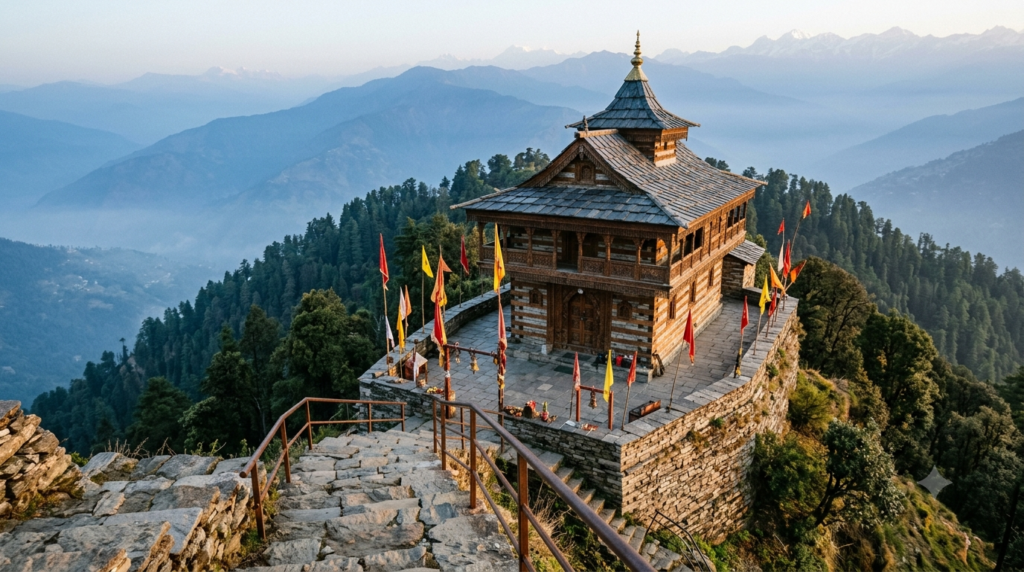
Tara Devi Mandir Shimla sits on a forested ridge roughly 11 km from the city, and locals rarely call it anything else. Travel pages label it Tara Devi Temple, yet most of them still describe the journey wrongly. They send you to Shimla railway station when a much closer halt exists on the same toy-train line. Because the road ends at a steep stairway, this trip rewards planning.
Go Kshetra is an independent pilgrim guide. We are not affiliated with the Tara Devi temple, the Keonthal family, or the Government of Himachal Pradesh. We do not run the official website, and we accept no bookings, donations or payments. Every official link below points to a government portal.
Tara Devi Mandir Shimla at a Glance
- Hill: Tara Parvat, in the Taradevi area of Shimla district, Himachal Pradesh.
- Road distance: about 11 to 13 km from Shimla city centre along NH-5.
- Timings: roughly 7:00 AM to 6:30 PM, every day of the year.
- Entry fee: none, because the temple issues no darshan ticket at all.
- Deity: Goddess Tara, counted among the ten Mahavidyas of the Shakta tradition.
- Idol: Ashtadhatu, meaning an alloy of eight metals.
- Architecture: kath-kuni, the Himachali stone-and-timber style.
- Time needed: about two hours, including the drive and the climb.
One line worth carrying with you: this is a free, ticketless hilltop shrine where the only real cost is the climb. Nobody sells darshan slots here. So treat any site offering to book one as a warning sign.
Tara Devi Mandir Shimla Timings and Entry Fee
Tara Devi Mandir Shimla opens at about 7:00 AM and closes around 6:30 PM daily. Entry costs nothing. No ticket, pass or online reservation exists for ordinary darshan. Priests perform aarti in the morning and again in the evening, although published clock times differ between sources.
Because those aarti timings disagree, treat any single figure you read online as indicative. The shrine sits under the local district administration rather than a large trust with a published helpline. So if a particular aarti matters to you, ask at the temple office when you arrive.
| Detail | What to expect |
|---|---|
| Opening | Around 7:00 AM |
| Closing | Around 6:30 PM |
| Entry fee | Free |
| Darshan ticket | None issued |
| Morning aarti | Roughly 8:00 AM, confirm locally |
| Evening aarti | Roughly 5:00 to 6:00 PM, confirm locally |
| Weekend footfall | Reported at 12,000 to 15,000 |
Weekday mornings stay quiet. Weekends are another matter, since reported footfall climbs into the tens of thousands. The small parking area also fills early.
How to Reach Tara Devi Mandir Shimla
By train, including the halt most guides skip
The nearest railhead is Taradevi station, code TVI, not Shimla station. It stands on the UNESCO-listed Kalka-Shimla narrow-gauge railway at about 1,849 m. That puts it roughly 8 km short of Shimla station and 81 km from Kalka.
Almost every competing page names Shimla railway station as the closest halt. Those pages then quote 17 to 20 km. That is simply the wrong station. Riding the toy train one stop further saves a long detour, and it drops you at the base of the forest trail.
By road
The temple road branches off NH-5, the Kalka-Shimla highway. Older articles still call it NH-22, a designation that changed years ago. Driving from Shimla city centre takes about 30 to 40 minutes across roughly 11 to 13 km.
HRTC buses and local taxis run from the Shimla bus stand. The last two kilometres narrow into a steep, curving climb, so a confident driver helps. Coming from the Shoghi side, the temple lies about 6.6 km away by the back road. Check current services on the Himachal Road Transport Corporation website.
By air
Shimla Airport at Jubbarhatti is the closest airstrip, about 22 to 23 km from the city. Scheduled services remain limited and weather-dependent. Chandigarh Airport lies roughly 110 to 115 km away and offers far more flights. From Chandigarh most travellers drive up, or ride the toy train from Kalka.
The forest trek route
Walkers start at Taradevi station or the nearby bus stop. The trail climbs 4 to 5 km through deodar, oak and rhododendron. Allow about two hours going up, and rather less coming down. It is moderate rather than technical, yet genuinely uphill throughout, so carry water and start early.
Why Distances to Tara Devi Mandir Shimla Disagree So Widely
You will find this shrine described as 7 km, 11 km, 13 km, 15 km and 20 km from Shimla. Each number measures something different. The 7 km figure runs roughly straight-line from the city centre. The 11 to 13 km range reflects the direct NH-5 approach, while larger numbers follow the longer Shoghi bypass loop.
Altitude suffers the same problem. Government tourism material puts the temple near 7,200 feet. Several Himachal news reports and trek guides instead state 1,851 m, which is about 6,073 feet. Since the ridge and the railway station below it sit at different heights, both figures likely describe different points.
The 2018 Rebuild: What You Actually See Today
The shrine is old, but the building you photograph is not. Between roughly 2015 and 2018, workers dismantled the weathered original structure and rebuilt it from scratch. The project ran about three and a half years and cost over six crore rupees. Around eighteen artisans, drawn mainly from Rohru and Kinnaur, carved the new woodwork in traditional Pahari style.
Priests installed idols of Tara Devi, Saraswati and Kali on 20 July 2018. Roughly ninety priests attended the ceremony. Gold and silver feature in the decorative work, while goddess miniatures run through the doors and beams. Several guides call this a light restoration that kept the old timber, which understates what happened.
History: Two Kings and Two Idols
Tradition traces the shrine to a Sen dynasty ruler. He carried his family deity on his arm while hunting in the Juggar forest. After losing his way and falling asleep, he dreamed that Goddess Tara asked him to reveal her to the people. He then granted fifty bighas of land and enshrined a wooden idol, generally dated to 1766.
Later, Raja Balbir Sen dreamed that the goddess wanted a shrine on the summit of Tarav Parvat. He commissioned the Ashtadhatu idol still worshipped today. An elephant named Shankar carried it up in procession around 1825. Sources differ on the original founder, with some crediting Bhupendra Sen and others Giri Sen of the Keonthal estate at Junga.
Descendants of the family still worship here. That estate connection explains why one quiet ridge attracted such lavish rebuilding.
Best Time to Visit Tara Devi Mandir Shimla
| Season | Months | Conditions |
|---|---|---|
| Spring, summer | March to June | Clearest views, easiest driving |
| Monsoon | July to September | Landslide, slippery roads |
| Autumn | October, November | Crisp air, festival season |
| Winter | December to February | Cold, snow, icy bends |
March to June remains the safest window for a first visit. The weather holds, and the Himalayan skyline shows clearly. October works quietly well too, once rain has washed the haze out of the valley.
Avoid driving up during heavy snowfall or steady monsoon rain. The approach road turns genuinely difficult, and local advice is unambiguous.
Festivals and Fairs on the Hill
Navratri arrives twice a year here. Chaitra Navratri falls around March and April, while Sharad Navratri comes in September and October. Both draw large crowds for daily aartis, bhajans and havan rituals. An annual fair traditionally falls on Ashtami.
Sharadotsav, the autumn festival, brings cultural performances in October. A separate Tara Devi fair takes place around May. Dussehra and Durga Ashtami see a large community feast. Devotees who wish to sponsor that bhandara reportedly join a waiting list running several years, which shows how local families regard the hill.
What the Climb to Tara Devi Mandir Shimla Demands
From the parking area a steep stone stairway leads up to the shrine. Visitors commonly count somewhere near two hundred steps. No ropeway exists, and no vehicle goes beyond the parking point. Anyone walking the forest trail instead faces a sustained 4 to 5 km ascent.
Because the ridge sits well above 1,800 m, the air runs thinner and colder than plains visitors expect. If you have a heart condition or a knee problem, talk to your doctor first. The same applies if you are pregnant, elderly, or recovering from illness. Carry your regular medication, water and a warm layer, since few stalls operate near the top.
Winter adds ice to the steps and to the last stretch of road. Sturdy shoes with grip matter more here than at most temple towns.
Dress Code, Leather and Photography
Wear modest clothing, and remove footwear before entering the temple premises. Leave leather items in your vehicle, including bags, belts and wallets, because the sanctum area discourages them. Shoe storage is usually available near the entrance.
Photography generally passes without objection around the complex and the viewpoint, though not inside the sanctum. Follow the posted signage, and pause during aarti out of courtesy. The best frames come from the terrace shortly after opening, when low light picks out the distant ridges.
What Most Guides Get Wrong About Tara Devi Mandir Shimla
- Naming Shimla station as the nearest railhead, when Taradevi station sits far closer.
- Quoting 15 to 20 km from the city, which describes the longer bypass route.
- Calling the road NH-22, a designation that NH-5 replaced years ago.
- Presenting the 2018 work as a gentle restoration, when crews rebuilt the structure.
- Citing commercial travel portals with official-sounding names as government sources.
- Suggesting agencies can arrange darshan, when no darshan is ever ticketed here.
That last point deserves emphasis. Nobody can book a free shrine, so any operator selling priority entry is selling nothing.
Nearby Stops Worth Adding to the Day
A small Shiva shrine called Shiv Bavdi stands close to the main temple. A Batuk Bhairav shrine lies nearby as well, and most visitors miss both entirely. The Centre for Science Learning and Creativity sits roughly 2 km away, which works well for families.
Further afield, Jakhoo Temple in central Shimla is about 15 km on. Kali Bari, The Ridge and Christ Church cluster around 13 to 15 km away, while Kufri lies roughly 29 km east. Travellers building a longer Himachal circuit often continue to Chamunda Devi Temple in Kangra or the ancient Baijnath Temple. A Kullu leg pairs naturally with Hidimba Devi Temple in Manali.
Before You Go
Treat Tara Devi Mandir Shimla as a half-day outing rather than a quick photo stop. Aim to arrive soon after opening. Take the toy train to Taradevi station if you want the walk, and drive up only when the weather holds. Budget nothing for entry, and everything for time on the steps.
Verify current timings and road conditions before travelling, especially in winter. The Shimla district administration page and the Ministry of Tourism listing on Incredible India are the appropriate official references.
Frequently Asked Questions
Is there an entry fee at Tara Devi Mandir Shimla?
No. Entry and darshan cost nothing, and the temple issues no tickets whatsoever. Offerings and donations remain entirely voluntary. Since no ticket exists here, no legitimate agency can sell you priority darshan.
What are the Tara Devi Mandir Shimla timings?
The shrine generally opens around 7:00 AM and closes around 6:30 PM, all year. A few sources list 6:00 PM as the closing hour, so allow a margin if you arrive late. Winter darkness also shortens the practical visiting window.
Which railway station is closest to the temple?
Taradevi station, code TVI, on the Kalka-Shimla narrow-gauge line. It lies about 8 km before Shimla station, right at the base of the forest trail. Guides that name Shimla station as the nearest halt are mistaken.
How many steps are there from the parking area?
Visitors typically report close to two hundred stone steps between the parking area and the shrine. The stairway climbs steeply and continuously, with no ropeway alternative. Anyone with mobility limits should plan accordingly.
How long does a visit take?
Around two hours covers the drive from Shimla, the climb, darshan and time at the viewpoint. Add an hour or more on weekends, when parking fills and the steps get busy. Trekkers should allow four to five hours in total.
Is the temple worth visiting during Navratri?
Navratri is the most atmospheric time to come, with daily aartis, bhajans and a traditional fair on Ashtami. Crowds and parking pressure rise sharply though. Arrive very early, or pick a weekday during the nine days.
Can I visit in winter or during monsoon?
You can, though conditions turn difficult. Snow ices the final bends and the steps, while monsoon rain brings landslide risk on the hill roads. Check local conditions on the day before committing to the drive.
How old is the temple building?
The shrine dates back roughly 250 years, yet crews reconstructed the current building and reopened it in 2018. That rebuild took about three and a half years and cost more than six crore rupees. So the tradition is ancient while the timber you see is recent.