
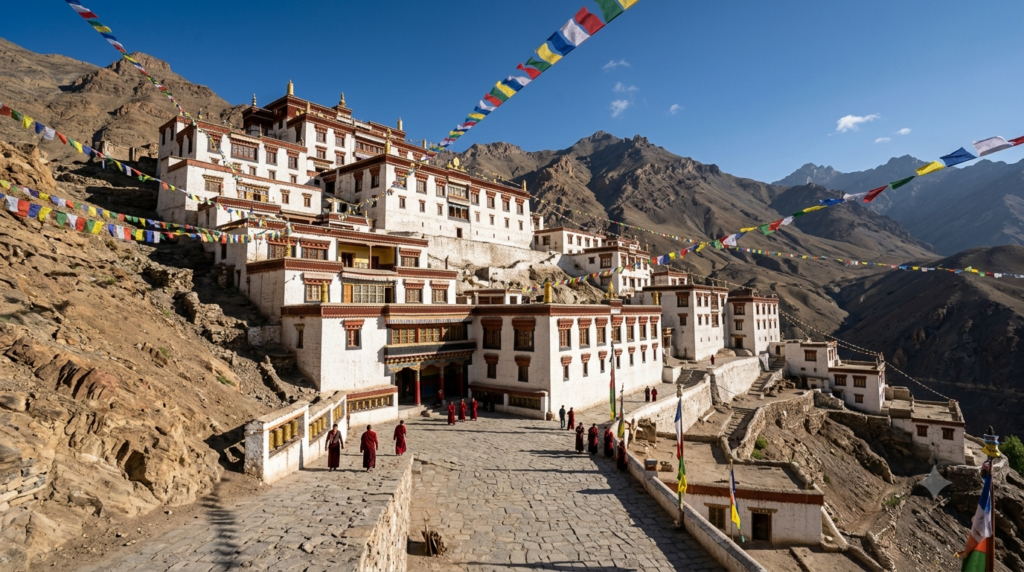
Hemis Monastery visiting is one of Ladakh’s most rewarding cultural experiences. Getting the timings, entry fee, and festival dates right makes the whole trip smoother. The gompa sits about 45 km southeast of Leh, tucked into a side valley on the west bank of the Indus.
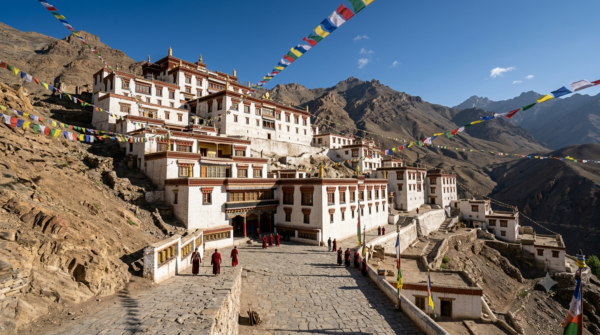
Because it belongs to the Drukpa lineage of Tibetan Buddhism, it carries centuries of living tradition. It is also the largest and wealthiest monastery in the region. This guide gives you the practical details that matter, and it corrects a few facts most pages still get wrong.
Go Kshetra is an independent travel guide. We are not affiliated with Hemis Monastery, the Drukpa order, or any government tourism body. We take no bookings or payments. For permits and current rules, always use the official Ladakh portals linked below.
Hemis Monastery Visiting: Quick Facts
If you only have a minute, here is what most travellers want to know before Hemis Monastery visiting begins. Use it as a fast reference while you plan the drive from Leh.
- Location: Hemis village, about 45 km southeast of Leh, on the Indus valley route toward Pangong.
- Timings: 8:00 AM to 1:00 PM, then 2:00 PM to 6:00 PM, daily.
- Entry fee: around ₹100 per person, which usually includes the museum.
- Time needed: 1.5 to 3 hours for the halls, museum, and courtyard.
- Best season: May to September, when roads are clear and services run.
- Signature event: the two-day Hemis Festival, held in June or July.
About Hemis Monastery and Its History
Hemis, locally called Hemis Gompa, is a Himalayan Buddhist monastery of the Drukpa Kagyu order. Its spiritual head is the Gyalwang Drukpa. The site’s roots reportedly stretch back before the 11th century, when the yogi Naropa is linked to the valley.
Here is where many guides slip. The present monastery was formally established in 1630 by the lama Stagsang Raspa Nawang Gyatso. He worked under the patronage of the Ladakhi king Sengge Namgyal.
Several pages repeat that it was “re-established in 1672 by Sengge Namgyal.” Yet that date does not add up, because the king died in 1642. The main temple and its great assembly hall took shape in the 1630s, so 1630 is the founding date worth remembering.
Over time the gompa grew into the richest in Ladakh. Its museum now holds thangkas, old manuscripts, and ceremonial objects. A gilded copper Buddha, silver and gold stupas, and a towering statue of Guru Padmasambhava sit among the treasures.
Hemis Monastery Visiting Hours and Entry Fee
The monastery opens daily from 8:00 AM to 1:00 PM. It then reopens from 2:00 PM to 6:00 PM after a midday break. It stays open through the week, including public holidays, though the quietest hours fall soon after opening.
Entry costs roughly ₹100 per person, and that ticket usually covers the museum too. Prices can change, so confirm the current amount at the counter when you arrive.
Some sources note a separate camera charge. Photography inside the prayer halls and museum is often restricted altogether. Because rules vary by area, ask before you point a lens at any artifact.
| Detail | What to expect |
|---|---|
| Visiting hours | 8:00 AM – 1:00 PM and 2:00 PM – 6:00 PM (midday break) |
| Entry fee | Around ₹100 per person (museum usually included) |
| Camera/photography | Restricted inside halls; confirm rules at the counter |
| Time to allow | 1.5 to 3 hours |
Best Time for Hemis Monastery Visiting
Timing shapes the whole Hemis Monastery visiting experience, so it helps to match your trip to what you want to see.
Summer (May to September)
This is the prime window. Roads stay clear, the weather is mild, and tourist services run at full strength. It is also the easiest season to pair Hemis with treks or nearby monasteries.
Hemis Festival (June to July)
If your dates line up with the festival, you will catch masked Cham dances, brocade costumes, and drums across the courtyard. The 2026 festival fell on 24 and 25 June. The dates shift each year with the Tibetan lunar calendar. Plan around it only if cultural immersion is your priority, because crowds swell sharply.
Winter (October to April)
Winters bring heavy snow and bitter cold. The monastery still opens, yet travel turns harder and many services close. Come in this season only if you are ready for the conditions and limited amenities.
The Hemis Festival and the Giant Thangka
The Hemis Festival, or Hemis Tsechu, honours Guru Padmasambhava, the eighth-century master who spread Buddhism across the Himalaya. It falls on the tenth day of the Tse-Chu in the Tibetan lunar month. That day usually lands in June or July.
Monks perform sacred Cham dances around a central flagpole. Their masks depict guardian deities and the battle of good over evil. There is no ticket for the festival performances, so anyone can watch, though arriving early secures a better spot.
One detail sets Hemis apart. Once every 12 years, during the Tibetan Year of the Monkey, the monastery unfurls a giant silk thangka of Padmasambhava. It rises two storeys high. The last unveiling took place in 2016, and the next is expected in 2028, so mark it if a rare spectacle appeals to you.
How to Reach Hemis Monastery
Reaching Hemis is straightforward, yet the altitude means you should plan and acclimatize first. There are three practical ways to arrive.
By Air
The nearest airport is Kushok Bakula Rimpochee Airport in Leh, which connects to Delhi, Srinagar, and other cities. From the airport, Hemis is about a 1 to 1.5-hour drive of roughly 45 km.
By Road
Leh is the road gateway. You can hire a taxi or rent a car, then follow the Indus valley through Karu. From there you cross the river toward the monastery. Many visitors combine Hemis with Thiksey, Shey, and Stakna on a single day tour, since they share the same route.
Union-approved taxi rates apply for these circuits. As of 2026, an Indus valley monastery tour runs around ₹4,865 per vehicle. Rates change yearly, so confirm at the Leh taxi stand.
By Public Transport
Local buses and shared cabs run between Leh and Hemis, but schedules are limited and infrequent outside the festival. A private taxi is more reliable if you want flexibility with your day.
Ladakh Permits and the Environment Fee
Many first-timers miss this step, and it can cost time at checkposts. Indian tourists no longer need an Inner Line Permit for most Ladakh circuits. It was replaced by the Ladakh Environment and Development Fee in 2021.
You pay the fee online through the official LAHDC Leh permit portal, then carry the printed receipt. As of 2026 the charge is roughly ₹400 as a one-time environment fee. Small wildlife and optional Red Cross amounts may apply, and the receipt stays valid for about three weeks.
Foreign nationals instead need a Protected Area Permit for restricted zones, arranged through a registered Leh agent. Confirm the latest structure on the official Leh district site before you travel.
What to See Inside Hemis Monastery
Hemis is more than a place of prayer; it is a store of art and history. Give yourself enough time to cover the highlights.
Main Assembly Hall
The Dukhang is the heart of the gompa, where monks gather for rituals. Its murals, statues, and sacred objects are centuries old and rich with Buddhist symbolism.
The Museum
The museum holds thangkas, manuscripts, ceremonial items, and sculptures, some dating back centuries. An 8-metre statue of Guru Padmasambhava upstairs is a highlight many visitors remember.
Butter Lamp Room and Library
The glow of hundreds of butter lamps makes a quiet, contemplative stop. Nearby, the library preserves ancient Buddhist texts, kept intact despite the harsh high-altitude climate.
One more curiosity draws attention. In 1894 the Russian journalist Nicolas Notovitch claimed Hemis held manuscripts about Jesus visiting the region. The legend is unproven, yet guides still whisper it today.
Health and Safety at High Altitude
Hemis sits at roughly 3,600 metres, so altitude deserves real respect before Hemis Monastery visiting. Spend at least one or two days in Leh first. Rushing straight up raises the risk of acute mountain sickness.
Drink water often, walk slowly on the monastery’s steps, and rest if you feel breathless or dizzy. If you are elderly, pregnant, or managing a heart or lung condition, check with a doctor before the trip. These are practical travel precautions, not medical advice, so seek professional guidance where your health is concerned.
Tips for Hemis Monastery Visiting
- Acclimatize in Leh: give yourself a day or two before heading up.
- Dress in layers: midday sun is warm, while shade and mornings turn cold.
- Respect the space: remove shoes at prayer halls, and ask before photographing monks.
- Carry cash: ATMs near Hemis are rare, so keep small notes handy.
- Go early: the first hour after opening is calm and uncrowded.
- Combine monasteries: add Thiksey and Shey to make a full, rewarding day.
Where to Stay and Eat
Hemis village has a few guesthouses and homestays. Most travellers, however, base themselves in Leh for their Hemis Monastery visiting day trip. Leh gives you more lodging choices, plus restaurants serving Ladakhi staples like thukpa noodle soup and khambir bread.
If you prefer to stay close, a handful of guesthouses near Hemis offer authentic hospitality and quiet mountain views. Book ahead in festival season, because rooms fill quickly when crowds arrive.
Common Mistakes to Avoid
Even seasoned travellers trip up during Hemis Monastery visiting, so a little planning goes a long way.
- Skipping acclimatization: altitude sickness can wreck a trip, so build in rest days.
- Underestimating time: rushing means missed details, so allow 2 to 3 hours.
- Assuming free photography: some spaces restrict cameras, so always ask first.
- Ignoring the permit: pay the environment fee online before you set out.
Where to Stay and Eat
Hemis village has a few guesthouses and homestays. Most travellers, however, base themselves in Leh for their Hemis Monastery visiting day trip. Leh gives you more lodging choices, plus restaurants serving Ladakhi staples like thukpa noodle soup and khambir bread.
Before You Go
Hemis Monastery visiting rewards a little preparation more than almost any site in Ladakh. Get the timings and entry fee right, pay the Ladakh environment fee online, and leave a buffer for altitude.
If your dates allow, time the visit near the Hemis Festival for its dances and colour. Above all, treat the gompa as the living place of worship it remains. The experience will stay with you long after you leave.
Frequently Asked Questions
What is Hemis Monastery famous for?
Hemis is the largest and wealthiest Buddhist monastery in Ladakh. It is best known for its rich museum, its Drukpa heritage, and the annual Hemis Festival dedicated to Guru Padmasambhava.
What are the Hemis Monastery timings and entry fee?
The monastery opens daily from 8:00 AM to 1:00 PM and 2:00 PM to 6:00 PM. Entry is around ₹100 per person, which usually includes the museum. Confirm the current rate at the counter.
How much time should I spend on Hemis Monastery visiting?
Plan at least 1.5 to 3 hours to see the assembly hall, museum, and courtyard without rushing. If you combine Hemis with nearby monasteries, set aside a full day.
When is the Hemis Festival held?
The festival falls on the tenth day of the Tibetan lunar Tse-Chu, usually in June or July. In 2026 it was held on 24 and 25 June. The dates shift each year, so confirm before booking.
Do I need a permit to visit Hemis?
Indian tourists pay the Ladakh Environment and Development Fee online instead of an Inner Line Permit, then carry the receipt. Foreign nationals need a Protected Area Permit for restricted zones, arranged through a registered Leh agent.
Is there an entry fee for foreign tourists?
The monastery ticket is generally the same modest amount for everyone. Foreign visitors, however, still need the separate Ladakh permit, so budget for that alongside the entry fee.
Are guided tours available?
Yes, local guides in Leh can add valuable historical and cultural context. A guide is worth it if you want the legends and symbolism behind the murals and rituals.
For broader route planning, our guides to the Raghunath Temple in Jammu and the Shankaracharya Temple in Srinagar pair well with a Ladakh trip. You can also cross-check current national travel advisories on Incredible India.