
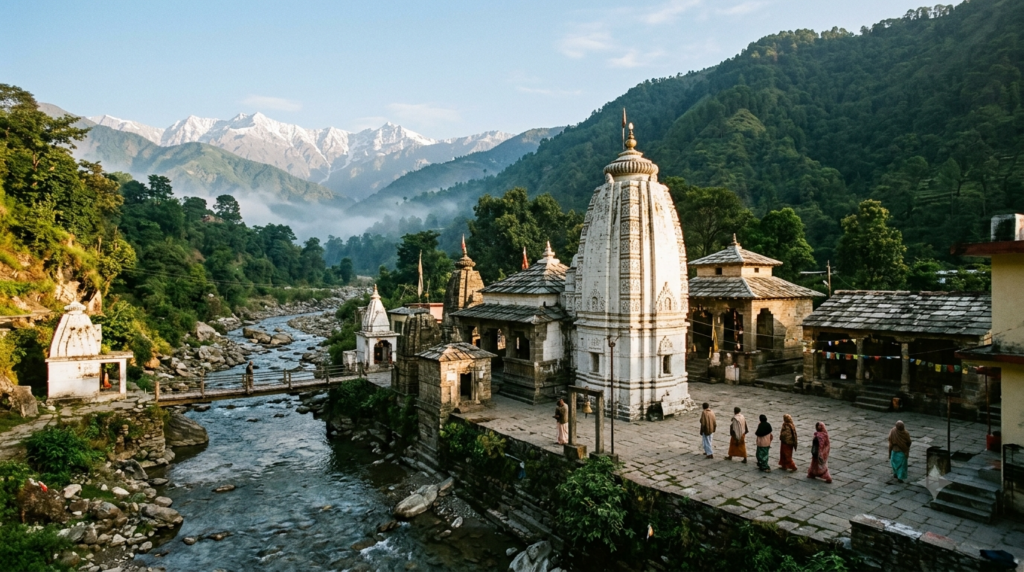
Most guides get the evening aarti at Chamunda Devi Temple wrong. That single error can cost you the best moment of your visit. The Himachal Pradesh government temple administration lists the evening aarti at 7:10 PM to 7:50 PM. It is not the 6 PM slot that circulates on travel blogs.
So if you plan around the wrong hour, you will reach the Baner riverbank shrine too late. This guide fixes that. It also covers the timings, the langar hours, the real nearest railway station, and the trek to the original hilltop shrine.
Go Kshetra is an independent pilgrim guide. We are not affiliated with or endorsed by the Shri Chamunda Nandikeshwar Temple Trust. Nor are we the official website of the Himachal Pradesh government.
We do not accept bookings, donations, or payments. Use the official temple portal linked in this article for anything official.
Chamunda Devi Temple at a Glance
Here are the essentials, drawn from the official Himachal Pradesh temple administration page for this shrine.
- Full name: Shri Chamunda Devi Mandir, also called Chamunda Nandikeshwar Dham
- Where: Padar, on the bank of the Baner river, Dadh area, Kangra district, Himachal Pradesh
- Summer timings: 5:00 AM to 12:00 PM, then 1:00 PM to 10:00 PM
- Winter timings: 6:00 AM to 12:00 PM, then 1:00 PM to 9:00 PM
- Aarti: 8:00 AM to 8:45 AM and 7:10 PM to 7:50 PM, in both seasons
- Entry fee: none; the shrine is free to enter
- Free langar: 12:00 PM to 2:00 PM and 7:00 PM to 9:00 PM daily
- Managed by: the Language, Art and Culture Department, Government of Himachal Pradesh
Chamunda Devi Temple Timings and the Midday Break
Chamunda Devi Temple opens at 5:00 AM in summer and 6:00 AM in winter. It then closes daily from 12:00 PM to 1:00 PM for bhog. That is the offering of food to the deity. Afterwards the shrine reopens until 10:00 PM in summer and 9:00 PM in winter.
That midday hour is the detail most visitors miss. Tour operators often schedule Kangra circuits around lunch. Plenty of pilgrims therefore arrive at 12:30 PM and find the sanctum shut. So build your route to reach either before noon or after 1:00 PM.
| Slot | Summer | Winter |
|---|---|---|
| Morning darshan | 5:00 AM to 12:00 PM | 6:00 AM to 12:00 PM |
| Bhog break | 12:00 PM to 1:00 PM | 12:00 PM to 1:00 PM |
| Afternoon and evening | 1:00 PM to 10:00 PM | 1:00 PM to 9:00 PM |
| Morning aarti | 8:00 AM to 8:45 AM | 8:00 AM to 8:45 AM |
| Evening aarti | 7:10 PM to 7:50 PM | 7:10 PM to 7:50 PM |
The Aarti Timing Error Worth Correcting
Several popular pages list the evening aarti at around 6:00 PM, and a few claim 7:00 PM. The official administration page, however, states 7:10 PM to 7:50 PM for both winter and summer. The same page notes that the aarti is telecast daily on the MH1 Prime channel. That is a useful cross-check if you cannot travel.
Timings do shift during Navratri and major festivals. Therefore confirm on the day itself at the temple office if your plan depends on the exact minute.
How to Reach Chamunda Devi Temple
Chamunda Devi Temple sits on the Dharamshala to Palampur road. So it folds easily into a Kangra valley itinerary. The official page places it about 14 km from Dharamshala and 19 km from Palampur. McLeod Ganj is 24 km away, while Kangra town sits 30 km off.
Road distances vary slightly by route. So treat these figures as close approximations rather than exact readings.
By train, and the station most guides name wrongly
The nearest railhead is Chamunda Marg, station code CMMG. It sits on the Kangra Valley narrow-gauge line, roughly 4 km from the shrine. Many articles instead name Kangra Mandir station as the closest, at 14 km. That figure is actually the rail distance between Kangra Mandir and Chamunda Marg, not the distance to the temple.
Because the narrow-gauge line runs slowly and infrequently, most pilgrims still arrive by road. For broad-gauge travel, Pathankot Junction is the practical gateway at roughly 90 km. Trains connect it with Delhi and other major cities.
By air
Kangra Airport at Gaggal is the closest airport, around 22 to 25 km away by road. Flights connect to Delhi and Chandigarh, though hill-weather cancellations are common in monsoon and winter. Taxis wait outside the terminal, and the drive takes about 45 minutes.
By road and bus
Himachal Road Transport Corporation buses run along the Dharamshala to Palampur highway. They stop at Chamunda Devi bus stand, under a kilometre from the entrance. Shared taxis also ply this stretch through the day.
If you are driving from Delhi, the route runs roughly 480 to 500 km. Most travellers therefore break the journey at Chandigarh or Una.
Is There a Ticket, Fee or Online Booking?
No. Entry to Chamunda Devi Temple is free, and regular darshan needs no ticket or prior booking. Donations are voluntary.
That simple answer matters. Several guides describe an elaborate online puja booking process that does not apply here.
The e-puja confusion, explained
The Himachal Pradesh temples portal does host e-puja listings for several Kangra shrines. On the official page for this temple, though, the notice still reads that e-pooja ceremonies will commence soon. Meanwhile a similarly named listing on the same portal, Shri Chamunda Nandikeshwer, carries a Jawalamukhi address and different timings altogether.
So if you book blindly by name, you may pay for a ritual at a different temple. Verify the address and timings on the booking screen before you confirm anything. The portal does sell official prasad packets and framed images. It also accepts online donations, which are separate from any puja booking.
Never route a payment through a private agent, a WhatsApp number, or any site that is not the government portal. Fake temple booking pages are a persistent problem across Himachal shrines. Usually they reveal themselves through an upfront processing fee.
Free Langar and Facilities at the Temple
The temple trust runs a free langar for every visitor, no matter their means. Meals run from 12:00 PM to 2:00 PM. A second sitting follows from 7:00 PM to 9:00 PM. During Navratri fairs the kitchen extends from morning breakfast right through to the night meal.
Devotees may contribute towards the community kitchen if they wish. Seva is accepted for a single meal or a full day. Beyond the langar, the trust maintains parking, drinking water, toilets, cleanliness staff and deployed security. It also funds medicine distribution and a free Sanskrit college.
Trigarat Sanskrit Mahavidyala
Since 1972 the trust has run the Trigarat Sanskrit Mahavidyala. Students there learn Shastri studies and ritual practice without paying fees. Few visitors notice it, yet it explains where a large share of the offering box actually goes. The trust also gives grants towards the marriage of girls from poor families.
Inside the Complex: What You Will Actually See
The main deity stays covered, so do not expect an unobstructed idol darshan. Idols of Hanuman and Bhairav flank the sanctum entrance, and tradition treats them as the goddess’s gatekeepers. In one corner sits a small stone bearing what devotees revere as the footprints of the goddess.
Behind the main shrine, a marble staircase descends to a cave-like alcove holding a Shiva Linga. This is why the site carries the name Chamunda Nandikeshwar Dham, the abode of Shiva and Shakti together. A kund, or bathing pond, lies within the complex, and a small shrine stands across the bridge beyond the ghat.
The Dhauladhar peaks rise directly behind the complex while the Baner khad runs below it. Early morning gives you the clearest mountain view, since haze usually builds after ten.
The Aadi Himani Chamunda Trek Above the Temple
The original shrine is not the one in the valley. Aadi Himani Chamunda, also called Barfani Chamunda, sits high on the Dhauladhar ridge at roughly 3,185 metres. The District Kangra administration describes it as reachable only on foot. Expect about 9 to 13 km one way, and five to seven hours of steady ascent.
Two routes serve it. Pilgrims usually take the paved stone-step trail via Jadrangal. The path from Jia village is shorter, yet steeper in places. Tea stalls and shelters dot the trail, and the temple complex keeps a dormitory with bedding for those staying overnight.
Safety note before you attempt the climb
This is a genuine high-altitude hike, not a temple staircase. Water runs out roughly halfway, so carry your own supply from the start. After mid-November the shrine is largely unmanned because of snow, and conditions turn hostile fast.
Are you elderly, pregnant, or managing a heart or breathing condition? Then speak to your doctor before committing to this trek. Carry warm layers even in June, since the ridge stays cold and windy at night. Anyone attempting it for the first time should start at dawn and turn back rather than push a late descent.
How Old Is Chamunda Devi Temple? Untangling the Claims
You will see three different ages quoted, sometimes on the same page. The official administration text says the shrine was built around 700 years ago. Elsewhere the same page dates it to the 16th century. Another line calls it 400 years old.
These claims do not agree, and no guide should pretend otherwise.
The most consistent thread across sources is the 16th-century relocation story. A king and a Brahmin priest sought the goddess’s consent to move the idol down from the inaccessible hilltop shrine. According to the legend, she appeared in the priest’s dream and named the spot where the idol lay buried.
So the safest phrasing is simple. Worship at the higher site is far older. The valley temple in its present form dates to roughly the 16th or 17th century. Treat any precise founding year you read elsewhere with caution.
Is it one of the 51 Shakti Peethas?
Regionally, yes, it is counted among Himachal Pradesh’s five great Shakti shrines alongside Chintpurni, Jwalamukhi, Brajeshwari and Naina Devi. Classical lists of the 51 Shakti Peethas vary, however. The official temple account frames the site through the Chanda and Munda legend, not a Sati body-part tradition. Both statements can sit together without contradiction.
Best Time to Visit Chamunda Devi Temple
September to December brings the clearest skies and the sharpest Dhauladhar views. March to June works well too, though afternoons warm up in the valley. Navratri, celebrated twice a year in Chaitra and Sharad, transforms the atmosphere but multiplies the crowds.
Avoid the July and August monsoon if you can. Hill roads turn slippery, landslides close stretches without warning, and the mountains stay hidden behind cloud. The temple itself remains open year-round, so the question is comfort rather than access.
Festivals worth planning around
The trust marks New Year Puja with flag hoisting on Chaitra Shukla Pratipada. Chaitra and Sharad Navratri draw the largest gatherings, while Shravan brings Gupt Navratri. A collective Yagyopaveet Sanskar ceremony takes place each year in March or April, and Shivratri is observed with due prominence.
What First-Time Visitors at Chamunda Devi Temple Get Wrong
- Arriving at 12:30 PM. The bhog break shuts the sanctum for that full hour, every day.
- Planning for a 6 PM aarti. The official evening slot is 7:10 PM, so an early dinner plan backfires.
- Expecting a full idol darshan. The main deity remains covered, and photography rules inside are strict.
- Booking a puja online without checking. Confirm the address on the portal, since a similarly named shrine sits elsewhere.
- Treating the Aadi Himani trek casually. It is a five to seven hour climb, not an extension of the temple visit.
- Skipping the langar. It is free, well run, and served twice daily.
Building a Two-Day Kangra Temple Circuit
Chamunda Devi Temple rarely justifies a standalone trip, yet it anchors an excellent two-day loop. Because the four Kangra-area Shakti shrines lie within a short radius, you can cover them comfortably without rushing.
| Day | Route | Rough drive |
|---|---|---|
| Day 1 morning | Brajeshwari Devi, Kangra town | 30 km to Chamunda |
| Day 1 evening | Chamunda Devi, stay near Dharamshala | 14 km onward |
| Day 2 morning | Jwalamukhi eternal flame shrine | about 60 km |
| Day 2 afternoon | Baijnath Shiva temple, Palampur side | about 40 km |
Reverse the loop if you want the evening aarti here rather than a morning darshan. Pilgrims heading further north often continue towards Chamba, and our Laxmi Narayan Temple Chamba guide covers that leg. For a longer Shakti circuit, readers also plan around Vaishno Devi and Raghunath Temple in Jammu.
Dress Code and Temple Etiquette
There is no rigidly enforced dress code, yet modest traditional clothing is expected and appreciated. Leave footwear at the designated stand before entering the complex. Photography is generally tolerated in the outer areas, while sanctum rules are stricter and staff instructions override everything.
Weekday mornings stay noticeably calmer than weekends. Since hill weather changes quickly, carry a light jacket even when the valley feels warm at midday.
Before You Go
Plan your arrival around two fixed points. Those are the noon to 1:00 PM bhog closure and the 7:10 PM evening aarti. Entry costs nothing, langar is free twice a day, and ordinary darshan needs no booking.
If you intend to book any puja online, check the address on the government portal first. A similarly named shrine sits elsewhere in Kangra district. Verify current timings on the official Himachal Pradesh temple administration page before you travel. Festival schedules override the regular chart.
Chamunda Devi Temple FAQs
What are the exact Chamunda Devi Temple timings?
Summer hours run 5:00 AM to 12:00 PM and 1:00 PM to 10:00 PM. Winter hours run 6:00 AM to 12:00 PM and 1:00 PM to 9:00 PM. The shrine closes for one hour at midday in both seasons for bhog.
What time is the aarti?
Morning aarti runs 8:00 AM to 8:45 AM. Evening aarti runs 7:10 PM to 7:50 PM, in both winter and summer. The temple administration also telecasts it daily on MH1 Prime. Timings can shift during Navratri.
Is there an entry fee?
No, entry is completely free and no ticket exists for regular darshan. Donations are entirely voluntary. The official portal also accepts online donations and sells prasad packets, though neither is required to visit.
Can I book darshan or a puja online?
Regular darshan needs no booking at all. The official page states that e-pooja ceremonies will begin soon. So a full puja booking flow is not confirmed as live here. Check the address shown on the portal before paying, because a similarly named shrine appears separately.
Which railway station is closest?
Chamunda Marg on the Kangra Valley narrow-gauge line is nearest, about 4 km away. Pathankot Junction, roughly 90 km off, is the main broad-gauge gateway for long-distance trains from Delhi and beyond.
Is food available at the temple?
Yes. The trust serves a free langar daily. Sittings run 12:00 PM to 2:00 PM and 7:00 PM to 9:00 PM. Small eateries also line the approach road, while Dharamshala and Palampur offer fuller restaurant and hotel options.
How hard is the Aadi Himani Chamunda trek?
It is a moderate high-altitude climb of about 9 to 13 km one way. The ascent takes five to seven hours, reaching roughly 3,185 metres. The route is unsuitable after mid-November because of snow. Anyone with heart, breathing or mobility issues should consult a doctor first.
Is Chamunda Devi Temple wheelchair accessible?
The main complex has parking close by and reasonably level approaches. Some steps remain, though, including the descent to the Shiva cave. Assistance is generally available from staff and fellow pilgrims. Confirm current arrangements with the temple office if mobility is a serious concern.
Where exactly is the temple located?
It stands at Padar on the bank of the Baner river in the Dadh area of Kangra district, Himachal Pradesh. The District Kangra administration site lists it among the district’s principal pilgrimage sites.