
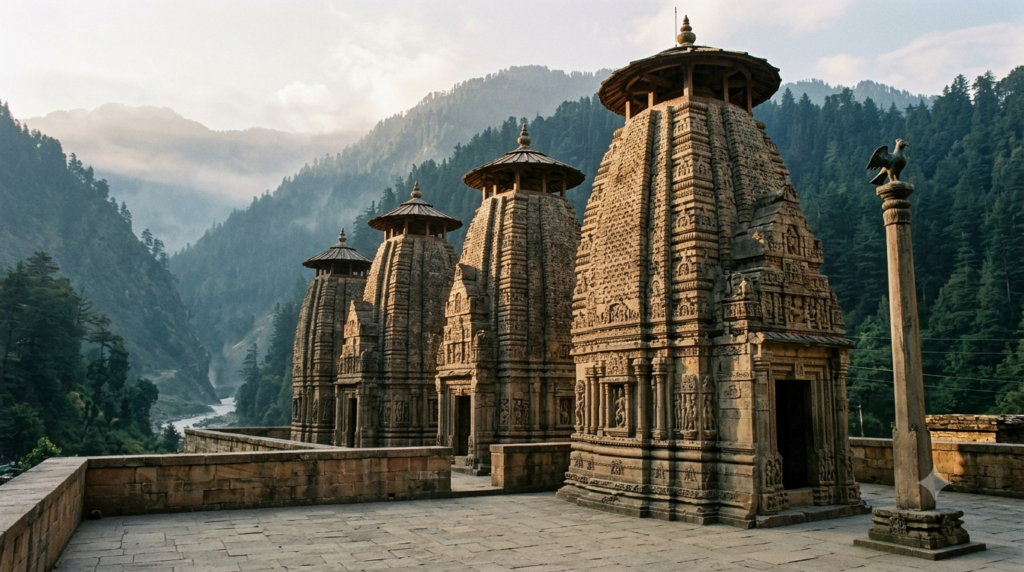
Laxmi Narayan Temple Chamba is not one temple but six. All of them stand in a single stone courtyard that Raja Sahil Varman laid out in the 10th century. Most guides mention the main Vishnu shrine and stop there.
So first-time visitors walk out in twenty minutes. They miss five older shrines, a 1678 act of royal defiance frozen in gilded metal, and a Garuda pillar older than the Mughal empire. This guide covers the timings, the route, and the road conditions that decide whether you reach Chamba on schedule.
Go Kshetra is an independent pilgrim guide. We are not affiliated with or endorsed by the temple, the Chamba district administration, or the Himachal Pradesh government. This is not the official website of Laxmi Narayan Temple Chamba. We accept no bookings, donations, or payments, so please use the official portals linked in this guide.
Laxmi Narayan Temple Chamba at a Glance
- Where: Chamba town centre, Himachal Pradesh, roughly a five-minute walk from the main bus stand
- Timings: widely reported as 6:00 AM to 12:30 PM, then 2:30 PM to 8:30 PM daily
- Entry fee: none; the temple takes voluntary offerings only
- Built by: Raja Sahil Varman, 10th century AD, in Shikhara style
- Shrines in the complex: six main temples plus several smaller ones
- Time needed: 45 to 90 minutes if you read the carvings properly
- Nearest railhead: Pathankot, about 118 to 120 km away
Because the temple sits inside the old town, you can reach it on foot from almost any hotel in central Chamba. There is no ticket counter, no queue system, and no dress-code enforcement beyond ordinary temple courtesy.
Darshan Timings at Laxmi Narayan Temple Chamba
Laxmi Narayan Temple Chamba opens in two sessions each day. Travel sources consistently report 6:00 AM to 12:30 PM in the morning. The second session then runs from 2:30 PM to 8:30 PM. That midday gap exists because the deities are traditionally believed to rest.
| Session | Reported hours | What it suits |
|---|---|---|
| Morning | 6:00 AM – 12:30 PM | Quiet darshan, best light on carvings |
| Midday break | 12:30 PM – 2:30 PM | Closed; use it for Bhuri Singh Museum |
| Evening | 2:30 PM – 8:30 PM | Aarti atmosphere, local footfall |
One caution matters here. These hours appear across travel listings rather than on a published temple notice, so treat them as approximate. Hill temples also shorten evening hours during heavy snow or a local mourning day. Confirm at the gate or with your hotel before you plan a tight schedule.
Laxmi Narayan Temple Chamba Entry Fee and Tickets
Entry is free. There is no darshan ticket, no VIP queue, and no paid seva slot here. If a website offers you a paid “Laxmi Narayan Temple Chamba booking”, treat it as unofficial. No such channel exists.
This matters more than it sounds. Search results for Himachal temples increasingly surface booking pages built by third parties, and pilgrims sometimes pay for access that was always free. Walk in during opening hours instead. If you want a specific puja performed, arrange it on the spot with a priest at the complex.
The Six Shrines Most Visitors Walk Past
The complex holds six main Shikhara-style temples in a north-to-south line, plus smaller shrines added over centuries. Three are dedicated to Vishnu and three to Shiva. According to the Chamba district administration, the Radha Krishna temple here was built as late as 1825. Rani Sarda, queen of Raja Jeet Singh, commissioned it.
The Chandragupta Shiva temple is attributed to Sahil Varman himself. His son and successor Yugkar Varman is credited with the Gauri Shankar temple. So the courtyard is not one building project but roughly nine centuries of them, stacked side by side.
Look up as you enter. Raja Balabhadra Varma placed a metal image of Garuda, Vishnu’s mount, on a tall pillar at the main gate. Most visitors photograph the shikhara and miss the pillar entirely.
Why the Roofs Look Different Here
The main shrine follows classic Shikhara form: a bimana, a garbhagriha with a small antarala, and a mandapa-like hall. Above that sits something you will not see in a plains temple. Wooden chhattries and a wheel-shaped roof cap the stone tower, and they exist for a practical reason.
Chamba gets real snowfall. The district administration records these timber roofs as a direct response to local climate. They shed snow load that would otherwise sit on carved stone. That blend of Nagara stonework and Himalayan carpentry makes Laxmi Narayan Temple Chamba architecturally distinctive.
History of Laxmi Narayan Temple Chamba
Raja Sahil Varman founded Chamba town and built this temple in the 10th century AD. Successive rulers kept adding to it rather than replacing it, which is why the complex reads like a timeline in stone.
Tradition holds that the marble for the Vishnu image came from the Vindhyachal hills. The legend attached to that journey has the king losing several sons before his eldest returned with the stone. Devotees repeat this as sacred history. Treat it as tradition rather than documented record, since no contemporary source confirms it.
The 1678 Pinnacles: Defiance in Gilded Metal
Here is the detail almost no travel page carries. The Chamba district administration records that Raja Chhatra Singh placed gilded pinnacles on the temple tops in 1678. He did it specifically as a reaction against Aurangzeb’s order to demolish the shrine.
Instead of hiding the shrine, the ruler made it shine brighter. Those pinnacles are still overhead when you stand in the courtyard. Once you know the story, the whole complex reads differently, because it survived by refusing to be inconspicuous.
How to Reach Laxmi Narayan Temple Chamba
Chamba town sits at roughly 996 metres in the Ravi valley. Distances quoted by official Himachal sources vary a little, so the figures below give both readings rather than a single false-precision number.
By Air
Himachal Pradesh Tourism lists Pathankot as the nearest airport at about 120 km. Gaggal Airport in Kangra, better known for Dharamshala flights, sits at 150 km by the state tourism department’s reckoning and 170 km by HPTDC’s. Either way, budget four to five hours by taxi, because the last stretch is mountain road.
By Train
Chamba has no railway station. Pathankot Junction is the nearest broad-gauge railhead at roughly 118 to 120 km, and Chakki Bank nearby serves the same purpose. Trains from Delhi, Amritsar and Chandigarh reach Pathankot regularly. Shared taxis and Himachal Road Transport Corporation buses run onward from there.
By Road
Correct a common error before you set off. Many guides say the Pathankot–Chamba route is NH-154. It is not. The road is NH-154A, which branches from NH-154 near Chakki and runs through Banikhet and Chamba to Bharmour, about 172 km in total.
Chamba is roughly 580 km from Delhi, 56 km from Dalhousie via Khajjiar, and 24 km from Khajjiar itself. From the central bus stand, the temple is a short walk uphill through the bazaar.
Road Conditions and Monsoon Safety
This section exists because the pretty photographs do not warn you. NH-154A runs through geologically active terrain and closes repeatedly during the monsoon. Landslides near Chamba have halted traffic for hours at a stretch, and in 2026 flooding washed away sections of the Chamba–Bharmour stretch entirely.
The National Highways Authority of India took formal charge of the highway in April 2026. It has since moved on restoration work valued at about ₹83 crore, including a new project unit based at Chamba. That is real progress, yet it does not make July and August travel predictable.
So if you are travelling between late June and mid-September, keep a buffer day. Avoid night driving on this route. Anyone with a heart condition, reduced mobility, or a young child should also factor in long unplanned halts. There is no reliable detour when a slide blocks the road.
Best Time to Visit Laxmi Narayan Temple Chamba
March to June and September to November are the strongest windows for Laxmi Narayan Temple Chamba. Skies stay clear, the courtyard stone is comfortable underfoot, and the surrounding heritage walk is genuinely pleasant.
| Season | Conditions | Verdict |
|---|---|---|
| March–June | Mild, clear, busy | Best overall |
| July–August | Rain, landslide risk | Festival season, travel risk |
| September–November | Crisp, stable roads | Best for photography |
| December–February | Cold, occasional snow | Atmospheric but slow travel |
Winter is not off-limits. The wooden roofs under snow are a remarkable sight, although road access gets slower and daylight is short. Carry proper layers, because Chamba nights drop sharply once the sun leaves the valley.
Minjar Mela and the Town’s Festival Calendar
Chamba’s biggest event is the International Minjar Mela, held on the Chowgan ground a few minutes from the temple. It runs for about a week from the last Sunday of July, and this season it falls from 26 July to 2 August.
The other local fair is the Sui Mata Mela. It is observed from the 15th of Chait to the first of Baisakh in honour of Rani Sunayana. Note the spelling, since many pages write it as “Suhi”. During Minjar week the Chowgan turns into a bazaar, so expect crowds and higher room rates.
One planning detail worth knowing: the Chowgan is closed to the public from after Dussehra until April for maintenance. If open-ground events are part of your itinerary, that window rules them out.
Manimahesh Yatra: New Rules This Season
Many pilgrims combine Chamba with the Manimahesh Yatra to the sacred lake at 4,080 metres in Bharmour. The rules changed significantly after the 2025 floods stranded more than 15,000 devotees.
The Chamba administration has introduced mandatory online registration with an e-pass system, on the pattern used for the Amarnath Yatra. This year’s pilgrimage begins on 25 August. Registration and slot booking open from 1 August through the official portal at manimaheshyatra.hp.gov.in. Around 5,000 pilgrims per day are permitted initially.
The traditional parikrama trek via Kugti village is restricted this year on safety grounds, with an exception for devotees approaching from the Lahaul-Spiti side. The main route remains a 14 km trek from Hadsar. That climb is strenuous and high-altitude, so consult a doctor first if you have cardiac, respiratory or mobility concerns.
What to See Within Walking Distance
The temple sits inside a compact heritage cluster, which makes Chamba unusually walkable for a hill town.
- Akhand Chandi Palace – the former royal residence, minutes away on the upper terrace
- Bhuri Singh Museum – Pahari miniatures, Chamba rumals and inscriptions, open 10:00 AM to 5:00 PM, closed Mondays and gazetted holidays
- Champavati Temple – built by Sahil Varman in memory of his daughter, in similar Shikhara style
- Chowgan – the grassy esplanade at the heart of town, and the Minjar venue
- Hari Rai Temple – an 11th-century Vishnu shrine beside the Chowgan
Because the museum shuts on Mondays, plan a Monday visit around the temples instead. Pair it with the temple’s own midday closure and you lose half a day if you get the sequencing wrong.
What First-Time Visitors to Laxmi Narayan Temple Chamba Get Wrong
Five mistakes come up again and again, and each one is easy to avoid.
- Treating it as a single shrine. Walk the full north-south line before you leave, since the smaller temples carry some of the finest carving.
- Arriving at 1:00 PM. The midday closure catches day-trippers from Dalhousie constantly.
- Paying an unofficial “booking” site. Entry is free and always has been.
- Skipping the Garuda pillar. It is the oldest sculptural element at the gate and most people never look up.
- Underestimating the drive. Mountain kilometres take roughly twice the time flat kilometres do.
One more practical note. Photography rules vary between the outer courtyard and the inner sanctum, so watch for signage and follow the priests’ instruction rather than assuming. Remove footwear before entering, and dress modestly, because this is an active place of worship rather than a monument.
Planning Your Chamba Temple Circuit
If you have one day, give the morning to Laxmi Narayan Temple Chamba and the afternoon to the museum and palace. With two days, add Champavati and Hari Rai temples. Then use the second day for Khajjiar or Dalhousie.
Travellers building a wider Himachal route often pair Chamba with the Chamunda Devi Temple in Kangra and the 13th-century Baijnath Temple. Both sit on the way back toward Pathankot. Those heading east to the state capital can also fold in the Jakhoo Temple in Shimla.
Before You Go
Laxmi Narayan Temple Chamba rewards visitors who slow down. Entry costs nothing, no booking exists, and the timings run in two clear sessions with a midday break. The real planning risk is the road rather than the temple, especially in monsoon months.
Verify current timings locally, and keep a spare day if you travel between late June and September. Check the Chamba district administration portal or Himachal Pradesh Tourism for official notices before you set out.
Laxmi Narayan Temple Chamba FAQs
Is there an entry fee at Laxmi Narayan Temple Chamba?
No. Entry to Laxmi Narayan Temple Chamba is completely free, and the temple accepts only voluntary offerings. There is no ticket counter and no paid darshan category. Any site charging you for entry is not an official channel.
What are the Laxmi Narayan Temple Chamba darshan timings?
Travel sources consistently report 6:00 AM to 12:30 PM and 2:30 PM to 8:30 PM daily. Because these hours are not published as an official notice, confirm them locally before planning a tight itinerary, especially in winter.
Can I book darshan online?
No online booking system exists for this temple. Visitors simply walk in during opening hours. If you want a specific puja performed, arrange it directly with a priest at the complex rather than through any third-party website.
How many temples are inside the Laxmi Narayan Temple Chamba complex?
Six main Shikhara-style temples stand in a north-to-south line, along with several smaller shrines. Three are dedicated to Vishnu and three to Shiva. The Radha Krishna temple was added in 1825, so the complex spans roughly nine centuries of construction.
How far is the temple from the bus stand?
It is a short walk of a few minutes from Chamba’s central bus stand, uphill through the bazaar. Auto-rickshaws are available although rarely necessary. Most central hotels are also within walking distance.
Is photography allowed?
Exterior carvings and the courtyard can usually be photographed. Rules for the inner sanctum vary, so look for signage and follow what the priests say. When in doubt, ask before raising a camera.
What is the best month to visit?
April, May, September and October are the strongest choices, since the weather stays clear and roads remain stable. Avoid mid-July to August unless you are attending Minjar Mela, because landslides frequently disrupt NH-154A during the monsoon.
Is the temple suitable for elderly visitors?
Yes, the complex itself is level and undemanding once you arrive. The approach involves a short uphill walk from the bus stand though, and the long mountain drive is the tiring part. Plan a rest day on arrival if travelling with elderly family members.
Which festival is the biggest in Chamba?
The International Minjar Mela, held on the Chowgan for about a week from the last Sunday of July. It brings large crowds, higher accommodation rates, and a full craft bazaar into the town centre right beside the temple.