
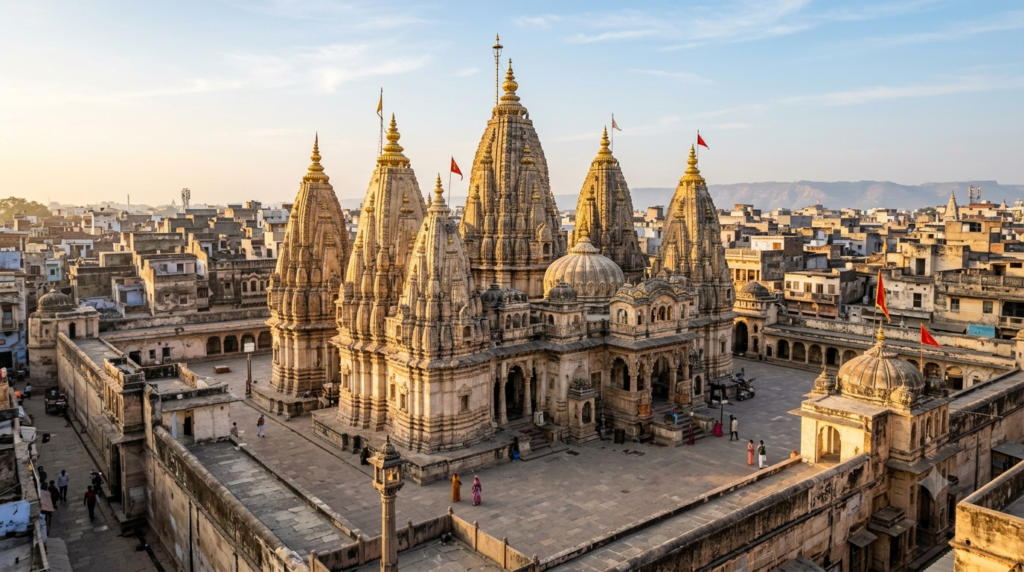
A visit to the Raghunath Temple Jammu means stepping into the largest temple complex in North India, and this guide hands you every verified detail before you set out. Darshan runs from 6:00 AM to 8:00 PM, entry is completely free, and no online ticket exists, so you simply walk in and pray. Below you will find the real timings, the aarti schedule, how to reach the shrine, what sevas are actually offered, and a clear warning about the fake “booking” pages circulating online.
The temple sits in the heart of old Jammu city, just north of the Tawi River. It is dedicated to Lord Rama, who is worshipped here as Raghunath, an avatar of Lord Vishnu. Seven gold-spired shrines stand inside one walled complex, so pilgrims and historians alike call it the grandest temple cluster in the region.
Go Kshetra is an independent pilgrim guide. We are not affiliated with, endorsed by, or the official website of the Raghunath Temple, the Dharmarth Trust, or any government body. We do not accept bookings, donations, or payments, and we do not issue tickets. Because darshan here is free and walk-in, always rely on the temple office on site for anything official.
Raghunath Temple Jammu at a Glance
Before the detail, here is a quick snapshot so you can plan fast. Each fact below is drawn from official tourism and heritage sources rather than aggregator guesswork.
- Presiding deity: Lord Rama (Raghunath), an avatar of Lord Vishnu
- Timings: 6:00 AM to 8:00 PM, open all seven days
- Entry fee: Free; no ticket and no online booking
- Built by: Maharaja Gulab Singh (started 1835), completed by Maharaja Ranbir Singh (1860)
- Location: Raghunath Bazaar, old Jammu city, north of River Tawi (PIN 180001)
- Best time: October to March
- Main festival: Ram Navami
| Detail | Information |
|---|---|
| Darshan hours | 6:00 AM – 8:00 PM daily |
| Morning aarti | Around 7:00 AM |
| Evening aarti | Around 6:00 PM |
| Nearest railway station | Jammu Tawi (about 3 km) |
| Nearest airport | Jammu Airport / IXJ (about 8 km) |
| Time needed | 2 to 3 hours |
Raghunath Temple Jammu Darshan Timings
The Raghunath Temple Jammu opens daily at 6:00 AM and closes at 8:00 PM, and these hours hold steady through the week. Because the shrine does not shut on any fixed weekday, you can plan a visit on whichever day suits your trip. On major festivals like Ram Navami and Diwali, the hours often stretch late into the night.
Many visitors ask whether the shrine breaks for lunch. Most tourism listings and the Jammu district portal show continuous darshan from morning to evening, so a long afternoon shutdown is not the norm. A few aggregator pages mention a 12:00 PM to 2:00 PM pause, yet this is not consistently reported. Since timings can shift slightly during rituals or maintenance, confirm at the gate if you plan to arrive around midday or near closing.
Aarti and Pooja Schedule
Two main aartis frame the day at the temple. The morning aarti, also called Mangala Aarti, unfolds around 7:00 AM when the deity is ceremonially woken. The evening aarti, or Sandhya Aarti, takes place around 6:00 PM, and this is the most atmospheric moment to attend.
During the evening aarti, bells, conch calls, and bhajans fill the golden inner hall. Arrive about twenty minutes early, since the main hall fills quickly once the lamps are lit. Prasad is shared with devotees after the rituals.
Raghunath Temple Jammu Entry Fee and Booking Myth
Entry to the Raghunath Temple is free, and general darshan costs nothing at all. This single fact matters, because several websites push “Book Darshan Tickets” or “online seva booking” pages that simply do not reflect how this temple runs.
Is Online Booking Available at Raghunath Temple Jammu?
No official online darshan or pooja booking system exists for the Raghunath Temple Jammu. You join the regular queue and walk in for free, so there is nothing to reserve in advance. Any third-party page that asks for advance payment to “guarantee” darshan is not connected to the temple.
This shrine is not run like Tirumala or Vaishno Devi, where digital slots exist. Here the model stays simple and open, which is wonderful for spontaneous visits. Unfortunately, that same openness lets scammers exploit the confusion. So if a site demands money to enter, treat it as a red flag and close the tab.
| What you may read online | The verified reality |
|---|---|
| “Book darshan tickets online” | No online booking exists; entry is free |
| “Closed on Tuesdays for maintenance” | Open all seven days |
| “Opens 6:30 AM, closes 11:30 PM” | Open 6:00 AM to 8:00 PM |
| “Entry ticket required” | General darshan is completely free |
Sevas and Poojas at Raghunath Temple Jammu
General darshan needs no payment, yet devotees often want to sponsor a specific pooja or offering. At the Raghunath Temple Jammu, these are arranged in person, not online. You speak to the priests or the temple office on site, so there is no advance internet payment to make.
Because no official portal publishes a fixed seva rate card, treat any price you see on a third-party site as unverified. Offerings such as flowers, sweets, and archana are welcome but never compulsory. If you wish to sponsor something special, ask at the counter on the day and pay only there. This keeps your money safe and routes it straight to the shrine.
History of the Raghunath Temple Jammu
Construction began in 1835 under Maharaja Gulab Singh, founder of the Dogra kingdom of Jammu and Kashmir. His son, Maharaja Ranbir Singh, carried the work forward and completed it in 1860. So the shrine took roughly twenty-five years to finish.
Ranbir Singh also turned the complex into a centre of Sanskrit learning. A pathshala, or traditional school, trained Brahmin students here for generations. The temple library still preserves more than 6,000 manuscripts in several Indian languages, including a notable collection in the old Sarada script. The Jammu district administration lists the shrine among the city’s foremost heritage sites.
Why It Honours Lord Rama
Lord Rama is the patron deity of the Dogra community, so the rulers chose Raghunath, a name of Rama, for their grandest shrine. Local tradition holds that a saint and devotee of Rama guided Gulab Singh toward building it. Because of this devotion, the central sanctum holds the image of Lord Rama, while the surrounding shrines honour other forms of Vishnu.
Architecture and the Seven Shrines
The temple is famous for its cluster of seven shrines, and each one carries its own shikhara, or temple spire. These spires follow the northern Nagara style, while the gold-plated tops add a distinct shine against the Jammu skyline. The main dome shows a Sikh architectural influence, and several arches reveal Mughal touches.
Inside, gold sheets cover the interior walls on three sides of the main shrine, and the doors are worked in silver. Fifteen painted panels narrate scenes from the Ramayana, the Mahabharata, and the Bhagavad Gita. Around 300 finely crafted icons of gods and goddesses fill the complex.
A Hidden Detail Most Guides Skip
One room inside the complex is arranged so the four dhams can be honoured together. The directions point symbolically toward Rameshwaram, Dwarka, Badrinath, and Kedarnath. A gallery also holds many lingams, the symbol of Lord Shiva, with saligrams placed on them. Because of this, the shrine feels like a pilgrimage map rendered in stone.
The 2002 Attacks and Security Today
The temple suffered two terrorist attacks in 2002, on 30 March and again on 24 November. Fidayeen militants of the Lashkar-e-Taiba struck while devotees were inside, and more than twenty people lost their lives across the two incidents. The shrine was shut for a short period afterwards.
Security has been strengthened heavily since then, so visitors today pass through checks at the entrance. Large bags and many electronic items are not permitted inside, which is why travelling light helps. The atmosphere now stays calm and well guarded, and lakhs of devotees visit every year without trouble.
How to Reach Raghunath Temple Jammu
Reaching the Raghunath Temple Jammu is easy, because it sits right in the city centre close to National Highway 44. Whether you arrive by air, rail, or road, the shrine is only a short ride from every major transit point. The nearest general bus stand is barely half a kilometre away.
By Train
The Jammu Tawi railway station is the nearest major station, roughly 3 km from the temple. Frequent trains link Jammu with Delhi, Amritsar, and other northern cities. From the station you can take an auto-rickshaw or local taxi, since the ride lasts only ten to fifteen minutes.
By Air
Jammu Airport, also called Satwari Airport (IXJ), lies about 8 km from the temple. Flights connect Jammu with Delhi, Srinagar, and other hubs. After landing, a prepaid taxi or app cab brings you to Raghunath Bazaar quickly.
By Road
Jammu is well linked by NH44, so buses and taxis run from Srinagar, Katra, Pathankot, and beyond. Many pilgrims headed to Vaishno Devi stop in Jammu first, because the temple is so central. Local autos drop you right at the Raghunath Mandir Chowk.
Where to Stay Near Raghunath Temple Jammu
Old Jammu city offers plenty of stays within walking distance of the shrine, which suits an early morning darshan. Budget lodges and dharamshalas around Raghunath Bazaar typically run from roughly ₹600 to ₹1,200 a night. Mid-range hotels near the railway station usually sit around ₹1,500 to ₹3,000, so you have options at every level.
Treat these figures as indicative, since tariffs shift with season and demand. Rates climb during Ram Navami and the Vaishno Devi yatra peak, so book ahead if you travel then. For official listings and travel advisories, the Jammu & Kashmir Department of Tourism is the reliable source to check.
Best Time to Visit Raghunath Temple Jammu
The best months to visit the Raghunath Temple Jammu are October to March, when the weather stays cool and pleasant. Summers in Jammu turn hot, so winter and early spring make a long darshan far more comfortable. Carry water if you come during the warmer months.
If you want the temple at its liveliest, plan around Ram Navami, the birthday of Lord Rama. The complex glows with extra lamps during Diwali as well. For a quieter darshan, choose a weekday morning soon after the 6:00 AM opening.
Raghunath Temple Jammu Dress Code and Rules
Modest, traditional clothing is expected, so cover your shoulders and knees before you enter. Photography is generally restricted inside the sanctum, although you can usually shoot the outer complex. Always check the signage at the gate, because rules tighten during festivals.
Footwear must come off before the inner shrines, and counters near the entrance hold your shoes safely. Keep valuables to a minimum, since security checks stay strict. A small offering of flowers or sweets is welcome but never required.
Temples to Combine With Your Visit
Jammu is called the City of Temples, so one trip can cover several shrines. Within the city you can add the Ranbireshwar Temple, a major Shiva shrine, along with the Bahu Fort and its Bawe Wali Mata (Kali) temple. The Peer Kho cave temple, dedicated to Shiva, sits nearby as well.
Most pilgrims also pair Jammu with a journey to the famous mountain shrine of the Goddess. If that is your plan, our detailed Vaishno Devi Temple pilgrimage guide covers the Katra trek, helicopter options, and timing. To understand the deeper meaning behind these structures, our overview of Hindu temple architecture and symbolism makes a useful read before you go.
Insider Tips Most Guides Miss
A few practical pointers will sharpen your visit, drawn from how the shrine actually runs on the ground. These are the details that save time and stress.
- Go early or at dusk: The 6:00 AM opening and the 6:00 PM aarti are the calmest, most beautiful windows.
- Travel light: Because security is tight, leave big bags and gadgets at your hotel.
- Ignore “booking” sites: Since entry is free, never pay an online middleman for darshan.
- Sponsor sevas on site: Arrange any special pooja at the counter, so your money goes straight to the temple.
- Mind the heat: Summer afternoons are harsh, so carry water and a cap.
- Visit nearby shrines: Ranbireshwar and Bahu Fort fit easily into the same day.
Before You Go
The Raghunath Temple is one of North India’s most rewarding shrines, and it asks nothing more than your presence. Remember the core facts: open 6:00 AM to 8:00 PM, free entry, no online booking, and best visited between October and March. Travel light, respect the dress code, and try to catch an aarti for the full experience. With these verified details in hand, you can skip the misinformation and focus on a peaceful darshan of Lord Rama.
Frequently Asked Questions
What are the Raghunath Temple Jammu timings?
The temple is open daily from 6:00 AM to 8:00 PM. These hours stay the same all week, although they may extend during major festivals. It is best to arrive early or in the evening for a calmer darshan.
Is there an entry fee or online booking?
No, entry is completely free and there is no online booking system. You simply join the queue and walk in. Any website asking for advance payment to enter is not affiliated with the temple.
Which deity is worshipped at the temple?
The presiding deity is Lord Rama, worshipped here as Raghunath, an avatar of Lord Vishnu. The complex also houses shrines to other forms of Vishnu, Lord Shiva, and Surya. Over 300 deity icons fill the seven shrines.
Is the temple open on Tuesdays?
Yes, the temple is open all seven days of the week, including Tuesday. Claims of a fixed Tuesday closure that circulate online are inaccurate. Only festival days or maintenance may alter the schedule.
How do I reach the temple from Jammu Tawi station?
The Jammu Tawi railway station is about 3 km away, roughly a ten to fifteen minute ride. You can hire an auto-rickshaw, local taxi, or app cab. The temple sits centrally at Raghunath Mandir Chowk.
Can I book a seva or pooja in advance?
No, sevas and poojas are arranged in person at the temple, not online. Speak to the priests or the temple office on the day of your visit. Pay only at the counter, since no verified online seva portal exists.
What is the best time of year to visit?
October to March is ideal, because the weather is cool and pleasant. Summers in Jammu get hot, which makes long temple visits tiring. Ram Navami and Diwali are the most vibrant festival periods.
Can I visit Vaishno Devi on the same trip?
Yes, many devotees combine both shrines easily. Katra, the base for the Vaishno Devi trek, is roughly two hours from Jammu by road. A Jammu city darshan pairs naturally with the mountain pilgrimage.
Is photography allowed inside?
Photography is generally restricted inside the inner sanctum. You can usually photograph the outer complex, but always check the signage at the entrance. Rules become stricter during crowded festival days.