
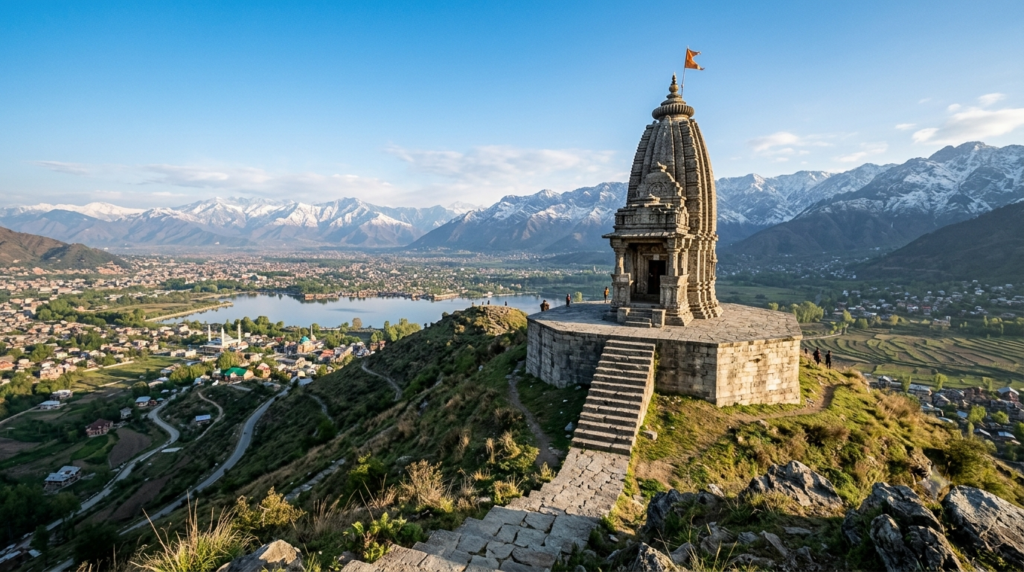
A Shankaracharya Temple Srinagar Darshan puts you atop the oldest Hindu shrine in the Kashmir Valley, roughly 1,000 feet above the city on the Zabarwan Range. The stone temple crowns Shankaracharya Hill, and it rewards the short climb with sweeping views of Srinagar and Dal Lake. Yet most online guides miss the one rule that trips up first-time visitors: phones and cameras are not allowed at the top. This guide fixes that gap and gives you verified timings, the real access route, the security rules, and honest travel advice, so you plan the visit correctly the first time.
Go Kshetra is an independent pilgrim guide. We are not affiliated with, endorsed by, or the official website of the Shankaracharya Temple, the Dharmarth Trust, or the Archaeological Survey of India. We take no bookings, payments, or donations. Always confirm timings and rules with local authorities or official Jammu & Kashmir tourism sources before you travel.
Shankaracharya Temple Srinagar Darshan at a Glance
The temple sits inside a high-security zone, so the practical details matter more here than at most shrines. Here are the essentials before you go.
- Also known as: Jyeshteshwara Temple; the hill is called Gopadri or Takht-e-Suleiman.
- Deity: Lord Shiva, worshipped as a stone Shiva Lingam.
- Entry fee: none; darshan is free.
- Phones and cameras: not permitted at the top, and no lockers are available.
- The climb: roughly 240 to 243 steps from the road to the shrine.
- Managed by: the J&K Dharmarth Trust, on a monument centrally protected by the Archaeological Survey of India.
| Detail | Information |
|---|---|
| Location | Shankaracharya Hill, Durgnag, near Boulevard Road, Srinagar, J&K |
| Timings (approx.) | Around 7:30 AM to evening; confirm locally |
| Vehicle cut-off | Cars usually stopped around 5:00 PM |
| Entry fee | Free darshan, no ticket |
| Steps | Approximately 240 to 243 |
| Best season | April to October |
The History Behind Your Shankaracharya Temple Srinagar Darshan
This shrine is widely regarded as the oldest temple in Kashmir. Traditional accounts trace the site back over two thousand years, while the present stone structure is usually dated to around the 9th century AD. Historians still debate the exact origins, so treat any single “built in” date you see online with caution.
The temple takes its name from Adi Shankaracharya, the philosopher who is believed to have stayed here when he visited Kashmir centuries ago. Devotees hold that he meditated at this spot before shaping the Advaita, or non-dualism, school of thought. Because of that association, the hill and the shrine both carry his name today.
Its older name, Jyeshteshwara Temple, still appears on many records. The J&K Dharmarth Trust installed a white marble bust of Adi Shankaracharya near the shrine in 1961, and the Trust has looked after the temple since the 19th century. Maha Shivaratri, known locally as Herath, remains the biggest festival on the hill.
Where the Temple Sits and Why It Feels Special
Shankaracharya Hill rises above Srinagar as part of the Zabarwan Range, and the temple sits right at the summit. From the terrace you look straight down over the city, the Jhelum, and the shimmering expanse of Dal Lake. On a clear day the snow line of the Pir Panjal range fills the horizon.
The stone temple rests on a tall octagonal plinth, and its sanctum is circular inside. Pilgrims heading to the Amarnath cave traditionally seek blessings here before the trek. Because the setting is so open, many visitors time the climb for sunset, when the valley lights begin to twinkle below.
Shankaracharya Temple Srinagar Darshan Timings
The temple generally opens in the morning and stays accessible into the evening, but the exact hours shift with the season and with local security. Most visitors report opening around 7:30 AM, while vehicles are usually stopped at the checkpoint near 5:00 PM. Winter hours are shorter, and heavy snow can close the approach entirely.
Sources disagree on the precise closing time, so do not rely on a single figure. Since the hill falls under a security zone, the army manages access and can adjust it on the day. Plan to reach well before the vehicle cut-off, and always confirm the current hours locally or through Jammu & Kashmir tourism before setting out.
Shankaracharya Temple Srinagar Darshan: Entry Fee and Booking Myth
A Shankaracharya Temple Srinagar Darshan is completely free, and no ticket or online booking exists for the temple itself. This is worth stressing, because several travel pages wrongly suggest you must “book” the shrine. You cannot, and you never need to.
Some aggregator sites even list unrelated booking portals for this temple, which only causes confusion. If a website asks you to pay a fee or share personal details to “reserve” darshan here, treat it as a red flag. The only paid services connected to a visit are optional taxis or sightseeing tours that pass through Srinagar, and you arrange those with a licensed operator, never through this page.
The Phone and Camera Rule You Must Know
Here is the single most important thing to plan for: cameras and mobile phones are not allowed at the top of Shankaracharya Hill. The temple sits inside a high-security zone, and security staff check bags at the base before you climb. Because no lockers are provided, you should leave your devices in your vehicle or at your hotel.
This rule catches out most first-time visitors, who expect to photograph the famous view. You can still take photos lower down and from the road, but not from the summit itself. Policies can tighten further on festival days, so respect the signage and follow every instruction from the staff on duty.
How to Reach the Shankaracharya Temple
Reaching a Shankaracharya Temple Srinagar Darshan is simple, because Srinagar connects easily to the rest of India by air and the hill lies right inside the city. The route to the base is straightforward, though the final approach depends on security checks that day.
By Air
Srinagar International Airport (SXR) is the nearest airport, roughly 14 to 18 km from the hill. You can hire a prepaid taxi or a ride-hailing cab from the terminal. Most drivers head to Boulevard Road near Nehru Park, which serves as the usual starting point.
By Train
Srinagar does not yet have a direct broad-gauge rail link to the plains. The nearest major railhead is Jammu Tawi, well over 250 km away, from where taxis and buses run to Srinagar. New rail projects on the Udhampur–Srinagar–Baramulla line are expected to improve this access over time.
By Road
Srinagar links to the country through National Highway 44, and taxis are easy to find across the city. A motorable road built by the Border Roads Organisation in 1969 climbs most of the way up the hill. Cars take you close to the top, after which you finish the ascent on foot up the steps.
The Climb and What to Expect
The final stretch of your Shankaracharya Temple Srinagar Darshan runs up a stone stairway of roughly 240 to 243 steps. Most walkers reach the top in about 15 to 30 minutes, with a few landings along the way for rest. The steps are not extremely steep, so visitors of many ages manage the climb with breaks.
A quick safety note: the altitude and the stairs can tire anyone who is elderly, pregnant, or managing a heart or breathing condition. Carry water, pace yourself, and rest at the landings whenever you need to. If you have a medical concern, check with your doctor before attempting the climb, especially in cold weather when the steps turn slippery.
Best Time for a Shankaracharya Temple Srinagar Darshan
A Shankaracharya Temple Srinagar Darshan works across most of the year, though the season shapes your experience. April to October brings the mildest weather and the clearest valley views. Late spring adds blooming gardens across the city, which makes the whole trip more scenic.
- Spring (March to May): pleasant days, blossoms, and crisp views of the valley.
- Summer (June to September): warm, green, and comfortable for the climb.
- Autumn (October to November): cool air and golden foliage across the slopes.
- Winter (December to February): cold and often icy; attempt only if you are prepared for snow.
Dress Code and Temple Etiquette
A Shankaracharya Temple Srinagar Darshan is a visit to an active place of worship, so modest clothing is expected. Cover your shoulders and knees, since staff and fellow pilgrims appreciate the respect. Remove your footwear before entering the temple premises, where shoe storage is usually available near the entrance.
Carry a valid photo ID, because security may ask to verify it at the checkpoint. Keep your voice low inside the sanctum, and follow the queue calmly during busy hours. Because photography is barred at the top, simply take in the view with your own eyes.
Nearby Attractions Worth Adding
The temple pairs well with a wider Srinagar itinerary, since several famous spots sit within a short drive. You can easily combine the darshan with a lake trip or a garden visit on the same day.
- Dal Lake (around 5 to 7 km): shikara rides and houseboats.
- Nishat Bagh (around 8 to 9 km): a terraced Mughal garden.
- Shalimar Bagh (around 9 to 10 km): another grand Mughal garden.
- Hazratbal Shrine (around 6 to 7 km): a revered lakeside mosque.
- Hari Parbat (around 5 to 6 km): a fort-topped hill with its own temple and shrines.
Insider Tips Most Guides Skip
A few practical habits make the visit smoother. These come from what regular visitors and pilgrims actually report on the ground.
- Go early: a start around 7:30 AM means thinner crowds, softer light, and a cooler climb.
- Travel light: since phones stay behind, carry only water, ID, and a little cash.
- Wear grippy shoes: the stone steps get slick, so comfortable walking shoes help a lot.
- Check the day’s rules: security can change access or timings, so ask your driver before you commit.
- Keep cash handy: small stalls near the base sell books and souvenirs, and cards are rarely accepted.
Before You Go
A Shankaracharya Temple Srinagar Darshan is short, free, and genuinely rewarding, as long as you plan around the security rules. Reach before the vehicle cut-off, leave your phone behind, dress modestly, and pace the climb. For anything time-sensitive, such as winter hours or festival-day access, confirm locally on the day. Do that, and the oldest shrine in Kashmir will reward you with one of the finest views in the valley.
Frequently Asked Questions
Is there an entry fee for Shankaracharya Temple Srinagar Darshan?
No, darshan is free and no ticket is required. You may only pay for optional transport or a sightseeing tour that includes the temple. The shrine itself never charges an entry fee.
Are phones and cameras allowed at the temple?
No. Cameras and mobile phones are not permitted at the top, since the hill is a high-security zone. No lockers are available, so leave your devices in your vehicle or hotel before the climb.
How many steps are there to the temple?
There are roughly 240 to 243 stone steps from the road to the shrine. A vehicle road covers most of the hill, so you climb only the final stretch. Landings along the way let you rest.
What are the Shankaracharya Temple timings?
The temple usually opens around 7:30 AM and stays accessible into the evening, though hours vary by season and security. Vehicles are commonly stopped near 5:00 PM. Confirm the current timings locally, especially in winter.
Can I do a Shankaracharya Temple Srinagar Darshan without booking?
Yes. You can reach the base by taxi or cab and climb the steps independently. Guided tours are optional and cover only transport and sightseeing, never temple entry.
Is the climb difficult?
The stair climb is easy to moderate for most people. Seniors and children usually manage it with breaks at the landings. Carry water and pace yourself, particularly in cold or icy conditions.
What should I carry for the visit?
Bring a valid photo ID, water, a little cash, and comfortable shoes. Wear modest clothing that covers the shoulders and knees. Leave phones and cameras behind, because they are barred at the top.
When is the best time for a Shankaracharya Temple Srinagar Darshan?
April to October offers the mildest weather and clearest views. Early morning is calmest for the climb and the least crowded. Winter is scenic but cold, with icy steps and shorter access hours.
For authoritative background, see the Archaeological Survey of India, official Jammu & Kashmir Tourism, and the temple’s documented history. For related pilgrimages, read our Raghunath Temple Jammu guide, the Hari Parbat Srinagar guide, and our Hemis Monastery guide.