
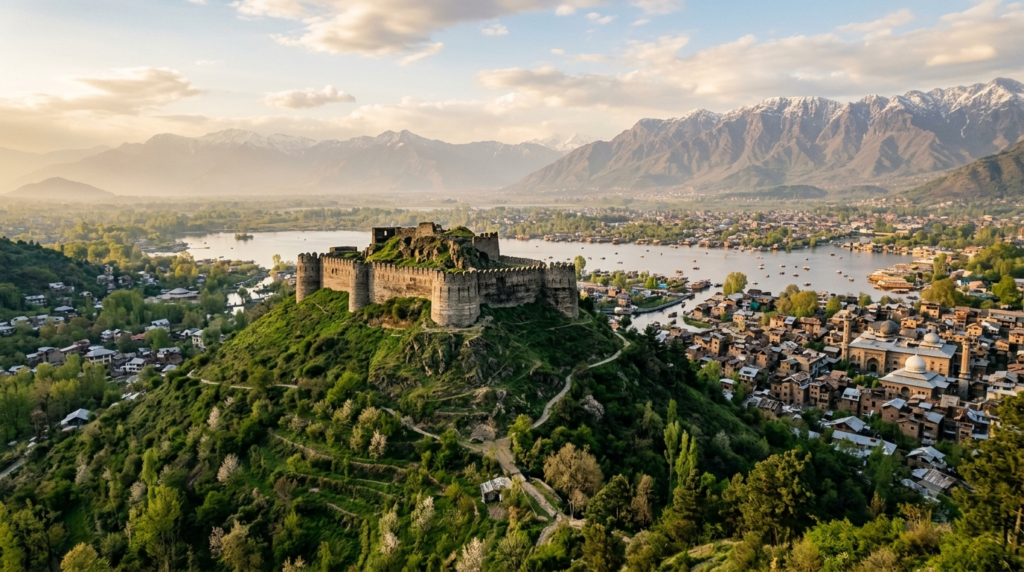
Planning a Hari Parbat Srinagar Darshan means climbing one hill to touch three faiths at once. This ancient hilltop in Srinagar carries a Kashmiri Pandit temple to Sharika Devi and the Sufi shrine of Makhdoom Sahib. It also holds a Sikh gurdwara, all ringed by a Mughal-era wall and an 1808 fort. So it draws devotees, history lovers, and view-seekers alike.
This guide walks you through the whole visit. You will find timings, the entry and permission rules, and how to reach the hill by Kashmir’s brand-new train link. It also covers the shrines, the dress code, safety on the climb, and the questions pilgrims ask most.
Go Kshetra is an independent pilgrim guide. We are not affiliated with the Sharika Devi temple, the J&K Tourism Department, or the Archaeological Survey of India, and we are not their official website. We take no bookings, fees, or donations. Always confirm live timings and access rules with the official sources before you travel.
Hari Parbat Srinagar Darshan at a Glance
Hari Parbat, also called Koh-e-Maran, rises on the western edge of Dal Lake, overlooking the old city. Because the hill is a security-supervised heritage zone, a Hari Parbat Srinagar Darshan needs a little planning that a normal temple visit does not. Here are the essentials before you go.
- What it is: a fortified hill with a Hindu temple, a Muslim shrine, and a Sikh gurdwara.
- Fort timings: roughly 9:30 AM to 5:30 PM, Tuesday to Saturday; often closed Sunday. Hours vary by source, so confirm locally.
- Sharika Devi temple: generally around 6:00 AM to 8:00 PM daily, with Tuesday considered special.
- Entry: a small nominal ticket at the fort counter; temples and shrines charge no fee.
- ID: carry a government photo ID — security checks it at the entry point.
- Time needed: about 2 to 3 hours for a relaxed visit.
Hari Parbat Srinagar Darshan Quick Facts
The table below sums up the core details so you can scan them fast. Treat the fee and timings as indicative, since the fort sits under changing security and heritage supervision.
| Item | Details |
|---|---|
| Location | Hari Parbat (Koh-e-Maran), Srinagar, Jammu & Kashmir |
| Fort timings | ~9:30 AM–5:30 PM, Tue–Sat; often closed Sunday (confirm) |
| Sharika Devi temple | ~6:00 AM–8:00 PM daily; Tuesday special |
| Fort entry fee | Small nominal ticket at the counter (confirm on site) |
| Shrine entry | Free for temple, gurdwara and dargah |
| ID required | Yes — government photo ID for security |
| Nearest airport | Srinagar (Sheikh ul-Alam) SXR, ~14–15 km |
| Official info | J&K Tourism and ASI portals (linked below) |
About Hari Parbat and Its Three Faiths
Hari Parbat is unusual because one small hill holds shrines sacred to three religions. Hindus revere the whole hill as the pebble the goddess dropped to crush a demon. Muslims honour the dargah of the Sufi saint Hamza Makhdoom on its southern slope. Sikhs remember Guru Hargobind’s visit at Gurdwara Chatti Padshahi near Kathi Darwaza.
Emperor Akbar built the long wall around the hill in the late 16th century. The fort on top came later, in 1808, during the rule of Shuja Shah Durrani. Because of this layered past, you walk through Mughal, Afghan, and Dogra history in a single loop. The fort is now maintained as a heritage monument under the Archaeological Survey of India.
Sharika Devi Temple, the Heart of the Darshan
The Sharika Devi temple is the main draw for Hindu pilgrims on Hari Parbat. The goddess Jagadamba Sharika Bhagwati is shown with eighteen arms and is worshipped as the presiding deity of Srinagar. She is represented not by a carved idol but by a self-manifested Shrichakra, a sacred geometric pattern. Many believe the very name Srinagar (Shri-nagar) traces to this Shrichakra.
A flight of 108 stone steps leads up to the shrine from the Devi Angan courtyard. The goddess is also called Chakreshwari, and Tuesday draws the largest crowds. During Navratri, priests perform special poojas and devotees offer taher charvan, a traditional rice offering. These benefits and blessings are matters of faith and Kashmiri Pandit tradition, not guaranteed outcomes.
Makhdoom Sahib and Gurdwara Chatti Padshahi
On the way, two more shrines round out the hill’s multi-faith character. The dargah of Makhdoom Sahib honours a revered 16th-century Sufi saint, and it draws visitors of every background. Gurdwara Chatti Padshahi, meanwhile, marks the sixth Sikh Guru’s stay in the area. Together they make a Hari Parbat Srinagar Darshan feel like a walk through Kashmir’s shared spiritual heritage.
Timings and Entry for Hari Parbat Srinagar Darshan
Timings for a Hari Parbat Srinagar Darshan split into two parts: the fort and the shrines. The fort generally opens around 9:30 AM and closes near 5:30 PM from Tuesday to Saturday. It is often shut on Sunday. Because reported hours differ across sources, always confirm the current schedule locally before you climb.
The Sharika Devi temple keeps longer hours than the fort. Devotees usually find it open from about 6:00 AM to 8:00 PM daily, though exact hours can shift. Early morning is calm and cool, so it suits a peaceful darshan. Tuesday, by contrast, is busy because it is the goddess’s special day.
Is There an Entry Fee?
Entry to the shrines themselves is free, though donations are welcome. The fort area may charge a small nominal ticket at the counter, but the amount is reported inconsistently and foreign tourists sometimes pay more. Since figures vary widely online, do not treat any single number as fixed — simply confirm the current fee on site and keep small change ready.
Do You Need Special Permission?
This is the one rule that surprises first-time visitors. Because Hari Parbat is a security-supervised site under heritage and defence oversight, entry to the fort area often requires clearance at the gate. You must carry a valid government photo ID, such as an Aadhaar card, voter ID, or passport, since staff check identification before allowing entry. Large groups and organised tours may need to arrange permission in advance, so plan ahead if you travel with one.
How to Reach Hari Parbat Srinagar Darshan
Hari Parbat sits close to the heart of Srinagar, roughly 5 to 7 km from Lal Chowk, the city’s central square. You can reach the base easily by air, by the newly opened railway, or by road, and then finish with a short uphill walk.
By Air
The nearest airport is Srinagar International Airport, also known as Sheikh ul-Alam (SXR). From there, Hari Parbat lies about 14 to 15 km away, or roughly 30 to 45 minutes by taxi. Cabs and app-based rides are readily available at the terminal, so the transfer is simple.
By Train
Here is the biggest change since older guides: Srinagar is now on the rail map. The Udhampur-Srinagar-Baramulla Rail Link (USBRL) opened in June 2025. Soon after, the Katra-Srinagar Vande Bharat Express began running. For the first time, the Kashmir Valley connects directly to the rest of India by train.
The route also crosses the Chenab Bridge, the world’s highest railway bridge, so the journey itself is a highlight. Pilgrims often pair the trip with the nearby Vaishno Devi yatra, since the same line starts at Katra.
Trains arrive at Srinagar station, whose code is SINA. From there, Hari Parbat is a short taxi ride into the old city. Book Vande Bharat tickets only through the official IRCTC portal, because seats sell out fast in tourist and Amarnath Yatra seasons. Since schedules keep expanding, always check the current timetable on official railway channels first.
By Road
Srinagar is well linked by road to Jammu and beyond via the national highway network. Buses, shared cabs, and private taxis all reach the city core. From Lal Chowk, an auto, cab, or local taxi gets you to the base of Hari Parbat in minutes, though traffic near popular spots can slow you down at peak hours.
Planning Your Hari Parbat Srinagar Darshan Step by Step
A Hari Parbat Srinagar Darshan runs smoothly when you plan the sequence in advance. There is no online booking system for the hill, so the process is refreshingly simple once you know it.
- Reach the base near Kathi Darwaza, the historic main gateway to the fort area.
- Keep a government photo ID handy, because security checks it before entry.
- If the fort counter is issuing tickets, pay the small nominal fee and collect your ticket.
- Climb toward the shrines — the 108 steps to Sharika Devi start from the Devi Angan courtyard.
- Plan to finish and descend before the fort’s closing time, since gates shut in the late afternoon.
Dress Code for a Hari Parbat Srinagar Darshan
Modest dress is expected across all three shrines, so cover your shoulders and knees. Remove footwear before entering the temple and gurdwara, and use the shoe storage near the entrances. Photography is generally fine across the ramparts and viewpoints, yet you should always ask before photographing inside a sanctum or a person at prayer. Drones are not allowed, because the hill remains a sensitive security zone.
Health and Safety for a Hari Parbat Srinagar Darshan
The visit involves uneven paths and the 108 stone steps to the main shrine, so it demands a little fitness. Wear sturdy shoes, since the surface can be slippery in places. Carry water and sun protection too, because shade is limited on the exposed slope.
Elderly pilgrims and anyone with mobility or heart concerns should pace themselves and take breaks. Go only as far as comfort allows. In winter, snow and ice make the steps riskier, so tread carefully or postpone the climb.
What Most Guides Won’t Tell You
A few practical details make the difference between a rushed stop and a rewarding visit. These come from what regular visitors and local guides consistently point out.
- ID checks happen more than once: staff may verify your ID at the counter and again near the fort walls, so keep it accessible.
- Go at golden hour: late afternoon light over Dal Lake and the old city is stunning for photos.
- Hire a local guide: for roughly ₹300–₹500, a guide unlocks the legends behind each shrine and the fort’s layered history.
- Weekdays beat weekends: queues and crowds thin out on ordinary weekdays, especially before 8 AM.
- Combine nearby sights: the hill pairs naturally with Dal Lake and Badamwari, so build a half-day loop.
Nearby Attractions to Combine
Because Hari Parbat sits so centrally, it slots easily into a wider Srinagar itinerary. A few standout stops lie within a short drive.
- Dal Lake (~5 km): houseboats and shikara rides, magical at sunset.
- Shankaracharya Temple (~3–4 km): an ancient hilltop Shiva shrine with sweeping views.
- Badamwari Garden (~4 km): famous for early spring almond blossoms.
- Nishat and Shalimar Gardens (~6–7 km): terraced Mughal gardens beside Dal Lake.
Best Time for Hari Parbat Srinagar Darshan
The best window for a Hari Parbat Srinagar Darshan is spring through early autumn, roughly April to October. Spring brings blooming almond orchards and clear valley views. Summer stays pleasant and pairs well with Dal Lake boat rides. Autumn offers crisp air and golden foliage that photographs beautifully.
Winter, from December to February, turns cold and often snowy. While the snow-dusted fort looks magical, the paths get slippery and the climb becomes harder, so visit then only with proper footwear and caution.
Before You Go
A Hari Parbat Srinagar Darshan rewards the pilgrim who arrives prepared. Carry your ID, dress modestly, wear good shoes, and start early for calm shrines and soft morning light. Confirm the fort’s timings and permission rules through the official Srinagar district tourism page, since these shift with the security situation.
Above all, treat the hill as the shared sacred space it is. One climb honours three faiths and one of the finest views in all of Kashmir.
Hari Parbat Srinagar Darshan FAQs
Is there a fee for Hari Parbat Srinagar Darshan?
Entry to the shrines is free, though donations are welcome. The fort area may charge a small nominal ticket at the counter, and foreign tourists sometimes pay more. Reported amounts vary, so confirm the current fee on site.
Do I need permission for a Hari Parbat Srinagar Darshan?
Often, yes. Hari Parbat is a security-supervised site, so clearance at the gate may be required and a government photo ID is mandatory. Large groups and organised tours should arrange permission in advance.
Can I reach Srinagar by train now?
Yes. Since the USBRL line opened in June 2025, the Katra-Srinagar Vande Bharat Express connects the valley by rail. Trains arrive at Srinagar station (SINA), and Hari Parbat is a short taxi ride away.
What are the Sharika Devi temple timings?
The Sharika Devi temple is generally open from about 6:00 AM to 8:00 PM daily, though exact hours can change. Tuesday is considered the goddess’s special day and draws bigger crowds.
How much time does a Hari Parbat Srinagar Darshan take?
Set aside about 2 to 3 hours. That is enough to climb the steps, visit the shrines, explore the fort, and enjoy the panoramic views over Dal Lake without rushing.
Is the climb suitable for elderly visitors?
It can be challenging, since it involves uneven paths and 108 steps. Elderly pilgrims and those with mobility issues should pace themselves, take breaks, and go only as far as they feel comfortable.
Is photography allowed at Hari Parbat?
Photography is generally allowed across the ramparts and viewpoints. However, ask before photographing inside a shrine or a praying devotee, and note that drones are prohibited because the hill is a sensitive zone.
What is the best time for a Hari Parbat Srinagar Darshan?
Spring to early autumn, roughly April to October, offers the most comfortable weather and clearest views. Winter brings snow and slippery paths, so it needs extra caution.