
Planning a Baijnath Temple darshan in the Kangra Valley takes less effort than most travel blogs suggest, because entry is free, no ticket system exists, and the shrine sits directly on the Pathankot–Mandi highway. Yet the same blogs repeat three errors that cost pilgrims time: a wrong nearest railway station, an invented “official booking portal”, and a confident claim about Jyotirlinga status that the Government of India has never settled. This guide fixes those, and it adds three temple festivals that almost no competing page mentions.
Go Kshetra is an independent pilgrim guide. We are not affiliated with, endorsed by, or the official website of the Shiv Mandir Trust Baijnath, the Archaeological Survey of India, or the Himachal Pradesh government. We accept no bookings, donations, or payments. Use the official channels linked below.
Baijnath Temple Darshan at a Glance
- Location: Baijnath town, Kangra district, Himachal Pradesh, on the left bank of the Binwa river
- Deity: Shiva worshipped as Vaidyanath, the “lord of physicians”
- Built: Saka 1126, or 1204 CE, by two merchant brothers named Ahuka and Manyuka
- Entry fee: None. Regular darshan is free and no ticket is issued
- Widely reported timings: roughly 6:00 AM to 9:00 PM daily, though sources disagree
- Managed by: Shiv Mandir Trust Baijnath; the monument itself is protected by the Archaeological Survey of India
- Altitude: about 1,050 metres, so mornings stay cold even in summer
Here is the single line worth remembering. Baijnath Temple is a continuously worshipped 1204 CE Nagara-style shrine that the Archaeological Survey of India protects as a monument, and darshan there costs nothing.
Baijnath Temple Darshan Timings: What Sources Actually Say
Most travel pages state 6:00 AM to 9:00 PM daily, and that range matches what visitors report on the ground. However, published timings genuinely conflict, so treat any single figure as approximate.
The Shiv Mandir Trust’s own website lists 10:00 AM to 6:00 PM. That almost certainly describes the trust office rather than the sanctum, since morning aarti clearly happens before 10 AM. Some guides also describe a midday break for bhog and cleaning.
| Source | Reported timing | What it likely means |
|---|---|---|
| Common travel listings | 6:00 AM – 9:00 PM | Full daily darshan window |
| Shiv Mandir Trust site | 10:00 AM – 6:00 PM | Trust office hours, not sanctum access |
| Several guides | Midday closure around noon | Bhog offering and cleaning |
Because the sources disagree, plan your Baijnath Temple darshan for early morning. Arrive between 6:00 and 7:00 AM and you avoid every version of the midday-closure problem. Ask at the temple office on arrival if you want exact aarti times for that day.
Is It a Jyotirlinga? The Claim Most Guides Get Wrong
Many pages assert flatly that Baijnath houses one of the twelve Jyotirlingas. That claim is contested, not settled. Three shrines carry the Vaidyanath name and each has supporters.
The three claimants are Baidyanath Dham at Deoghar in Jharkhand, Parli Vaijnath in Maharashtra, and Baijnath here in Himachal Pradesh. Adi Shankaracharya’s Dwadasha Jyotirlinga stotra places Srivaidyanatha in the north-east, which most scholars read as Deoghar. Meanwhile the Government of India has never formally notified any one of them.
So the honest position is this. Baijnath is a genuinely ancient and continuously worshipped Vaidyanath shrine, though its Jyotirlinga status remains disputed. Any page that states the matter as settled fact, in either direction, is overreaching.
Entry Fee, Tickets and How Donations Actually Work
There is no entry fee for Baijnath Temple darshan and no ticketing system at all. You will not find VIP queues, paid slots, or online darshan bookings, because none exist here. Anyone claiming to sell you a Baijnath darshan ticket online is running a scam.
Donations work differently from ticketing. The Shiv Mandir Trust publishes its own bank account details on its website and also issues receipts at the temple office. Use only those two routes.
We deliberately do not reproduce the trust’s account number on this page. A single mistyped digit copied from a third-party blog can send your donation to a stranger. Read the numbers from the trust’s own site instead, or simply donate at the office and collect a receipt.
How to Reach Baijnath Temple for Darshan
By air
Gaggal Airport near Dharamshala, also called Kangra Airport, is the nearest airport. The Kangra district administration lists it at 56 km from Baijnath, so allow about 90 minutes by taxi. Flights connect Gaggal mainly with Delhi, although hill-weather cancellations happen in monsoon and winter.
By train
Baijnath Paprola station sits roughly 3 km from the temple on the narrow-gauge Kangra Valley line. That line runs between Pathankot and Joginder Nagar, and it is slow but scenic. Several popular blogs claim Amb Andaura is “4 km away”, which is simply wrong. Amb Andaura is a broad-gauge railhead well over 100 km distant.
By road
Baijnath lies on the Pathankot–Mandi highway, numbered NH 154 today and NH 20 in older signage. Approximate road distances are 16 km from Palampur, about 50 km from Dharamshala, roughly 250 km from Chandigarh, and around 500 to 520 km from Delhi. Himachal Road Transport Corporation buses and shared taxis run frequently from Palampur and Dharamshala.
Because the temple sits on the main highway, parking is available beside the complex. Drivers do not need to negotiate narrow lanes, unlike at many hill shrines.
What a Baijnath Temple Darshan Feels Like on the Ground
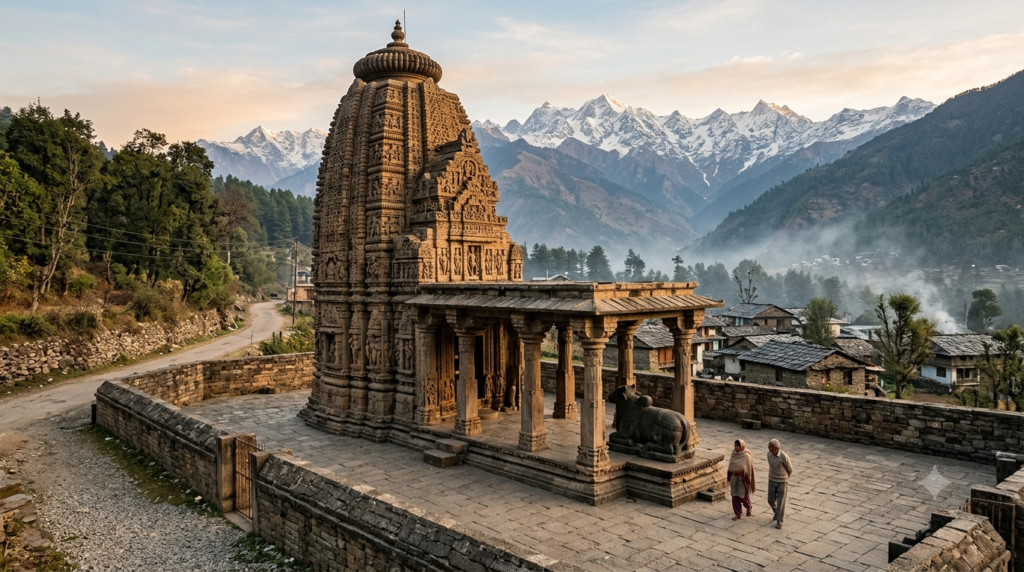
The complex is compact and level, so the walk from gate to sanctum takes only a couple of minutes. A large stone Nandi faces the shrine from a pillared porch, and devotees traditionally whisper their prayers to him first.
Inside, the sanctum holds the Shiva lingam. The mandapa carries the two long stone inscriptions that record the temple’s construction, which is why historians can date it so precisely. Smaller shrines to Ganesha and Harihara stand within the enclosure.
Allow about 45 minutes if you want to walk the full exterior. The curved shikhara carries dense carving on all four faces, and the ASI information board near the entrance gives useful context. Photography is generally fine outside, while sanctum photography is usually restricted, so ask before you shoot.
Three Festivals That Make a Baijnath Temple Darshan Different
Maha Shivratri
Maha Shivratri brings a five-day state-level fair to Baijnath and Paprola. The trust performs a Laghu Rudra yagna with 1,100 recitations, and the temple is decorated with flowers and lights. Cultural programmes run at the Indira Gandhi Stadium through the fair.
Makar Sankranti and the Ghrithmandal
This one is genuinely unusual. For eight days from Makar Sankranti, pure ghee is laid on the lingam to form a butter column called the Ghrithmandal. When the column is removed, devotees receive the butter as prasad, since tradition holds it carries healing properties.
Panch Bhisham Chaturdashi, or Khod Mar
Around October or November, after sunset, walnuts are showered from the top of the temple. Locals call the custom Khod Mar. It is a small, joyful ritual that almost no national travel site records.
These traditions come as tradition and belief, not as verified outcomes. The Ghrithmandal butter is prasad, so please do not treat it as medicine.
Why Dussehra Is Not Celebrated Here
Baijnath is one of very few Indian towns where Ravana’s effigy is never burned. The reason sits in the temple’s founding legend, and it explains the shrine’s name too.
According to the Kangra district administration’s account, Ravana performed severe penance for Shiva and sacrificed his own heads. Shiva restored them, earning the name Vaidyanath, the lord of physicians. Shiva then agreed to travel with Ravana as a lingam, on the condition it never touched the ground. A shepherd set it down at Kiragrama, the old name for Baijnath, where it rooted permanently.
Out of respect for Ravana’s devotion, the town skips Dussehra entirely. If you plan a Baijnath Temple darshan during Navratri, expect the temple busy and the surrounding town notably quiet on Vijayadashami.
Best Time to Plan Your Baijnath Temple Darshan
The Shiv Mandir Trust recommends March to June and September to December. Those windows give clear Dhauladhar views and comfortable daytime walking weather.
Monsoon months from July to early September bring heavy hill rain and occasional landslides on the Pathankot route. Winter stays open but gets genuinely cold, since the town sits at roughly 1,050 metres. Maha Shivratri is spiritually rich yet crowded, so book accommodation in Palampur or Bir well ahead if you travel then.
Dress Code, Comfort and Health Notes
Dress modestly and remove footwear before entering the complex. Shoe storage is available near the entrance.
Carry a shawl or light jacket year-round, because Himalayan mornings turn cold even in May. The complex is level and step-free in most parts, so it suits elderly pilgrims better than hill shrines like the Chamunda Devi temple in Kangra. Still, if you fast for Shivratri and have diabetes, heart conditions, or you are pregnant, please consult your doctor before fasting or travelling at altitude.
Nearby Places Worth Adding to the Trip
Baijnath works well as a base rather than a quick stop. Distances below are approximate road distances, so confirm locally before committing to a tight itinerary.
| Place | Approx. distance | Why go |
|---|---|---|
| Palampur tea gardens | ~16 km | Tea estates and valley walks |
| Bir village | ~15 km | Monasteries, cafes, paragliding landing site |
| Billing take-off | ~24 km | India’s best-known paragliding launch |
| Sherabling monastery | ~5 km | Quiet Tibetan Buddhist complex |
| Chamunda Devi temple | ~35 km | Major Kangra Shakti shrine |
| Kangra Fort | ~55 km | Katoch-era hill fort and museum |
Note the correction here. Several guides list Kangra Fort at 20 km from Baijnath, which understates the drive badly. Budget a full half-day if you want the fort and the temple on one trip.
If you are building a longer Himachal circuit, the Laxmi Narayan temple complex at Chamba pairs naturally with Baijnath, since both are early stone shrines. Travellers heading further north often continue toward the Raghunath temple in Jammu.
What First-Time Visitors Get Wrong
- Confusing this temple with Deoghar. Baba Baidyanath Dham in Jharkhand is a different shrine roughly 1,900 km away. Check your booking before you fly.
- Hunting for online darshan slots. None exist. Any site selling them is fraudulent.
- Arriving at midday. Early morning avoids both the crowd and any bhog-time closure.
- Skipping the inscriptions. The mandapa slabs are the reason this temple has a verified construction date, which is rare in India.
- Treating it as a 20-minute stop. The exterior carving alone rewards 45 minutes.
- Booking Dussehra travel expecting festivities. The town deliberately does not observe it.
Before You Go
A Baijnath Temple darshan is one of the easiest major Shiva pilgrimages in Himachal Pradesh, because it is free, roadside, level, and open daily. Arrive at dawn, allow 45 minutes, and let the Dhauladhar backdrop do its work.
Verify current timings at the temple office when you arrive, since published hours conflict. If you want to donate, use the Shiv Mandir Trust’s own site or its office counter, and nothing else. For official reference, see the Kangra district administration page, the Archaeological Survey of India, and the Shiv Mandir Trust Baijnath.
FAQ About Baijnath Temple Darshan
Is there any entry fee for Baijnath Temple darshan?
No. Regular darshan is completely free and no ticket is issued at any counter. The temple runs no paid queue, no VIP darshan, and no online slot booking. Treat any website selling Baijnath darshan tickets as a scam.
What are the Baijnath Temple darshan timings?
Travel listings commonly report roughly 6:00 AM to 9:00 PM daily. However, the trust’s own site shows 10:00 AM to 6:00 PM, which likely reflects office hours. Because sources conflict, arrive early morning and confirm the day’s aarti schedule at the temple office.
Is Baijnath Temple a Jyotirlinga?
Its status is disputed rather than confirmed. Deoghar in Jharkhand, Parli in Maharashtra, and Baijnath in Himachal all claim the Vaidyanath Jyotirlinga, and the Government of India has notified none of them. Most traditional readings of Adi Shankaracharya’s stotra point to Deoghar.
Which railway station is nearest to the temple?
Baijnath Paprola, about 3 km away, on the narrow-gauge Kangra Valley line between Pathankot and Joginder Nagar. Ignore blogs claiming Amb Andaura sits 4 km away, because that broad-gauge station lies more than 100 km off.
How much time should I allow at the temple?
Plan 45 to 60 minutes. Darshan itself is quick since queues rarely stretch long outside festivals. The extra time lets you walk the full exterior, read the ASI board, and view the shikhara carvings from the rear.
Can I book a special puja in advance?
Arrange rituals through the Shiv Mandir Trust office at the temple rather than through agents or travel sites. Trust staff can explain what is offered and issue proper receipts. Avoid anyone soliciting puja payments outside the complex.
Is photography allowed during darshan?
Photography is generally permitted in the courtyard and around the exterior. Sanctum photography is usually restricted, so ask temple staff before pointing a camera inside. Drones need separate ASI permission, since this is a protected monument.
Why is Dussehra not celebrated in Baijnath?
Because the town honours Ravana as an exceptional Shiva devotee, whose penance gave the temple its Vaidyanath name. Ravana’s effigy is therefore never burned here. It is one of the very few places in India where this holds true.