
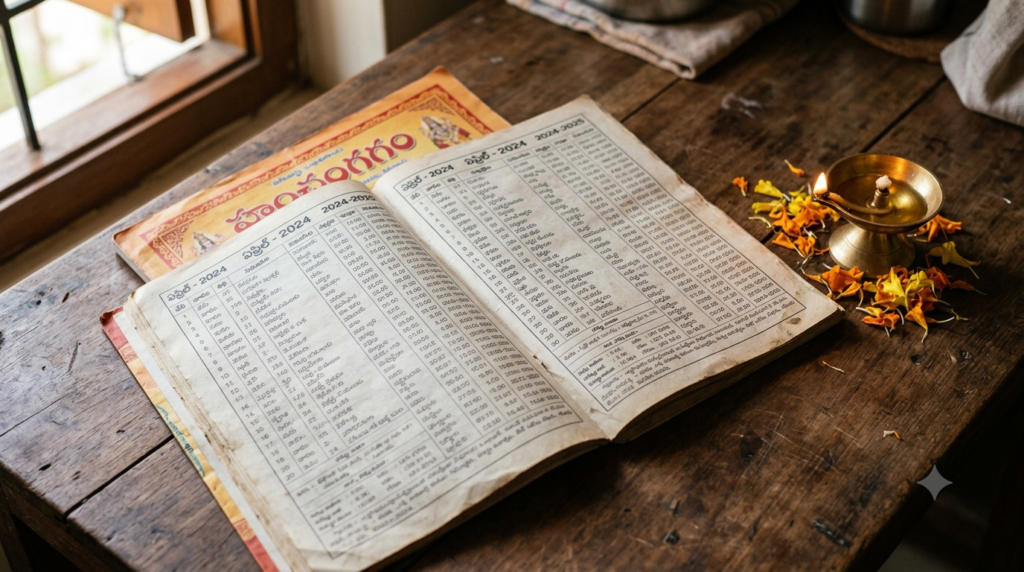
The Butte Veerabhadra Panchangam costs less than a hundred rupees in print, yet thousands of Telugu households search every year for a free PDF the publisher has never issued. That gap between what people search for and what actually exists is where most pages on this topic go wrong. Because the almanac changes name every Ugadi, buying the wrong year is easy. This guide explains which edition is running now, what the book contains, and how to avoid the download traps.
Go Kshetra is an independent pilgrimage and temple guide. We are not affiliated with Vasundhara Publications, Srisailam Devasthanam, or any Panchangam author, and we do not sell, host, or distribute Panchangam files. Purchase links point to the publisher’s own retail channels.
Butte Veerabhadra Panchangam at a Glance
- Compiled by: Pandita Dr. Butte Veerabhadra Daivagna, Aasthana Siddhanti of Srisailam Devasthanam
- Publisher: Vasundhara Publications, Vijayawada
- Current Telugu year: Sri Parabhava Nama Samvatsara, which began at Ugadi on 19 March 2026
- Current edition: Gantala Panchangam 2026–27, the 37th annual edition
- Length: roughly 192 pages, printed in Telugu
- Typical price: about ₹90 to ₹99 at most Telugu bookstores
- Official free PDF: none released by the publisher
What the Butte Veerabhadra Panchangam Actually Is
A panchangam is a Hindu almanac built on five limbs of time. Those five are tithi, vara, nakshatra, yoga and karana. The Wikipedia entry on Panchangam explains the underlying calendar system in plain terms. This particular almanac belongs to the Gantala Panchangam family, a printed Telugu format used across Andhra Pradesh and Telangana.
The compiler is Pandita Dr. Butte Veerabhadra Daivagna. He serves as Aasthana Siddhanti of Srisailam Devasthanam, and he also authored a Shatabdi or century-span panchangam covering 110 years. Vasundhara Publications in Vijayawada has issued the annual edition since 1990.
The publisher describes it as the highest-circulation panchang across the two Telugu states. That claim comes from the publisher rather than an audited circulation body, so treat it as a marketing figure. What is verifiable is the run length: the 2026–27 book is the 37th consecutive edition.
What the book contains
Every Gantala Panchangam follows a broadly similar layout. You get daily tables, a festival calendar, muhurtham blocks and rasi phalalu for the twelve signs. The 2026–27 edition also carries an expanded treatment of Kala Sarpa Yoga, which the publisher flags as a special section for this year.
Which Butte Veerabhadra Panchangam Edition Is Current?
As of July 2026, the running edition is the Sri Parabhava Nama Samvatsara book covering 2026–27. Telugu years do not follow the January calendar. Each one starts at Ugadi and carries a name drawn from a sixty-year cycle, so an edition labelled 2026 may already be out of date by March.
This single point causes more wasted purchases than anything else. Someone buys a “2026 panchangam” in April, only to find it ended at Ugadi. The table below maps recent Telugu years to the edition you would need.
| Telugu year (Samvatsara) | Edition label | Ugadi start date |
|---|---|---|
| Shobhakrit | 2023–24 | 22 March 2023 |
| Krodhi | 2024–25 | 9 April 2024 |
| Viswavasu | 2025–26 | 30 March 2025 |
| Parabhava | 2026–27 (current) | 19 March 2026 |
| Plavanga | 2027–28 | 7 April 2027 |
Parabhava is the fortieth year in the sixty-year samvatsara cycle. A handful of regional calendars listed Ugadi 2026 as 20 March instead of 19 March, since the tithi straddled sunrise. Because that one-day variation exists, check your family’s tradition before fixing ritual dates.
Is There a Free Butte Veerabhadra Panchangam PDF?
No. Vasundhara Publications has not released an authorised free PDF of the Butte Veerabhadra Panchangam. The book is sold as a printed almanac priced around ₹90 to ₹99. Any site offering a complete free download is either reproducing copyrighted pages without permission or using the file as bait.
Search demand here is enormous, and dozens of pages compete for phrases like “butte panchangam pdf free download”. Very few of them actually host a file. Most serve one of three things instead.
How to spot a fake Panchangam download page
- The endless redirect: a “Download” button that opens three ad pages, then a bookstore listing. No file ever arrives.
- The wrong-year scan: a genuine PDF, but scanned from a 2023 or 2024 edition and relabelled with the current year.
- The app install: a prompt to install an APK or browser extension before the download unlocks. Avoid these entirely.
- The payment gate: a small “processing fee” to a private UPI ID. The printed book costs less than that fee.
A useful test is the price check. When a book retails under ₹100, a site charging you ₹149 to unlock a PDF is not saving you money. It is collecting a payment for something it has no right to distribute.
What you can use for free instead
Daily panchangam data itself is not copyrighted, though a specific author’s book is. Free calculators such as Drik Panchang give you tithi, nakshatra, rahu kalam and varjyam for your exact location. For daily reference that is often more accurate than a printed book, because printed tables assume one fixed longitude.
What the printed almanac still does better is the yearly view. Rasi phalalu, the full festival list and the muhurtham blocks all sit in one place. So many households keep both, and that combination costs under ₹100.
Where to Buy the Butte Veerabhadra Panchangam
The edition appears on Amazon India and on Telugu book retailers such as Logili, Devullu, Sree Rama Book Centre and Telugu Pustakalu. Prices cluster between ₹90 and ₹99 before shipping. Temple bookstalls and devotional shops across Vijayawada, Guntur and Hyderabad stock it from around Ugadi.
Before you pay, confirm three things on the listing. Check that the samvatsara name matches the year you need, since sellers often leave old listings live. Confirm the author line reads Butte Veerabhadra Daivagna, because several unrelated Gantala Panchangams share similar cover art. Finally, check the page count, as the genuine edition runs close to 192 pages.
Shipping can take longer than the listing suggests during the Ugadi rush. If you need the book for panchanga sravanam, order at least three weeks ahead.
When Each Butte Veerabhadra Panchangam Edition Releases
The new book reaches shelves well before the Telugu year it covers. Retail listings for the 2026–27 edition carry a publication date of 1 January 2026, roughly eleven weeks ahead of Ugadi. That lead time exists for a practical reason.
Panchanga sravanam, the public reading of the new almanac, happens on Ugadi day itself at temples and in homes. Priests and astrologers therefore need copies in hand weeks earlier. Households buying for ritual use follow the same pattern.
Demand peaks in the fortnight either side of Ugadi. Popular editions sell through at smaller stalls during that window, and online sellers often mark them out of stock. Buying in January or early February avoids the squeeze altogether.
One quirk catches out late buyers. Sellers rarely delist the previous year’s book, so an old Butte Veerabhadra Panchangam edition can still appear in search results at a discount. That discount is not a bargain when the year has already ended.
How to Read a Gantala Panchangam Without an Astrologer
Most first-time buyers open the book, see dense Telugu tables, and close it again. The structure is simpler than it looks once you know what the columns mean.
Reading a daily row
Find the current Telugu month, then the date. Each row lists the tithi and its ending time, the nakshatra and its ending time, the yoga, the karana and the weekday. Rahu kalam, yamagandam and varjyam usually appear alongside.
The ending times matter more than the labels. A tithi does not run midnight to midnight, so it begins and ends at fixed lunar positions. If a tithi ends at 10:40 am, the next tithi governs the rest of that day.
Choosing a muhurtham
For weddings and griha pravesham, the book carries dedicated muhurtham tables rather than daily rows. These combine favourable tithi, nakshatra and weekday into listed windows. Traditional astrologers then narrow those windows against the individuals’ birth charts.
Printed timings are calculated for a reference longitude, usually in coastal Andhra. Since sunrise shifts by several minutes across the Telugu states, timings need a small adjustment for Hyderabad or for locations abroad.
Butte Veerabhadra Panchangam vs Other Telugu Almanacs
Several Gantala Panchangams circulate every year, and families usually stay loyal to one lineage. The differences are real but modest, since all follow the same siddhanta calculations.
| Almanac | Known for | Typical print price |
|---|---|---|
| Butte Veerabhadra | Widest circulation; Srisailam Siddhanti lineage | ₹90–₹99 |
| Nemani Vari | Long-running Godavari-belt following | ₹90–₹120 |
| Relangi Tangirala (TTD) | Published in a TTD special edition | ₹90–₹150 |
| Mulugu | Strong media and television presence | ₹100–₹150 |
Prices move each year, so confirm the current figure on the seller’s page. If your family already follows one lineage, staying with it avoids conflicting festival dates at home. For comparison, our guides to the Nemani Vari Gantala Panchangam and the Mulugu Gantala Panchangam cover those editions in detail.
Mistakes Telugu Households Repeat Every Year
- Buying by calendar year: a book labelled 2026 may expire at Ugadi. Always match the samvatsara name.
- Reading tithi as a date: tithis end at lunar positions, not at midnight, so festival dates shift accordingly.
- Ignoring location: timings are printed for one longitude, and Gulf or US readers need a proper conversion.
- Mixing lineages mid-year: switching almanacs halfway can produce two different Sankranti dates in one household.
- Chasing a free PDF: the search costs more time than the book costs money.
Astrological guidance in any panchangam reflects Vedic tradition and devotional practice. It is not a substitute for medical, legal or financial advice, so treat rasi phalalu as tradition rather than prediction.
Before You Buy This Year’s Edition
Match the samvatsara first, then the author name, then the price. For 2026–27 that means Sri Parabhava Nama Samvatsara compiled by Butte Veerabhadra Daivagna, at roughly ₹90 to ₹99.
Pair the printed book with a free online calculator for location-accurate daily timings. Skip the PDF hunt entirely, since no authorised free version exists and the alternatives carry real risk. If your family already follows another lineage, keep it rather than switching mid-year.
Frequently Asked Questions
Which Telugu year does the current Butte Veerabhadra Panchangam cover?
It covers Sri Parabhava Nama Samvatsara, running from Ugadi on 19 March 2026 to Ugadi 2027. This is the 37th edition in the series. The next book will cover Plavanga Nama Samvatsara from April 2027.
Who writes the Butte Veerabhadra Panchangam?
Pandita Dr. Butte Veerabhadra Daivagna compiles it. He holds the position of Aasthana Siddhanti at Srisailam Devasthanam. He is also credited with a Shatabdi Panchangam spanning 110 years.
How much does it cost?
Recent editions have retailed at roughly ₹90 to ₹99 across Telugu bookstores and online sellers. Prices vary slightly by retailer and shipping. Confirm the current figure on the seller’s listing before ordering.
Can I download it as a PDF legally?
No authorised free PDF exists. Vasundhara Publications sells the almanac as a printed book, so any complete free download infringes copyright. Sites offering one are usually serving ads, an outdated scan, or an app install.
Is it available in English?
No. The Gantala Panchangam is published in Telugu script only. English-speaking readers generally use online panchangam calculators, which present the same five elements in English.
How does it differ from a Telugu wall calendar?
A wall calendar shows dates, festivals and a few timings. A panchangam adds tithi and nakshatra ending times, yoga, karana, muhurtham tables and yearly predictions. That extra detail is what ritual planning requires.
Can I use it to fix a wedding date?
It lists the muhurtham windows astrologers work from, so it is a starting point rather than a final answer. Family astrologers narrow those windows using the couple’s birth charts. Most households use the book to shortlist dates, then confirm with a purohit.
Do the timings work outside India?
Not directly, because the tables assume an Indian reference longitude. Readers in the Gulf, Singapore or North America should convert timings or use a location-aware calculator. The festival dates and muhurtham logic still apply.