
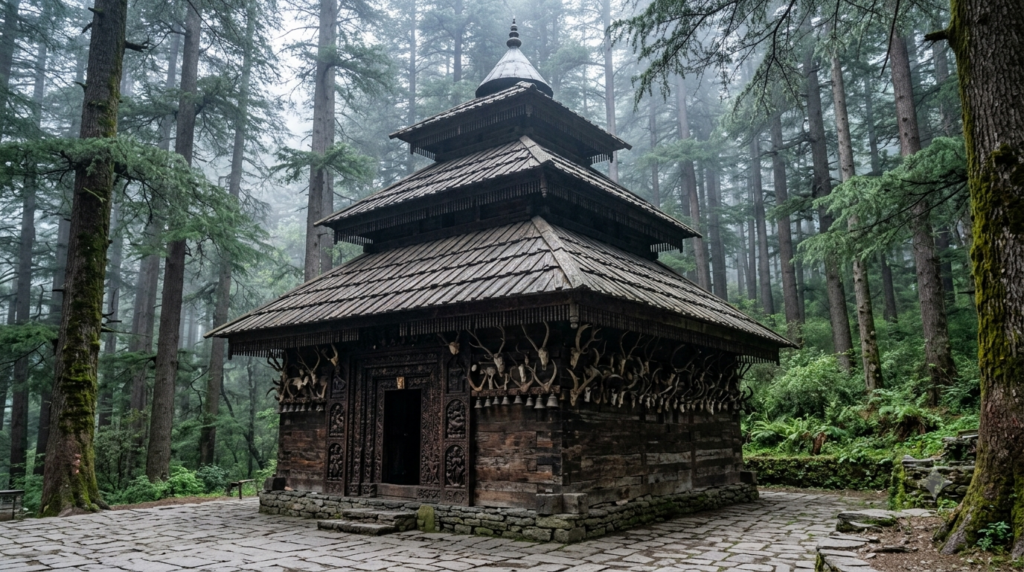
A Hidimba Devi Temple darshan begins with a walk into a cedar forest. There is no hill to climb and no ticket queue to join. The shrine sits about two kilometres from Manali’s Mall Road, inside the Dhungiri Van Vihar deodar grove. It opens daily from 8:00 AM to 6:00 PM, and entry costs nothing.
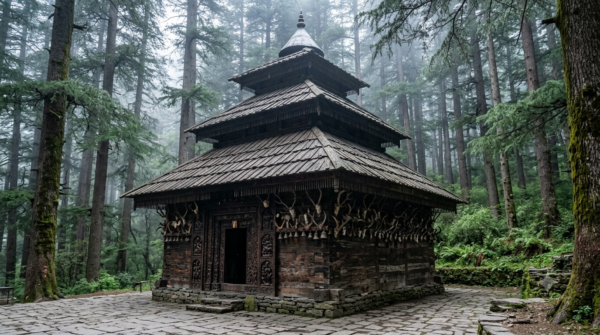
What surprises most first-time visitors is that no idol stands inside. Devotees bow instead to a rock bearing a footprint impression. A four-tiered wooden pagoda has sheltered that rock since 1553.
Independence note: Go Kshetra is an independent pilgrim guide. We are not affiliated with the Hidimba Devi Temple, the Archaeological Survey of India, or the Himachal Pradesh Government. We accept no bookings, donations, or payments. Timings and local rules can change at short notice, so confirm locally or through the official sources linked below.
Hidimba Devi Temple Darshan at a Glance
Here are the details most visitors check before a Hidimba Devi Temple darshan. The temple is a protected monument, not a managed devasthanam. So its practical rules differ sharply from the big South Indian shrines.
| Detail | Current position |
|---|---|
| Location | Dhungiri Van Vihar, Dhungri, Manali, Kullu district, Himachal Pradesh |
| Other names | Hadimba Temple, Dhungri Temple, Dhungiri Temple |
| Distance from Mall Road | About 2 km, a 25 to 30 minute walk uphill |
| Opening hours | 8:00 AM to 6:00 PM, daily |
| Entry fee | Nil; a small camera charge may apply locally |
| Built | 1553 CE, by Maharaja Bahadur Singh of Kullu |
| Height | About 24 metres, four-tiered pagoda |
| Protection status | Monument of National Importance, ASI Shimla Circle |
| Main festival | Dhungri Mela, mid-May, three days |
The single most useful number here is the walking distance. The temple sits only 2 km from the town centre. So you need neither a full day nor a booked vehicle. A morning slot of about two hours covers travel, darshan and the forest walk comfortably.
Hidimba Devi Temple Darshan Timings and Entry Fee
The temple opens at 8:00 AM and closes at 6:00 PM, every day of the year. No entry ticket exists. Doors stay open through the afternoon, without the midday break that many Indian temples keep. Winter snow occasionally shortens access, though the published schedule itself does not change seasonally.
Is there any ticket, pass, or online booking?
No. There is no darshan ticket, no VIP queue, no seva counter, and no official online booking system for this shrine. Anyone may walk in during opening hours.
If a website offers to sell you a paid Hidimba Devi Temple darshan ticket, treat that as a warning sign. Nobody has ever charged entry here. Manali attracts heavy package-tour traffic. So touts occasionally bundle this free stop into a paid itinerary, then present it as an entry charge.
Camera and photography rules
Photography rules during a Hidimba Devi Temple darshan are simple. Attendants do not allow cameras inside the sanctum, and they enforce that firmly. The outer complex, the carved doorway, and the forest are all fair game for photographers. Attendants sometimes collect a nominal charge for still or video cameras, so keep small change handy.
Are there facilities for elderly or differently-abled visitors?
Partly. The approach path is paved but slopes upward, while the courtyard around the shrine is uneven stone. Wheelchair movement gets difficult without help. Vehicles can drop passengers reasonably close to the entrance, which shortens the walk considerably.
How to Reach Hidimba Devi Temple Darshan from Manali
Manali is the base for every Hidimba Devi Temple darshan route. Once you are in town, the temple is a short local hop rather than a journey. The real planning question is how you reach Manali itself.
By air
The nearest airport is Bhuntar, also called Kullu-Manali Airport, roughly 50 km south of Manali town. Taxis and buses run the route, and the drive usually takes 1.5 to 2 hours. Flights here are weather-sensitive. So many travellers still prefer to fly into Chandigarh and drive up.
By train
There is no railway station at Manali. Joginder Nagar is the closest narrow-gauge railhead. Chandigarh is the practical broad-gauge option at roughly 300 to 310 km, while Ambala and Una also serve as boarding points. From any of these, the onward leg runs by road.
By road
Road access is the most common route by far. Himachal Road Transport Corporation buses and private operators run overnight services from Delhi and Chandigarh. The Chandigarh to Manali stretch takes roughly 8 to 10 hours. Landslides during monsoon can stretch that further, so build slack into a monsoon plan.
From Mall Road to the temple gate
From Mall Road, walk or ride up Hadimba Temple Road for about 2 km. Autos and taxis are readily available, and the fare is short-distance. If you walk, allow 25 to 30 minutes, because the gradient is gentle but continuous. The last stretch runs through deodar forest and is genuinely pleasant on foot.
What Happens During Hidimba Devi Temple Darshan, Step by Step
A Hidimba Devi Temple darshan follows a simple sequence. Knowing it saves you from hesitating at the gate.
- Enter through the forest gate and follow the paved path to the courtyard.
- Ring the bells at the entrance, since announcing your arrival to the goddess is the local custom.
- Remove footwear before stepping into the shrine area, and leave it at the designated spot.
- Join the short queue at the wooden doorway; on ordinary weekdays this takes only a few minutes.
- Step inside the cave chamber and offer prayers at the rock bearing the footprint impression.
- Walk the courtyard afterwards to see the carved facade, the antlers, and the pagoda roofs.
- Continue about 70 metres to the small open shrine of Ghatotkacha, son of Hidimba and Bhima.
Most visitors finish in 30 to 45 minutes. Add another half hour if you plan to sit in the forest afterwards. That is what turns a quick stop into a memorable one.
Why This Shrine Looks Nothing Like a Typical Temple
Hidimba Devi Temple is a pagoda, not a shikhara or gopuram temple. Three tiers of timber-tile roofs rise above a stone base. A conical metal roof caps the structure at roughly 24 metres. Builders raised the whole thing around a natural rock outcrop, so the cave itself serves as the sanctum.
The carved doorway is the piece art historians single out. Sixteenth-century Kullu artisans worked images of Durga, the Navagraha, dancers, animals, and floral bands into the wooden frame. Look closely at the lintel before you step through, because most visitors miss the detail while queuing.
Animal horns and antlers on the outer walls also puzzle newcomers. They are offerings gathered over centuries. They reflect the older hill-deity traditions of the Kullu valley, which sit alongside mainstream Hindu practice rather than inside it.
The 1553 Story and the Mahabharata Link
Maharaja Bahadur Singh, ruler of Kullu, commissioned the present structure in 1553 CE. That makes the building itself more than 470 years old. Yet the site drew veneration long before, as the rock where the goddess is said to have meditated.
The Mahabharata connection explains the devotion. Hidimba, born into a rakshasa family, married Bhima after he defeated her brother Hidimb. Their son Ghatotkacha later became a warrior in the Kurukshetra war. Tradition holds that Hidimba withdrew to the Dhungri forest for penance once Ghatotkacha came of ruling age.
There she attained the status of a goddess, and devotees hold these accounts as matters of faith and regional tradition. Her standing in the valley remains striking today. The Kullu royal line regards Goddess Hidimba as its grandmother deity. Even the famous Kullu Dussehra procession waits for her chariot from Manali before it begins.
The Claim Most Travel Pages Still Get Wrong
Anyone researching a Hidimba Devi Temple darshan online meets this claim quickly. A large number of travel articles state that animal sacrifice still happens openly at this temple. That framing is out of date, and families planning a visit deserve the accurate picture.
The Himachal Pradesh High Court banned animal sacrifice at religious places statewide on 1 September 2014. It rejected a review plea later that month. The Supreme Court then granted interim relief in 2017. That order permits slaughter only inside a legally designated area, under municipal supervision.
Sacrifice as a public temple spectacle is therefore not what a visitor encounters today. Two other errors circulate widely. Some pages give the construction year as 1953 rather than 1553, and dozens of sites have copied that typo. Others place the temple 50 km from Manali, confusing the shrine with the distance to Bhuntar airport.
Dhungri Mela and the Festival Calendar
Plan a Hidimba Devi Temple darshan around mid-May and you will meet the valley’s biggest local fair. The Dhungri Mela, also called the Hadimba Devi Fair, marks the goddess’s birthday. It runs for three days, traditionally from 14 May. Palanquins carrying deities from surrounding villages arrive in procession, while Kullu Nati folk dancing continues throughout.
Navratri also brings heavier footfall and special worship. If you want crowds and colour, mid-May is unbeatable. If you want quiet, avoid those dates entirely. Exact fair dates shift slightly with the local calendar, so confirm the current schedule before booking travel around it.
Best Time for Hidimba Devi Temple Darshan, Season by Season
The temple stays open year-round, yet the experience changes sharply with the season. Use this comparison to match the visit to what you actually want.
| Season | Conditions | Best for |
|---|---|---|
| March to June | Roughly 10°C to 25°C, clear skies, peak season | Festival atmosphere, easy walking, long daylight |
| July to September | Monsoon rain, landslide risk on approach highways | Lowest crowds, greenest forest, flexible travellers |
| October to November | Crisp, dry, post-monsoon clarity | Photography, quieter darshan, comfortable weather |
| December to February | Cold, possible snow, occasional road blocks | Snow scenery, though plans need a buffer day |
October and November are the sweet spot for most pilgrims. Crowds thin out after the summer rush. The light through the deodars is at its best, and approach roads usually stay clear. May delivers the festival, but it also brings the year’s heaviest tourist load.
Health and Safety Notes for Hidimba Devi Temple Darshan
Manali sits at roughly 2,050 metres. Visitors arriving from the plains sometimes feel mild breathlessness on the first day. Give yourself a night to adjust before any strenuous walking. Carry drinking water, because the uphill approach is short but continuous.
Winter visitors should note that the stone courtyard turns slippery when wet or icy. Wear shoes with grip, since footwear comes off only at the shrine itself. Anyone with cardiac, respiratory, or mobility conditions should consult a doctor before a Himalayan trip. Keep regular medication in hand luggage rather than checked bags.
One further caution applies to the forest. Dhungiri Van Vihar is a working woodland with uneven ground and exposed roots. Keep young children within reach, and avoid straying from marked paths after dusk.
What to Combine With Your Visit
Pair your Hidimba Devi Temple darshan with these nearby stops. Distances run from the temple gate:
- Ghatotkacha shrine, about 70 metres, an open platform under a large deodar
- Van Vihar forest park, a few hundred metres, boating and shaded walking paths
- Old Manali, roughly 2 km, cafes, handicraft shops, and the Manu Temple
- Vashisht hot springs, about 3 km across the Beas, natural sulphur baths
- Jogini waterfall trail, roughly 3 to 4 km, a short hike from Vashisht
- Solang Valley, about 13 km north, adventure activities and a ropeway
A practical sequence is temple first at opening time, then Old Manali for breakfast, then Vashisht by mid-morning. That order keeps you ahead of the tour buses, which typically reach the temple between 11 AM and 4 PM.
Building a wider Himachal itinerary? Our guides to Jakhoo Temple in Shimla and the Baijnath Shiva temple in Kangra cover two more northern shrines. Chamunda Devi near Dharamshala completes that circuit.
Insider Tips Most Manali Guides Skip
These are the details that lift a Hidimba Devi Temple darshan above a ten-minute photo stop.
- Arrive at 8:00 AM sharp. The first hour stays close to empty, while the courtyard fills after 10:30 AM.
- Walk up rather than driving. Parking near the gate congests badly in season.
- Carry small denomination notes. Offerings, the camera charge, and local stalls all run on cash.
- Find the Ghatotkacha shrine before you leave, because most visitors never realise it is there.
- Dress warmly even in June. Under the deodar canopy the temperature drops several degrees.
- Skip weekends if you can. Saturday and Sunday footfall roughly doubles during tourist season.
- Give the doorway five minutes. The carved panels reward slow looking more than a photograph does.
Before You Go
A Hidimba Devi Temple darshan asks very little of you and gives back a great deal. Entry is free, hours are generous, no booking exists, and the walk from Mall Road takes under half an hour. One decision genuinely shapes your visit: timing. Go at opening, or in the last hour before closing.
Treat everything volatile as provisional, because camera charges, fair dates, and winter road conditions all shift. For authoritative background, see the Ministry of Tourism entry for the Hidimba Temple on Incredible India. The Archaeological Survey of India protects the monument through its Shimla Circle. The Kullu district administration posts local advisories.
Frequently Asked Questions
Do I need to book Hidimba Devi Temple darshan in advance?
No booking exists, and none is needed. The temple has no ticketing system, no online portal, and no advance registration. Simply arrive between 8:00 AM and 6:00 PM on any day of the year. Then join the short queue at the entrance.
What are the Hidimba Devi Temple timings?
Hidimba Devi Temple darshan hours run from 8:00 AM to 6:00 PM daily, without a midday closure. Heavy snowfall occasionally shortens access in deep winter. The published schedule itself does not change seasonally. Arriving in the first hour gives the calmest experience.
Is there an entry fee at Hidimba Devi Temple?
Entry is free for everyone. Attendants sometimes collect a nominal charge for still or video cameras, so carry small change. No other fee applies, and nobody may sell you an entry ticket for this shrine.
Can I take photographs inside the temple?
You cannot photograph the sanctum where devotees worship the sacred rock. The exterior is open to photographers, including the carved doorway, the pagoda roofs, and the surrounding deodar forest. Attendants will stop you if you raise a camera indoors.
Is there a dress code?
No dress code applies, though modest clothing covering shoulders and knees is the respectful norm. Footwear comes off before you enter the shrine area. Given the altitude and forest shade, layered warm clothing makes sense in almost every season.
How far is the temple from Manali Mall Road?
About 2 km, which means a 25 to 30 minute uphill walk or a five to ten minute ride. Autos, taxis, and shared cabs all run the route along Hadimba Temple Road. Many visitors walk up and ride back down.
Is animal sacrifice still performed at the temple?
Not as a public practice. The Himachal Pradesh High Court prohibited animal sacrifice at religious places in September 2014. A 2017 Supreme Court interim order allows it only in a legally designated area. Visitors today will not encounter it as part of ordinary darshan.
What is the best month to visit?
October and November suit most pilgrims. The weather is dry, crowds have thinned, and the forest light is at its best. May offers the Dhungri Mela and its processions, yet it also brings the year’s heaviest tourist traffic to Manali.
Is the temple suitable for elderly visitors?
Broadly yes, with a caveat. The walk from a drop-off point is short, though the courtyard is uneven stone and the path slopes. Vehicles can approach fairly close, so plan a drop-off if mobility is limited. Also allow a day to acclimatise to the altitude first.