
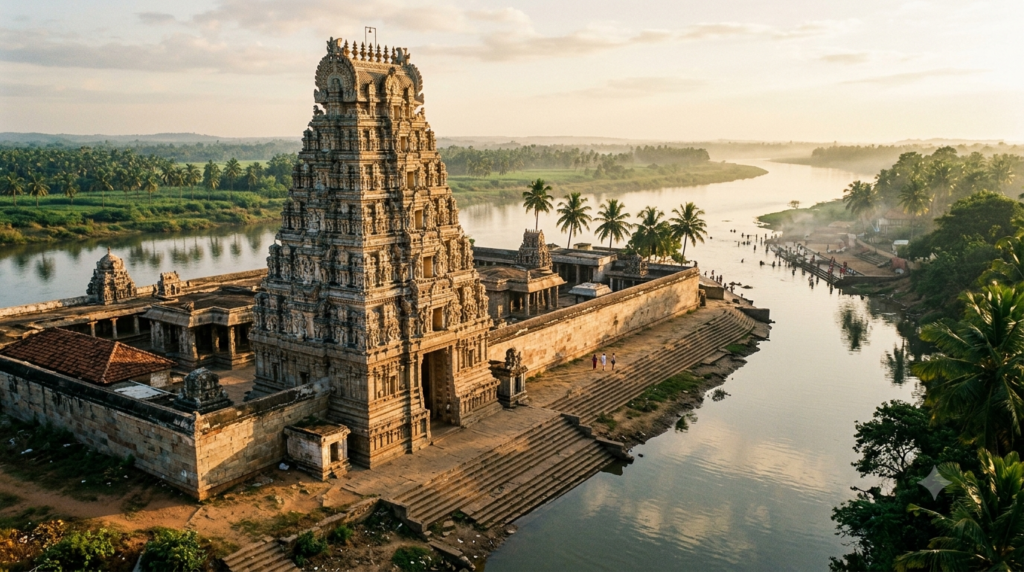
Amaravati Temple Guntur Darshan begins with an address that most websites still get wrong. The temple town sits in Palnadu district today, not Guntur district. Andhra Pradesh redrew its map on 4 April 2022, so Amaravathi mandal moved out of Guntur altogether. Guntur is still the nearest big city, which is why the old name survives in search results.
That single detail matters more than it sounds, because a second Amaravati now exists roughly 35 km downstream. Read on and you will get verified timings, honest fee guidance, the real airport distance, and a plain answer on online booking.
Go Kshetra is an independent pilgrim guide. We are not affiliated with, endorsed by, or the official website of Sri Amareswara Swamy Temple or the Andhra Pradesh Endowments Department. We accept no bookings, donations, or payments of any kind. Use the official AP Endowments temple page for official information.
Amaravati Temple Guntur Darshan at a Glance
Sri Amareswara Swamy Temple, also called Amaralingeswara Swamy Temple or Amararama, stands on the southern bank of the Krishna River. It is one of the five Pancharama Kshetras of Andhra Pradesh. Entry for general darshan is free, and no dedicated online booking system exists for this temple.
| Detail | What to expect |
|---|---|
| Temple name | Sri Amareswara Swamy (Amararama) |
| Location | Amaravathi town, Palnadu district |
| PIN code | 522020 |
| General darshan | Free for all devotees |
| Deity | Shiva as Amareswara; consort Bala Chamundika |
| Lingam | White marble, about 15 feet tall |
| Nearest railhead | Pedakurapadu, roughly 19 km |
| Nearest airport | Gannavaram, roughly 58 km |
| Online booking | Not available; counter only |
Because fee and timing details shift without public notice, treat every number below as a planning estimate. Confirm at the temple counter on the day you travel.
Two Amaravatis: The Mistake That Costs Pilgrims an Hour
Andhra Pradesh has a capital city called Amaravati and a temple town called Amaravathi. They are not the same place. The greenfield capital is rising near Thullur, closer to Vijayawada and inside Guntur district.
The ancient temple town lies further upstream along the Krishna, inside Palnadu district. Parliament passed the Andhra Pradesh Reorganisation (Amendment) Bill in April 2026, giving the capital statutory status. Since then, map searches for “Amaravati” often surface the capital zone first.
So anyone planning Amaravati Temple Guntur Darshan should type “Sri Amareswara Swamy Temple, Amaravathi 522020” into the navigation app rather than just the town name. Drivers unfamiliar with the area sometimes head to the secretariat complex instead. That detour adds thirty to forty minutes each way.
The district change is also worth knowing if you plan to file a complaint or check administrative notices. Those now sit with Palnadu district administration, not Guntur.
Amaravati Temple Guntur Darshan Timings: Why Every Site Lists Something Different
Published timings for Amaravati Temple Guntur Darshan disagree wildly across the internet. You will find 6:00 AM to 9:00 PM on one page, 9:30 AM to 1:30 PM on another, and 4:00 AM openings elsewhere. None of these carry a dated official stamp, so none deserve blind trust.
The pattern that most sources agree on is a morning session and an evening session, with a long midday break. Plan around roughly 6:00 AM to midday, then roughly 4:00 PM to 8:00 PM. Arrive before 8:00 AM if you want a calm darshan.
Timings stretch during Maha Shivaratri and Karthika Masam, when the temple often stays open far longer. Conversely, abhishekam windows can block general queues for short stretches. Ring ahead through the official portal listing if your schedule is tight.
How to check timings the reliable way
Skip the aggregator pages entirely, because they copy each other rather than the temple. Instead check the AP Endowments listing for this temple shortly before you leave. Local Telugu news also carries festival timing notices, and those tend to be accurate.
Entry Fees, Sevas and What You Actually Pay
General entry for Amaravati Temple Guntur Darshan costs nothing. That has been consistent across every source, and no credible report suggests otherwise. Special darshan and arjitha sevas carry modest counter charges instead.
Widely repeated figures include roughly ₹50 for special darshan per person, and low hundreds for abhishekam or archana. These numbers circulate on travel sites without any dated official circular behind them, so treat them as indicative only. Endowments temples revise seva rates periodically, and small shrines rarely publicise the change.
Carry cash in small denominations, since counter card facilities at smaller endowments temples remain patchy. ATMs in Amaravathi town are few and empty out during festival weekends. Withdraw in Guntur or Vijayawada before you drive down.
Free annadanam is generally offered during the day, with tokens handed out at the temple premises. Availability depends on the day and the crowd, so do not build your travel plan around it.
Can You Book Amaravati Temple Guntur Darshan Online?
No. There is no official online booking portal for Amaravati Temple Guntur Darshan, and no app that reserves a slot here. Darshan and sevas are handled at the temple counter on arrival. Temple rooms are also allotted at the counter, not online.
This is where the internet actively misleads pilgrims. Several aggregator pages publish confident step-by-step instructions telling you to create an account, pick a slot, and pay by card for this temple. Those steps describe a system that does not exist here.
The AP Endowments portal does run genuine online booking, though only for a subset of larger temples such as Simhachalam, Annavaram, Srisailam and Srikalahasti. Amararama is not currently among them. Its page on the portal is an information listing rather than a booking engine.
How to spot a fake booking page
The Endowments department states plainly that it authorises no agents or third-party agencies for online booking of its services. So any site offering to reserve your darshan is not acting officially. Watch for these signals before you enter card details:
- A domain that is not a genuine government address ending in gov.in
- A helpline number presented as a booking line, often a mobile number
- A “processing fee” or “service charge” for a free darshan
- Requests for card, CVV or OTP details over phone or WhatsApp
- Confident pricing with no dated source or official circular cited
If a page asks for payment before you have reached a counter, close it. Losing an afternoon to a queue is annoying, while losing card details is far worse.
How to Reach Amaravati Temple Guntur Darshan
Road is the practical option for Amaravati Temple Guntur Darshan, because rail and air both leave you a long transfer. The temple sits about 32 to 35 km from Guntur and about 40 to 46 km from Vijayawada. Allow an hour from either city under normal traffic.
By road
APSRTC runs frequent buses from Guntur, and services from Vijayawada are regular too. Fares stay low, and journey time runs around an hour. Private taxis and app cabs work from both cities, though return availability from Amaravathi thins out after dark.
By train
Pedakurapadu (station code PKPU) is the closest railhead at roughly 19 km, but it handles limited services. Guntur Junction, roughly 33 km away, is the practical railhead for most travellers. Vijayawada Junction is better still for long-distance trains, although it sits slightly further out.
By air
Vijayawada International Airport at Gannavaram is the nearest airport, at roughly 58 to 60 km. Older guides that quote 40 to 45 km understate the drive by a wide margin. Budget ninety minutes from the terminal, and more if you land during peak city traffic.
What You Actually See Inside the Temple
The white marble lingam here rises about 15 feet, which makes it the tallest among the Pancharama shrines. Priests climb a raised platform to perform abhishekam, so the ritual looks unlike anything at a standard Shiva temple. Devotees watch from below while the anointing happens overhead.
A reddish mark near the top of the lingam draws attention from almost every visitor. Tradition holds that the lingam kept growing until a nail was driven in to stop it, and that the stain records what followed. This is devotional tradition rather than documented history, and the temple presents it as such.
Four Dravidian gopurams mark the outer enclosure, and the complex rises across three levels on a small rise known as Krouncha Shaila. Sub-shrines along the circuit include Mahishasura Mardini, Veerabhadra, Kalabhairava, Anjaneya and Kumaraswamy. Bala Chamundika, the consort, has her own shrine.
Inscriptions on the walls run from the Kota chiefs through the Vijayanagara period, and Krishnadevaraya is among the names recorded. Vasireddy Venkatadri Naidu, zamindar of Chintapalli, carried out the major renovation in 1796. Walk the prakaram slowly, since the epigraphy is easy to miss.
Amaravati Temple Guntur Darshan Dress Code and Facilities
Traditional attire is expected, and short dresses are not permitted for men or women. Dhoti or pancha for men and saree or salwar for women fit the setting comfortably. Cotton beats synthetic fabric here, because the riverside humidity builds quickly.
Footwear comes off before the enclosure, and stands are available near the entrance. Photography is generally tolerated in outer areas but restricted near the sanctum, so follow posted signage rather than assuming. Mobile phone rules can tighten during festival days.
Facilities are modest compared with major pilgrimage centres. Around fifteen devasthanam rooms exist within the premises, allotted at the counter when available. Most visitors stay in Guntur or Vijayawada instead, where the hotel range is far wider.
Festivals Worth Timing Your Visit Around
Maha Shivaratri is the biggest event by a distance, and the temple fills through the night. Karthika Masam brings heavy weekend crowds, especially on Mondays. Navaratri and Kalyanotsavam also draw large gatherings.
Krishna Pushkaralu, the river festival observed roughly every twelve years, transforms the ghats entirely. If your visit coincides with one, expect crowd control measures and altered access routes. Book accommodation weeks ahead in that case.
Ordinary Saturdays, Sundays and Mondays are busier than midweek days, since Mondays carry particular significance for Shiva worship. Choose a Tuesday or Wednesday morning if a quiet darshan matters to you. Festival dates follow the lunar calendar, so verify them before booking travel.
Safety Notes for the Steps, the River and the Heat
The temple stands on a rise, so reaching the main enclosure involves steps. The climb is short and manageable for most people, though elderly pilgrims and anyone with knee or cardiac trouble should pace it. Handrails are not continuous along the whole route.
Summer temperatures between April and June regularly turn punishing by mid-morning. Carry water, wear a cap for the walk between the parking area and the gopuram, and avoid the afternoon slot entirely. Heat exhaustion is a real risk on the open riverside stretch.
Krishna River ghats sit beside the temple, and many devotees take a ritual dip there. Currents and drop-offs vary with the season and with upstream releases, so keep children away from the deeper steps. Nothing about a holy dip removes the need for ordinary water safety.
Rituals and remedies performed here are matters of faith and tradition. They are not substitutes for medical treatment, and anyone fasting with a health condition should speak to a doctor first.
Nearby Places Worth Adding to the Trip
Amaravathi rewards a half-day rather than a quick stop, because Buddhist and Hindu heritage sit side by side here. The Amaravati Mahachaitya stupa lies about 1.5 km away and is protected by the Archaeological Survey of India. Its sculptural style influenced Buddhist art across South and Southeast Asia.
The site museum next door holds recovered railings and friezes, and it takes about forty minutes. Dhyana Buddha statue and the riverside ghats sit within a short drive. Mangalagiri Panakala Narasimha Swamy Temple and Vijayawada Kanaka Durga Temple are each roughly 37 km away.
A workable single-day plan runs temple first at dawn, stupa and museum by late morning, then lunch in Guntur. Add Undavalli Caves if you are returning towards Vijayawada. That sequence keeps you out of the midday sun.
Planning Amaravati Temple Guntur Darshan Within the Pancharama Circuit
Amaravati Temple Guntur Darshan is one leg of the Pancharama yatra, which links five Shiva shrines across Andhra Pradesh. The other four cluster in the Godavari region, while this one stands alone on the Krishna. That geography shapes how the circuit is usually sequenced.
Most pilgrims start here, then travel east towards the Godavari group over two or three days. You can pair it with our guides to Draksharamam Temple darshan, Kumararama at Samarlakota, and Somarama at Bhimavaram. Ksheerarama at Palakollu completes the set.
Doing all five in one stretch takes roughly three days by car. Attempting it in two leaves almost no time at any shrine. Since the Godavari four sit relatively close together, the long leg is always the one to or from Amaravathi.
What Most Guides Get Wrong About Amaravati Temple Guntur Darshan
Several claims repeat endlessly online, and almost none of them survive checking:
- The Guntur district address, superseded on 4 April 2022
- Airport distance quoted as 40 to 45 km, when Gannavaram is nearer 58 km
- Step-by-step “online booking” instructions for a counter-only temple
- Links routing readers to the Tirumala portal, which has no role here
- Exact seva prices stated as current with no dated source behind them
A few practical habits will save you trouble on the day. Reach before 8:00 AM, because both the crowd and the heat build fast. Keep the address with the PIN code handy so navigation apps do not send you towards the capital zone.
Ask at the counter about the abhishekam viewing window when you arrive, since watching the platform ritual is the distinctive experience here. Finally, allow time on the ghats rather than rushing straight back.
Before You Go
Amaravati Temple Guntur Darshan needs less planning than most major shrines, precisely because there is nothing to book. Turn up in the morning, walk in free, and pay at the counter only if you want a special darshan or seva. The real preparation is logistical rather than administrative.
Get the district and address right, budget an hour of road time from Guntur or Vijayawada, and carry cash. Combine the temple with the stupa so the journey earns its distance. Verify timings and any fee on the official Endowments listing shortly before you travel, since those are exactly the details that drift.
Frequently Asked Questions
Is Amaravati Temple in Guntur district or Palnadu district?
The temple town of Amaravathi has been in Palnadu district since 4 April 2022, when Andhra Pradesh reorganised its districts. Guntur remains the nearest major city at roughly 32 to 35 km, which is why the older Guntur address still circulates widely online.
Is there an entry fee for Amaravati Temple Guntur Darshan?
General darshan is free for all devotees. Special darshan and sevas such as abhishekam or archana carry modest counter charges, commonly reported around ₹50 upwards. Because rates are revised periodically without wide publicity, confirm the current amount at the counter.
Can I book darshan tickets online for this temple?
No official online booking exists for this temple. Tickets and sevas are issued at the temple counter on arrival. Pages offering online reservation are not operating officially, and the Endowments department states that it authorises no agents for booking its services.
What are the Amaravati Temple Guntur Darshan timings?
Sources disagree, so treat published timings cautiously. The consistent pattern is a morning session from roughly 6:00 AM to midday and an evening session from roughly 4:00 PM to 8:00 PM. Hours extend during Maha Shivaratri and Karthika Masam.
How far is the temple from Vijayawada airport?
Vijayawada International Airport at Gannavaram is roughly 58 to 60 km from the temple, which works out to about ninety minutes by road. Many older guides understate this as 40 to 45 km, so budget the longer figure when planning a same-day flight connection.
Are rooms available at the temple?
Around fifteen devasthanam rooms exist within the premises, allotted at the counter subject to availability. There is no online room booking system for this temple. Most visitors stay in Guntur or Vijayawada, where hotel choice and quality are considerably better.
What is the dress code?
Traditional and modest clothing is expected, and short dresses are not permitted. Dhoti or pancha suits men, while saree or salwar kameez works for women. Footwear is removed before the enclosure, so carry socks if the stone gets hot.
How much time should I allow for Amaravati Temple Guntur Darshan?
Allow about an hour inside the temple on an ordinary weekday, and two hours or more during festivals. If you add the Mahachaitya stupa and the museum, plan a half day in Amaravathi. Adding the Krishna ghats stretches it to a comfortable full morning.