
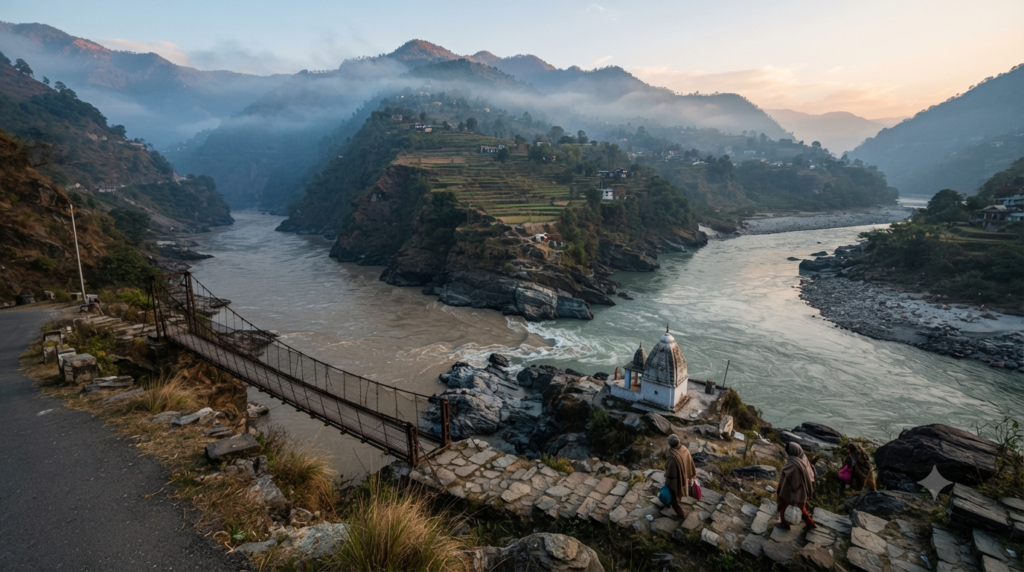
Rudraprayag darshan timings are the first detail most pilgrims check before a Garhwal trip. The town sits at roughly 895 m, where the Mandakini joins the Alaknanda. So nearly every Kedarnath and Badrinath route passes through it.
The town shrines are small, free and locally managed. That is exactly why fixed Rudraprayag darshan timings are hard to pin down.
This guide gives the hours pilgrims actually rely on. It also covers real road distances and the registration rule that catches visitors out.
Go Kshetra is an independent pilgrimage guide. We are not affiliated with, endorsed by, or the official website of any temple, trust, or the Uttarakhand government. We do not take bookings, donations, or payments. For registration and official notices, use the official portals linked in this guide.
Rudraprayag Darshan Timings at a Glance
Here is the short version of Rudraprayag darshan timings, so you can plan the day.
- Town shrines open around sunrise and close at dusk, because priests follow daylight rather than a printed schedule.
- Koteshwar Mahadev usually keeps a midday break, so the safest windows are early morning and late afternoon.
- No entry fee applies at any Rudraprayag town temple. Donations stay voluntary.
- No online booking exists for these shrines, although Char Dham registration is compulsory if you continue to Kedarnath.
- Rudraprayag town stays reachable all year, while the high shrines in the district close for winter.
One line worth remembering: Rudraprayag darshan timings follow daylight at free, walk-in shrines. The Kedarnath leg of the same district needs a registered e-pass.
Rudraprayag Darshan Timings Temple by Temple
Three shrines matter most to a visitor with one day in hand. Rudraprayag darshan timings differ at each, so treat the hours below as the practical pattern.
Rudraprayag Darshan Timings at the Sangam Temple
The Rudranath Temple stands beside the confluence itself, a short walk down from the main road. Local tradition ties the spot to Lord Shiva appearing before sage Narada in his Rudra form. The town takes its name from that story.
In practice the shrine opens with first light and closes after the evening lamps. So a 6 AM to 7 PM window covers almost every visit.
No temple committee publishes a fixed daily schedule for this shrine. If you want a specific aarti, ask at the temple in the morning. The priest sets the evening timing by season.
Rudraprayag Darshan Timings at Koteshwar Mahadev
Koteshwar Mahadev has the one widely reported schedule near Rudraprayag. Darshan runs roughly 6:00 AM to 12:00 noon, then 2:00 PM to 5:00 PM. It sits about 3 km from the town centre, above the Alaknanda. The cave lies at the foot of a stairway of around 100 steps.
Because the last stretch is a descent and then a climb back, allow 45 minutes even for a quick darshan. Water seeps naturally onto the shivling inside the cave, which is the detail most visitors remember. Sawan and Maha Shivratri bring heavy local crowds, so start earlier on those days.
Rudraprayag Darshan Timings at Dhari Devi
Dhari Devi sits about 19 km from Rudraprayag on the Srinagar road. Devotees across Garhwal treat her as the guardian of the yatra route. The shrine now stands on a raised platform above the Alaknanda after the 2013 relocation. Doors open early and stay open into the evening, with the aarti drawing the biggest gathering.
Navratri and Amavasya days run special worship, so expect slow queues then. Most travellers fold this stop into the drive between Srinagar and Rudraprayag rather than making a separate trip.
Rudraprayag Darshan Timings, Fees and Distances Compared
The table below sets Rudraprayag darshan timings against fees and real road distances.
| Shrine | Typical hours | Entry fee | From Rudraprayag town |
|---|---|---|---|
| Rudranath Temple (sangam) | Approx. 6 AM to 7 PM, daylight based | None | In town |
| Koteshwar Mahadev | Approx. 6 AM to 12 noon, 2 PM to 5 PM | None | About 3 km |
| Dhari Devi | Early morning to evening aarti | None | About 19 km |
| Kartik Swami | Daylight only, trek access | None | About 40 km plus 3 km trek |
| Kedarnath | Seasonal, roughly April to November | None, registration required | About 70 km plus 16 km trek |
None of these shrines charge an entry ticket. The costs on a Rudraprayag day trip come from transport, not from darshan.
The Rudranath Mix-Up Competing Guides Repeat
Search results blur two different shrines with the same name, and that error sends people to the wrong valley. The Rudranath at Rudraprayag is a small riverside temple in the town, reachable by car in minutes.
The other Rudranath belongs to the Panch Kedar circuit. It stands at roughly 3,600 m in Chamoli district. Reaching it needs a demanding trek from Sagar village near Gopeshwar. So if a page promises a Panch Kedar shrine at the Rudraprayag confluence, it has merged two temples into one.
Check the district name before you trust any itinerary. Rudraprayag district and Chamoli district sit next to each other. The travel effort between these two Rudranaths, though, is a world apart.
Entry Fees and Booking: What You Actually Pay
There is no entry fee at the Rudraprayag temples, and no ticket counter to queue at either. Priests accept voluntary offerings for upkeep and for sankalp pujas, and the amount stays your decision.
Also, no genuine online booking system exists for these shrines. Treat any website offering paid darshan slots for Rudraprayag town temples as a red flag. No authority sells such access here.
Arrange any special puja face to face after you arrive. Ask for a receipt when you donate.
Carry cash. ATMs thin out sharply beyond Rudraprayag, while mobile networks drop in and out along the Mandakini valley.
The Kedarnath Registration Rule Most Visitors Miss
Kedarnath lies inside Rudraprayag district, so this affects far more visitors than the town shrines alone. Uttarakhand makes Char Dham registration compulsory for every pilgrim, and checkpoints scan the QR e-pass along the route.
Registration costs nothing. You can complete it free on the state portal at registrationandtouristcare.uk.gov.in. The Tourist Care Uttarakhand app and counters such as Sonprayag also work.
Aadhaar authentication applies, so keep the card handy. Offline counters also operate at Haridwar and Rishikesh for anyone who could not register earlier.
For 2026 the Kedarnath portals opened on 22 April, a date the Shri Badrinath-Kedarnath Temple Committee announced on Maha Shivratri. The winter closing usually falls on Bhai Dooj, which points to around 11 November 2026. Still, the committee confirms it only on Vijayadashami. Check badrinath-kedarnath.gov.in before fixing your dates.
Best Rudraprayag Darshan Timings by Season
Season changes Rudraprayag darshan timings more in practice than any temple rule does. April to June brings clear mornings, full yatra traffic and the widest choice of transport.
September to November is the quieter half of the season. Skies clear after the monsoon, crowds thin once the Kedarnath doors close, and hotel rates fall. Early morning still wins, because hill fog lifts by about 8 AM. The light on the confluence also peaks then.
July and August bring heavy rain, landslides and sudden road closures on the Rishikesh-Rudraprayag stretch. Travel is possible, though schedules slip constantly. December to February stays open in the town itself. Snow shuts the higher shrines, while dawn temperatures drop close to freezing.
How to Reach Rudraprayag
By Air
Jolly Grant Airport near Dehradun is the closest airport, about 160 km away. From there a taxi takes roughly six to seven hours, since the road climbs steadily after Rishikesh. Book the transfer before you land during peak yatra weeks, as cabs get scarce by afternoon.
By Train
Yog Nagari Rishikesh is the nearest useful railhead, about 140 km from Rudraprayag. Haridwar works as an alternative with far more long-distance trains. Shared jeeps and state buses leave Rishikesh from early morning. Aim to depart before 8 AM, so you arrive in daylight.
By Road
Road travel remains the practical option. Rudraprayag lies on NH-7 between Devprayag, Srinagar and Guptkashi, and Uttarakhand Transport buses run through it daily. Hill drivers stop after dusk, though, so plan every leg to finish before dark.
Real Distances From Rudraprayag Town
Several popular pages understate these distances badly, which wrecks a one-day plan. Here are the road figures that hold up.
- Koteshwar Mahadev: about 3 km, roughly 10 minutes.
- Dhari Devi: about 19 km towards Srinagar.
- Kartik Swami: about 40 km by road to Kanakchauri, then a 3 km ridge trek.
- Guptkashi: about 45 km on the Kedarnath road.
- Sonprayag: about 70 km, not 10 km as several guides claim.
- Chopta and the Tungnath base: about 70 km.
- Triyuginarayan: about 80 km, reached by a 12 km link road from Sonprayag.
- Kedarnath: about 70 km by road to Gaurikund, then a 16 km trek.
Triyuginarayan is the figure to double check, because a widely copied claim places it 14 km from Rudraprayag. It sits near Sonprayag instead, so treat it as a full day out or an add-on to the Kedarnath leg.
What to Expect on the Ground
Rudraprayag feels like a working town rather than a temple complex. The sangam sits below the main bazaar. The walk down involves uneven steps and a suspension bridge over the water.
Dress modestly and remove footwear at the shrine doors. Photography is generally accepted at the confluence, although you should ask before shooting inside any sanctum.
A safety note matters here. Steps at both the sangam and Koteshwar turn slippery in the rain. The river current also runs strong where it looks calm, while the onward Kedarnath trek climbs to 3,583 m.
Anyone elderly, pregnant, or living with a heart or breathing condition should ask a doctor before the high-altitude legs. No ritual or remedy replaces medical care.
What Beginners Get Wrong About Rudraprayag Darshan Timings
Most wasted days come from three assumptions about Rudraprayag darshan timings rather than from bad luck.
First, people plan a midday darshan at Koteshwar and arrive during the break. Go before 11 AM or after 2 PM instead. Second, travellers treat Rudraprayag as a lunch halt and give it 40 minutes. The sangam plus Koteshwar realistically needs half a day.
Third, drivers on the Kedarnath run push through Rudraprayag without stopping, so an overnight here is worth considering. Rooms cost noticeably less than in Guptkashi or Sonprayag, and you still start the next morning fresh. If you plan to sleep closer to the shrine, our guide to Kedarnath dharamshala options covers the choices higher up.
If Your Plan Does Not Work Out
Darshan at the town shrines is effectively guaranteed, since nothing is ticketed or capped. The failures happen on the road and on the calendar.
Landslide closures are the common one. When NH-7 shuts, traffic waits rather than diverts, so keep a spare day in any monsoon itinerary.
If Kedarnath registration slots for your dates fill, shift that leg. Use Rudraprayag, Koteshwar and Dhari Devi as a full alternative day. Then register for the next available date on the state portal.
If the high shrines shut for winter, Ukhimath becomes the answer. The Kedarnath deity moves to Omkareshwar Temple there for six months. Pilgrims who arrive off season still get darshan, only at the winter seat. For the neighbouring confluence, our Vishnuprayag darshan guide covers the same planning ground in Chamoli district.
Before You Go
Rudraprayag darshan timings reward an early start, so treat the town as a half-day rather than a photo stop. Start at the sangam soon after sunrise. Reach Koteshwar before the midday break, and keep Dhari Devi for the drive in or out.
Register for Char Dham on the official portal if Kedarnath is on your route. Carry cash, and confirm road status the night before you travel. For district notices, the administration publishes updates at rudraprayag.gov.in. Another Shiva shrine worth pairing on the way up is covered in our Neelkanth Mahadev temple guide.
Frequently Asked Questions
What are the usual Rudraprayag darshan timings?
Rudraprayag darshan timings run roughly 6 AM to 7 PM at the sangam shrine. Koteshwar Mahadev keeps about 6 AM to 12 noon, then 2 PM to 5 PM. No temple board publishes a binding schedule, so confirm locally on arrival.
Is there an entry fee at Rudraprayag temples?
No entry fee applies at any Rudraprayag town temple. Darshan stays free, and offerings remain voluntary. Char Dham registration for the onward Kedarnath journey also costs nothing. Any site charging a fee for either one is not official.
Do I need to book darshan online for Rudraprayag?
No online booking exists for the Rudraprayag town shrines, because they operate as free walk-in temples. Special pujas get arranged in person with the priest. Only the Char Dham route needs a registration e-pass, which you obtain free on the Uttarakhand state portal.
How far is Sonprayag from Rudraprayag?
Sonprayag lies about 70 km from Rudraprayag by road, roughly two and a half to three hours in normal conditions. Several guides wrongly list it as 10 km. Gaurikund, the Kedarnath trek head, sits a few kilometres beyond Sonprayag.
Is the Rudranath here the same as the Panch Kedar Rudranath?
No, these are two different shrines. The Rudranath at Rudraprayag is a riverside temple in the town at about 895 m. The Panch Kedar Rudranath stands at roughly 3,600 m in Chamoli district. It needs a long trek from near Gopeshwar.
Do Rudraprayag darshan timings change in winter?
Yes, the town and its shrines stay accessible through winter. Nights turn very cold, though, and higher routes may close after snow. Kedarnath itself shuts for about six months, while worship shifts to Omkareshwar Temple at Ukhimath. Check road status before you set out.
How many days should I spend in Rudraprayag?
One full day suits the sangam, Koteshwar and Dhari Devi at a relaxed pace. Add a second day if Kartik Swami or Chopta interests you, since both involve a trek. Most Kedarnath travellers use Rudraprayag as a comfortable overnight halt.
Is Rudraprayag safe for solo and elderly travellers?
Rudraprayag is generally safe, with regular transport and a busy bazaar. Steps down to the confluence and to Koteshwar turn steep and slippery. Elderly visitors should take support, and avoid them after rain. Tell someone your route before any trek to outlying shrines.