
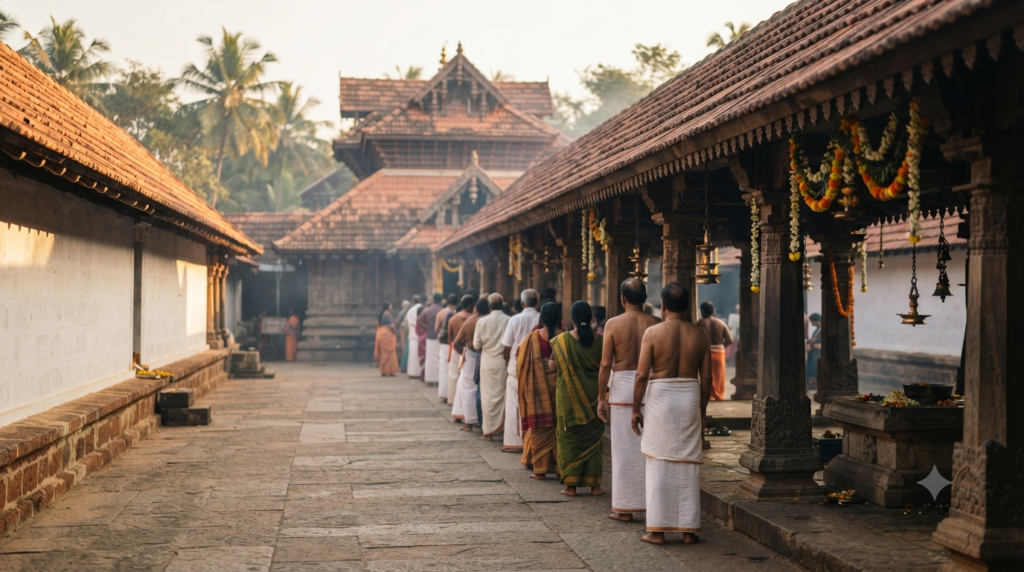
Mangaladevi Temple Mangalore Darshan is free, walk-in, and available every single day of the year, so no ticket, quota or advance booking stands between you and the Goddess. Yet most guides still get two things wrong about this shrine in Bolar. They publish a single unbroken timing block, and they hint at an online booking portal that does not exist. Both mistakes cost devotees a wasted trip.
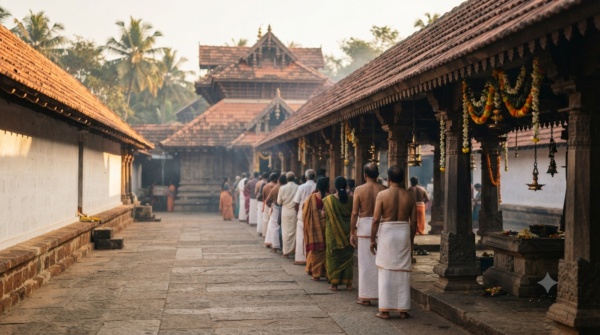
This Mangaladevi Temple Mangalore Darshan guide works from the temple’s own published notices, so you get the real pooja windows, the full official seva rate card, and the Navaratri 2026 dates as the temple itself lists them.
Go Kshetra is an independent pilgrimage guide. We are not affiliated with, endorsed by, or the official website of Mahatobara Shri Mangaladevi Temple. We accept no bookings, sevas, donations or payments. For anything transactional, use the official temple site linked below or the temple counter.
Mangaladevi Temple Mangalore Darshan at a Glance
- Full name: Mahatobara Shri Mangaladevi Temple, Bolar, Mangaluru 575001
- Deity: Goddess Mangaladevi, a form of Shakti, seated in the central shrine
- Entry fee: Free for all devotees, with no VIP or paid queue
- Open: All 365 days; three daily pooja anchors at 6:00 AM, 1:00 PM and 8:30 PM
- Online booking: None for darshan or seva; the official site handles donations only
- Sevas: Booked in person at the counter, priced from ₹2 to ₹2,50,000
- Peak season: Sharannavaratri, which begins 11 October 2026
Because the city itself takes its name from the Goddess, locals treat Mangaladevi Temple Mangalore Darshan as Mangaluru’s founding ritual. The Alupa king Kundavarma is credited with building it in the ninth century, under the guidance of the Nath saint Matsyendranath.
Mangaladevi Temple Mangalore Darshan Timings and Daily Pooja Schedule
The temple opens at 6:00 AM, and the night pooja closes the day at 8:30 PM. On Fridays the evening pooja shifts later, to 9:00 PM. Between those anchors the sanctum stays accessible through the day, although the middle hours run quieter.
| Pooja | Time | Note |
|---|---|---|
| Morning Pooja | 6:00 AM | Calmest darshan of the day |
| Afternoon Pooja | 1:00 PM | Precedes the Friday Annasantarpane |
| Evening Pooja | 8:30 PM | 9:00 PM on Fridays |
Those three timings come straight from the temple’s own timings page. Third-party listings that quote “6 AM to 10 AM, then 12 PM to 1 PM” describe an older or seasonal pattern, so treat them with caution.
The Karpura Arathi gap almost no guide mentions
Here is the detail that catches out first-time visitors. The temple’s official notice states that Karpura Arathi does not take place at the Mangaladevi Sannidhi between 9:00 AM and 1:00 PM, or between 6:00 PM and 8:30 PM.
You can still enter and take darshan during those hours. However, if the camphor arathi at the sanctum matters to you, plan around it. Arrive before 9:00 AM or between 1:00 PM and 6:00 PM instead.
That single rule explains why a mid-morning visit can feel oddly flat while a 7:30 AM visit feels complete. Nobody publishes it because nobody reads the notice board.
Entry Fee and Whether Mangaladevi Temple Mangalore Darshan Needs Booking
No. Mangaladevi Temple Mangalore Darshan carries no entry fee and needs no ticket, pass or advance reservation. Devotees simply join the queue during opening hours. The temple runs no paid quick-darshan tier, so a daily-wage worker and a business owner stand in the same line.
Sevas are the only paid element, and you arrange those at the temple counter on the day. Because the shrine sits inside the city rather than on a hill, even a peak-hour queue rarely swallows more than thirty minutes outside festival season.
Why Mangaladevi Temple Mangalore Darshan booking pages are a scam signal
The temple’s official website does carry an Online Services section. Read it closely, though, and it covers donations only — a bank transfer or UPI payment, followed by a form where you inform the temple office. There is no seva cart and no darshan slot picker.
So any third-party page offering to sell you a Mangaladevi darshan slot, a “special entry” pass, or a seva booking with a service fee is selling something the temple does not issue. Check three things before you pay anyone: the domain, whether the page names a real temple counter, and whether it demands a processing fee. Genuine temple payments end at the temple’s own account or its counter receipt.
The temple is a notified institution under Karnataka’s Hindu Religious Institutions and Charitable Endowments Department, listed as TM000105. That registration is your cross-check if a site claims official status.
Seva List and Rates for Mangaladevi Temple Mangalore Darshan
Darshan itself costs nothing, yet the temple publishes a strikingly granular rate card for sevas at the Mangaladevi Sannidhi. Rates start at ₹2 for a Hannukai Kanike and climb to ₹2,50,000 for the Dodda Rathotsava. Here are the sevas devotees ask about most often.
| Seva | Rate | Typically sought for |
|---|---|---|
| Karpura Arathi | ₹5 | A quick personal offering |
| Kunkumarchane | ₹40 | Devi worship with kumkum |
| Ashtottara Archane | ₹50 | 108 names of the Goddess |
| Vahana Pooja (two-wheeler) | ₹20 | Blessing a new vehicle |
| Vahana Pooja (four-wheeler) | ₹30 | Blessing a new vehicle |
| Devi Mahathme Parayana | ₹80 | Recitation of the Devi Mahatmya |
| Kalasha Snana (morning) | ₹100 | Ceremonial bathing ritual |
| Naga Thambila (morning) | ₹100 | Serpent worship |
| Vidyarambha (morning) | ₹200 | Starting a child’s education |
| Swayamvara Parvathi Pooja (night) | ₹350 | Marriage prayers |
| Nitya Maha Pooja | ₹500 | Full-day sponsorship |
| Sri Satyanarayana Pooja (individual) | ₹800 | Family thanksgiving |
| Shashwatha Pooja | ₹2,000 | A perpetual annual seva |
| Durga Homa | ₹12,500 | Major protective homa |
| Chandika Yaga | ₹30,000 | Seven-priest Devi yaga |
Rates change when the temple revises its list, so confirm at the counter before you pay. Note the Navaratri variant too: the Nitya Maha Pooja costs ₹500 on an ordinary day and ₹550 during Navaratri.
Choosing a seva without overspending
Devotees often assume a costlier seva carries more weight. Temple practice does not work that way, since intent matters more than the receipt. A ₹50 Ashtottara Archane is the standard choice for a routine visit.
Families marking a milestone usually pick Vidyarambha for a child aged two to five, or the Swayamvara Parvathi Pooja when a marriage is being sought. The Shashwatha Pooja at ₹2,000 works differently again. You pay once, then register the date you want the pooja performed each year.
Free Annadana and the Monthly Satyanarayana Pooja
Two recurring events deserve a place in your Mangaladevi Temple Mangalore Darshan planning, because both are free or near-free and neither appears on the aggregator sites.
Every Friday the temple serves Annasantarpane, a free community meal, from 12:45 PM to 2:30 PM. If you time a Friday visit around the 1:00 PM pooja, you can take darshan and then eat at the temple.
On the first Friday of each month, the temple performs a public Sri Satyanarayana Pooja at 12:00 noon. Joining the public version costs ₹100, against ₹800 for the same pooja performed individually. For most families that is the sensible route.
Donations towards Annadana above ₹100 go through the temple counter, and the office issues a receipt. The same applies to offerings of gold, silver, jewellery or sarees, so always collect the acknowledgement slip.
Navaratri 2026 Dates for Mangaladevi Temple Mangalore Darshan
Sharannavaratri is the temple’s biggest festival, and this is where Mangaladevi Temple Mangalore Darshan planning goes wrong most often. The temple’s own 2026-27 calendar sets out the schedule below.
| Observance | Date (2026) | Day |
|---|---|---|
| Sharannavaratri begins | 11 October | Sunday |
| Chouthi | 14 October | Wednesday |
| Lalitha Panchami | 15 October | Thursday |
| Moola Nakshatra, Sharada Pooja, night utsava begins | 16 October | Friday |
| Durgashtami | 19 October | Monday |
| Mahanavami | 20 October | Tuesday |
| Vijayadashami and Maha Rathotsava | 21 October | Wednesday |
| Avabhrutha Mangalasnana | 22 October | Thursday |
The one-day gap that ruins Rathotsava plans
Read that table against the all-India panchang and you will spot a mismatch. National calendars place Vijayadashami on Tuesday, 20 October 2026. The temple’s Tulunadu calendar places Mahanavami on 20 October and Vijayadashami with the Maha Rathotsava on Wednesday, 21 October.
Regional variance like this is normal, because temples follow their local panchangam. The practical consequence is not normal, though. A devotee who books travel for the widely published Dussehra date will reach Bolar a day before the chariot procession.
If the Rathotsava is your reason for travelling, plan for 21 October 2026 and confirm with the temple office closer to the date. Two other 2026 dates are worth noting: the Karthika Laksha Deepotsava on 2 December, and the Dhanurmasa pooja season opening on 17 December.
The annual Jatra Mahotsava in March 2027
Navaratri is not the only chariot festival here. The temple’s annual Jatra Mahotsava opens with Dhwajarohana on Thursday, 25 March 2027, and the Rathotsava follows on Monday, 29 March 2027. Shayanotsava and Avabhrutha Mangalasnana come on 30 March, with the Nemotsava of the parivara daivas on 31 March.
How to Reach Mangaladevi Temple in Bolar
Mangaladevi Temple Mangalore Darshan happens about three kilometres south-west of the city centre, in the Bolar locality. Because it is an urban shrine, getting there is genuinely easy.
By train
Mangaluru Central Railway Station lies roughly 3 to 4 kilometres away. An auto-rickshaw takes ten to fifteen minutes in normal traffic. City buses also run towards Bolar, so ask the conductor for the Mangaladevi stop.
By air
Mangaluru International Airport at Bajpe is about 14 to 15 kilometres from the temple. Prepaid taxis and app cabs wait outside the terminal. Allow 30 to 40 minutes, since city traffic thickens through the middle of the day.
By road
KSRTC and private buses connect Mangaluru with Bengaluru, Mysuru, Udupi and the coastal towns. Once you are in the city, any auto driver knows Mangaladevi. Parking near the temple is limited and fills fast during festivals, so an auto beats driving yourself on busy evenings.
Best Time for Mangaladevi Temple Mangalore Darshan
October to March is the comfortable window, when coastal Karnataka drops to mild, dry weather. Within the day, the 6:00 AM to 9:00 AM stretch gives you the quietest sanctum and a live Karpura Arathi.
Avoid the monsoon months of June to August if you dislike heavy rain, although the temple stays open throughout. Fridays draw larger local crowds, and Navaratri fills the premises from morning to late night.
A health note: Mangaluru is humid for most of the year, and festival queues mean long periods standing on stone floors. Carry water, and pace yourself if you are elderly, pregnant or managing a medical condition. Anyone planning a Navaratri fast should speak to a doctor first, particularly with diabetes or blood pressure in the picture. Temple rituals are matters of faith and tradition, not substitutes for medical treatment.
Dress Code and Etiquette for Mangaladevi Temple Mangalore Darshan
The temple enforces no strict dress code, yet coastal Tulu custom leans traditional. Men often remove upper garments before entering the inner area, as is common across Dakshina Kannada shrines. Women generally wear a saree or salwar kameez.
Leave footwear at the stand outside and switch off your phone camera near the sanctum. Panchakajjaya, a jaggery and coconut preparation, is the prasadam most associated with the shrine, and a Panchakajjaya offering costs ₹20.
If you plan to offer a saree or jewellery to the Goddess, do it through the counter so that the temple records it properly.
What Can Go Wrong With Mangaladevi Temple Mangalore Darshan
Free walk-in darshan is not the same as a guaranteed smooth visit. These are the realistic failure modes, with a fallback for each.
- You arrive between 9:00 AM and 1:00 PM expecting arathi. Karpura Arathi is paused at the Devi sannidhi then. Return after 1:00 PM, or come the next morning.
- Your seva needs a specific slot. Several sevas are morning-only or night-only. Reach the counter early and ask before you pay.
- You travelled for the Rathotsava on the wrong date. Use the temple calendar, not the national Dussehra date. Phone the temple office to confirm.
- Parking is full during Navaratri. Park near Mangaluru Central and take an auto for the last stretch.
- A website asks you to pay for darshan. Walk away, because darshan is free and the temple sells no entry tickets.
Nearby Temples and a One-Day Mangaluru Circuit
Bolar sits close enough to the rest of the city that you can build a satisfying day around Mangaladevi Temple Mangalore Darshan.
- Kudroli Sri Gokarnanatheshwara Temple — about 3 to 4 km, and the centre of Mangaluru Dasara. Our Kudroli Temple darshan guide covers its timings.
- Kadri Manjunatha Temple — roughly 5 km, known for its bronze Lokeshwara idol and hilltop tanks.
- St Aloysius Chapel — about 3 km, famous for its painted ceilings.
- Tannirbhavi Beach — around 10 km, best at sunset.
- Kateel Durgaparameshwari Temple — about 26 km north, a river-island Devi shrine.
Pilgrims heading further inland often continue to Dharmasthala, roughly 75 km away; our Dharmasthala darshan guide maps that leg. Coastal routes north lead to the Udupi Krishna Temple, about 55 km up the highway.
Insider Tips Locals Follow
- Come on the first Friday of a month. You catch the public Satyanarayana Pooja at noon and the free meal right after.
- Do vehicle pooja on a weekday morning. Weekend queues at the vahana pooja spot get long, and the seva costs only ₹20 or ₹30.
- Book Shashwatha Pooja for a family date. One ₹2,000 payment fixes an annual pooja on a day that means something to you.
- Carry small notes. Counter sevas are priced in ₹2, ₹5 and ₹20 increments, so change moves the queue faster.
- During Navaratri, come for the night utsava. The evening processions from 16 October 2026 onward are the real spectacle.
Before You Go
Three facts cut through the noise around Mangaladevi Temple Mangalore Darshan. Darshan is free, no online booking exists for darshan or seva, and the temple’s own calendar overrides the national one for festival dates. Get those right and the visit takes care of itself.
Plan an early-morning arrival, keep ₹50 to ₹200 aside for a simple seva, and check the official Mangaladevi Temple website for notices before you travel. The Karnataka Endowments listing confirms the temple’s registration, and Incredible India carries background on the site.
Frequently Asked Questions
Is there an entry fee for Mangaladevi Temple Mangalore Darshan?
No. Entry and general darshan are completely free, every day of the year. The temple operates no paid special-entry queue. You only pay if you choose a seva, and those rates start at ₹2 at the counter.
Can I book Mangaladevi Temple Mangalore Darshan online?
No online darshan or seva booking exists. The temple’s Online Services page handles donations only, through bank transfer or UPI. Any website selling darshan slots or seva bookings for this temple is not authorised to do so.
What are the Mangaladevi Temple Mangalore Darshan timings?
The temple opens at 6:00 AM and the night pooja happens at 8:30 PM, shifting to 9:00 PM on Fridays. The afternoon pooja is at 1:00 PM. Karpura Arathi at the Devi sannidhi pauses from 9:00 AM to 1:00 PM and again from 6:00 PM to 8:30 PM.
When is Navaratri 2026 at Mangaladevi Temple?
Sharannavaratri begins on Sunday, 11 October 2026. Durgashtami falls on 19 October and Mahanavami on 20 October. The temple celebrates Vijayadashami with the Maha Rathotsava on Wednesday, 21 October 2026, which is one day after the widely published national Dussehra date.
Is free food available at the temple?
Yes. Annasantarpane, a free community meal, is served every Friday from 12:45 PM to 2:30 PM. Devotees who wish to contribute can donate ₹100 or more towards Annadana at the temple counter and collect a receipt.
Which seva should I choose for a marriage prayer?
The Swayamvara Parvathi Pooja, performed at night, costs ₹350 and is the seva families traditionally choose when praying for a marriage. Ask at the counter about the slot, since it runs in the evening rather than during the day.
How far is the temple from Mangaluru railway station?
Mangaluru Central Railway Station is about 3 to 4 kilometres from the temple in Bolar. An auto-rickshaw covers it in ten to fifteen minutes. The airport at Bajpe is 14 to 15 kilometres away, or roughly 30 to 40 minutes by taxi.
Is there a dress code at the temple?
No dress code is strictly enforced, though traditional attire is expected. Following local Tulu temple custom, men often remove upper garments before entering the inner precinct. Modest clothing is the safe choice for everyone, especially during festivals.
Why is the city named after the Goddess?
Mangaluru takes its name from Mangaladevi herself. Tradition holds that the Alupa king Kundavarma built the shrine in the ninth century under the guidance of the saint Matsyendranath, and the settlement around it grew as Mangalapura. A parallel legend credits Parashurama with founding the site.