
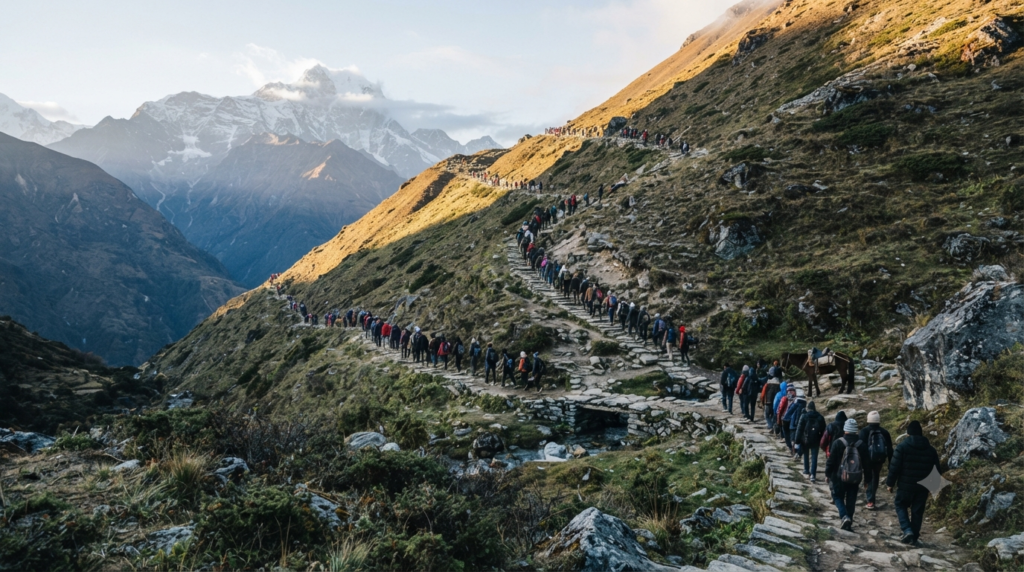
Hemkund Sahib Darshan Timings follow one rule that most travel pages get badly wrong: there is no evening darshan. Several popular guides still list a “2:00 PM to 8:00 PM” evening session at this Himalayan Gurudwara. That schedule does not exist. Nobody stays overnight at Hemkund Sahib, so pilgrims must start walking down to Ghangaria by early afternoon or risk being caught above 4,000 metres after dark.
Go Kshetra is an independent pilgrimage guide. We are not affiliated with, endorsed by, or the official website of Gurdwara Shri Hemkund Sahib Management Trust or the Government of Uttarakhand. We accept no bookings, donations, or payments. Use the official portals linked below for registration and helicopter tickets.
Hemkund Sahib Darshan Timings at a Glance
Hemkund Sahib Darshan Timings come down to a handful of numbers that decide your entire day on the mountain. Read them before you book anything, because the descent deadline shapes every other choice you make.
- Darshan window: roughly 5:00 AM to early afternoon, during the open season only
- Hard cut-off: begin your descent to Ghangaria by about 2:00 PM
- Overnight stay at the Gurudwara: not permitted for pilgrims
- Season 2026: opened in the last week of May, closing around 10 October
- Entry fee: none — darshan and langar are free
- Registration: mandatory and free on the Uttarakhand government portal
- Final climb: 6 km from Ghangaria, gaining roughly 1,100 metres
Hemkund Sahib Darshan Timings and the Daily Schedule
Hemkund Sahib Darshan Timings run from around 5:00 AM until the early afternoon, and only during the short summer yatra season. The Gurdwara Shri Hemkund Sahib Management Trust sets the daily schedule, which shifts with snow and weather. Because no pilgrim may stay overnight at the shrine, everyone must leave in time to reach Ghangaria before dark.
| Activity | Typical timing | Note |
|---|---|---|
| Leave Ghangaria | 4:30 AM – 6:00 AM | Earlier is safer; clouds build after noon |
| Reach the Gurudwara | 8:00 AM – 11:00 AM | Depends on pace and acclimatisation |
| Darshan and langar | 1 to 2 hours | Most pilgrims do not linger at this altitude |
| Start descending | By 2:00 PM | The operative safety rule |
| Back at Ghangaria | 4:00 PM – 6:00 PM | Descent takes 2 to 4 hours |
Published Hemkund Sahib Darshan Timings sometimes also mention a short midday closure of the darbar between noon and 2:00 PM. Reports differ on whether this runs every day, so confirm the current schedule at the Govindghat or Ghangaria Gurudwara before you set out.
Why the Evening Hemkund Sahib Darshan Timings Claim Is Wrong
The 2:00 PM to 8:00 PM evening slot repeated across aggregator sites appears to be copied from ordinary plains temples. It does not match how this shrine works. Hemkund Sahib sits beside a glacial lake with no pilgrim accommodation, no lighting on the trail, and freezing night temperatures even in July.
Believing that claim is genuinely dangerous. A pilgrim who leaves Ghangaria at noon expecting an evening darshan would be descending a steep, wet rock path in the dark. Rescue on that stretch is slow. Treat any page listing evening Hemkund Sahib Darshan Timings as unreliable on everything else too.
Hemkund Sahib Darshan Timings Across the Yatra Season
The shrine stays buried under snow for more than six months each year. Consequently the yatra runs only from late May to early October, and the Indian Army clears the upper trail before the Gurudwara Committee at Govindghat declares it open.
For 2026, reports of the opening date differ slightly: some sources state 23 May and others 25 May, both at 12:00 noon. The closing date is consistently reported as around 10 October 2026. Since these dates are set season by season, confirm the current status on the Uttarakhand Tourism Development Board site before travelling.
Registration Is Mandatory, Not Optional
Every pilgrim heading to Hemkund Sahib must register in advance. This is a legal requirement, not a suggestion, and unregistered visitors are turned back at checkposts. Registration is completely free, generates a QR-coded yatra letter, and doubles as a location record if rescue teams need to find you.
How to Register
- Open the official portal at registrationandtouristcare.uk.gov.in, or use the Tourist Care Uttarakhand app.
- Create an account and verify your mobile number by OTP.
- Enter traveller details with Aadhaar or another government photo ID.
- Select Hemkund Sahib and your exact travel dates.
- Add an emergency contact who is not travelling with you.
- Download the yatra registration letter with its QR code, and carry a printout.
Offline counters also operate at Haridwar, Rishikesh and Govind Ghat if the portal is busy. Network coverage above Joshimath is patchy, so a paper copy matters more than you expect.
Spotting Fake Registration and Booking Sites
Fraudulent portals appear every season. They charge a “processing fee” for a service the government provides free, or they harvest Aadhaar details. Two rules keep you safe. Registration never costs money, and the only genuine address ends in uk.gov.in.
Helicopter tickets carry the same risk. IRCTC states that its HeliYatra portal is the only authorised platform for Hemkund Sahib helicopter booking, and that agents and touts at Govindghat and Ghangaria are not authorised to sell these seats.
The Trek: Govindghat, Ghangaria and the Final Climb
Reaching the shrine takes roughly 19 km of walking one way, split across two very different days. Old guides often describe the last stretch as 4 km, which understates it badly. The real figure is 6 km, and it is the hardest part of the whole journey.
| Stage | Distance | What to expect |
|---|---|---|
| Govindghat to Pulna | ~4 km by road | Shared taxis run this stretch |
| Pulna to Ghangaria | ~9 to 10 km trek | Steady gradient beside the Lakshman Ganga |
| Overnight at Ghangaria | — | Last accommodation before the shrine |
| Ghangaria to Hemkund Sahib | 6 km trek | Steep switchbacks, about 1,100 m of ascent |
Ghangaria sits at roughly 3,050 metres. The Gurudwara stands far higher, with sources citing figures between 4,329 and 4,632 metres. Either way you gain well over a kilometre of vertical height in six kilometres, which is why an overnight halt at Ghangaria is not negotiable.
Helicopter, Pony and Palki Options
No helicopter lands at Hemkund Sahib itself. Flights only cover Govindghat to Ghangaria, so every pilgrim still climbs the final 6 km on foot, by pony, or by palki. That single fact surprises many families who book a chopper expecting a door-to-shrine service.
Round-trip helicopter fares for the Govindghat–Ghangaria sector have been reported at roughly ₹10,500 to ₹10,800 per person including taxes and convenience charges for the 2026 season. The authorities notify fares each year, so confirm the current amount on the IRCTC HeliYatra portal. You cannot book a seat until your yatra registration number exists.
Local operators set pony and palki charges on the Ghangaria to Hemkund stretch, and rates move with demand. Ask two or three operators at Ghangaria and agree the price before starting, since there is no fixed published tariff.
Planning Your Day Around Hemkund Sahib Darshan Timings
Hemkund Sahib Darshan Timings should drive your whole schedule, not the other way round. Work backwards from 2:00 PM rather than forwards from sunrise, and the day plans itself. Here is the sequence that works for most reasonably fit pilgrims.
- Day 1: Reach Govindghat from Rishikesh or Joshimath. Roughly 10 hours from Rishikesh.
- Day 2: Trek or fly to Ghangaria. Rest, hydrate, and sleep early.
- Day 3: Leave by 5:00 AM, darshan by mid-morning, back at Ghangaria by evening.
- Day 4: Optional Valley of Flowers day hike, or descend to Govindghat.
Add one buffer day if you can. Landslides and weather closures on the Rishikesh–Joshimath road are common, and a twelve-hour delay is routine during monsoon months.
Missed the Hemkund Sahib Darshan Timings? Your Options
Darshan is never guaranteed here, however carefully you plan. Weather, snowfall, and administrative closures can stop pilgrim movement at any point, and the shrine has been closed mid-season before after fresh snow on the glacier. Knowing your fallbacks beforehand saves a wasted trip.
- You started too late: turn back. Trail managers can stop late ascents, and pushing on after noon is the classic mistake.
- Weather closed the trail: wait a day at Ghangaria. Closures often lift within 24 to 48 hours.
- Altitude symptoms appeared: descend immediately. There is no partial credit at 4,600 metres.
- The season has ended: there is no alternative. Plan for the next season instead.
- Helicopter cancelled: trek instead, or shift your registration dates on the official portal.
Altitude, Health and Safety
This is a genuinely demanding high-altitude trek, not a temple visit with steps. Acute mountain sickness affects fit young trekkers as readily as older pilgrims. Headache, nausea, dizziness, and breathlessness are the warning signs, and the only reliable treatment is descent.
Spend at least one night at Ghangaria before climbing. Walk slowly, drink water steadily, and skip alcohol entirely. Anyone with heart, lung, or blood pressure conditions should consult a doctor before booking, and senior citizens are advised to carry a medical fitness certificate.
Many pilgrims dip in the glacial lake before darshan. The water sits close to freezing, so it is not advisable for children, elderly devotees, or anyone with a cardiac history. Faith practices carry real physical risk at this altitude, and they are no substitute for medical care.
Dress Code and Packing List
There is no rigid uniform, though the Gurudwara requires a covered head for everyone. Cold is the real constraint. Temperatures near the lake can approach freezing even in high summer, while rain arrives without warning.
- Head covering or patka — mandatory inside the darbar
- Thermal layers plus a windproof outer jacket
- Trekking shoes with genuine grip, already broken in
- Rain poncho, since monsoon showers are frequent
- Sunglasses and high-SPF sunscreen for snow glare
- Personal medication, ORS sachets, and cash for local services
Best Time to Visit
Late May to mid-June brings clear skies, thick snow walls beside the trail, and heavy crowds. September to early October is quieter, greener, and generally the safest window for trekking, though mornings turn cold.
July and August deliver the Valley of Flowers at peak bloom. However, this is also the landslide season, when trails turn slippery and road closures multiply. Choose these months only if the flowers are your main reason for coming.
Nearby: Valley of Flowers and Badrinath
Ghangaria serves as the shared base camp for both Hemkund Sahib and the Valley of Flowers National Park, a UNESCO World Heritage Site about 3 to 4 km away. Adding one day for the valley costs little extra effort and rewards you enormously.
Badrinath lies roughly 25 km beyond Govindghat by road, so many pilgrims combine both shrines. Our Badrinath Temple pilgrimage guide covers timings and access, while the Kedarnath accommodation guide helps if you are extending into a wider Char Dham circuit.
What Experienced Pilgrims Know
These are the details that rarely make it into standard guides, yet they change how the day feels.
- Langar at the Gurudwara serves hot khichdi and tea free of charge. After a cold climb it restores you faster than any packed snack.
- Ponies are far more useful on the descent than the ascent, because tired knees fail before lungs do.
- Carry small denomination cash. Digital payments fail regularly above Govindghat.
- Charge everything at Ghangaria overnight, since power at the shrine is limited.
- Rest twenty minutes at the top before descending. Rushing down straight after arriving worsens altitude fatigue.
Hemkund Sahib Darshan Timings: Before You Go
Hemkund Sahib rewards preparation more than enthusiasm. Register free on the official Uttarakhand portal, sleep a night at Ghangaria, and start your climb before six in the morning. Treat the published Hemkund Sahib Darshan Timings as a descent deadline, and ignore any page promising evening darshan.
If you are travelling with parents or young children, book the Govindghat–Ghangaria helicopter through IRCTC HeliYatra only, and accept that the last 6 km is still yours to walk. Check official advisories the week you travel, because Himalayan schedules change quickly.
Frequently Asked Questions
What are the Hemkund Sahib Darshan Timings each day?
Darshan generally runs from around 5:00 AM until the early afternoon during the open season. Pilgrims must begin descending to Ghangaria by roughly 2:00 PM. Exact Hemkund Sahib Darshan Timings are set by the Gurudwara management and vary with weather, so confirm locally.
Do Hemkund Sahib Darshan Timings Include an Evening Slot?
No. Evening darshan does not exist at this shrine, despite what several travel pages claim. Nobody stays overnight at Hemkund Sahib, and the trail has no lighting. Everyone descends to Ghangaria the same day.
Is registration compulsory for Hemkund Sahib?
Yes. Registration is compulsory and free, either on the Uttarakhand government portal or through the Tourist Care Uttarakhand app. Checkposts along the route verify your QR code. Unregistered pilgrims are stopped and redirected to offline counters.
How difficult is the trek to Hemkund Sahib?
The trek is moderate to challenging. The final 6 km from Ghangaria climbs about 1,100 metres on steep switchbacks. Technical skill is not required, but stamina and acclimatisation are. Ponies and palkis cover this section for those who need them.
Can I take a helicopter directly to Hemkund Sahib?
No helicopter lands at the Gurudwara. Flights operate only between Govindghat and Ghangaria, and everyone completes the final 6 km on foot, pony, or palki. Book only through the IRCTC HeliYatra portal after completing your yatra registration.
Is there an entry fee at Hemkund Sahib?
No. Entry to the Gurudwara is free, and so is the langar meal. Your costs are travel, accommodation at Ghangaria, and optional pony, palki or helicopter services. Government registration also costs nothing.
When does Hemkund Sahib close for the season?
The shrine closes around 10 October each year, then reopens in late May once the Army clears the snow. Exact dates are announced by the Gurudwara Committee at Govindghat, so check official sources before planning a late-season visit.
Where can I stay near Hemkund Sahib?
Ghangaria is the last village with accommodation, offering guesthouses, GMVN rooms, tents, and a Gurudwara dharamshala. Book ahead during peak weeks, and time your return around the Hemkund Sahib Darshan Timings above.