
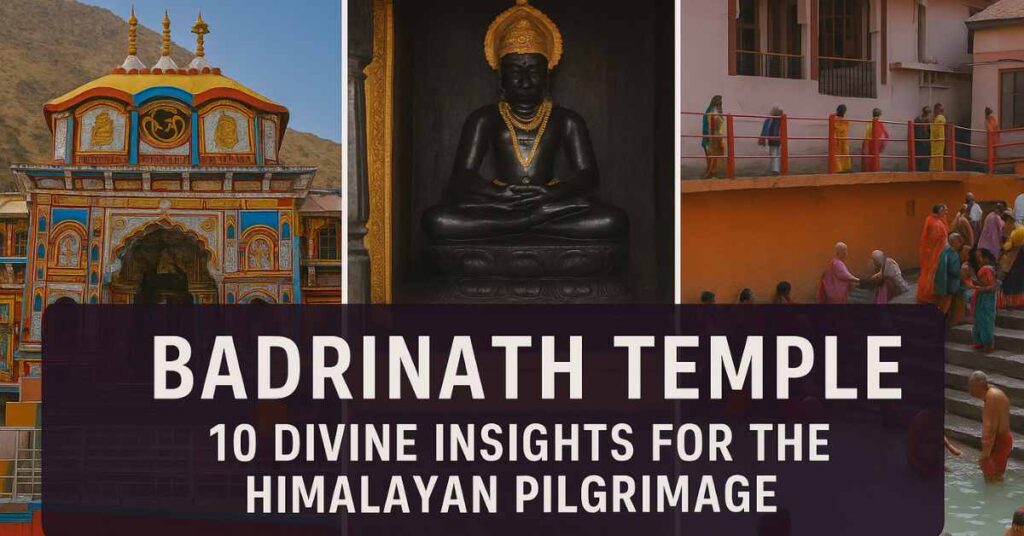
Explore Badrinath Temple in Uttarakhand: history, ritual, architecture & pilgrimage tips for one of India’s sacred Char Dham sites.
High in the Garhwal Himalayas, nestled at over 3,000 metres, lies the sacred Badrinath site and its famed Badrinath Temple—a shining emblem of devotion to Vishnu in his form as Badrinarayan. Rich in myth, ancient tradition and mountain-aura, this shrine attracts pilgrims from across India and beyond. In this blog we explore ten essential insights into Badrinath Temple: its history, spiritual dimension, architecture, rituals, travel tips and why this Himalayan pilgrimage remains so compelling.
Key Information at a Glance
- Timings: & Practical Tips
Best Season: April/May (opening) through early October
- Location: Badrinath, Chamoli district, Uttarakhand, India
- Contact: of rooms is limited given altitude and terrain
Quick Facts
- Location: Badrinath, Chamoli district, Uttarakhand, India.
- Elevation: Approx. 3,133 metres above sea level.
- Deity: Vishnu as Badrinarayan, seated in meditative posture.
- Pilgrimage Circuit: One of the four sacred sites of the Char Dham (North: Badrinath; others: Dwarka, Puri, Rameswaram) as defined in Vaishnavite tradition.
- Seasonal Opening: Typically open for pilgrims from late April/early May to October/November due to winter snow.
1. Mythic & Scriptural Significance
According to legend, Vishnu performed deep penance here alongside his twin-aspects Nara and Narayana. The site was once a forest of berry-trees (Badari) where the goddess Lakshmi is said to have taken the form of a berry tree to shelter him, thus giving the place its name.
Scriptures such as the Bhagavata Purana and Skanda Purana extol the kshetra (sacred land) of Badrikashrama as being uniquely potent for spiritual liberation.
2. Historical Evolution
While the precise date of the original shrine is unclear, the site appears in texts going back millennia and was revived and formalised by Adi Shankaracharya in the 8th–9th century.
Over centuries it faced the ravages of mountain-earthquakes, avalanches and reconstruction efforts. The temple as seen today incorporates those layers of history.
3. Architecture & Sacred Features
The sanctum houses a finely sculpted black stone image of Badrinarayan seated in padmasana, under a gold-gilded roof.
There are hot sulphur springs (the Tapt Kund) just below the temple which pilgrims often bathe in as a purificatory act before darshan (viewing).
The northern Himalayan setting, the alpine ambience and the harmonious scale of the temple-town make it an immersive pilgrimage rather than mere sightseeing.
4. The Pilgrimage Experience
Visiting Badrinath Temple is typically part of a larger journey (for example the Chota Char Dham circuit) — requiring mountain roads, sometimes long drives from places like Rishikesh, and acclimatisation to altitude.
Given the short open season and weather risks, planning is crucial: road conditions, lodging in Badrinath town, early morning darshan, and thermal comfort all matter.
5. Rituals, Festivities & Closing/Opening
The temple opens each year on an auspicious day (often around Vasant Panchami) and closes around Vijayadashami in autumn.
Major festivals include the Badri Kedar festival and others tied to Vaishnava liturgy.
6. Why It Matters for You — Spiritual & Travel Implications
For a pilgrim from Andhra Pradesh (like from Tirupati) or any part of India:
- It offers a north-Himalayan contrast to the south-Indian temples, deepening the pilgrimage horizon.
- The elevation, cold climate, mountain drive and remote ambience bring a different devotional intensity.
- Combining a visit here with other temples (e.g., south → north) can enrich your spiritual journey.
7. Best Time & Practical Tips
- Best Season: April/May (opening) through early October. Outside this the temple is closed and roads may be blocked.
- Accommodation: Book in advance in Badrinath town – the number of rooms is limited given altitude and terrain.
- Clothing: Warm layers essential, even in summer evenings.
- Health & Altitude: The high altitude (3000 m+) means hydration, gradual acclimatisation and caution for altitude sickness.
- Transport: Road connectivity from Rishikesh via Devprayag, Rudraprayag etc. Confirm road conditions.
- Respect: Dress modestly, follow temple norms, remove shoes where required, abide by darshan timing.
8. Linkages & Further Exploration
- If you’re exploring Vaishnava temples, link to articles about other Char Dham sites like Dwarka or Puri.
- Internally you might connect to a Gokshetra article about a southern Vishnu temple like Tirumala Venkateswara Temple for north-south pilgrimage contrast.
- External sources: official temple site of Badrinath.
9. Key Takeaways & Why It’s Unique
- The Himalayan setting elevates the spiritual ambience: meditating Vishnu, berry-trees, mountain peaks and cold springs combine myth + nature.
- The seasonal window and remoteness mean the pilgrimage demands intent and preparation, making the experience more meaningful.
- It’s both a journey of faith and of geography — the pilgrimage route itself becomes part of the devotion.
FAQs
Q1: Is the temple open year-round?
A: No — the temple doors close for winter, typically from October/November to April/May due to snow and weather.
Q2: What is the main darshan time?
A: Early morning darshan is preferred when the shrine opens, offering tranquillity and fewer crowds.
Q3: Can non-Hindus visit the temple?
A: Yes, generally pilgrims of all backgrounds may visit, but should respect the sanctity and rules of the temple.
Q4: Are there combining pilgrimage packages from south India?
A: Yes — many travel agents and pilgrimage tour operators link with Char Dham routes; from Tirupati one can plan a north-India leg.
Q5: What should one avoid or be cautious about?
A: Altitude sickness, weather changes, limited room availability, unpredictable mountain roads — all require prior planning.
The Badrinath Temple stands as a towering beacon of devotion to Vishnu amidst the Himalayan heights — a place where myth, mountain, devotion and endurance converge. For a pilgrim willing to journey beyond comfort and into the heights of faith, this shrine offers a profound encounter. Plan well, tread respectfully, and let the alpine silence of Badri Kshetra speak to your soul.
- covers the temple in Tirupati, Andhra Pradesh.
- explores temple architecture broadly. gokshetra.com
- further reading on temple symbolism. gokshetra.com
- official Uttarakhand government portal for temple history, darshan timings, and updates.
- for travel routes, weather info, and accommodation details.
Author Box
Author: Gokshetra Blog Team
Gokshetra.com – Dedicated to detailed, spiritually accurate articles on Hindu temples and pilgrimage sites across India.
Important Tips for Visitors
- Visit during weekdays for shorter queues. Weekends and festival days see significantly higher footfall.
- Wear modest, traditional clothing — most temples require covered shoulders and knees.
- Carry a valid ID proof — some temples require it for special darshan or accommodation booking.
- Remove footwear before entering the temple premises. Shoe storage is usually available near the entrance.