
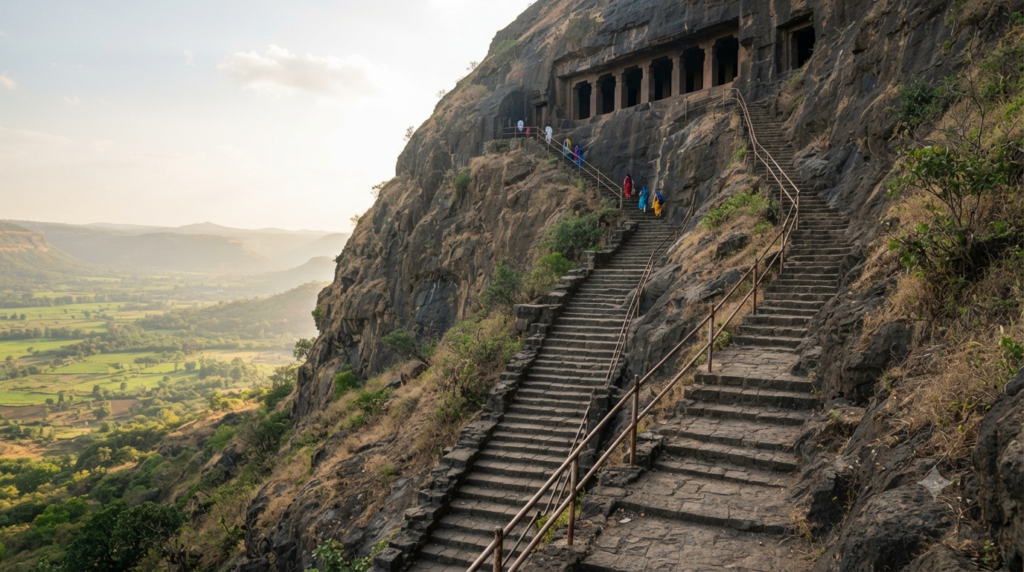
Most guides to the Lenyadri Girijatmaj Ganpati Temple leave out the detail that decides your whole day. The shrine sits inside a ticketed Archaeological Survey of India monument. So the hill gate opens and closes with daylight, not with the temple aarti.
Devotees who plan a late evening darshan often reach the base and find the counter shut. This guide fixes that gap.
It also settles the confusing step counts, the entry fee, the palkhi option for elderly pilgrims, and the return-transport trap.
Go Kshetra is an independent pilgrimage guide. We are not affiliated with the temple trust or the Archaeological Survey of India. This is not their official website. We do not accept bookings, donations, or payments.
Use the official portals linked below for tickets and current information.
Lenyadri Girijatmaj Ganpati Temple at a Glance
- Location: Golegaon, near Junnar, Pune district, Maharashtra, about 5 km from Junnar town.
- Circuit position: sixth shrine in the Ashtavinayak sequence, and the only hill temple among the eight.
- Setting: Cave 7 of the Lenyadri rock-cut group, dated to the 1st–3rd century AD.
- Climb: 307 stone steps per Maharashtra Tourism, roughly 20 to 35 minutes.
- Site access: ASI-protected ticketed monument, open sunrise to sunset.
- Entry ticket: a small ASI fee applies, so confirm the current amount at the counter.
- Distance: about 96 km from Pune and roughly 165 km from Mumbai.
The name Girijatmaj means the son of Girija, another name for Goddess Parvati. Tradition places Parvati’s twelve-year penance in this very cave. Because of that, devotees come to pray for children, for family wellbeing, and for the removal of obstacles.
Lenyadri Girijatmaj Ganpati Temple Darshan Timings
The Lenyadri Girijatmaj Ganpati Temple generally opens around 5:00 AM. It continues until roughly 8:00 PM, with a short afternoon break for naivedya. However, the cave complex is a ticketed ASI monument.
It admits visitors only between sunrise and sunset. So your practical darshan window is daylight, not the full aarti schedule.
| Activity | Indicative timing |
|---|---|
| Temple opening | Around 5:00 AM. |
| Morning darshan | Roughly 5:30 AM to noon. |
| Afternoon naivedya break | Around noon to 1:00 PM. |
| Evening darshan | Roughly 1:00 PM to 8:00 PM. |
| ASI gate and ticket counter | Sunrise to sunset. |
Why two different sets of hours exist
Two authorities share this hill. The temple trust runs the shrine and its rituals. Meanwhile the Archaeological Survey of India controls the caves, the gate, and the ticket counter.
You cannot reach Cave 7 without passing that gate. So the monument hours are the ones that actually govern your visit.
In winter the last realistic entry falls around 5:30 PM. Start climbing at least ninety minutes before sunset, because staff clear the steps well before dark. Timings do shift, so confirm on the day at the counter.
Lenyadri Girijatmaj Ganpati Temple Entry Fee and Costs
The caves carry an entry ticket because the site is a centrally protected monument. Indian visitors pay a nominal ASI charge. Foreign nationals pay the higher ASI rate that applies to non-World-Heritage monuments. Children below fifteen generally enter free at ASI sites.
| Item | Indicative cost |
|---|---|
| ASI entry, Indian visitor | Nominal, around ₹25. |
| ASI entry, foreign national | Standard ASI foreign rate. |
| Two-wheeler parking | Approximately ₹20. |
| Four-wheeler parking | Approximately ₹50. |
| Palkhi, up and down | Roughly ₹700 to ₹1,000. |
These figures come from visitor reports rather than a published live tariff. Fees change from time to time. So treat the table as a budgeting guide only. Before you travel to the Lenyadri Girijatmaj Ganpati Temple, also check the ASI e-ticket service for its monuments.
The 307 Steps and Why Step Counts Differ Online
Search this shrine and you will see 283, 307, 315, 338 and even 350 steps quoted with equal confidence. Maharashtra Tourism, the state government source, states 307 steps. Archaeological accounts instead record 283 masonry steps. Devotees built those flights, probably as late as the nineteenth century.
Both numbers hold up, because they count different things. The 283 figure describes the historic devotee-built flights up the cliff face. Higher counts add the approach steps from the parking area. That also explains why reported walking times vary so much.
How long the climb really takes
A reasonably fit adult climbs in about 20 minutes from the ticket counter. Allow 30 to 45 minutes if you pace yourself or carry a child. Shaded rest points exist along the way, although they are few. So an early morning climb beats a midday one comfortably.
If You Cannot Manage the Climb
No lift, ropeway, or motorable road reaches the cave. The steps are the only walking route to the Lenyadri Girijatmaj Ganpati Temple. Pilgrims who cannot climb still have options, though nothing is certain on a given day.
- Palkhi service: four bearers carry you up and back for roughly ₹700 to ₹1,000. Mornings offer the best availability.
- Split the climb: rest at the intermediate landings instead of pushing through in one go.
- Send a family group: some elderly pilgrims wait at the base shops while relatives complete darshan.
- Choose a cooler month: the same climb feels far easier between November and February.
If the palkhi bearers already have passengers, no other carrying arrangement exists at the site. So plan an early arrival rather than assuming one will be free at midday.
History of the Lenyadri Girijatmaj Ganpati Temple
The Lenyadri group holds roughly thirty rock-cut caves. Artisans excavated them between the first and third centuries AD. They served as Buddhist viharas and chaityas along an active trade route through the Western Ghats. Cave 7, the largest, later became the Ganesha shrine.
The hall is a pillarless chamber of impressive span. It measures roughly 17 metres long and 15 metres wide, with monk cells cut into three sides. Because no pillars support the ceiling, the interior feels unusually open. Natural light reaches the sanctum through the veranda openings, so daylight alone lights the shrine for most of the day.
Is the deity a carved idol or a rock form?
Maharashtra Tourism describes the sanctum as a natural rock formation rather than a separately carved idol. Devotees worship the form as it appears in the cave wall. That is why writers often call the temple monolithic. Descriptions of the orientation vary between sources, so treat any confident claim about direction with caution.
Spiritual Significance of Girijatmaj
Devotees revere Girijatmaj as Ganesha in his child form. That is unusual across the Ashtavinayak circuit. Tradition holds that Parvati performed tapascharya here for twelve years, after which Ganesha appeared as her son. These accounts belong to devotional tradition rather than documented history.
Because of this association, many families visit while praying for children. Others come seeking success in study and work, since tradition treats Ganesha as the remover of obstacles.
How to Reach the Lenyadri Girijatmaj Ganpati Temple
The temple lies near Golegaon in Junnar taluka. It sits roughly 96 km from Pune along the Pune–Nashik highway. Mumbai travellers usually approach through Kalyan and the Malshej road, a distance of about 165 km.
| From | Approximate distance |
|---|---|
| Junnar town | 5 km. |
| Ozar, Vighnahar temple | 15 km. |
| Pune | 96 km. |
| Pune Airport | Around 100 km. |
| Mumbai | 165 km. |
Talegaon is the nearest railway station at roughly 85 km. Still, many pilgrims find Pune Junction more practical because of its wider connections. State transport buses run from Pune and Kalyan, while taxis and shared vehicles operate from Junnar.
The return-transport trap
Getting there by bus is straightforward. Getting back is where travellers get stuck. Return buses from the temple base run infrequently, and autos rarely wait there.
So arrange a return vehicle from Junnar in advance. Otherwise plan to reach Junnar town first and travel onward from the stand.
Best Time to Visit the Lenyadri Girijatmaj Ganpati Temple
October to February suits the climb best. The steps lie exposed, and the rock radiates heat by late morning. Sunrise visits work well because queues stay short. The light inside the cave is also at its softest then.
Monsoon turns the hillside green and dramatic. Yet the steps become slippery and visibility drops. If you travel between June and September, wear grippy footwear and avoid climbing during heavy rain.
Festivals at the Lenyadri Girijatmaj Ganpati Temple
Ganesh Chaturthi in the Bhadrapada month, falling in August or September, draws the largest crowds. Maghi Ganesh Jayanti in the Magha month is the other major observance. It falls during January or February and includes abhishek, havan and processions.
Diwali brings lamp illumination across the cave frontage. Kartik Purnima and every monthly Chaturthi see additional rituals. These follow the lunar calendar, so dates move each year. Check a reliable panchang before fixing travel.
Fitting Lenyadri Into the Ashtavinayak Circuit
Lenyadri and Ozar sit just 15 km apart. So pilgrims almost always pair them in a single half-day. Visiting the Lenyadri Girijatmaj Ganpati Temple first makes sense, because the climb is easier in cooler morning hours.
Many travellers then continue toward the other shrines over two days. Our guides to Chintamani Ganpati at Theur, Varadvinayak at Mahad, and Ballaleshwar at Pali cover the rest of the circuit.
What Most Guides Get Wrong
- “Open till 8 PM, so evening darshan is fine.” The ASI gate closes at sunset, which decides your last entry.
- “Carry snacks for the climb.” The monument restricts edibles, and resident monkeys snatch bags aggressively.
- “The nearest station is Pune Junction.” Talegaon sits nearer at about 85 km, though Pune has better connectivity.
- “Entry is free because it is a temple.” Darshan costs nothing, but the ASI monument ticket does.
- “It is the eighth cave.” The shrine occupies Cave 7 in standard ASI numbering, although older listings differ.
Health and Safety on the Climb
The steps run steep and uneven in sections. So pilgrims with knee, cardiac or breathing conditions should judge the climb realistically. Consult a doctor first if you have a known condition. Never combine a strenuous climb with a strict fast in hot weather.
Carry water and drink before you begin, since no shops operate beyond the ticket counter. Keep bags closed because of the monkeys. Hold children’s hands on the narrower flights. Ritual and astrological observances are matters of faith, and they do not replace medical treatment.
Before You Go
Treat this place as a heritage site and a shrine at once. That dual identity shapes every practical decision. Arrive at first light, buy the ASI ticket, and climb before the rock heats up.
Keep your return transport arranged in advance. Confirm current fees and gate hours on the Maharashtra Tourism page for Lenyadri or with the Archaeological Survey of India.
Frequently Asked Questions
What are the darshan timings at the Lenyadri Girijatmaj Ganpati Temple?
The shrine generally runs from about 5:00 AM to 8:00 PM with a short afternoon break. However, the ASI cave gate admits visitors only between sunrise and sunset. So plan darshan within daylight hours.
Is there an entry fee?
Darshan itself costs nothing. Yet the caves form a ticketed ASI monument, so you must buy an entry ticket. Indian visitors pay a nominal amount while foreign nationals pay the higher ASI rate. Confirm the current fee at the counter.
How many steps lead up to the Lenyadri Girijatmaj Ganpati Temple?
Maharashtra Tourism states 307 steps. Archaeological accounts record 283 historic masonry steps. Higher counts include the approach steps, which explains the differing figures online.
Which Ashtavinayak temple is this?
The Lenyadri Girijatmaj Ganpati Temple is the sixth shrine in the Ashtavinayak sequence. It is also the only one of the eight on a hill and inside a cave.
Is a palanquin available for elderly pilgrims?
Yes. A palkhi carried by four bearers is usually available at the base. It costs roughly ₹700 to ₹1,000 for the round trip, and availability is not guaranteed.
Can I visit Lenyadri and Ozar on the same day?
Yes, easily. The two temples sit about 15 km apart, so most pilgrims complete both within a single morning.
What is the best month to visit?
October to February offers the most comfortable weather for the climb. Early morning works best in any season, because the exposed steps heat up quickly.
Is the deity a carved idol?
Maharashtra Tourism describes the sanctum as a natural rock form rather than a sculpted idol. The whole shrine is cut from a single mass of rock.