
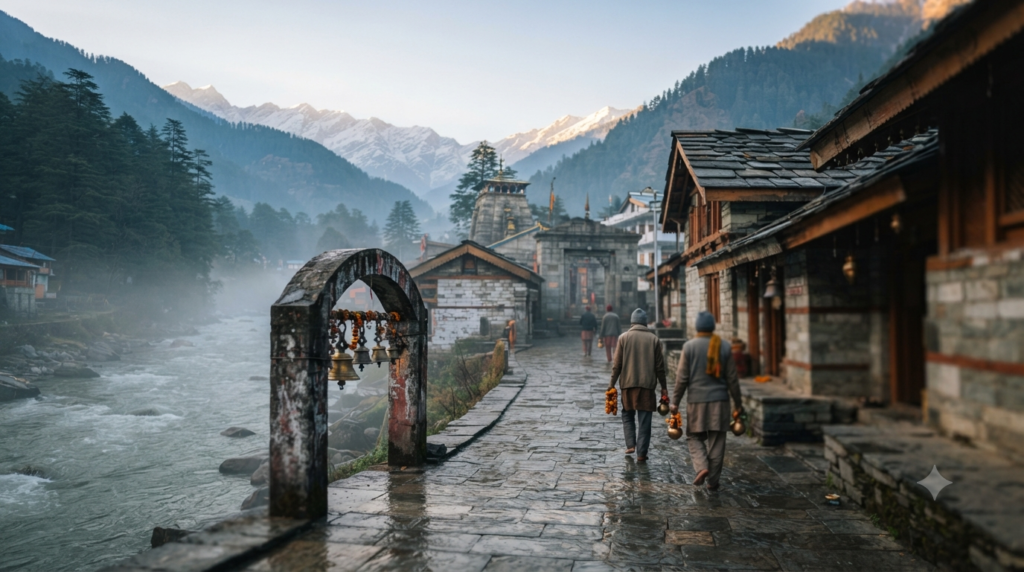
Kashi Vishwanath Temple Uttarkashi sits inside a working Himalayan market town, a short walk from the bus stand. There is no ticket, no queue token and no online slot to book. Most travellers still find it by accident while driving up to Gangotri. That is a pity, because the courtyard holds a 19.5-foot trident older than almost every standing structure in Uttarakhand.
Go Kshetra is an independent pilgrimage guide. We are not affiliated with the temple committee, the district administration or Uttarakhand Tourism. We also accept no bookings, donations or payments of any kind. Use the official links in this guide for registration and confirmed information.
Kashi Vishwanath Temple Uttarkashi at a Glance
- Entry fee: free for everyone, because donations here are voluntary and go into the temple hundi.
- Booking: none exists, so darshan stays walk-in and first come, first served.
- Char Dham e-pass: not needed for this temple, although it is mandatory if you continue to Gangotri.
- Timings: broadly 6:00 AM until early evening, with a midday break in some seasons.
- Setting: Uttarkashi town, on the Bhagirathi, at roughly 1,158 metres.
- Time needed: 30 to 45 minutes, including the Shakti Temple opposite.
Here is the single line worth carrying into your planning. Darshan at Kashi Vishwanath Temple Uttarkashi is free, unbookable and open to all. So the only thing you genuinely need to arrange is reaching the town itself.
Quick Facts and Distances
| Detail | What to know |
|---|---|
| Full name | Shri Kashi Vishwanath Temple, Uttarkashi |
| Deity | Lord Shiva, worshipped here as Vishwanath |
| Presiding form | Shivling roughly 56 cm tall, tilted towards the south |
| Architecture | Katyuri style stone shrine on a rock base |
| Town elevation | About 1,158 metres above sea level |
| Entry fee | Free; voluntary donations only |
| From Rishikesh | About 154 km |
| From Dehradun | About 199 km |
| To Gangotri | About 100 km further up the valley |
| Best months | April to June, then September to early November |
The district administration lists Uttarkashi as 199 km from Dehradun and 154 km from Rishikesh. Because the road climbs and twists, treat those numbers as seven to eight hours of driving.
Kashi Vishwanath Temple Uttarkashi Darshan Timings
Darshan usually runs from about 6:00 AM to the evening aarti. However, the temple committee publishes no official timing table online. Travel sites quote closing times between 7:00 PM and 8:30 PM. A midday break also appears in some seasons.
Treat any exact figure you read online as indicative rather than confirmed.
That gap matters, since several competing guides present a firm “6 AM to 8 PM, daily” as verified fact. It is not verified anywhere official. If your visit depends on a precise hour, ask at your hotel the previous evening.
In practice this rarely causes trouble. The shrine sits inside town, so you can walk over twice in a day without losing travel time.
Do You Need Char Dham Registration for Kashi Vishwanath Temple Uttarkashi?
No. Char Dham Yatra registration is not required at Kashi Vishwanath Temple Uttarkashi, because it is not one of the four dhams. You need the e-pass only if you continue north to Gangotri. Officials scan it at the Hina checkpoint on that route.
This is the most common misunderstanding pilgrims arrive with, and it costs people money. Registration for Yamunotri, Gangotri, Kedarnath and Badrinath is compulsory, yet it is completely free on the Uttarakhand government portal.
Register only at registrationandtouristcare.uk.gov.in, the Tourist Care Uttarakhand app, or the official WhatsApp and helpline channels. Any website charging a “processing fee” for a Char Dham e-pass is not official.
Private vehicles heading beyond Uttarkashi also need a Green Card or Trip Card from the state transport department. Ask your driver to show you theirs before you set off, since checkpoints do turn vehicles back.
The Shakti Temple and the Trishul Most Guides Skip
Directly opposite the main shrine stands the Shakti Temple, dedicated to Goddess Parvati. Its centrepiece is a massive metal trident roughly 19.5 feet high and about 90 cm thick at the base. Local tradition holds that Goddess Durga hurled it at the demons.
The trishul carries Indo-Tibetan inscriptions and markings linked to the Naga dynasty. Estimates place it well over a thousand years old. Priests will tell you it cannot be shifted by force, although it trembles faintly when touched with one finger. Whether you read that as physics or as faith, watching devotees test it is the most memorable minute of the visit.
Miss this courtyard and you have essentially skipped the reason historians care about the site at all.
Why the Shivling Tilts South
The shivling at Kashi Vishwanath Temple Uttarkashi is about 56 cm tall. Unusually for a Shiva temple, it leans noticeably towards the south. Devotees call it a swayambhu, or self-manifested, form. Sanskrit tradition connects the tilt to Sage Markandeya, who embraced the lingam while fleeing death.
The Skanda Purana records the belief that Shiva will settle permanently in the northern Kashi during the later Kali Yuga. That single verse is why the town carries the name Uttarkashi, meaning the Kashi of the North.
History gives the site independent weight too. A fifth-century inscription in the temple names a prince called Ganeshwara. The present stone structure dates to an 1857 rebuilding by Maharani Khaneti Devi, wife of Sudarshan Shah of Tehri.
How to Reach Kashi Vishwanath Temple Uttarkashi
By air
Jolly Grant Airport near Dehradun is the nearest airport, roughly 200 to 230 km away depending on your route. Taxis wait outside the terminal, though most travellers save money by taking a shared vehicle from Rishikesh instead. Budget a full day if your flight lands after noon.
By train
Rishikesh is the practical railhead, about 154 km away, while Dehradun and Haridwar handle more long-distance trains. Buses to Uttarkashi leave Rishikesh mainly in the morning. So an overnight train arriving before 8:00 AM works best. After midday the frequency drops sharply.
By road
Uttarkashi lies on the Rishikesh–Gangotri highway, past Narendranagar, Tehri and the Dharasu bend. Buses run from Dehradun, Rishikesh and Haridwar, and shared jeeps cover the same route faster. Drive during daylight only, because the Bhagirathi gorge sections are narrow and unlit.
Once you reach town, the temple is an easy walk from the bus stand and the main market. Almost any local will point you towards Vishwanath Mandir if you ask.
Entry, Rituals and What Costs Money
Entry and ordinary darshan cost nothing. Priests perform rudrabhishek, the ritual bathing of the shivling with milk, water, curd and honey. Families commonly sponsor one.
The priests set those rates directly, and nobody publishes them officially. So agree the amount before the ritual begins, not after.
Sponsored pujas are the only real cost most visitors encounter. Flowers, bel patra and prasad come from small stalls near the gate for a few rupees.
No agency can sell you a “darshan booking” here, and nobody should. If a tour operator quotes a fee for temple entry at Kashi Vishwanath Temple Uttarkashi, that money is not reaching the temple.
Best Time to Visit Kashi Vishwanath Temple Uttarkashi
April to June and September to early November are the reliable windows. The road stays open and Himalayan views stay clear. These months also coincide with the Char Dham season, so Uttarkashi fills with pilgrims moving towards Gangotri.
Winter is not off-limits. Uttarkashi sits at only about 1,158 metres, so the town stays accessible while higher shrines close. Magh Mela in January and Mahashivratri in late winter both draw large local crowds to this temple.
Monsoon is the season to think hard about. July and August bring landslides across the Gangotri valley. The flash flood that destroyed much of Dharali village in August 2025 also washed away long stretches of highway above Uttarkashi. The town itself was not hit, yet the route beyond it stayed unusable for weeks.
Safety Notes for Pilgrims
Altitude is not the concern at the temple itself, because Uttarkashi lies well below the threshold where mountain sickness begins. Gangotri, above 3,000 metres, is a different matter. Build in a night at Uttarkashi to acclimatise before going higher.
Road risk deserves more caution than most guides give it. Check the district administration and Uttarakhand Tourism advisories before monsoon travel. Avoid night driving in the gorge at any time of year.
Carry regular medication in your daypack rather than in checked luggage, since roadblocks can strand vehicles for hours. Elderly pilgrims and anyone with heart or breathing conditions should speak to a doctor before a Char Dham circuit. Rituals and prayers at the temple are matters of faith and tradition, not medical treatment.
If Something Goes Wrong: Realistic Fallbacks
Nothing about this temple can be “sold out”, which removes the usual pilgrim anxieties. Still, three things do go wrong on this route, and each has a workable answer.
- You arrive after closing: stay the night in Uttarkashi and go at 6:00 AM, when the shrine is quietest.
- The Gangotri road is blocked: Uttarkashi becomes your base. Use the day for Kuteti Devi, Manikarnika Ghat or Nachiketa Tal.
- Your e-pass fails at a checkpoint: official counters operate during the yatra season and the state helpline can reissue a pass. Never pay a tout to fix it.
If the highway closes entirely, the yatra pauses rather than reroutes. There is no alternative road to Gangotri, so plan for the next available day instead of chasing a workaround.
Nearby Stops Within an Hour
- Manikarnika Ghat: the Bhagirathi ghat that mirrors its Varanasi namesake, minutes from the temple.
- Annapurna and Bhairav temples: both in the Chowk area, and both easy to combine on foot.
- Kuteti Devi Temple: a hillside shrine above town with a clean valley view.
- Nehru Institute of Mountaineering: a short drive out, with a small museum on Garhwal climbing history.
- Gangnani hot springs: about 25 km towards Gangotri, where pilgrims bathe before continuing.
- Nachiketa Tal: a forest lake roughly 29 km away, reached by a short uphill walk.
What First-Time Visitors Get Wrong
- Treating this as a five-minute photo stop. Give it 45 minutes so the Shakti Temple gets its share.
- Confusing it with the Varanasi shrine. They share a name and a legend, yet they are separate temples with separate trusts.
- Booking a “special darshan” through an agent. No such category exists here.
- Arriving at midday in summer, when the market is loud and the courtyard hot.
- Skipping the evening aarti, which is genuinely the better experience if your schedule allows only one visit.
- Photographing inside the sanctum without asking. Ask a priest first, because rules vary by day and ritual.
Our guide to the Kashi Vishwanath Temple in Varanasi covers the history the two shrines share. Travellers building a wider Uttarakhand circuit may also find our Rudranath temple darshan guide and Hemkund Sahib guide useful.
Before You Go
Kashi Vishwanath Temple Uttarkashi rewards a slower visit than most itineraries allow. Entry is free, no booking exists, and the Char Dham e-pass applies to Gangotri rather than to this shrine. Verify road conditions before monsoon travel, and give yourself an early morning slot.
Official information sits with the Uttarkashi district administration and Uttarakhand Tourism. Use those sources for anything that could change before you travel.
Frequently Asked Questions
Is there an entry fee at Kashi Vishwanath Temple Uttarkashi?
No, entry and darshan are completely free. Donations are voluntary and go into the temple hundi. Sponsored rituals such as rudrabhishek carry a charge set by the priests, so confirm the amount beforehand.
Do I need Char Dham registration for Kashi Vishwanath Temple Uttarkashi?
No. The e-pass covers Yamunotri, Gangotri, Kedarnath and Badrinath only. You will need it if you travel on to Gangotri, and registration is free on the official Uttarakhand government portal.
What are the Kashi Vishwanath Temple Uttarkashi darshan timings?
Darshan generally runs from about 6:00 AM into the evening. Because no official timing table is published, closing times quoted online vary between 7:00 PM and 8:30 PM. Confirm locally on the day.
Is this the same temple as Kashi Vishwanath in Varanasi?
No, they are two separate shrines. Varanasi has the Jyotirlinga. Kashi Vishwanath Temple Uttarkashi is an ancient shrine sharing the name and the Skanda Purana tradition of the northern Kashi.
Is the temple part of the Char Dham Yatra?
Not formally. It sits on the road to Gangotri, so most Char Dham travellers stop here anyway. Many treat it as the traditional first darshan before continuing up the valley.
How long does a Kashi Vishwanath Temple Uttarkashi visit take?
Plan 30 to 45 minutes on an ordinary day. Queues are short outside festivals. Mahashivratri and Magh Mela are the exceptions, when waits can stretch considerably.
Can I perform a special puja here?
Yes. Temple priests conduct rudrabhishek and other Shiva rituals through the day. Approach a priest at the shrine directly, and settle the offering amount before the ritual starts.
What should I wear?
Modest, covered clothing is expected, and many devotees choose traditional dress. Footwear comes off at the entrance, where storage is available. Carry warm layers, since evenings turn cold even in summer.
Is Uttarkashi safe during the monsoon?
The town is generally stable, but the Gangotri highway above it is landslide-prone in July and August. Check official advisories before travelling, and keep your itinerary flexible.