
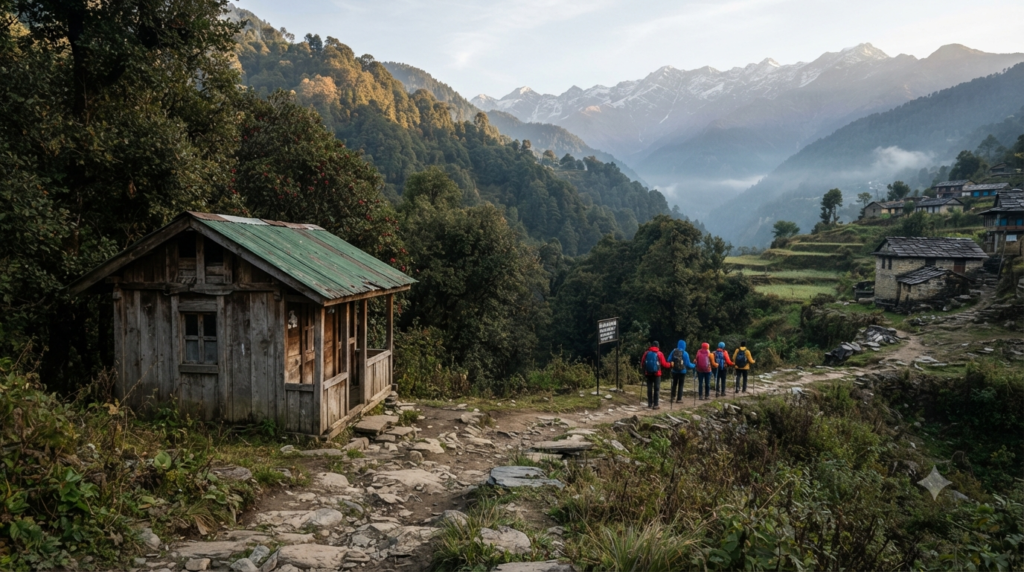
A Rudranath Temple Darshan starts with one hard truth: this is the only Panch Kedar shrine with no road, no ropeway and no shortcut. You walk the whole way. The face (mukha) of Lord Shiva, worshipped here as Neelkanth Mahadev, sits at roughly 3,600 metres in the Garhwal Himalayas.
Locals sum up the climb in one blunt line: “Rudranath ki chadai, German ki ladai”. One thing has changed since the older guides were written, though. Your forest permit now goes online, before you ever reach Sagar village.
Go Kshetra is an independent pilgrimage guide. We are not affiliated with, endorsed by, or the official website of the Rudranath or Gopinath temple committee, or of the Uttarakhand Forest Department. We take no bookings, donations or payments — use the official portals linked in this guide.
Rudranath Temple Darshan at a Glance
Read these verified essentials once, because they shape every other decision in planning a Rudranath Temple Darshan.
- Location: Chamoli district, Uttarakhand, inside the Kedarnath Wildlife Sanctuary.
- Altitude: about 3,600 m (11,800 ft), so altitude sickness is a real risk.
- Deity: the face of Lord Shiva, revered as Neelkanth Mahadev; fourth shrine in the Panch Kedar order.
- 2026 season: opened 18 May, with closing expected around 17 October.
- Trek base: Sagar village, about 3-5 km from Gopeshwar.
- Shortest route: Sagar village, roughly 20-22 km one way.
- Temple entry: free, because no darshan ticket exists.
- Forest permit: mandatory, ₹200 per adult on the Sagar route, booked online.
- Trail cut-off: no trekker may start after 2:00 PM.
What Changed on This Trail Recently
The biggest planning change is the permit. The Kedarnath Wildlife Division now runs an official online booking portal, and the Shri Rudranath Yatra trek sits on it as a paid forest permit. Walk-up hopefuls can be turned back if the day is already full.
Two more rules catch first-timers. First, the division enforces a hard 2:00 PM entry cut-off on this trail, so a late start simply ends your day. Second, the portal lists five approved trailheads instead of one, and each carries its own booking.
Older posts still tell readers to just register at the Sagar desk. That advice is out of date, and following it can cost you a full day. So book before you travel, then carry the same ID you entered while booking.
Where Is Rudranath and Why Is It So Hard to Reach?
Rudranath sits deep inside the Garhwal Himalayas, and the nearest road head is Sagar village near Gopeshwar. Because the shrine lies at 3,600 m with no motorable approach, every pilgrim must walk 20 km or more. That remoteness is exactly why the place stays uncrowded.
The temple is a raw stone-and-cave shrine, not a grand carved structure like Kedarnath. Panch Kedar legend says Shiva took the form of a bull to evade the Pandavas, then dissolved into the earth. His face later emerged here, so the shrine worships the mukha, or face form.
Sacred ponds such as Surya Kund, Chandra Kund and Tara Kund surround the temple, while nearby Vaitarani Kund draws devotees performing rites for ancestors. One correction also matters here: several travel pages list the altitude as 2,286 m, yet the shrine stands near 3,600 m. That gap changes how you plan acclimatisation.
Rudranath Temple Opening and Closing Dates
For the 2026 season the gates opened on 18 May at around 7:00 AM, after the deity returned from its winter seat. Priests and the Gopinath Temple committee in Gopeshwar fix that date by panchang calculation, and they announce it on Basant Panchami — not on Akshaya Tritiya, as several blogs wrongly repeat.
Closing falls on or about 17 October 2026, although the committee confirms the exact day only during October itself at Gopinath Temple. So treat any closing date you read as tentative, and reconfirm before late-season travel.
Once the temple closes, the deity travels back to Gopinath Temple in Gopeshwar for winter worship. You can still seek blessings there off-season, so devotees who miss the trekking window often visit Gopeshwar instead.
Planning for next year? Priests will declare the 2027 opening date on Basant Panchami at Gopinath Temple, which falls in late January or February. No credible date exists before that ritual, so ignore any site publishing one now.
Rudranath Temple Darshan Timings and Aarti
A Rudranath Temple Darshan usually begins around 6:00 AM and runs through the morning. The shrine then breaks for midday bhog and rest, typically in the early afternoon, before reopening later in the day. The evening aarti, generally around 6:30 PM, is the emotional high point of the visit.
Priests here work in a tiny team at high altitude, so timings stay flexible and weather can shift them. If you want both aartis, plan to stay overnight near the temple.
If you descend the same day, leave the premises by early afternoon, because the trail turns dangerous in fog and darkness. Carry a headlamp regardless, since pre-dawn darshan needs one.
Which Trek Route Should You Pick for Rudranath Temple Darshan?
The Kedarnath Wildlife Division permits five approved trailheads, and most pilgrims still choose Sagar. The others matter more than they look, because they become your fallback when Sagar sells out for your date.
| Approved trailhead | Character | Best for |
|---|---|---|
| Sagar | Traditional pilgrim route via Pung Khark, ~20-22 km | Most pilgrims and first-timers |
| Gwar | Starts about 1 km beyond Sagar; strong wildlife sightings | Backup when Sagar permits are gone |
| Gangol Gaon | Neighbouring village; merges with the main trail above Sagar | Second backup on the same trail |
| Siroli | Quieter village approach | Trekkers avoiding crowds |
| Kunjon-Maikot | Remote high-country line | Experienced trekkers only |
Beyond the permit list, two classic circuit trails stay popular. The Mandal route via Anasuya Devi runs roughly 24-26 km and rewards solitude, while the Helang-Urgam-Kalpeshwar line stretches near 38 km and suits a full Panch Kedar circuit.
A smart move is climbing via Sagar and returning through Anasuya Devi to Mandal, so you see two valleys without repeating trail. On the Sagar side you rise through Pung Bugyal and Lyuti Bugyal to the wide meadow at Panar. The trail then crests at Pitradhar near 3,900 m before dropping past Panch Ganga.
What the Sagar Route Looks Like Day by Day
Most trekkers split the Sagar route across three to four days, since rushing altitude invites sickness. This rhythm works well, though shelter availability shifts with the season.
- Day 1: Drive Rishikesh to Sagar village (9-10 hours), then rest and acclimatise.
- Day 2: Trek Sagar to Lyuti or Panar Bugyal through oak and rhododendron forest.
- Day 3: Cross Pitradhar to Rudranath, take darshan and stay overnight nearby.
- Day 4: Descend to Sagar, then drive onward.
How to Reach the Rudranath Trek Base
The trek starts at Sagar village, roughly 250-265 km from Rishikesh, and the drive takes about 9-10 hours. You route through Devprayag, Rudraprayag, Chamoli and Gopeshwar. So the road itself becomes a mini pilgrimage past several sacred confluences.
By air, the nearest airport is Jolly Grant in Dehradun, around 258 km away. By train, Rishikesh is the closest railhead, and it links well to Delhi and Haridwar. From either point, hire a taxi or shared jeep to Gopeshwar, then cover the last few kilometres to Sagar.
Because no buses run beyond Gopeshwar to the trailhead, arrange that final leg in advance. For wider route planning, the Uttarakhand Tourism portal helps. Our Rudraprayag darshan guide and Vishnuprayag visiting guide cover stops you pass on the way.
Permit Rules for a Rudranath Temple Darshan
Every trekker needs a forest permit, because the trail crosses the Kedarnath Wildlife Sanctuary. Book it on the Kedarnath Wildlife Division portal, which the Uttarakhand Forest Department runs. The Sagar route permit costs ₹200 per adult, while some categories start lower, so confirm your exact rate at checkout.
The booking flow stays simple. You pick a route and date, enter an ID number for every trekker, then pay by card, UPI or net banking. A digital ticket works fine, although a printout helps where the network dies.
Carry the original ID whose number you entered, since forest staff check it against their record. You cancel through the link in your confirmation email, and refunds land in about five to seven working days. The portal does not support date changes, so cancel and rebook if plans move.
One rule still trips up families. Rudranath is not part of the Char Dham Yatra, so the Char Dham e-pass does not apply here. You need the forest permit instead, and the wrong document costs you a day.
Sanctuary Rules You Must Follow
The division publishes its trail rules plainly, and enforcement is real. Stay on marked trails, carry out every wrapper, and use the bio-toilets properly. Littering inside a protected area draws penalties under the Wildlife Protection Act, 1972, reaching ₹1,00,000 or up to three years in prison.
Alcohol and narcotics are banned outright inside the sanctuary, and pets stay out too, because the area shelters musk deer, Himalayan black bear and snow leopard. Children aged six and above may join easier treks, though the division does not advise high routes above 3,000 m below age twelve.
Is Online Booking Needed for Rudranath Temple Darshan?
Yes for the trek permit, and no for the temple. A Rudranath Temple Darshan is free at the shrine, and no committee sells a darshan slot or a VIP ticket. The only official payment in this journey is the forest permit on the government portal.
Private websites blur that line constantly. What they actually sell is a trek package — transport, guide, tents and meals — and never temple access. Pay an operator for logistics if you want, but never pay anyone claiming to sell darshan slots.
So treat any page promising paid “VIP Rudranath darshan online” as a red flag. Equally, ignore the newer claim that no registration is needed at all. Both statements are wrong, and each one leaves a pilgrim exposed at the trailhead.
What If Your Plan Falls Through?
Nothing about a Rudranath Temple Darshan is guaranteed, since permits carry daily limits and mountain weather does what it likes. Knowing the failure modes in advance saves the trip.
- Sagar permits sold out: book Gwar or Gangol Gaon instead, because both join the same trail above Sagar.
- You reach the gate after 2:00 PM: entry closes, so stay at Sagar and start at first light.
- Heavy rain or landslides: the Gopeshwar road can shut during heavy spells, so keep a buffer day.
- Altitude symptoms at Panar: descend rather than push on, then reattempt after a rest day if you recover.
- Season already closed: take darshan at Gopinath Temple in Gopeshwar, where winter worship continues.
Cancellations refund to the original payment method, so a weather abort is not a total loss. Book refundable road transport wherever you can.
Rudranath Trek Cost: Guided vs Independent
A guided package usually runs ₹8,500 to ₹20,000 per person for a four-day format, and most fixed departures cluster between ₹12,000 and ₹16,000. Doing it independently, with your own transport and simple camping, can drop to roughly ₹4,000 to ₹6,000.
| Option | Indicative cost per person | What it covers |
|---|---|---|
| Forest permit (Sagar route) | ₹200 per adult | Official trail entry, booked online |
| Guided package | ₹8,500-₹20,000 | Transport, guide, tents, trail meals, permit help |
| Independent trek | ₹4,000-₹6,000 | Own transport and camping, no operator support |
| Basic stay near temple | Around ₹1,200 a night | Shared room or dorm with simple meals |
Package prices come from operators and move with the season, so treat every figure above as indicative. Porter and mule charges usually sit outside package rates, so ask before you commit. You can also rent poles, ponchos and sleeping bags at Gopeshwar or Chopta rather than carrying them across the country.
Best Time to Visit Rudranath
Two windows work best. The first is May to June, just after opening, while the second runs from mid-September to mid-October, before the gates close. Summer brings green meadows and daytime warmth near 15-20°C, although nights stay cold and weekends get busy.
Avoid July and August, because monsoon rain makes the trail slippery, brings leeches, and triggers landslides on the Gopeshwar road. Autumn rewards photographers with crisp air and the clearest views of the season, so many pilgrims time a Rudranath Temple Darshan for late September.
From Pitradhar on a clear day, you can pick out Nanda Devi, Trishul, Nanda Ghunti, Hathi Parvat and Chaukhamba across the horizon. Few high-altitude treks line up so many famous peaks at once.
Accommodation, Food and Mobile Network
Stay options are basic and few, so set expectations early. Sagar village has guesthouses and homestays, while Lyuti and Panar Bugyal offer seasonal tents and simple shelters. Near the temple, the Mandir Committee and a few homestays run shared rooms on a first-come basis.
Food along the trail is simple Himalayan fare — dal, rice, roti, sabzi and tea — and stalls thin out as you climb. Beyond Gopeshwar you will find no ATMs, pharmacies or hospitals.
Mobile coverage stays patchy at best, and the forest division warns of long stretches with no signal at all. So carry enough cash, download offline maps, and tell family before you lose network.
Health, Altitude and Emergency Help
This trek asks a lot of your body, because you gain serious height while carrying your own load. Anyone with heart, lung or blood-pressure conditions should speak to a doctor before committing, and the same applies to pregnant trekkers and older pilgrims.
Watch for headache, nausea, breathlessness at rest and poor sleep, since these signal early altitude trouble. The response is simple: stop climbing, then descend if symptoms persist. Ritual and faith practices carry deep meaning here, yet they never replace medical care.
Forest rangers and first-aid points sit at key checkpoints along the route. The Kedarnath Wildlife Division publishes emergency contacts for Chamoli district, including the district Aapda control room and the forest helpline on 1926. Save those numbers offline before you start walking.
What to Pack for the Rudranath Trek
Smart packing is half the battle at this altitude, because you carry everything you need. Keep the load light, yet never skip warmth, rain cover or basic medicine.
- Sturdy waterproof trekking shoes, already broken in.
- Warm layers and a windproof jacket, since nights drop sharply.
- A poncho or rain cover, which works better than an umbrella.
- A headlamp, power bank and refillable bottle.
- Basic first aid, ORS and personal medication for five days.
- Your booked permit, plus the original ID you entered while booking.
- Cash in small notes, because cards are useless beyond Gopeshwar.
Insider Tips Most Guides Skip
After the logistics, small calls decide whether the trek feels joyful or brutal. These come from what actually works on the ground during a Rudranath Temple Darshan.
Book your permit the moment your dates are fixed, because popular weekends fill first and the alternate trailheads fill soon after. Sleep one night at Sagar before climbing, since gaining height too fast triggers headaches and nausea.
Start each day early, because afternoon fog erases trail markings within minutes. Hire a local guide on a first visit, as the path splits in places above the forest. Finally, treat the kunds around the shrine with care, because they carry deep ritual meaning for the families who serve here.
Before You Go
A Rudranath Temple Darshan rewards effort like few journeys in the Himalayas, pairing a hard trek with one of the most atmospheric Shiva shrines in the country. Book the forest permit online first, then build the rest of the plan around it. Pick the Sagar route unless you are a seasoned trekker, and keep Gwar or Gangol Gaon as backup.
Reconfirm the closing date before any late-season attempt, and never pay anyone for a darshan ticket that does not exist. If this sparks more Shiva pilgrimage, our Neelkanth Mahadev temple guide near Rishikesh makes a gentler companion trip, while the Vriddha Badri darshan guide covers another quiet Chamoli shrine.
Frequently Asked Questions
How long is the Rudranath trek?
The Sagar village route runs about 20-22 km one way, and most trekkers take two to three days up with one day down. The Mandal and Helang routes are longer, at roughly 24-26 km and 38 km. Fit trekkers finish the Sagar round trip in three to four days.
Do I need to book a forest permit online for Rudranath?
Yes. The Kedarnath Wildlife Division issues trekking permits for the Shri Rudranath Yatra online, and the Sagar route costs ₹200 per adult. You enter an ID number for each trekker while booking, then carry that original ID on the trail. Permits stay route-specific and date-specific.
Is Rudranath Temple Darshan suitable for beginners?
A Rudranath Temple Darshan is possible for fit beginners with preparation, although it is never a casual walk. The trail involves steep, continuous ascents at high altitude, so build stamina with daily cardio for several weeks beforehand. Anyone with serious heart or breathing conditions should consult a doctor first.
What is the Rudranath Temple closing date in 2026?
Closing falls around 17 October 2026, though the committee confirms the exact day only during October at Gopinath Temple. Shelters at Panar and Pitradhar wind down near that time. So treat published closing dates as tentative until the announcement.
When is the 2027 opening date announced?
Priests declare the Rudranath opening date on Basant Panchami at Gopinath Temple in Gopeshwar, which falls in late January or February. They fix it by panchang calculation in front of the committee. Any 2027 date published before that ritual is guesswork.
Can I book Rudranath Temple Darshan online?
No, and a Rudranath Temple Darshan is free at the shrine itself. Websites sell trek packages covering transport, guide and stay, never temple entry. Avoid any listing claiming to sell paid darshan slots, because the temple committee runs no such portal.
Is the Char Dham e-pass valid for Rudranath?
No. Rudranath is not part of the Char Dham circuit, so Char Dham registration does not cover this trail. You need the Kedarnath Wildlife Division forest permit instead. Families arriving with only an e-pass usually lose a day rebooking.
Where do pilgrims stay near Rudranath Temple?
Near the shrine, the Mandir Committee and a few homestays offer basic shared rooms with simple meals, indicatively around ₹1,200 a night. They run first-come, so arrive early to secure a bed. Many trekkers instead camp at Lyuti or Panar Bugyal on the way up.
How tough is the Rudranath trek compared with other Panch Kedar treks?
Rudranath ranks as the toughest and longest of the five Panch Kedar treks. Distance, steep climbs and 3,600 m altitude challenge even seasoned hikers. The reward is unmatched solitude and close views of major Garhwal peaks from Pitradhar.