
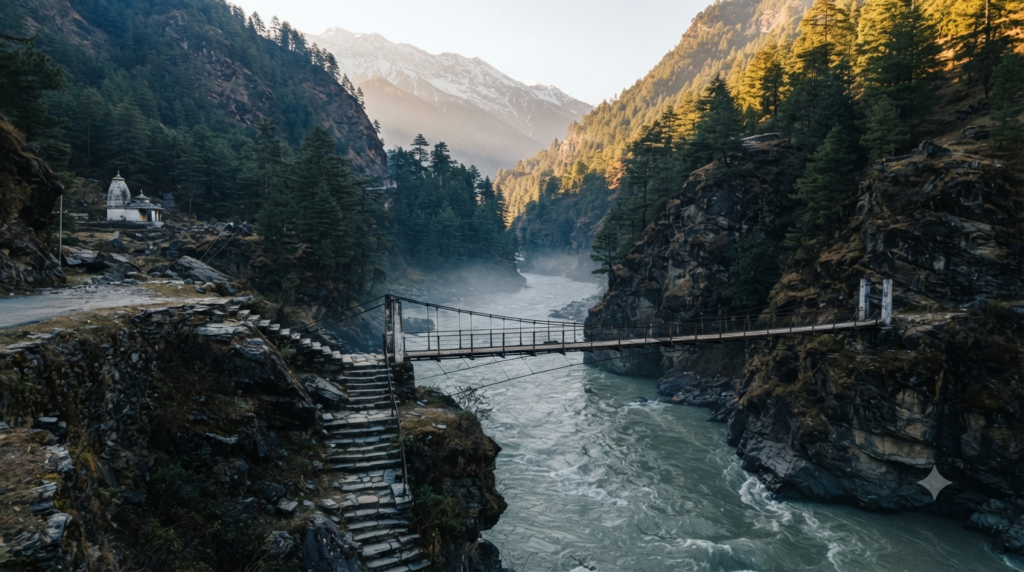
There is no ticket counter at the confluence, so Vishnuprayag darshan timings come down to daylight and road conditions. Most visitors therefore reach the sangam between 6:00 AM and 6:00 PM. The stone stairway down to the water is unlit, while the gorge loses light early.
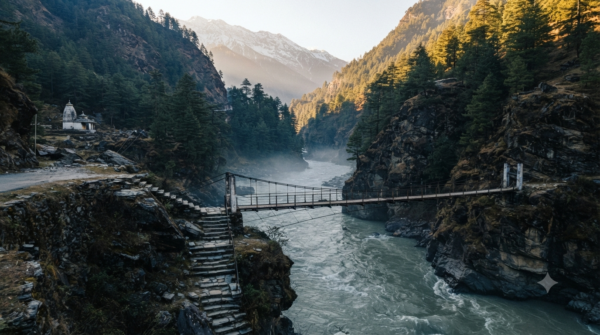
Vishnuprayag sits at 1,372 metres in Chamoli district, Uttarakhand. Here the Alaknanda meets the Dhauliganga. It is the first of the five Panch Prayag, and it lies on the Rishikesh–Badrinath highway between Joshimath and Badrinath.
This guide covers what route pages usually skip. You will find what the timings actually mean, whether Char Dham registration applies here, and what the road does in monsoon.
Go Kshetra is an independent pilgrimage guide. We are not affiliated with, endorsed by, or the official website of the Badrinath-Kedarnath Temple Committee or Uttarakhand Tourism. We do not accept bookings, donations or payments, so please use the official portals linked below.
Vishnuprayag Darshan Timings at a Glance
- Location: Chamoli district, Uttarakhand, on NH-7 between Joshimath and Badrinath.
- Altitude: 1,372 metres (4,501 feet).
- Rivers: Alaknanda, called Vishnu Ganga here, and the Dhauliganga.
- Vishnuprayag darshan timings: daylight-based, roughly 6:00 AM to 6:00 PM.
- Entry fee: none. No ticket, no pass, no booking.
- Distance: about 11–12 km from Joshimath, about 32 km from Badrinath.
- Time needed: 45 minutes for the viewpoint, or two hours with the walk down.
What the Vishnuprayag Darshan Timings Actually Mean
Vishnuprayag darshan timings are not fixed by any temple board. The confluence, the octagonal Vishnu temple and the Vishnu Kund stay open through daylight hours. Still, visitors generally treat 6:00 AM to 6:00 PM as the usable window. Entry is also free, and nobody issues tickets or online slots for this site.
That absence of a schedule confuses first-time visitors. Several aggregator pages still list precise darshan hours here, and some even print a pooja timetable. Yet no temple trust publishes one. The small shrine is looked after locally, so priest availability varies.
Because of that, light is the real constraint rather than a gate. The stairway from the temple down to the kund stays steep, damp and unlit after rain. Once the sun drops behind the ridge, the descent becomes unsafe. In this narrow gorge that happens well before 6:00 PM.
Donations at the shrine also stay voluntary. Nobody sets an amount. So do not pay anyone who claims to collect an official entry fee here.
Where the Confluence Is, and What You Actually See
The Alaknanda arrives from Badrinath. By then it has already absorbed the Saraswati near Mana village. The Dhauliganga comes down from Niti Pass, close to the Indo-Tibet border. They collide in a rock cleft below the highway, so the noise carries far up the slope.
A suspension bridge crosses the water. It also gives the best photograph of the merge. Two ridges frame the site, and local tradition names them Jai and Vijay after Vishnu’s gatekeepers.
One detail almost no guide mentions. A run-of-river hydroelectric project run by Jaiprakash Power Ventures also draws from this stretch. As a result, the volume at the confluence can look thinner than the dramatic photos online. Manage your expectations before making a long detour.
The Octagonal Temple and the 1889 Puzzle
A small octagonal temple to Vishnu stands above the confluence. A stairway then runs from it down to the Vishnu Kund. Pilgrims usually stop here before continuing to Badrinath. The site is tied to Sage Narada, who meditated here until Vishnu appeared before him.
Nearly every page online still credits the building to Maharani Ahilyabai Holkar of Indore. Those same pages then date it to 1889. Both facts cannot be right, because Ahilyabai Holkar died in 1795.
The likeliest explanation is a later rebuild on an older Holkar-era foundation. That pattern is common across Himalayan shrines, since earthquakes and floods damage them repeatedly. Treat any confident single-date claim about this temple with caution. Still, no inscription or heritage listing settles it.
Do You Need Char Dham Registration for Vishnuprayag?
No. Vishnuprayag is a public confluence on a national highway, so nothing gates it. It needs no registration, no e-pass and no booking. Registration becomes compulsory only if you continue to Badrinath, Kedarnath, Gangotri, Yamunotri or Hemkund Sahib.
Still, this is where the biggest correction belongs. Older versions of this page pointed readers to a wrong registration address, and several sites still do. The only official channel is the Uttarakhand Tourism Development Board portal at registrationandtouristcare.uk.gov.in. The official Tourist Care Uttarakhand app also works.
Verify the “.uk.gov.in” ending before you enter anything. Registration is free, so nobody should charge you. No genuine government channel routes you to a private site for a processing fee. If a page charges you to register, it is not the government.
On the Badrinath route the pass check happens later, at Pandukeshwar. That lies beyond Vishnuprayag, so you can stop at the sangam without a pass. Checkpoint arrangements also shift between seasons. Confirm the current position on the official portal before you travel.
How to Reach Vishnuprayag
Road is still the only realistic option. Every route funnels through Joshimath, officially renamed Jyotirmath.
By Road
Vishnuprayag sits on NH-7, the Rishikesh–Badrinath highway. Buses also run from Rishikesh, Haridwar and Dehradun as far as Joshimath. Shared jeeps and taxis cover the last 11–12 km.
Allow 9 to 11 hours from Rishikesh, even though the distance is only about 250 km. The last stretch is slow, because the road narrows. Within Joshimath the administration also enforces a 30 km/h limit through the subsidence-affected section. The Joshimath–Marwari stretch also carries construction debris.
By Train
Rishikesh is the nearest usable railhead, roughly 250–260 km away. Haridwar is the bigger junction just beyond it, so more trains stop there. Trains connect both to Delhi, Lucknow and Dehradun. From the station you switch to a bus or taxi, and the mountain leg takes the rest of the day.
By Air
Jolly Grant Airport at Dehradun is still the closest airport. It sits about 280–300 km away by road, with daily flights from Delhi and other metros. Since the drive still takes 8–9 hours, plan a night at Joshimath. Attempting the airport-to-sangam run in one push rarely works, although some try.
Do Vishnuprayag Darshan Timings Change by Season?
Naturally, the daylight window stays roughly the same all year. Access does not. Vishnuprayag darshan timings mean nothing when the highway above Joshimath is shut, and that happens for part of the year.
Badrinath opened for the 2026 season on 23 April 2026, when its kapat parted at 6:15 AM. The closing date is declared on Vijayadashami each year, and it normally falls in mid-to-late November. Confirm it with the Badrinath-Kedarnath Temple Committee before a late-season trip. Once the shrine closes, traffic on this stretch thins to almost nothing.
| Season | Conditions | Verdict |
|---|---|---|
| May–June | Clear skies, full yatra traffic, hotels busy | Best overall. |
| July–August | Heavy rain, frequent landslide closures | Avoid if possible. |
| Sept–mid-Nov | Washed-clean views, thinning crowds | Best for photography. |
| Dec–March | Snow, cold, Badrinath shut, few services | Hardy travellers only. |
Note the correction here. Many older guides recommended February to May, and this page once did the same. February is still deep winter in upper Chamoli, so the route beyond Joshimath handles little tourist traffic. May and September remain the two reliable months.
What Can Go Wrong on This Road — and What to Do
Yet official pages leave this part out. Reaching Vishnuprayag is not guaranteed on any given day, and the failure modes are predictable.
Landslide closures. The Rishikesh–Badrinath highway has closed at Vishnuprayag itself, when boulders came down from the Hathi Pahar slope. During monsoon the Chamoli stretch has been blocked for days. Pilgrims then wait at Joshimath, Pipalkoti or Govindghat until the Border Roads Organisation clears it.
What to do if it shuts. Do not sit in the queue while hoping for an evening opening. Take a room at Joshimath or Pipalkoti instead, then check district and police updates that evening. Two-wheelers sometimes pass before cars, and walkers are often escorted across cleared debris first.
Weather cancellations. If the forecast carries an orange or red rain alert for Chamoli, treat the trip as off. Uttarakhand suspends yatra movement during severe alerts. Nothing overrides that, so plan around the alert instead.
If you cannot get through. The honest answer is that no alternative route exists, because NH-7 is the only road in. So rebuild the day around Joshimath instead. The Narsingh temple, the Adi Shankara math and the Auli ropeway are also within reach.
Safety at the Sangam
The currents at Vishnuprayag run fast and cold, so full immersion is not advised. Pilgrims traditionally touch the water, or take a token dip at the kund, instead of entering the main flow. Several sources describe bathing at the confluence as prohibited, so follow the notice posted on the day.
The stairway turns slippery whenever it rains. Parts of it have no railing. Wear shoes with grip, not slippers.
Altitude is modest here, so acclimatisation rarely matters at the sangam itself. It matters far more if you continue to Badrinath at 3,133 metres. Are you elderly, pregnant, or living with a heart or lung condition? Then talk to your doctor before the higher legs, and keep your regular medication with you.
Mobile coverage is patchy beyond Joshimath. Download offline maps first. Save a printed copy of any registration pass, because you cannot rely on data here.
Fitting Vishnuprayag Darshan Timings Into a Badrinath Day
Most people treat Vishnuprayag as a five-minute photo halt. That wastes the stop. Because Vishnuprayag darshan timings track daylight rather than a gate, the smartest slot is the outbound leg early in the morning.
Leave Joshimath by 6:30 AM and you reach the confluence in under half an hour. Spend 45 minutes at the bridge and the kund. You will still reach Badrinath before its midday closure, which runs from 1:00 PM to 4:00 PM.
The return leg works far worse. Afternoon light in the gorge is flat, and traffic bunches behind slow vehicles. You also risk descending the stairway in poor visibility. Similar logic applies at the other confluences, as our Rudraprayag darshan guide explains, and at the far larger Triveni Sangam in Prayagraj.
Nearby Stops Worth the Detour
| Place | Distance | Why stop |
|---|---|---|
| Joshimath (Jyotirmath) | ~11–12 km | Base town, Narsingh temple, Shankara math. |
| Auli | ~25–30 km | Ropeway, meadows, winter skiing. |
| Badrinath | ~32 km | Char Dham shrine, Tapt Kund, Mana village. |
| Govindghat | ~20 km | Trailhead for Valley of Flowers, Hemkund Sahib. |
Govindghat is the practical gateway for the Valley of Flowers National Park. It blooms hardest in July and August. That timing collides with the worst landslide season, so weigh the trade-off honestly.
Vishnuprayag Darshan Timings: What Most Guides Get Wrong
- Invented schedules. Fixed Vishnuprayag darshan timings and pooja charts get copied between sites, yet no temple board publishes them.
- Booking links. There is nothing to book. Any page selling Vishnuprayag tickets is selling something that does not exist.
- February as a good month. It is winter, and the upper route is unreliable then.
- Ignoring the road. Joshimath subsidence and monsoon landslides shape this trip more than any timing chart.
- Skipping the walk down. The highway view is ordinary. The kund and the bridge are the reason to come, and most visitors never leave the car.
Planning Around Vishnuprayag Darshan Timings
Vishnuprayag rewards a planned stop rather than a hurried one. Vishnuprayag darshan timings favour the morning, so arrive in the first half of the day. Come between May and June, or from September to mid-November. Give yourself ninety minutes rather than ten.
Register on the official Uttarakhand portal only if a dham is on your route. Never pay a private site to do it. Check Chamoli district and highway updates the night before, because road status decides this trip. For deeper Himalayan planning, our Kedarnath temple guide covers the neighbouring circuit.
Frequently Asked Questions
What are the Vishnuprayag darshan timings?
Vishnuprayag darshan timings are daylight-based rather than fixed. Visitors generally use a 6:00 AM to 6:00 PM window. No temple board publishes an official schedule. The stairway down to the Vishnu Kund is unlit, so finish well before dusk.
Is there an entry fee at Vishnuprayag?
No. Entry to the confluence, the octagonal Vishnu temple and the kund is free. Donations at the shrine stay voluntary, and no authority collects an official fee at this site.
Do Vishnuprayag darshan timings require online booking?
No booking system exists for Vishnuprayag. Char Dham registration applies only to Badrinath, Kedarnath, Gangotri, Yamunotri and Hemkund Sahib. It is free on the official Uttarakhand Tourism portal.
Can you take a dip at the Vishnuprayag sangam?
Full immersion is strongly discouraged. The currents are powerful and the water is glacier-cold. Pilgrims usually touch the water or bathe at the Vishnu Kund instead. Follow any local notice, since bathing at the main confluence is often restricted outright.
How far is Vishnuprayag from Joshimath and Badrinath?
Vishnuprayag lies about 11–12 km from Joshimath and roughly 32 km from Badrinath, all on NH-7. The Joshimath leg takes 25 to 40 minutes. The Badrinath leg usually needs 1.5 to 2 hours in season traffic.
Do Vishnuprayag darshan timings apply in winter?
The site itself never closes, but the route turns unreliable once Badrinath shuts in November. Snow, ice and thin services make December to March difficult. Check road status with the district administration before attempting it.
How long should I spend at Vishnuprayag?
Allow 45 minutes for the bridge and the highway viewpoint. Budget 1.5 to 2 hours if you walk down to the Vishnu Kund and sit by the water. Rushing it in ten minutes is the most common regret visitors report.
Is Joshimath safe to stay in after the land subsidence?
Joshimath remains open and its hotels operate normally. Parts of the town stay under monitoring after the 2023 subsidence crisis. Scientists report that movement continues slowly, so prefer established accommodation away from the flagged wards.
Where can I check official information about the region?
Use the Ministry of Tourism page for Vishnuprayag for background. The Chamoli district administration site carries local advisories. Registration and yatra updates sit on the Uttarakhand Tourism portal.