
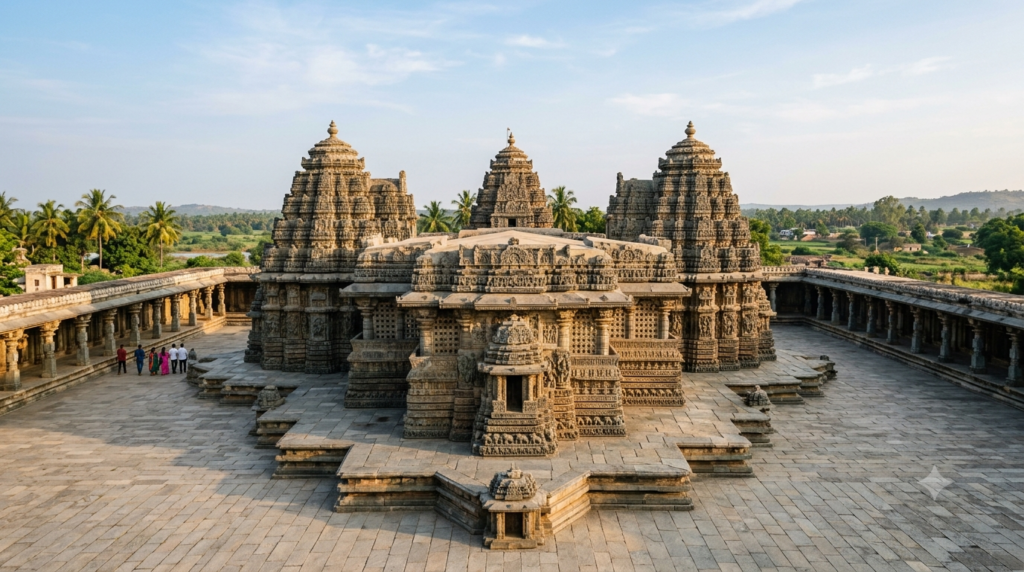
Planning a Keshava Temple Somanathapura Darshan is a little different from most temple trips, because this 13th-century Hoysala marvel is a protected monument rather than an active worship shrine. The temple sits on the banks of the River Kaveri near Mysuru, and it now holds UNESCO World Heritage status. This guide covers the real timings, the ticket process, how to reach, and one thing most other pages get wrong: what you will actually see when you arrive.
Go Kshetra is an independent pilgrimage and heritage guide. We are not affiliated with, endorsed by, or the official website of the Archaeological Survey of India or any temple trust. We do not sell tickets or take bookings. For entry tickets, use the official ASI portal linked below.
Keshava Temple Somanathapura Darshan at a Glance
Here are the essentials before you go. Because a few facts change from time to time, always confirm the fee and timings on arrival or on the official ASI portal.
| Detail | Information |
|---|---|
| Full name | Chennakeshava (Keshava) Temple, Somanathapura |
| Location | Somanathapura, Mysuru district, Karnataka |
| Managed by | Archaeological Survey of India (ASI) |
| Status | UNESCO World Heritage Site (since 2023) |
| Open | Around 8:30 AM to 5:30 PM, daily |
| Entry fee (Indian) | Approx. ₹25 (ASI ticket) |
| Entry fee (foreign) | Approx. ₹250 (ASI ticket) |
| Nearest city | Mysuru, about 35–38 km |
| Time needed | 1.5 to 3 hours |
What You Actually See: A Monument, Not a Live Darshan
This is the single most important thing to know before your Keshava Temple Somanathapura Darshan, and most guides skip it. The temple is a non-living monument, so there is no daily pooja here and no priest performing sevas. The main Keshava idol is missing, while the Janardhana and Venugopala idols are damaged.
UNESCO itself notes that regular religious activity stopped here centuries ago. So if you arrive expecting a Suprabhata Seva or an evening aarti, you will be surprised. Any page listing a “daily pooja schedule” for this temple is simply wrong.
What you get instead is arguably more remarkable. You walk through one of the finest sculptural galleries in India, where nearly every stone surface carries carving. Because the site is a museum-grade monument, you can explore the platform, the three shrines, and the outer friezes at your own pace.
So think of a Keshava Temple Somanathapura Darshan as a heritage walk rather than a ritual visit. You will not queue for a deity sighting or offer a pooja. Instead, you circle a stone masterpiece and read history off its walls, which many visitors find deeply moving in its own way.
UNESCO World Heritage Status
On 18 September 2023, UNESCO inscribed the temple on the World Heritage List as part of the “Sacred Ensembles of the Hoysalas.” This serial listing groups three temples together: Belur, Halebidu, and Somanathapura. It became India’s 42nd World Heritage Site, listed under reference number 1670.
This matters for your visit in a practical way. Since the recognition, footfall has risen, and weekends now draw larger crowds than before. If you want quiet time with the carvings, plan a weekday morning. The heritage tag also means conservation rules are stricter, so follow the posted guidance inside the complex.
About the Keshava Temple Somanathapura Darshan Site
Somanatha Dandanayaka, a commander under the Hoysala king Narasimha III, consecrated the Chennakeshava Temple in 1258 CE. He founded the town of Somanathapura, which carries his name. The temple represents the climax of the Hoysala building tradition, and many art historians rate it as the most complete surviving example of the style.
The temple is a Trikuta, meaning it has three shrines, each once dedicated to a form of Vishnu: Keshava, Janardhana, and Venugopala. It stands on a raised, star-shaped platform that you can walk around fully. Because the plan is stellate, the light shifts across the carvings as you circle the building, which is why the hour you visit changes the whole experience.
What to Look For During Your Keshava Temple Somanathapura Darshan
The real reward of a Keshava Temple Somanathapura Darshan lies in the detail, so it helps to know where to look. The outer walls carry horizontal bands, or friezes, that run around the entire building. From the bottom up, they show elephants, horsemen, foliage, and then long narrative panels.
Those narrative bands retell episodes from the Ramayana, the Mahabharata, and the Bhagavata Purana. Because Hoysala artists signed some of their work, you can even spot sculptor names carved into a few pieces. That personal touch is rare in Indian temple art, and it makes the panels feel closer to hand.
Step inside and look up at the ceilings of the three shrines. Each one is carved into a different domed pattern, from banana-bud motifs to lotus tiers. The pillars, meanwhile, show the smooth, lathe-turned finish that Hoysala workshops mastered. Give the interior a slow, careful look, since the low light hides much of this work from a quick glance.
How to Book Keshava Temple Somanathapura Darshan Tickets
Because Somanathapura is a small town, mobile networks can be patchy at the counter. So booking ahead genuinely saves time on busy days. The Archaeological Survey of India issues the ticket through its official e-ticketing system.
- Open the official ASI ticketing portal at asi.payumoney.com (also reachable via asi.nic.in).
- Search for the monument by name: “Keshava Temple” or “Chennakeshava Temple, Somanathapura.”
- Pick your visit date and, where offered, a time slot.
- Enter visitor details and nationality so the system calculates the correct fee.
- Pay through the secure gateway, then save the e-ticket or QR code.
- Show the printed or digital ticket with a photo ID at the entrance.
If online booking fails for any reason, you can still buy a ticket at the entrance counter. Go Kshetra does not sell these tickets, so always transact only on the official ASI portal.
Keshava Temple Somanathapura Darshan Timings and Entry Fee
The monument is generally open from around 8:30 AM to 5:30 PM every day. Since these hours can shift on special days, it is wise to confirm locally before a long drive. Unlike active temples, there is no midday closure for rituals here.
The entry ticket is an ASI monument ticket, not a temple seva ticket. Indian visitors pay roughly ₹25, while foreign nationals pay about ₹250. Children below 15 usually enter free, as at other ASI sites. These amounts can be revised, so treat them as approximate and check the current figure on the official portal before you rely on them.
One quick note on a common mix-up: you may see figures like ₹300 for foreigners on older pages. Rates for ASI monuments do change over time, so the on-site board or the ASI portal is always the final word.
How to Reach Somanathapura
By Air
The nearest major airport is Kempegowda International Airport in Bengaluru, roughly 130–140 km away. From there, many travellers hire a taxi, while others first head to Mysuru and continue by road. Mysuru also has a smaller airport with limited flights.
By Train
Mysuru Junction is the closest major railhead, well linked to Bengaluru, Chennai, and Hyderabad. After you reach Mysuru, Somanathapura is about a 35-minute drive of roughly 35–38 km. Taxis and local buses both cover this stretch.
By Road
Somanathapura is easy to reach by road, since it lies about 35 km from Mysuru and around 130 km from Bengaluru via NH275. State buses and private taxis run this route regularly. If you enjoy a scenic drive, the road from Mysuru through Bannur is a pleasant one.
Best Time for Keshava Temple Somanathapura Darshan
The most comfortable months for a Keshava Temple Somanathapura Darshan run from October to March. During this window the weather stays cool, so you can study the carvings and walk the complex without harsh heat. Early morning, soon after opening, gives you soft light and the smallest crowds.
Monsoon between June and September brings heavy rain that can disrupt travel, although the surrounding greenery is lovely. Summers in April and May turn hot, and the open stone platform offers little shade. Because the temple has no covered darshan queue, weather affects your visit more than at a typical shrine.
Insider Tips Most Guides Miss
Arrive at opening time if you can. The early light rakes across the carvings and makes the detail pop, and the site is far quieter before mid-morning tour groups arrive. The stone platform also heats up fast, so early hours are kinder on bare feet.
Hiring a licensed local guide is worth it here. Much of the outer frieze narrates scenes from the Ramayana and Mahabharata, and a good guide turns rows of carvings into stories you will remember. You can easily spend two hours on the panels alone.
Footwear comes off before you step onto the platform, as at any temple. Photography is generally allowed in the open areas, though tripods and professional gear may need permission. Since there are few shops nearby, carry your own water, especially in the warmer months.
A Quick Health and Comfort Note
The visit involves a fair amount of walking and standing on open stone, with little shade. So elderly visitors, young children, and anyone with mobility concerns should pace themselves and carry water. On hot days, a hat and light cotton clothing make the walk far more comfortable.
Nearby Attractions
Somanathapura pairs well with a wider Mysuru circuit. Because most sights sit within an hour or two, you can combine several in a single day.
- Talakadu – about 25 km, known for sand-buried temples on the Kaveri.
- Shivanasamudra Falls – around 38 km, striking during and after the monsoon.
- Mysuru Palace – roughly 38 km, the region’s most famous royal landmark.
- Ranganathittu Bird Sanctuary – about 38–45 km, best in the breeding season.
- Srirangapatna – near 45–50 km, a historic island fort town.
Final Thoughts on Your Keshava Temple Somanathapura Darshan
A Keshava Temple Somanathapura Darshan rewards visitors who come for art and history rather than active ritual. Set your expectations for a world-class monument, book the ASI ticket ahead when you can, and aim for a cool-season weekday morning. Confirm the current fee and timings on the official ASI portal, then give yourself unhurried time with the carvings. For more Hoysala heritage, you can read our guides to the Halebidu temples and to Hindu temple architecture, or explore the nearby Udupi Krishna Temple.
FAQs About Keshava Temple Somanathapura Darshan
Is there a daily pooja or live darshan at the temple?
No. The Keshava Temple is a non-living ASI monument, so there is no daily pooja or priest-led seva. The main Keshava idol is missing and the other two are damaged. You visit it as a heritage monument, not as an active worship shrine.
Is prior online booking necessary?
No, you can buy a ticket at the entrance counter. Still, booking online through the official ASI portal saves time when the local network is slow or crowds are heavy, especially on weekends.
What are the entry fees?
Indian visitors pay roughly ₹25 and foreign nationals about ₹250 for the ASI ticket. Children under 15 usually enter free. These figures can change, so confirm the current amount on the official ASI portal or the on-site board.
Can I visit outside the listed timings?
No. The monument opens around 8:30 AM and closes near 5:30 PM daily. There is no midday break, unlike active temples that close for rituals.
Are photography and videography allowed?
Photography is generally permitted in the open areas. However, tripods and professional equipment may need prior permission, so check at the entrance before setting up.
Is there a dress code?
There is no strict dress code, though modest clothing is respectful. You must remove your footwear before stepping onto the temple platform.
How long should I plan for the visit?
Allow about 1.5 to 3 hours. That gives you time to walk the star-shaped platform, study the outer friezes, and take photographs without rushing.
Is the temple a UNESCO World Heritage Site?
Yes. UNESCO added it to the World Heritage List on 18 September 2023 as part of the “Sacred Ensembles of the Hoysalas,” alongside the temples at Belur and Halebidu.