
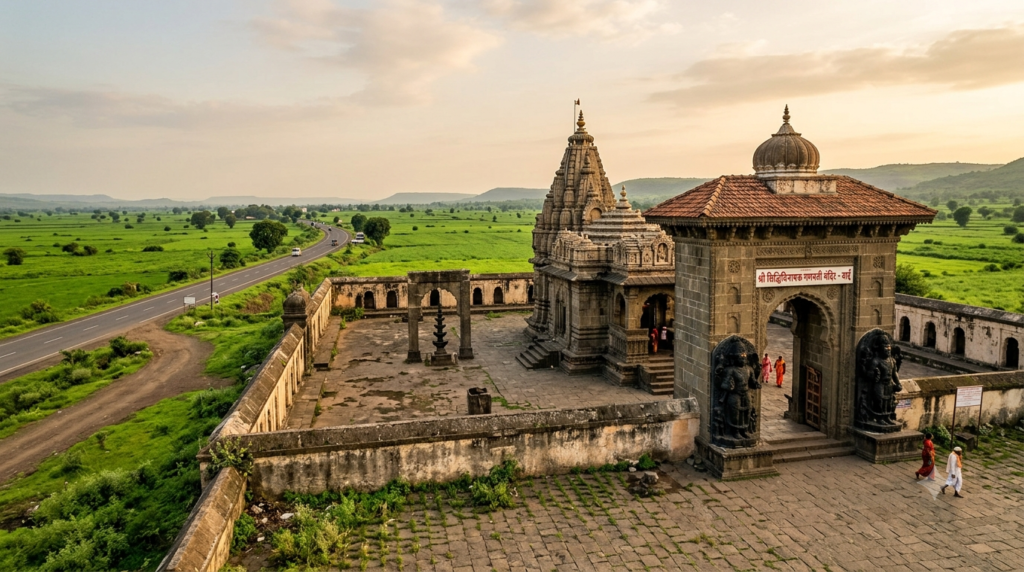
Ranjangaon Ganpati Temple darshan draws thousands of Ganesh devotees to a quiet Pune-district village, where devotees worship the most powerful of the eight Ashtavinayak forms of Lord Ganesha as Mahaganapati. The shrine sits right off the Pune–Ahmednagar highway, so it slots easily into a day trip or a full Ashtavinayak circuit. This guide covers verified timings, the real booking picture, how to reach, where to stay, and the mistakes first-time visitors make. Because many travel pages still repeat outdated fees and fake “official booking” links, we checked every changeable detail against official sources before publishing.
Go Kshetra is an independent pilgrim guide. We are not affiliated with, endorsed by, or the official website of the Mahaganapati Devasthan Trust or the Ashtavinayak temples, and we do not take bookings, donations, or payments. Please use the official Maharashtra Tourism Ranjangaon page and the on-site temple counter for reservations and current information.
Here is the short version, so you can plan fast. General darshan is free. The temple stays open from early morning until late at night. No official online booking exists for regular darshan.
Everything else below simply helps you time the visit well and avoid the common traps.
Ranjangaon Ganpati Temple Darshan at a Glance
The table below gathers the key planning facts in one place. Treat prices and timings as indicative, since the trust can revise them, and confirm anything critical at the counter when you arrive. Use it as a quick reference while you plan your Ranjangaon Ganpati Temple darshan.
| Detail | Information |
|---|---|
| Temple name | Shree Mahaganapati Temple (Ranjangaon Ganpati) |
| Location | Ranjangaon, Shirur Taluka, Pune district, Maharashtra – 412209 |
| Darshan timings | Around 5:00 AM to 10:00 PM daily (may extend on festival days) |
| Entry fee | Free for all visitors |
| Special poojas | Nominal charges at the counter (see below) |
| Distance from Pune | About 50 km via the Pune–Ahmednagar highway |
| Nearest railhead | Pune Junction (about 50 km; practical option) |
| Nearest airport | Pune International Airport (roughly 45–50 km) |
| Official reference | Maharashtra Department of Tourism |
Ranjangaon Ganpati Temple Darshan Timings and Daily Rituals
The temple is generally open for Ranjangaon Ganpati Temple darshan from about 5:00 AM to 10:00 PM every day. The exact opening minute varies slightly by season and festival. Some sources list a 5:30 AM start, so arrive a little early if a specific aarti matters to you. Entry stays free throughout these hours.
The day follows a fixed rhythm of aartis and poojas. The morning begins with Abhishek around 5:30 AM, followed by the collective morning aarti near 7:30 AM. Midday brings the Mahapuja and naivedya offering around noon, while the evening aarti falls close to 7:30 PM.
Priests perform the final Shej Aarti late, near 10:30 PM. The shrine then closes for the night.
If you want a calm, unhurried darshan, come for the early Abhishek or the morning aarti, because the queue is shortest then. Weekday mornings are the quietest windows overall. During festivals the same hours apply, yet crowds swell sharply, so allow far more time.
Ranjangaon Ganpati Temple Darshan: Booking and Pooja Charges
General darshan needs no booking and no ticket, because entry is free and open to everyone. You simply walk in during temple hours and join the queue. This is the single most useful fact to know before you travel.
Is there an official online booking for darshan?
No official online booking exists for regular Ranjangaon Ganpati Temple darshan. Many websites advertise “Ashtavinayak Darshan Online Booking,” yet almost all of these are private tour operators or hotels selling packages, not the temple itself.
Book a package if you want one. Just never assume it is the official shrine. And never share card details on a site that claims to “reserve your darshan slot” for a free, walk-in temple.
What do special poojas cost?
Special rituals carry only nominal charges, arranged at the trust counter near the entrance. Long-published trust listings put Abhishek at about ₹11, Satyavinayak Pooja around ₹51, and Sahasravartan near ₹101. These figures have circulated for years and may have changed, so treat them as a guide and confirm the current amounts at the counter. Pay only at the designated counter, never to a middleman in the queue.
Are photography and video allowed?
Photography rules shift over time and are often restricted inside the sanctum. Some accounts mention a small fee for cameras or video, while others report a full ban within the inner shrine. Since the rule can change, check the notice board or ask at the counter before you raise your phone.
About the Mahaganapati Shrine and Its Legend
Devotees regard Mahaganapati as the most powerful of Ganesha’s forms. Ranjangaon honours him in that fierce, protective aspect. Local tradition holds that Lord Shiva prayed to Ganesha here before defeating the demon Tripurasura. Because of that victory, the deity is also called Tripurarivade Mahaganapati.
The stone pillars point to a shrine built around the 9th or 10th century, later expanded under Maratha patronage. Madhavrao Peshwa built the stone sanctum around the swayambhu (self-manifested) idol. Tradition says he prayed here before riding to battle.
Builders aligned the east-facing shrine with care. At certain times of year, the rising sun’s rays fall straight on the idol.
The idol sits cross-legged, flanked by Riddhi and Siddhi, with the trunk turned to the left. In one striking local custom, villagers do not bring Ganesh idols into their homes during Ganesh Chaturthi. Instead the whole village worships at the temple itself, which tells you how central this shrine is to the community. For a wider view of the eight shrines, our Morgaon Ganpati Temple guide covers the traditional starting point of the circuit.
Planning Your Ranjangaon Ganpati Temple Darshan: How to Reach
Ranjangaon sits about 50 km from Pune on the Pune–Ahmednagar highway, and the temple’s main gate is visible from the road. The drive usually takes 1.5 to 2 hours, depending on traffic. The comparison below sums up your main options.
| Mode | Route and distance | Approx. time |
|---|---|---|
| Road (car/taxi) | Pune–Ahmednagar highway, ~50 km | 1.5–2 hours |
| Bus | State buses from Pune’s Shivaji Nagar stand | ~2 hours |
| Train | Pune Junction (~50 km), then road | Varies |
| Air | Pune International Airport (~45–50 km), then road | ~1.5 hours from airport |
By road
Road is the easiest way to plan a Ranjangaon Ganpati Temple darshan, because the shrine sits directly on the highway. Regular state transport buses run from Pune’s Shivaji Nagar bus stand toward Shirur and Ranjangaon. If you drive or hire a cab, the trip from Pune is roughly 50 km and takes about 1.5 hours.
By train
Pune Junction is the practical railhead, since it is well connected across India. Although Uruli station lies closer at around 16 km, it has limited connectivity, so most pilgrims still route through Pune. From Pune, take a taxi, shared cab, or bus onward to Ranjangaon.
By air
Pune International Airport is the nearest airport, roughly 45–50 km away by road. After you land, hire a taxi or board a state bus heading toward Shirur. The onward drive takes about 1.5 hours in normal traffic.
Where to Stay and Eat Near the Temple
Most visitors treat the shrine as a day trip from Pune, because the distance is short and buses are frequent. If you want to stay overnight, the Ranjangaon Ganpati Devasthan Trust runs a Bhakta Niwas. It offers simple rooms and a dormitory at nominal rates. The trust arranges rooms directly, so book on arrival or through official trust channels rather than a third-party “official” site.
Private hotels and lodges also cluster around the temple town and along the highway, covering budget to mid-range needs. For meals, the trust operates the Annapurna Bhojanalaya, which serves an afternoon lunch inside the complex. Dhaba-style eateries and South Indian options line the highway too, so food is never a problem.
Best Time for Ranjangaon Ganpati Temple Darshan
The most comfortable window for Ranjangaon Ganpati Temple darshan runs from roughly July to February. Post-monsoon and winter months bring cool, pleasant weather that suits both travel and unhurried temple visits. From July to October the surrounding plains turn lush and green, which adds to the atmosphere.
Festivals transform the mood but multiply the crowds. Ganesh Chaturthi in Bhadrapada (August or September) is the grandest occasion. The six-day Magh Utsav around Ganesh Jayanti (January or February) is another major draw.
If you prefer a peaceful darshan, avoid these peaks, or arrive very early on festival days. Because lunar-calendar dates shift each year, confirm exact festival dates before you plan around them.
Insider Tips for a Smooth Ranjangaon Ganpati Temple Darshan
A few practical habits make the visit far easier. These come from what regular Ashtavinayak pilgrims consistently report, and they cost nothing to follow.
- Arrive before 7:00 AM for the calmest Ranjangaon Ganpati Temple darshan, since queues and parking fill quickly later in the day.
- Carry enough cash, because ATMs in temple towns can run dry during festival rushes.
- Dress modestly in clean, traditional attire, since the shrine expects it out of respect.
- Book any overnight stay early during festival season, when rooms and the Bhakta Niwas fill fast.
- Combine temples wisely if you are doing the full circuit, so travel time stays manageable.
One safety note for festival days: crowds get dense, and the walk from parking can be long in the sun. Carry water, keep any medication handy, and take extra care with elderly travellers or young children in the crush.
Nearby Places to Combine With Your Visit
Ranjangaon works well as one stop in a longer day out, because several attractions sit within easy reach. The distances below are approximate, so confirm routes on a live map before you set off.
- Morachi Chincholi (~22 km): a rural spot famous for peacocks and green landscapes.
- Shirur (~21 km): a small market town with local eateries.
- Pune city (~50 km): home to Shaniwar Wada and the Dagdusheth Halwai Ganpati Temple.
- Bhimashankar (~90 km): a Jyotirlinga shrine and wildlife sanctuary for nature lovers.
Pilgrims doing the Ashtavinayak trail often pair Ranjangaon with the other seven Ganesha shrines. Our Siddhatek Ganpati Temple guide covers another key stop on the route. If your road trip continues into Ahmednagar district, the Shani Shingnapur temple guide is a useful companion read. For the full circuit context, the Maharashtra Tourism site lists all eight Ashtavinayak shrines.
Frequently Asked Questions
Is there an entry fee for Ranjangaon Ganpati Temple darshan?
No, entry is completely free for everyone. Donations are welcome but never required. You may pay a small charge only for parking or for optional special poojas.
Can I visit without any booking?
Yes. General darshan needs no booking at all, so you simply arrive during temple hours and join the queue. You arrange only certain special poojas at the counter, and you book even those on the spot.
Are special poojas like Abhishek available?
Yes, rituals such as Abhishek, Satyavinayak Pooja, and Sahasravartan are available at the temple counter. They carry only nominal charges. Confirm the current rates at the counter, since these amounts change over time.
Is there a dress code?
There is no strict enforced dress code, yet modest, traditional attire is strongly advised. Clean and conservative clothing is the safe, respectful choice at any Ashtavinayak shrine.
How long does Ranjangaon Ganpati Temple darshan take?
On weekdays a darshan can be quick, often 10 to 30 minutes. On weekends and festival days it stretches much longer, so budget extra time. Early mornings are consistently the fastest.
Can non-Hindus visit the temple?
Yes, the temple welcomes visitors of all backgrounds. Everyone follows the same customs of respect, quiet conduct, and modest dress inside the shrine.
Is Ranjangaon the last stop on the Ashtavinayak circuit?
In the traditional sequence, pilgrims visit Ranjangaon eighth, after Ozar, before returning to Morgaon to complete the yatra. Many devotees plan it as the final Ganesha shrine of the trail. You can, of course, visit it on its own as a simple day trip from Pune.