
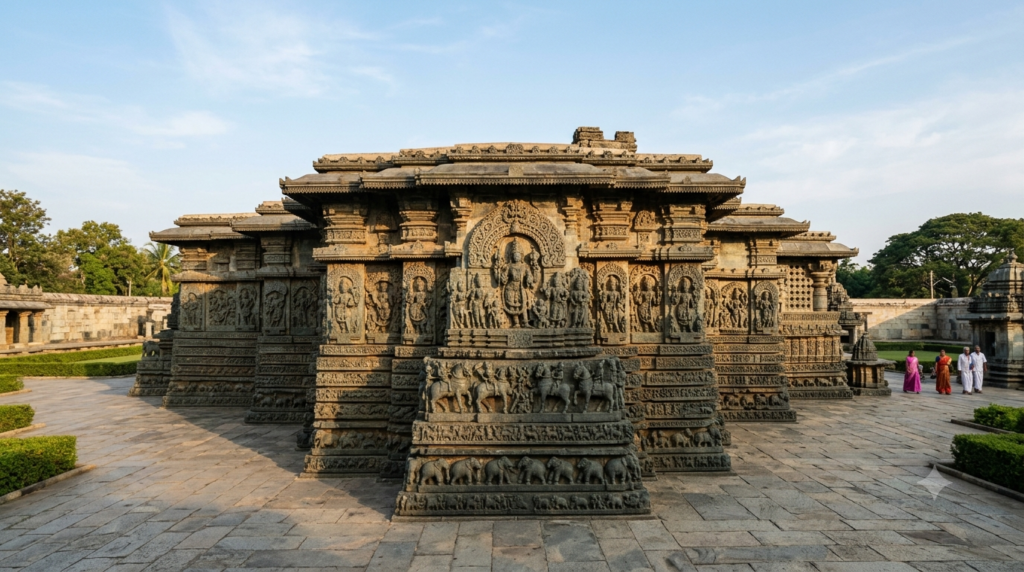
The Hoysaleswara Temple Halebidu is a 12th-century Shiva monument in Karnataka, and many pilgrims travelling from Bhadravati add it to their Hoysala heritage trip. This guide clears up a common mix-up first: the temple sits in Halebidu, Hassan district, not in Bhadravati itself. After that, you get verified timings, the real entry fee, how to reach the site, its UNESCO World Heritage status, insider tips, nearby attractions, and honest answers to the questions most guides skip. Everything here is checked against official and heritage sources so you can plan the visit with confidence.
Go Kshetra is an independent pilgrimage and heritage guide. We are not affiliated with, endorsed by, or the official website of the Archaeological Survey of India or the temple authorities. We do not sell tickets or take bookings. For entry rules and any official notices, use the resources linked below.
Quick Facts at a Glance
- Temple: Hoysaleswara Temple (also called the Halebid or Halebidu temple)
- Location: Halebidu, Hassan district, Karnataka
- Deity: Lord Shiva, in twin sanctums named Hoysaleswara and Shantaleswara
- Built: around 1121 CE to 1160 CE, under the Hoysala king Vishnuvardhana
- Temple timings: commonly cited as 6:30 AM to 9:00 PM daily; confirm locally
- Temple entry: free
- On-site museum (ASI): about ₹5 entry, closed on Fridays
- Status: UNESCO World Heritage Site since 2023
Is the Hoysaleswara Temple Halebidu in Bhadravati?
No. The Hoysaleswara Temple Halebidu stands in Halebidu, a town in Hassan district, and not in Bhadravati. This matters because the two places get confused online. Bhadravati has its own famous Hoysala-era shrine, the Lakshmi Narasimha Temple, so travellers often merge the two into one search.
Because both towns share Hoysala roots, the confusion is understandable. Still, they are separate destinations roughly 165 to 175 km apart. If you are starting from Bhadravati, treat this as a day trip or a comfortable overnight plan rather than a quick local visit.
Overview of the Hoysaleswara Temple Halebidu
The temple is a twin-shrine structure, so it holds two sanctums side by side under one connected hall. One shrine honours Hoysaleswara, a form of Shiva linked to the king, while the other honours Shantaleswara, named after Queen Shantala Devi. Both sanctums enshrine Shiva in the linga form.
Construction began around 1121 CE and continued for decades, finishing near 1160 CE. An officer of King Vishnuvardhana named Ketamalla is credited with commissioning it, although the temple famously lacks its original dedication inscription. The builders carved it from soapstone, a soft stone that hardens after quarrying, which let sculptors cut astonishingly fine detail.
Halebidu was once Dorasamudra, the Hoysala capital for nearly three centuries. The city was sacked in the early 14th century by the Delhi Sultanate, after which it earned the name Halebidu, meaning “old ruined city.” Even after that damage, the temple survives as one of the finest examples of Hoysala temple architecture in South India.
What the carvings show
The outer walls run in bands of continuous relief, so you can follow scenes from the Ramayana, the Mahabharata, and the Bhagavata Purana as you walk around. Rows of elephants, lions, horsemen, and dancers wrap the base, while larger figures of gods and celestial dancers rise above. No two panels repeat exactly, which is why unhurried walking beats rushing here.
Look closely and you will spot musicians, hunting scenes, and mythical creatures tucked between the larger figures. Bring a small torch if you have one, since the deeper carvings show more detail under direct light.
UNESCO World Heritage Status
In September 2023, UNESCO inscribed this temple on the World Heritage List as part of the “Sacred Ensembles of the Hoysalas.” The serial site groups three temples together: Chennakeshava at Belur, the Hoysaleswara Temple Halebidu, and the Keshava temple at Somanathapura. Together they became India’s 42nd World Heritage Site.
This recognition is recent, so many older travel pages still miss it. The listing praised the temples for hyper-real sculptures, stone carvings covering the whole surface, and the raised platform that lets visitors walk fully around the shrine. Knowing this adds real weight to what you are looking at on the ground.
Hoysaleswara Temple Halebidu Timings and Entry Fee
Most sources list the Hoysaleswara Temple Halebidu timings as 6:30 AM to 9:00 PM daily, though a few heritage listings note narrower monument hours around sunrise to sunset. Since the figures vary, treat the window as approximate and confirm on the day, especially during festivals. Entry to the temple itself is free.
The separate Archaeological Museum, run by the Archaeological Survey of India, sits about half a kilometre away, in front of the temple. It charges a nominal fee of roughly ₹5, payable by UPI, and it stays closed on Fridays. The museum opens through the day and shuts by around 5 PM, so plan the museum before late afternoon if you want to see it.
Photography rules
Photography of the temple exterior is generally allowed, and the carvings reward a good camera or phone. Inside the sanctum and inside the museum, restrictions apply, so look for signage or ask the staff before you shoot. Tripods and commercial shoots usually need prior permission.
How to Reach Hoysaleswara Temple Halebidu
Halebidu has no airport or railway station of its own, so most visitors route through Hassan. From Hassan, the temple is about 31 km by road, and taxis or local buses cover the stretch easily. Because the last leg is short, Hassan makes a natural base for an unhurried trip.
By air
The nearest large airports are Mangalore International Airport, about 170 km away, and Kempegowda International Airport in Bengaluru, around 210 km away. From either, you can hire a taxi or take a bus toward Hassan, then continue to Halebidu by road. Mysuru’s airport is closer for domestic flyers when flights suit your schedule.
By train
Hassan Junction is the closest major railway station, and trains connect it with Bengaluru, Mysuru, and other cities. After you reach Hassan, a taxi or bus finishes the roughly 31 km to Halebidu. Travellers from Bhadravati can take a train toward Hassan, sometimes with a change, and then drive the final stretch.
By road
Halebidu links well to state and national highways, so buses run from Bengaluru, Mysuru, and nearby towns to Hassan or directly to Halebidu. If you are driving from Bhadravati, the road distance is roughly 165 to 175 km, about four hours via Hassan. Because the route passes through several small towns, start early to keep the day relaxed.
What to Expect at the Hoysaleswara Temple Halebidu
Unlike a busy active shrine, the Hoysaleswara Temple Halebidu is mainly a heritage and archaeological site. The sanctums hold symbolic lingas, yet the real focus for most visitors is the carved stone and the sense of history. Expect a raised stone platform, open walkways, and long stretches of sculpture rather than long darshan queues.
On a cool morning, the first thing that strikes people is the quiet grandeur of the walls. The epic stories sit frozen in soapstone, almost like watching silent films etched into rock. Arriving before 9 AM helps, because crowds stay thin and the low light throws the carvings into sharp relief.
Best Time to Visit Hoysaleswara Temple Halebidu
The best months are October to February, when Karnataka stays cool and comfortable for open-air walking. Summers from March to June turn hot, so midday viewing becomes tiring under the sun. The monsoon looks lush and green, although rain can disrupt travel and make the stone paths slippery.
Within any day, early morning and late afternoon are ideal. Because most walking happens outdoors on stone, softer light is easier on the eyes and better for photos. If you can, avoid the harsh midday hours between noon and 3 PM.
Insider Tips Most Guides Miss
- Hire a licensed guide at the entrance. A good guide points out symbolism and lesser-seen panels you would otherwise walk past. Rates vary, so agree on the fee before you start.
- Wear comfortable shoes. You will cover uneven stone around the platform, and smooth soles slip easily on the polished surfaces.
- Carry water and sun protection. Shade is limited on the open walkways, and the sun gets strong by late morning.
- Pair it with Belur. The Chennakeshava temple at Belur sits about 16 km away, so many visitors see both in one day.
- Check Friday plans. The temple stays open, but the on-site museum closes on Fridays, so adjust if the museum matters to you.
Health and Safety Note
The site involves a fair bit of walking on hard, sometimes uneven stone, so wear supportive footwear and pace yourself. Older visitors and anyone with knee or mobility issues should take the steps around the platform slowly. Carry water and any regular medication, since shops are limited right at the monument.
Nearby Attractions Around Hoysaleswara Temple Halebidu
- Kedareshwara Temple, Halebidu (on site): another elegant Hoysala shrine within easy walking distance.
- Chennakeshava Temple, Belur (~16 km): the sister UNESCO temple, famed for its detailed sculpture.
- Hassan city (~31 km): the practical base town for hotels, food, and transport.
- Shravanabelagola (~85 km): the towering Bahubali statue and a major Jain pilgrimage centre.
- Belur to Chikmagalur hills (~40 km onward): green coffee country if you extend the trip.
Where to Stay Near Halebidu
Halebidu itself is a small town, so most visitors base themselves in Hassan, about 31 km away. Hassan offers a wide range of budget and mid-range hotels, plus reliable transport links. A state-run tourism hotel also operates close to the temple for those who prefer to stay near the Hoysaleswara Temple Halebidu overnight.
Belur, roughly 16 km away, is another handy base if you want to cover both UNESCO temples early. Because rooms fill up during peak winter weekends, book ahead when you can. For a relaxed pace, an overnight stay lets you reach the temple soon after it opens, before tour groups arrive.
Before You Go
The Hoysaleswara Temple rewards visitors who slow down and read the stone rather than rushing through. Confirm the day’s timings, keep the museum’s Friday closure in mind, and set aside at least two hours for the complex. If you are coming from Bhadravati, plan the distance honestly and consider staying near Hassan. Above all, treat this as a heritage walk through 900 years of craftsmanship, and it will not disappoint.
FAQs About the Hoysaleswara Temple Halebidu
Is there an entry ticket for the temple?
No, entry to the temple is free. The separate ASI Archaeological Museum nearby charges a nominal fee of about ₹5, and it stays closed on Fridays. Guide and parking charges may apply locally.
Is the Hoysaleswara Temple in Bhadravati?
No, it is in Halebidu, Hassan district, roughly 165 to 175 km from Bhadravati. Bhadravati has its own Hoysala-era shrine, the Lakshmi Narasimha Temple, which is a different site. The two are often confused because both share Hoysala heritage.
What are the temple timings?
Most sources list 6:30 AM to 9:00 PM daily, though some heritage listings note narrower hours. Because figures vary, confirm on the day, especially during festivals. Early morning visits are quieter and better for photos.
Is photography allowed inside?
Exterior photography is generally fine and highly rewarding. Inside the sanctum and the museum, restrictions apply, so check signage or ask staff first. Tripods and commercial shoots usually need permission.
How long should a visit take?
Most visitors spend about 1.5 to 3 hours exploring the temple and nearby ruins. Add extra time if you plan to see the museum or pair the trip with Belur. A guide can make the same time far more rewarding.
Can I visit from Bhadravati in one day?
Yes, but it is a full day given the distance of around 165 to 175 km each way. Start very early to explore comfortably and return. Staying overnight near Hassan makes the schedule far more relaxed.
Is the Hoysaleswara Temple Halebidu a temple or a monument?
It is mainly a heritage and archaeological site, though the sanctums hold Shiva lingas. Most visitors come for the carvings and history rather than daily ritual. The Archaeological Survey of India protects and maintains the monument.