
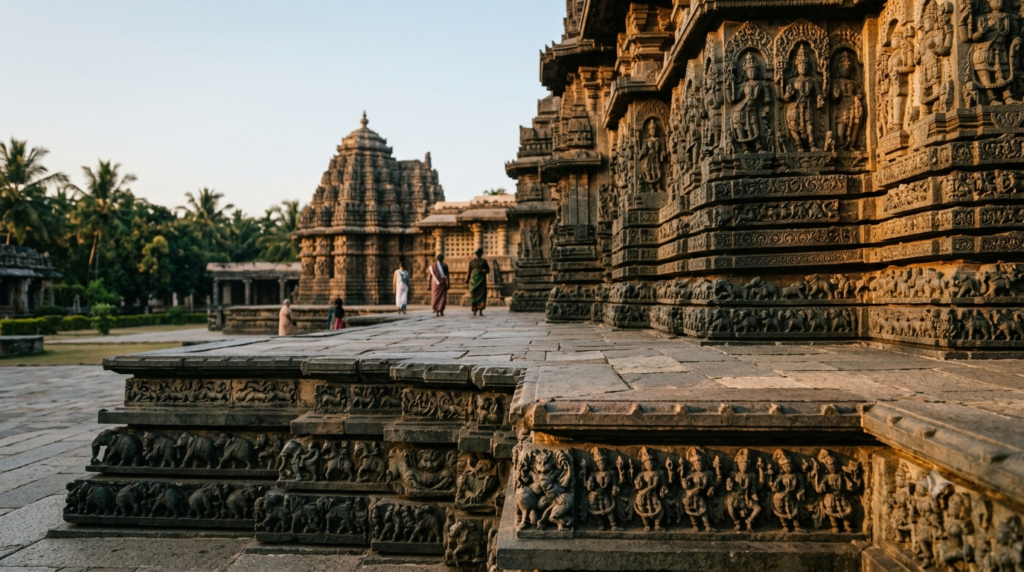
Halebidu temples darshan draws travellers to one of India’s finest examples of Hoysala stone craft, and since 2023 it carries a UNESCO World Heritage tag. The 12th-century Hoysaleswara Temple sits at the heart of the old Hoysala capital, its walls carved end to end with gods, animals, and scenes from the epics.
This guide gives you the verified timings, the real entry-fee position, museum details, and travel routes for a Halebidu temples darshan, plus one correction most other pages get wrong. Because the site is now a protected heritage monument, the way you visit differs from a regular worship temple, and knowing that saves you a wasted evening drive.
Go Kshetra is an independent travel guide. We are not affiliated with the Archaeological Survey of India, Karnataka Tourism, or any temple trust, and we do not sell tickets or take bookings. Use the official links below to confirm timings, fees, and to book any entry ticket.
Halebidu Temples Darshan at a Glance
Here are the core facts before you plan the trip. Each one is expanded further down, so treat this as your quick reference.
- Where: Halebidu, Hassan district, Karnataka, about 216 km from Bengaluru.
- Main monument: Hoysaleswara Temple, a 12th-century Shiva shrine and UNESCO World Heritage Site.
- Timings: generally sunrise to sunset, roughly 6:00 AM to 6:00 PM daily (not 9:00 PM).
- Entry fee: long free, but an ASI e-ticket now applies at several World Heritage monuments; confirm before you go.
- Museum: ASI Archaeological Museum nearby, 9:00 AM to 5:00 PM, closed Fridays, about ₹5.
- Best time: October to March, and before 11:00 AM for soft light and thin crowds.
Halebidu Temples Darshan Timings You Can Trust
The Hoysaleswara Temple grounds open from sunrise to sunset, which works out to roughly 6:00 AM until 6:00 PM every day. Many older pages still list 6:30 AM to 9:00 PM, yet an Archaeological Survey of India (ASI) monument closes by dusk. So do not plan a late-evening visit, because the gates will already be shut.
This matters because Halebidu is a small town with limited transport after dark. If you drive in from Hassan or Belur, aim to arrive by mid-afternoon at the latest. Since timings can shift on festival days, confirm the same-day hours with ASI or Karnataka Tourism before a long journey. A little planning keeps your Halebidu temples darshan smooth from start to finish.
The nearby Kedareshwara Temple keeps similar daylight hours. The Archaeological Museum, however, runs on its own schedule, and it closes on Fridays, which surprises many first-time visitors.
Entry Fee for Halebidu Temples Darshan
For years, entry to the Hoysaleswara Temple was free, and countless travel pages still repeat that. After the 2023 World Heritage listing, though, the position has tightened. Booking platforms now show an ASI e-ticket for the monument, so the old “always free” claim is no longer reliable.
Where a ticket applies, the World Heritage monument rate is commonly listed as around ₹40 for Indian visitors and ₹600 for foreign nationals, while children under 15 usually enter free. Because sources still disagree, treat these figures as indicative rather than fixed. Always confirm the current fee on the official ASI e-ticketing portal before you travel.
One warning worth heeding: fake ASI ticket websites exist, and the ASI itself flags them. So book only through the official portal, and never pay an inflated “processing fee” to a private site claiming to sell monument entry.
What a Halebidu Temples Darshan Actually Shows
A Halebidu temples darshan is really a heritage visit, not a busy worship queue. The Hoysaleswara Temple is a twin-shrine, or dvikuta, structure, with two sanctums side by side under one hall. One shrine honours Hoysaleswara, a form of Shiva, while the other honours Shantaleswara, named for Queen Shantala Devi.
Both sanctums hold Shiva lingas, and quiet worship still happens, yet the crowds come mainly for the carving. King Vishnuvardhana’s minister Ketamalla began the temple around 1121 CE. Master artisans then covered every surface in soapstone friezes, so no two panels feel the same.
Notably, the temple was never finished. The towering superstructure, or shikhara, was halted by 14th-century invasions and never built. Because of this, the whole visual weight sits in the horizontal bands of sculpture rather than a soaring tower. Look also for the Garuda Sthamba, a hero pillar honouring the royal bodyguards who died with their king.
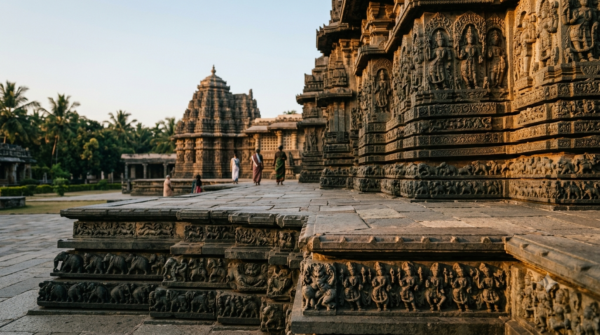
The detail rewards a slow walk. Craftsmen carved the friezes in soapstone, which is soft when quarried and hardens with age, so the artists could cut jewellery, claws, and drapery with astonishing precision. Rows of elephants, lions, horsemen, and dancers run around the base, and each band tells its own story. Of an original 84 large female figures, sadly only 14 survive today, since many were carried off over the centuries.
How to Reach Halebidu
By Air
Mangaluru Airport is the closest at about 185 km, while Bengaluru’s Kempegowda International Airport lies roughly 216 km away. From either, hire a taxi or take a bus to Hassan, then a local cab or auto to the temple. Mysuru’s airport is another option at around 150 km.
By Train
Hassan Railway Station is the nearest railhead, about 30 km from Halebidu. Regular trains link Hassan with Bengaluru, Mysuru, and Mangaluru. After arriving, you can grab a bus, taxi, or auto for the final stretch to the temple complex.
By Road
Halebidu is well connected by road, so a self-drive or bus trip is easy. KSRTC and private buses run from Bengaluru, Mysuru, and Mangaluru. Driving from Bengaluru takes about five hours via NH75, and buses drop you at Hassan or near the temple junction. Many visitors reach Halebidu on a loop that also covers Bengaluru temples like Gavi Gangadhareshwara before heading west.
The Museum and Guides at Halebidu
The ASI Archaeological Museum stands just across from the Hoysaleswara Temple, barely half a kilometre away. It opens 9:00 AM to 5:00 PM and stays closed on Fridays, with entry near ₹5. Inside, you will find Nandi figures, a dancing Ganesha, and hundreds of sculptures rescued from the ruined town.
Photography inside the museum is generally not allowed, so keep your camera for the open-air temple instead. Because many carvings carry layered meaning, a local guide adds real value. Guides wait near the entrance, and they usually charge around ₹300 to ₹500 for a group, though you should agree the fee before you start.
Best Time for Halebidu Temples Darshan
The ideal months for a Halebidu temples darshan run from October to March, when the weather stays cool and dry. Summer, from March to May, turns harsh, so the stone platform grows hot under bare feet by midday.
Early mornings reward you twice over. Before 11:00 AM, the low light throws the carvings into sharp relief, and the crowds are still thin. If you enjoy culture, time your trip with the Hoysala Mahotsava, a dance festival held near the temples around March.
Where to Stay for a Halebidu Temples Darshan
Halebidu itself is tiny, so most visitors stay in Hassan or Belur and drive in for the day. Hassan, about 30 km away, has the widest choice of budget and mid-range hotels. Belur, only 16 km off, keeps you close to both World Heritage temples.
Right by the monument, the state-run KSTDC Hotel Mayura Shantala offers simple rooms from roughly ₹1,300 a night, which suits an early-morning start. Prices shift with the season, so treat any figure as indicative and book through the hotel’s own channel. For a relaxed Halebidu temples darshan, an overnight nearby beats a rushed same-day return to Bengaluru.
Belur, Halebidu, and Somanathapura: The Hoysala Trio
Halebidu is one of three temples inscribed together as the Sacred Ensembles of the Hoysalas. The other two are the Chennakeshava Temple at Belur, about 16 km away, and the Keshava Temple at Somanathapura, near Mysuru. Together they became India’s 42nd World Heritage Site in September 2023.
Most travellers pair Halebidu with Belur in a single day, since the two sit so close. If you have longer, add Somanathapura on the Mysuru leg for the full set. Belur’s Chennakeshava is a living temple with active worship, so it offers a contrast to Halebidu’s quieter, monument-first mood.
This combined circuit is the smart way to plan, because it saves repeat trips and puts the three finest Hoysala works in one itinerary. No single official page maps the route for you, which is exactly why planning it ahead pays off.
Nearby Attractions With Distances
- Kedareshwara Temple (~0.5 km): another graceful Hoysala shrine right beside the main complex.
- Halebidu Archaeological Museum (~0.2 km): soapstone sculptures and inscriptions from the 12th to 13th centuries.
- Belur Chennakeshava Temple (~16 km): the living twin site of the Hoysala World Heritage group.
- Basadi Halli Jain temples (~1 km): three shrines to the Tirthankaras, quiet and often missed.
- Shravanabelagola (~50 km): the towering Bahubali statue and a major Jain pilgrimage site.
Insider Tips for a Halebidu Temples Darshan
- Arrive early: soft morning light on the carvings beats the harsh midday glare, and parking is easier.
- Mind the Friday closure: the temple stays open, but the museum shuts, so shift museum plans to another day.
- Hire a guide for the stories: the friezes hide the Ramayana, Mahabharata, and Bhagavata scenes you would otherwise walk past.
- Carry water and a hat: shade is scarce inside the courtyard, and the town has few shops.
- Footwear stays outside: you walk a sun-warmed stone platform barefoot, so morning visits spare your feet.
A quick safety note: the platform can burn underfoot in summer, and there is a fair bit of walking. So elderly visitors and anyone with mobility issues should carry water, pace the visit, and avoid the midday hours.
Before You Go
A Halebidu temples darshan rewards planning more than most temple trips, because it is a heritage monument first. Get there in the morning, keep the sunset closing in mind, and confirm the ticket position on the official ASI portal. Pair it with Belur for a fuller day, and you will see two of the greatest works of Hoysala art in one outing. For heritage lovers exploring Karnataka, this circuit sits alongside other gems like the Durga Temple at Aihole.
Frequently Asked Questions
Is there an entry fee for Halebidu temples darshan?
Entry was free for years, but an ASI e-ticket now applies at several World Heritage monuments. Where charged, the rate is commonly around ₹40 for Indians and ₹600 for foreign nationals, with under-15s free. Confirm the current fee on the official ASI portal before you visit.
What are the Hoysaleswara Temple timings?
The monument opens from sunrise to sunset, roughly 6:00 AM to 6:00 PM daily. Ignore older listings of 9:00 PM, since an ASI site closes by dusk. Plan an earlier visit to be safe.
Is Halebidu a UNESCO World Heritage Site?
Yes. The Hoysaleswara Temple was inscribed in September 2023 as part of the Sacred Ensembles of the Hoysalas, alongside Belur and Somanathapura. It forms India’s 42nd World Heritage Site.
Can I take photos at the temple?
Photography is generally allowed around the open temple complex. Inside the museum, however, cameras are usually not permitted. Always check the signs on arrival.
Is there a dress code?
No strict code is enforced, though modest clothing covering shoulders and knees is respectful. Footwear must be left outside the temple platform.
Can I visit Halebidu as a day trip?
Yes, many travellers combine Halebidu and Belur in one day from Bengaluru or Mysuru. An overnight stay in Hassan lets you enjoy a slower, less rushed pace.
How much time do I need at Halebidu?
Plan about 90 minutes to two hours for the temple and museum together. Add more if you take a guide, since the carvings reward a slow, close look.
Is the Hoysaleswara Temple still an active worship temple?
The sanctums hold Shiva lingas and quiet worship continues, but Halebidu is run chiefly as a heritage monument. So expect an architecture-first visit rather than a busy darshan queue.