
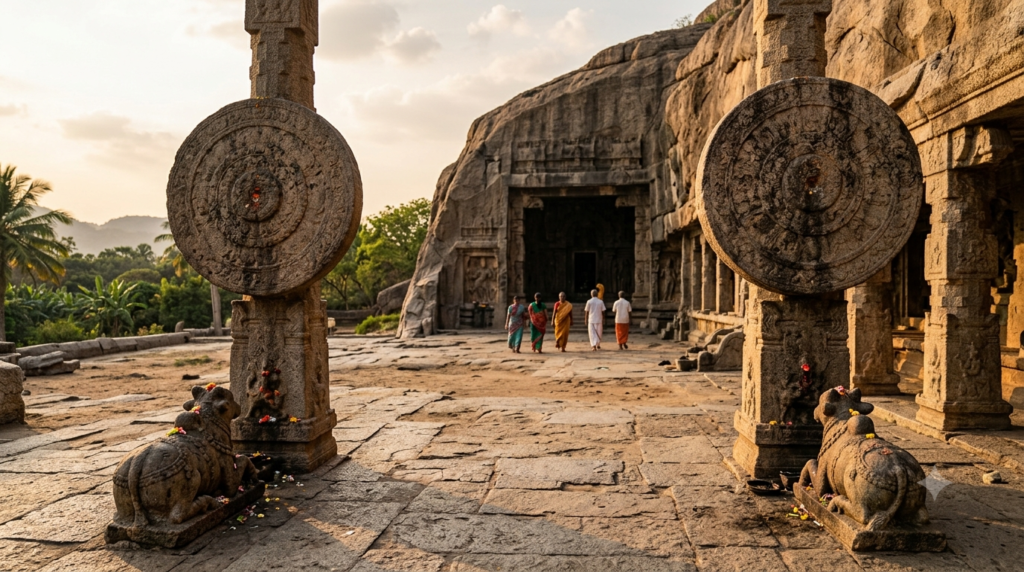
Planning your Gavi Gangadhareshwara Temple Darshan means walking into a 9th-century cave carved from solid rock. Here sunlight itself becomes part of the worship. This Shaivite shrine sits in Gavipuram, Bengaluru, and it hides a secret that draws crowds every January. The stone is cool, the sanctum is dim, and the place feels far older than the city outside.
Go Kshetra is an independent temple-travel guide. We are not affiliated with the temple management or any government body, and we do not take bookings, donations, or payments. Use only official or on-site channels for arrangements.
Gavi Gangadhareshwara Temple Darshan at a Glance
Here are the essentials before you plan the trip. Because timings and seva charges can change, treat the figures below as a guide, and confirm locally on the day.
- Deity: Lord Shiva, worshipped here as Gangadhareshwara, the bearer of the Ganga.
- Location: Gavipuram Extension, Kempegowda Nagar, Bengaluru, Karnataka 560019.
- Entry: Free for all visitors; sevas are optional and paid at the counter.
- Famous for: A rock-cut cave sanctum and the Makar Sankranti sun-ray phenomenon.
- Nearest Metro: National College (Green Line), roughly 1.8 km away.
| Detail | Information |
|---|---|
| Temple type | Rock-cut cave temple (monolithic) |
| Built | 9th century origin; renovated 16th century by Kempe Gowda I |
| Typical timings | Around 6:00–7:00 AM to 12:30 PM, then 5:00 PM to 8:30 PM (varies) |
| Entry fee | Free (general darshan) |
| Seva charges | Optional, roughly ₹100 upward depending on the ritual |
| Best festival day | Makar Sankranti (mid-January); also Maha Shivaratri |
| Protected status | State-protected monument, Karnataka |
Gavi Gangadhareshwara Temple Darshan Timings
The temple usually opens early in the morning and again in the evening. So a Gavi Gangadhareshwara Temple Darshan works best soon after opening, or an hour before the evening close. Most sources list a morning window from about 6:00 or 7:00 AM until 12:30 PM. The evening window runs from around 5:00 PM to 8:30 PM, while the temple stays shut through the afternoon.
Here is the honest catch that competing pages gloss over. Published timings differ from source to source, because the temple has no single official website that fixes them. One listing says 6:00 AM, another says 7:00 AM, and evening close ranges between 8:00 and 8:30 PM. So if your time is tight, call ahead or check on arrival rather than trusting one number online.
Weekdays stay calmer, while weekends and festival evenings fill up fast. Since the cave interior is small, even a modest crowd slows the queue. Arriving 30 to 45 minutes before the evening close still gives you room to see the carvings without rushing.
Entry Fee And Sevas For Gavi Gangadhareshwara Temple Darshan
General entry is completely free, so the Gavi Gangadhareshwara Temple Darshan costs you nothing for a standard visit. Anyone may enter and worship, including international visitors. Voluntary donations are welcome, although never required.
If you want a specific ritual, the temple offers optional sevas such as abhishekam and archana. You arrange these in person at the counter near the entrance. There is no official online booking portal and no phone-booking line for this temple. Charges are modest and vary by ritual, so ask at the counter for the current rate.
This is an important correction. Several aggregator pages and lookalike sites claim you can “book darshan online” here, or list a private number to reserve poojas. That is misinformation.
No genuine online darshan booking exists for Gavi Gangadhareshwara. So avoid any site asking for an upfront “processing fee” to secure a slot.
How Onsite Sevas Actually Work
The process is refreshingly simple, so first-timers rarely struggle. Reach the temple during open hours, then walk to the seva counter near the entrance. Choose the ritual you want, pay the listed amount, and keep the receipt. When the priest calls your turn, you offer the seva, after which prasadam is usually distributed.
The Makar Sankranti Sun Phenomenon Explained
This is the reason the temple is famous worldwide. On Makar Sankranti in mid-January, the rays of the setting sun pass between the horns of the stone Nandi. They travel through a precise arch and window, then fall directly on the Shiva Linga deep inside the cave. The linga glows golden for a few minutes, and devotees treat this brief alignment as deeply auspicious.
Makar Sankranti generally falls on 14 or 15 January, though the exact date shifts slightly by year and panchang. Because of that, confirm the current year’s date before you travel rather than assuming a fixed day.
Now a detail almost every other guide misses. Local accounts and heritage records note the alignment is visible across a short window, roughly 13 to 16 January, not only on Sankranti itself. Some observers also report a second illumination window in late November to early December. So if clouds spoil the main day, the surrounding evenings can still reward an early arrival.
One safety-minded note for this event: crowds are enormous, and people gather hours ahead near a narrow cave mouth. If you are elderly, pregnant, or travelling with small children, stand back from the crush and pick a calmer evening in the window instead.
History Of The Gavi Gangadhareshwara Temple
The shrine began as a small cave cut from monolithic rock around the 9th century. It was likely started under the Western Ganga dynasty. Kempe Gowda I, the chieftain who founded Bengaluru in 1537, later renovated and expanded it.
That royal patronage is why the temple ties so closely to the city’s origin story. You can read more about this rock-cut cave temple on Wikipedia, or explore the wider tradition in our guide to Hindu temple architecture.
Tradition reaches back even further. Devotees hold that the sages Gautama Maharishi and Bharadwaja Muni meditated at this cave. That is why some texts call the site Gowthama Kshetra. History and legend blur here, and both add to the temple’s pull.
Colonial artists were fascinated too. Thomas and William Daniell painted the temple in 1792, and their work records walls added over the centuries. Today the monument carries state heritage protection under Karnataka’s antiquities law, so its structure is legally safeguarded.
The Mysterious Stone Discs You Should Not Miss
Step into the forecourt and you meet the temple’s real puzzle. Four monolithic pillars stand here, and two of them lift enormous stone discs about two metres across. One disc is the Surya Pana, the sun; the other is the Chandra Pana, the moon. The remaining two pillars carry a Trishula, Shiva’s trident, and a Damaru, his two-headed drum.
What makes them remarkable is their rarity. No other temple in India is known to have discs quite like these, so historians still debate their purpose. Each disc even carries crosshair-like markings, and the pair does not align neatly to the cardinal directions, which deepens the mystery.
Inside, look for the unusual idol of Agni, the fire god, shown with two heads, seven hands, and three legs. Such a depiction is extremely rare in South India. Many devotees believe worship here helps with eye ailments, which they hold as a matter of faith rather than medical fact.
How To Reach The Temple
Gavipuram sits in south Bengaluru, so the temple is easy to reach by several routes. Because parking is tight around the narrow lanes, an auto-rickshaw or a ride-hailing cab is usually the smoothest option.
By Metro
The Namma Metro Green Line is your fastest city option. National College station lies roughly 1.8 km away, after which a short auto ride or a brisk walk brings you to the entrance. Many locals prefer this because it skips Bengaluru’s notorious traffic.
By Train
Bengaluru City Railway Station, often called Majestic, is the nearest major railhead at about 4 to 5 km. From there an auto or taxi reaches the temple in a short ride, although travel time swells during peak hours.
By Air
Kempegowda International Airport is roughly 36 to 38 km from the temple. A prepaid taxi or app cab takes about 1 to 1.5 hours, since the route crosses the length of the city.
By Road
Bengaluru connects well by road to the rest of South India. If you arrive by bus, Kempegowda Bus Station at Majestic is closest. From there, local transport or a cab covers the last stretch to Gavipuram.
Best Time For Gavi Gangadhareshwara Temple Darshan
The comfortable season for a Gavi Gangadhareshwara Temple Darshan runs from October to February, when Bengaluru’s weather stays cool and pleasant. Mornings are quiet and meditative, so they suit a calm visit, while evenings bring soft lamp light that flatters the cave.
Makar Sankranti is the headline event, yet it is also the most crowded, so visit then only if you are ready for long waits. Maha Shivaratri, usually in February or March, brings special abhishekams and heavy footfall as well. For an unhurried Gavi Gangadhareshwara Temple Darshan, a weekday morning outside festival season is ideal.
For seasonal planning, the Karnataka Tourism portal is a useful reference. If you are touring the wider state, our Halebidu temples guide pairs well with a Bengaluru visit.
What To Do If Your Visit Does Not Go To Plan
The official happy path is simple: turn up during open hours and join the queue. Still, a few things can go wrong, so it helps to plan for them.
If you arrive during the afternoon closure, the sanctum will be shut, so return in the evening window instead. If Makar Sankranti is rained out or impossibly crowded, try the surrounding evenings in the mid-January window, when the alignment can still appear. And if a specific seva is unavailable, the counter staff can suggest an alternative ritual. Arrangements are handled flexibly on site rather than through a rigid booking system.
Dress Code And Practical Tips
There is no strict uniform, yet modest clothing is expected at this active shrine. Cover shoulders and knees, and be ready to remove footwear before entering. Since the cave floor can be uneven and dim, watch your step as your eyes adjust.
Photography is generally allowed in the outer courtyard, where the sun and moon discs make striking subjects. Inside the dark sanctum, avoid flash and respect worshippers, and check with staff if you are unsure. Carry a valid ID, keep water handy, and allow extra time on weekends.
Insider Tips Most Guides Miss
The contrast is the real experience here. One moment you are in loud, modern Bengaluru. The next, you step through the rock, the light dims, the air cools, and chanting echoes off stone. Early darshan between 7:00 and 8:00 AM catches this at its most powerful, because the abhishekam chants carry through the quiet cave.
Pair the temple with the forecourt discs before you leave, since most visitors rush past them straight to the sanctum. Give the Surya Pana and Chandra Pana a few minutes, as they are genuinely unique in India. Weekday visits also mean shorter queues, so plan around them if your schedule allows.
Nearby Attractions Worth Adding
The temple sits in a cluster of Basavanagudi landmarks, so you can easily build a half-day around it.
- Bull Temple (Dodda Basavana Gudi): about 1 km, famous for its giant monolithic Nandi.
- Bugle Rock Park: around 1.5 km, a shaded park set among ancient boulders.
- Ramakrishna Math: a calm spiritual centre for quiet reflection nearby.
- Lalbagh Botanical Garden: roughly 3.5 km, with its glasshouse and seasonal blooms.
- Tipu Sultan’s Summer Palace: about 5 km, an 18th-century teak palace.
Before You Go
A Gavi Gangadhareshwara Temple Darshan rewards curiosity as much as devotion. You get an ancient cave, a Shiva sanctum, and a genuine astronomical marvel in one visit. Entry is free and the sevas are optional.
The real trick is timing your trip to the calmer windows, unless the Sankranti spectacle is your goal. Confirm the current timings and festival dates before you set out, then linger over the mysterious stone discs. For most travellers, an unhurried weekday morning is the sweet spot.
Frequently Asked Questions
Is there an entry fee for Gavi Gangadhareshwara Temple Darshan?
No. General darshan is free for everyone, including tourists. Only optional sevas carry a charge, and you pay those at the counter. Donations are voluntary.
Do I need to book online for Gavi Gangadhareshwara Temple Darshan?
No. There is no official online booking system for darshan or sevas at this temple. Everything is arranged in person when you arrive. Be wary of any website claiming to sell darshan tickets or charging a booking fee.
What are the Gavi Gangadhareshwara Temple timings?
The temple typically opens around 6:00 to 7:00 AM until about 12:30 PM. It then reopens from roughly 5:00 PM to 8:30 PM. It closes in the afternoon. Because listings vary, confirm on the day.
When does the sunlight illuminate the Shiva Linga?
The main event is Makar Sankranti in mid-January, when the setting sun’s rays reach the linga through the cave. The alignment can appear across a short window around 13 to 16 January. Some accounts also report a second window in late November.
Who built the Gavi Gangadhareshwara Temple?
The cave shrine dates to roughly the 9th century and was renovated in the 16th century by Kempe Gowda I, the founder of Bengaluru. Tradition also links it to the sages Gautama and Bharadwaja.
Is photography allowed inside the temple?
Photography is generally fine in the outer courtyard, where the sun and moon discs stand. Inside the dark sanctum, avoid flash and respect worshippers. When in doubt, ask temple staff first.
What is special about the stone discs in the courtyard?
Two large monolithic discs, the Surya Pana and Chandra Pana, sit on pillars in the forecourt alongside a Trishula and Damaru. No other Indian temple is known to have discs quite like them, and their exact purpose remains a puzzle for historians.
How much time should I plan for the visit?
A relaxed visit takes about 45 minutes to an hour, which lets you see the sanctum, the carvings, and the courtyard discs. Allow extra time on weekends and far more during Makar Sankranti crowds.