
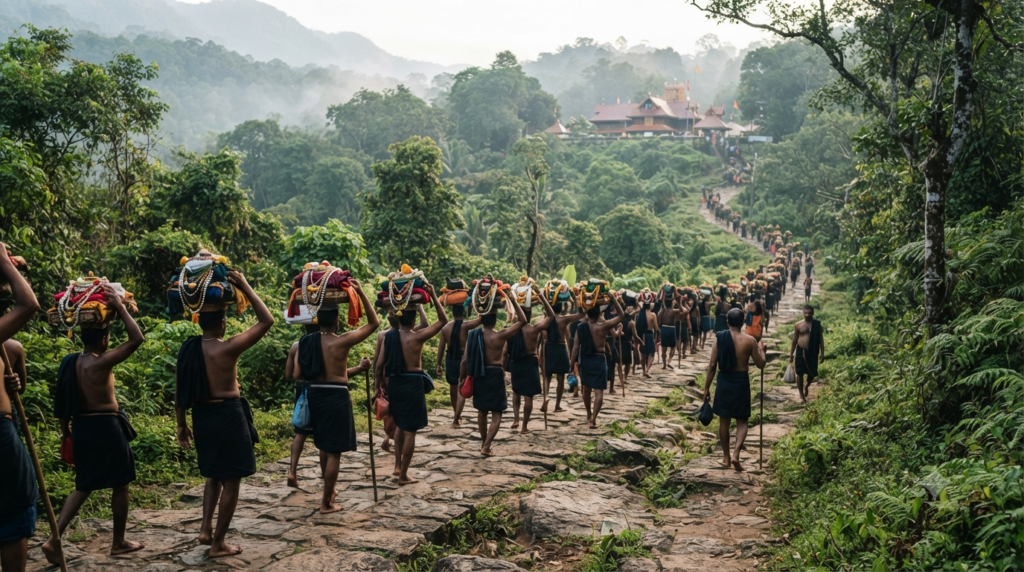
This Sabarimala pilgrimage guide explains when the hill shrine opens, how to prepare for darshan, and why the Irumudi matters at the 18 holy steps. The crucial distinction is simple: a Virtual-Q pass helps manage entry, but it does not replace religious preparation or reserve a pooja.
Independent-guide notice: Gokshetra is not affiliated with Sabarimala Temple or the Travancore Devaswom Board. We do not accept darshan bookings, donations or payments. Use the official channels linked below.
Sabarimala pilgrimage guide: essential facts
| Question | What pilgrims need to know |
|---|---|
| Where is the shrine? | Pathanamthitta district, Kerala, within the Western Ghats. |
| Is it open all year? | No. Worship follows specified festival and Malayalam-month openings. |
| Main season | Mandala and Makaravilakku; check the actual calendar. |
| Traditional vratham | 41 days of prayer, restraint and simple living. |
| 18 holy steps | Pilgrims must carry the Irumudi kettu to ascend them. |
| Main approach | Pamba to Sannidhanam: approximately 5 km uphill. |
| Darshan planning | Check official Virtual-Q availability before travel. |
| Pooja and prasadam | Separate from Virtual-Q; use TDB’s authorised offering channels. |
These facts describe the usual pilgrimage framework, not a promise that a particular day or service is available. Always check Travancore Devaswom Board (TDB) notices before booking travel.
Why Sabarimala is a pilgrimage, not an ordinary temple visit
Set among forested hills, Sabarimala Sree Dharma Sastha Temple is dedicated to Lord Ayyappa. The climb is central to its identity. For many devotees, the preparation begins well before they reach Kerala, with daily worship and a promise of personal discipline.
Tradition describes Lord Ayyappa as the son of Shiva and Vishnu in the form of Mohini. Stories also connect him with Mahishi, the Pandalam royal tradition and the sage Parasurama. A trustworthy Sabarimala pilgrimage guide treats these stories as religious belief, not independently documented history.
While Sabarimala has older local traditions, it developed into a major modern pilgrimage centre during the twentieth century. The shrine’s setting and rituals continue to draw devotees from different regions. Pilgrims often greet one another with the chant “Swamiye Saranam Ayyappa”.
Sabarimala pilgrimage guide: when the temple opens
Sabarimala does not remain open throughout the year. The main season covers Mandala worship and Makaravilakku, while shorter openings occur around Vishu and specified Malayalam-month worship periods. Consequently, a general statement that the temple is open every day would mislead anyone planning travel.
Kerala Tourism explains the seasonal opening pattern. However, the actual opening and closing times depend on the calendar and current TDB notices. A Sabarimala pilgrimage guide should not assume a monthly opening offers every service available during the main season.
Check the exact date before buying tickets or arranging accommodation. If a planned visit falls outside an announced opening, choose another authorised date. An open road to Pamba is not evidence that the sanctum is open for darshan.
Mandala, Makaravilakku and monthly openings
Mandala kaalam centres on the traditional 41-day observance and draws large pilgrim groups. Makaravilakku is another major period, associated with worship in January. Both can involve lengthy queues, traffic controls and changes to access routes.
Monthly and special-event openings are shorter. So do not transfer a Mandala-season bus timetable, queue arrangement or counter location to a different opening. Check each service against the particular visit window.
Sabarimala pilgrimage guide to the 41-day vratham
Mandala Vrutham is the traditional 41-day period of austerity before the pilgrimage. Devotees usually begin with Malayidal, wearing a mala as a sign of their vow. They then focus on prayer, vegetarian food, celibacy, restraint and a simple daily routine.
The Kerala government’s ritual guidance describes the 41-day observance. There is no verified official rule in that guidance establishing a shorter “minimum days” substitute. Therefore, this Sabarimala pilgrimage guide does not present an arbitrary shorter period as equivalent.
Black clothing has a traditional association with detachment. Some groups wear blue or other simple attire according to their practice. Ask your Guru Swamy, the experienced pilgrim guiding your group, about the customs your group follows.
What preparation matters beyond the vow?
Start walking regularly before the journey because the final hill approach requires effort. Make time for sleep, proper meals and hydration. A religious vow should never require you to stop essential medication or ignore medical advice.
People who are pregnant, elderly, unwell or living with heart, breathing or mobility conditions should discuss the exertion and any dietary restriction with a healthcare professional. Spiritual practice is not a substitute for healthcare, and your safety matters throughout the pilgrimage.
Sabarimala pilgrimage guide to Irumudi and the 18 steps
The Irumudi kettu is a traditional two-part cloth bundle prepared during Kettunirakkal, usually under a Guru Swamy’s guidance. One part carries offerings for Lord Ayyappa; the other holds permitted personal items. The ghee-filled coconut used for Neyyabhishekam is especially significant in this practice.
Do not leave the Irumudi at the foot of the steps. The official ritual guidance says that only pilgrims carrying Irumudi may ascend the 18 holy steps, known as Pathinettampadi. Pilgrims carry the bundle through the ascent and follow the temple’s directions for presenting offerings afterwards.
For any Sabarimala pilgrimage guide, this distinction matters: the steps are not a shortcut into the shrine. They have a specific ritual purpose. Anyone without Irumudi should ask authorised temple staff about the permitted darshan route instead of attempting to join that staircase.
What do the 18 steps signify?
Devotional explanations connect the steps with inner discipline, the senses, the three gunas and other spiritual ideas. Different traditions describe their symbolism in different ways. The exact interpretation is less important for practical planning than the access rule and respectful conduct.
Kerala Tourism also instructs pilgrims not to kneel on the steps or break coconuts there. Follow the moving queue and keep both hands available as staff direct. If you feel unsteady, tell the attendant before attempting the ascent.
Sabarimala pilgrimage guide: how Virtual-Q works
The TDB identifies Virtual-Q booking as the required queue-management arrangement for pilgrims. It helps assign an entry date and route subject to available slots. It does not mean you have paid for a ritual, reserved a room or secured priority access to a particular pooja. Therefore, this Sabarimala pilgrimage guide treats entry and offerings as separate decisions.
- Confirm that Sabarimala will be open on your preferred date.
- Visit the official Sabarimala Virtual-Q service, as linked by Kerala Police.
- Follow the current registration and identity-check instructions on that portal.
- Select an available date, route and reporting window, if offered.
- Keep the official confirmation and the required identification ready for checking.
- Follow police and TDB instructions at Nilakkal, Pamba and later checkpoints.
Virtual-Q registration is free under the board’s published arrangement. Do not pay an agent for a supposedly guaranteed slot. Availability may end before your preferred date, and a confirmation does not remove travel or crowd-control restrictions.
What if you cannot get a Virtual-Q slot?
First, look for another available official date or authorised route. Next, read current TDB notices to see whether a limited spot-booking facility exists for that opening. Counter locations and quotas can change, so do not presume that Pamba accepts walk-in registration.
If the board confirms no suitable slot or counter option, postpone the visit. Neither a travel booking nor an Irumudi guarantees entry. Avoid people promising to bypass queues, and never share identity documents with an unofficial booking service.
Virtual-Q, Neyyabhishekam and other offerings are different
Pilgrims often confuse three separate parts of a Sabarimala visit: joining the authorised darshan queue, carrying offerings inside Irumudi, and arranging an optional vazhipadu or temple pooja. Each has its own purpose and instructions.
| Activity | Purpose | Where to confirm |
|---|---|---|
| Virtual-Q | Manage darshan entry and reporting | Official Sabarimala queue portal |
| Irumudi / Neyyabhishekam | Traditional offerings and ghee ritual | Guru Swamy and temple instructions |
| Other vazhipadu | Specific optional poojas or offerings | TDB offering list and authorised service |
The TDB offering page lists poojas and points to its online pooja service. That list carries older dated tariffs, so check the live amount and availability before paying. A Virtual-Q confirmation alone is not proof of a paid offering. The Sabarimala pilgrimage guide makes that clear because queues and offerings follow different rules.
Some offerings require specific materials or procedures. Ask an authorised counter or your Guru Swamy what applies to your intended ritual. Do not infer that a pooja includes faster darshan unless the board explicitly confirms its current terms.
Sabarimala pilgrimage guide: Pamba to Sannidhanam
For many pilgrims, Nilakkal is the road-transport hub, while Pamba marks the start of the hill approach. The walk from Pamba to Sannidhanam is approximately 5 km. It climbs through a forested landscape, so a short distance on paper can feel demanding. This Sabarimala pilgrimage guide uses the Pamba route as a practical reference, not a promise of an easy climb.
Common landmarks include Neelimala, Appachimedu, Sabari Peetam and Saramkuthi. However, the approach and movement restrictions can change. Use authorised paths and the route assigned in your booking instead of relying on an old map.
Kerala’s official travel information identifies rail access through Kottayam and Chengannur and onward travel by road. It also describes transport connections involving Nilakkal and Pamba. Check current bus operations before choosing a late arrival.
Is the longer Erumeli route suitable for everyone?
No. Traditional forest-route pilgrimage involves much greater distance and physical effort than the usual Pamba approach. It can also be subject to permits, route-specific quotas, forest restrictions and seasonal closures.
If you are a first-time visitor or travelling with someone who has limited stamina, start by reviewing the standard Pamba approach. Do not enter a forest trail unless officials have confirmed access for your date and booking.
Sabarimala pilgrimage guide: packing for the trek
A light, organised load makes the climb safer. This Sabarimala pilgrimage guide recommends packing the essentials before you set out. However, treat Irumudi as a sacred offering bundle, not a spare luggage bag. Ask your Guru Swamy how to prepare and protect it without mixing unrelated items into the ritual pack.
- Carry your identification and official booking details in an accessible, protected place.
- Bring essential medicine, safe drinking water and a small amount of necessary personal gear.
- Choose footwear for the approach, then follow current temple-entry instructions near the shrine.
- Use reusable items where permitted and avoid littering in the forest.
- Keep heavy bags, excess valuables and prohibited items out of the trekking queue.
For the practical details, read Gokshetra’s footwear guide and drinking-water guidance. Those pages explain why a facility or storage option should not be assumed available on arrival.
Sabarimala pilgrimage guide: health and queue safety
The hill, crowds and changing weather create real demands, even for regular walkers. A Sabarimala pilgrimage guide is incomplete without advice on rest and emergency help. Take breaks during the ascent rather than trying to finish in one push. If you feel chest pain, unusual breathlessness or faintness, stop and seek urgent medical help.
Kerala Tourism’s pilgrim instructions call for orderly queues, security cooperation and the use of designated toilets. They also restrict mobile-phone use inside the temple premises. This does not establish a blanket phone ban over every road and trekking section.
Before you approach the final queue, agree on a meeting point with your group. Read Gokshetra’s mobile-phone rules and Pamba medical-facilities guide for practical precautions. If you need help, ask police or Devaswom personnel rather than strangers promising special access.
Respecting the spiritual meaning of the journey
Sabarimala carries a strong tradition of equality, shared effort and self-control. Pilgrims from varied backgrounds call one another “Swami”, reflecting the belief that every devotee undertakes an inward journey as well as a physical climb.
The Vavar tradition associated with Erumeli also expresses a history of religious coexistence in local devotion. Some pilgrims take part in Petta Thullal, a traditional observance linked with Ayyappa legends. These rites are meaningful practices, so seek local guidance rather than copying them without preparation.
At Sannidhanam, allow the queue to move and keep the path clear. Respect the instructions given for offerings and darshan. The experience is most rewarding when preparation, courtesy and personal safety receive as much care as the ritual itself.
Common mistakes this Sabarimala pilgrimage guide helps prevent
The most costly mistakes often start before departure. Pilgrims assume an opening is year-round, confuse a queue confirmation with a paid seva, or plan around a counter mentioned in an older article. Each assumption can spoil a long journey.
- Assuming an opening: confirm the exact date and hours with TDB.
- Leaving Irumudi at the steps: carry it as prescribed for the 18-step ascent.
- Shortening vratham by guesswork: follow the traditional 41-day guidance; ask your Guru Swamy about individual circumstances.
- Trusting a guaranteed darshan agent: use official registration and approved counters only.
- Underestimating the climb: allow rest and follow medical advice where needed.
Before you begin the journey
Use this Sabarimala pilgrimage guide as a planning framework, then verify the details that change from season to season. Confirm the temple opening, your official entry arrangements and the route before leaving home. Prepare the traditional Irumudi with proper guidance, while keeping pooja bookings separate from Virtual-Q. A safe, respectful journey matters more than rushing to a particular queue.
Frequently asked questions
Is Sabarimala Temple open throughout the year?
No. Sabarimala opens for specified Mandala, Makaravilakku, Vishu and Malayalam-month worship periods. It is not a daily-access temple. Check the current TDB calendar for your exact visit date.
Can I climb the 18 steps without Irumudi?
No. The official ritual guidance permits ascent of the 18 sacred steps only with Irumudi kettu. If you do not have it, ask temple staff which authorised darshan approach applies.
Must vratham last 41 days?
The traditional Mandala Vrutham lasts 41 days. Official descriptions do not establish the unspecified shorter minimum sometimes promoted online. Consult your Guru Swamy for religious guidance and a clinician about health-related limits.
Does Virtual-Q booking include Neyyabhishekam?
No. Virtual-Q concerns queue registration, whereas Neyyabhishekam is a religious offering with separate instructions. Check the TDB’s approved pooja arrangements and ask how to present the ghee-filled coconut from Irumudi.
Is a Virtual-Q slot guaranteed for my preferred date?
No. Availability depends on the authorised quota, date and route. If your choice has no slot, check another official date and any announced counter options. Never rely on an agent’s promise.
How far is Sabarimala from Pamba?
The principal uphill approach from Pamba to Sannidhanam is approximately 5 km. The climb can be strenuous, especially during crowded or wet conditions. Rest when necessary and follow the route assigned by officials.
Can women visit Sabarimala?
The temple’s age-related entry practice has been the subject of significant court proceedings and public debate. Do not rely on an undated yes-or-no claim. Check current court directions and the administration’s published entry guidance before travelling.
May I use my phone at the temple?
Kerala Tourism instructs pilgrims not to use mobile phones inside temple premises. Keep any required booking proof ready for official checks, then follow staff directions. Phone rules on the approach and storage arrangements require separate confirmation.
Can I book poojas from the same Virtual-Q screen?
Do not assume so. TDB publishes a separate listing for vazhipadu and an authorised online pooja service. Confirm the current ritual, fee and booking route there rather than treating your queue pass as an offering receipt.