
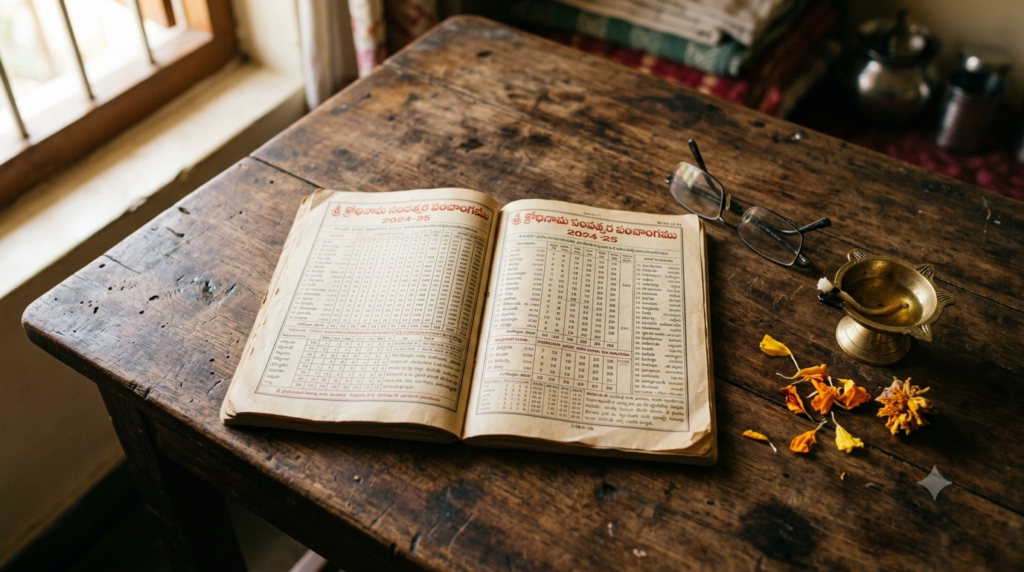
The Nemani Vari Gantala Panchangam is one of the most widely bought Telugu almanacs in Andhra Pradesh and Telangana, yet most pages about it get one basic thing wrong. They keep pointing readers at an edition that expired years ago. A panchangam runs from one Ugadi to the next, so the copy on your shelf stops being useful the moment the Telugu year turns. This guide explains what the almanac actually contains, which edition is current, what a real copy costs, and why the free PDF links circulating online deserve a hard second look.
Go Kshetra is an independent pilgrimage and temple guide. We are not affiliated with the Nemani family of siddhantis, Sree Saraswathi Jyothishalayam, or any panchangam publisher. We do not sell, host, or distribute panchangams, and we take no bookings or payments. Buy from the publisher or a licensed bookseller.
Nemani Vari Gantala Panchangam at a Glance
Here are the essentials before we go deeper.
- What it is: a printed Telugu almanac (panchangam) covering one full Telugu year, Ugadi to Ugadi.
- Language: Telugu only, printed in Telugu script.
- Associated with: the Nemani family of siddhantis from the Kakinada and Thuni belt of the East Godavari region.
- Common publisher credit: Sree Saraswathi Jyothishalayam, with distribution through several Telugu book houses.
- Typical length: roughly 190 pages in recent paperback editions.
- Indicative price: about ₹90 to ₹200 depending on seller and edition; confirm the current price at the point of sale.
- Current Telugu year: Sri Parabhava Nama Samvatsara, which began on Ugadi, 19 March 2026.
What the Nemani Vari Gantala Panchangam Actually Is
A panchangam is a Hindu almanac built on five limbs of time: tithi, vara, nakshatra, yoga and karana. The Nemani Vari Gantala Panchangam is one specific Telugu edition of that tradition. Because Telugu communities follow a chandramana (moon-based) reckoning, the book runs from one Ugadi to the next rather than from January to December.
The book is not a calendar in the wall-poster sense. It is a dense reference volume. Each page carries day-by-day astronomical data, and the back sections carry yearly predictions, festival lists and muhurtam tables.
Why It Is Called a “Gantala” Panchangam
In Telugu, ganta means an hour. Older almanacs printed timings in ghadiyas, a traditional unit that most readers can no longer convert in their heads. A gantala panchangam prints the same timings in clock hours and minutes instead.
That single choice is why these editions sell so well. A grandmother planning a gruhapravesham can read 9:42 a.m. directly off the page. She does not need a siddhanti to translate the figure for her.
Who Compiles the Almanac
Attribution varies across editions and sellers, so treat compiler names carefully. Recent listings credit Sri Nemani Somesham Sharma, sometimes alongside a co-compiler named Padmanabham Siddhanti.
Older editions carry Sri Nemani Satyakrishna Sarma, while some reference pages name Sri Nemani Venkata Jagannatha Sharma of Thuni.
These are not contradictions so much as a family lineage passing the work down. Still, the varying credits are exactly why look-alike listings slip through online. Check the cover carefully before you pay.
Which Nemani Vari Gantala Panchangam Edition Is Current
The current edition is the one for Sri Parabhava Nama Samvatsara, covering 2026–27. That Telugu year began on Ugadi, Thursday 19 March 2026, and it runs until the following Ugadi in 2027. Amazon listings show the Parabhava edition of the Nemani Vari Gantala Panchangam published in February 2026, ahead of Ugadi.
Publishers usually release the new edition four to eight weeks before Ugadi. Consequently, if you are shopping in January or February, you may still see last year’s stock on shelves. Always read the samvatsara name printed on the cover.
What Happened to the 2023–24 Sobhakritu Edition
Sobhakrit (also spelled Shobhakruth or Sobhakritu) Nama Samvatsara covered 2023–24. That edition is now three Telugu years old, so its muhurtams, tithis and festival dates no longer apply to any date you are planning today.
Many readers still search for it because old blog posts and marketplace listings never got updated. If you landed here looking for the Sobhakritu copy, treat it as an archive item only. For a wedding date or a housewarming, you need the Parabhava edition.
Recent Telugu Years and Their Editions
| Telugu year | Samvatsara name | Status |
|---|---|---|
| 2023–24 | Sobhakrit | Expired |
| 2024–25 | Krodhi | Expired |
| 2025–26 | Viswavasu | Expired |
| 2026–27 | Parabhava | Current edition |
What Is Inside the Nemani Vari Gantala Panchangam
The contents follow a fairly standard Telugu almanac structure. Because the layout repeats year after year, a reader who learns it once can use any edition confidently.
- Daily tithi, vara, nakshatra, yoga and karana, with start and end times in hours and minutes.
- Sunrise and sunset times, plus the daily rahu kalam, yamagandam and gulika kalam windows.
- Varjyam and durmuhurtam periods to avoid when beginning something new.
- Subha muhurtam tables for marriage, upanayanam, gruhapravesham and vehicle purchase.
- Festival and vratam dates for the full Telugu year, including Ugadi, Sri Rama Navami, Varalakshmi Vratam and Sankranti.
- Kartari and mudhami periods, when tradition advises against construction or new ceremonies.
- Eclipse timings and, in most editions, yearly rasi phalalu for all twelve signs.
If you only ever use one page, it will probably be the daily grid. Everything else supports it.
Where to Buy the Nemani Vari Gantala Panchangam
You have three practical routes, and each suits a different reader. Local Telugu bookshops in Kakinada, Rajahmundry, Vijayawada and Hyderabad stock it from roughly February onward. Temple bookstalls and pooja samagri shops also carry it around Ugadi. Online, Amazon India and Telugu book sites such as Logili and Mohan Publications list it once the new edition prints.
Buying locally has one underrated advantage. You can open the book and confirm the samvatsara name before handing over money.
Price Range and What You Should Pay
| Where you buy | Indicative price | Worth knowing |
|---|---|---|
| Local Telugu bookshop | ₹60–₹120 | Cheapest route; no delivery wait |
| Temple or pooja stall | ₹80–₹150 | Stock peaks near Ugadi |
| Online marketplace | ₹90–₹200 | Shipping may exceed the book price |
Recent Amazon India listings for the Parabhava edition have appeared between roughly ₹90 and ₹195. These figures move with seller and stock, so confirm the live price before you order.
How to Spot a Look-Alike Listing
Several Telugu almanacs use “Gantala Panchangam” in their titles, because the phrase describes a format rather than a brand. As a result, search listings mix them together freely.
Before paying, check three things. First, confirm the Nemani name appears on the cover image, not only in the listing text. Second, read the samvatsara name and year range. Third, check the stated publication date, since a 2023 print run cannot cover 2026–27.
Free PDF Downloads: The Part Most Pages Skip
Search results are full of “free PDF download” pages for Telugu panchangams, and the Nemani Vari Gantala Panchangam is a frequent target. Here is the honest position. The printed almanac is a copyrighted commercial publication, so a scanned copy uploaded by a third party is almost never authorised by the publisher.
Some panchangams genuinely are distributed free by their compilers or by mathas. Nemani’s edition is a priced retail book, however, so a free scan of it sits in a different category entirely.
Three Risks Nobody Mentions
Beyond the copyright question, unauthorised scans create practical problems for the reader.
- Wrong edition. Scans are rarely labelled properly. Plenty of files titled for the current year are actually older samvatsara editions, which makes every muhurtam in them wrong.
- Missing pages. Amateur scans routinely skip pages. Muhurtam tables sit deep in the book, so those are exactly the pages that go missing.
- Unsafe download sites. Many hosts wrap the file in redirect chains and ad-injection scripts. You may collect adware before you collect the almanac.
Since a printed copy costs less than a cinema ticket, the trade-off rarely favours the download.
Legal Ways to Read a Panchangam on a Screen
If you want the data on your phone, you still have good options. The Drik Panchang website publishes daily tithi, nakshatra and rahu kalam for your exact city, free and legally. Tirumala Tirupati Devasthanams (TTD) also publishes its own panchangam and calendar through its official portal.
Neither replaces a full gantala panchangam for muhurtam work. Still, for everyday checks they are accurate, free and above board. India’s Copyright Office sets out the rights that apply to published books if you want the legal detail.
How to Read the Nemani Vari Gantala Panchangam
The layout intimidates first-time readers, though the logic is simple once you see it. Each day occupies one horizontal band, and the timings run left to right in the order the day unfolds.
A Five-Step Method
- Find the Telugu month, then locate your date in the daily grid.
- Note the tithi and nakshatra, along with the clock time each one ends.
- Check the rahu kalam, yamagandam, gulika and varjyam windows for that day.
- Turn to the muhurtam section if you are fixing a ceremony, and match your event type.
- Cross-check the festival list, because a major festival changes crowd levels at temples.
That last step matters more than people expect. A perfect muhurtam on Vaikunta Ekadasi still means a six-hour queue at a busy shrine.
Mistakes First-Time Readers Make
Three errors come up again and again. Readers assume a tithi lasts a full calendar day, when it can end mid-morning. They also apply printed sunrise times to a distant city, although the panchangam is calculated for a specific reference longitude.
The third mistake is subtler. Many readers treat a printed muhurtam as personally suitable, yet traditional practice matches muhurtams against an individual horoscope. For a wedding or a major ceremony, most families still consult a siddhanti. Our guide to rahu kalam, yamagandam and gulika timings covers the daily windows in more depth.
Nemani Vari Gantala Panchangam Compared With Other Telugu Almanacs
Telugu readers have plenty of choice, and the differences are real but narrow. Calculations follow the same siddhanta, so variations usually appear at the margins of tithi end-times.
| Almanac | Known for | Typical reader |
|---|---|---|
| Nemani Vari | Clock-hour timings, compact format | Households wanting quick daily reference |
| Mulugu Vari | Wide media presence, detailed predictions | Readers who follow rasi phalalu closely |
| Chilakamarthi Vari | Long-standing muhurtam tables | Families fixing ceremony dates |
| Butte Veerabhadra | Traditional daivagna presentation | Readers following that lineage |
| TTD Panchangam | Tirumala-region timings and seva dates | Pilgrims planning TTD visits |
Families generally stay loyal to one edition for good reason. Switching mid-year invites confusion when two books disagree by a few minutes. If you want a comparison point, see our notes on the Butte Veerabhadra Panchangam and the TTD Tirumala panchangam calendar.
A Note on Timing, Faith and Real Decisions
Muhurtams, doshas and rasi phalalu belong to Vedic tradition and personal faith. They are not tested predictions, and no almanac guarantees an outcome. We present them here as tradition, because that is what they are.
Keep that boundary firm where real risk exists. A panchangam should never delay medical treatment, and it is not a substitute for professional medical, legal or financial advice. Where a decision carries genuine consequences, consult a qualified professional as well as your family priest.
Before You Buy This Year’s Copy
The Nemani Vari Gantala Panchangam earns its following because it turns dense astronomical data into plain clock times. That practical strength is the whole reason to own one. The key point is simply this: buy the edition matching the current samvatsara, which is Parabhava for 2026–27, and check the cover before you pay.
Skip the free PDF hunt. A printed copy costs roughly the price of two coffees, it arrives complete, and it supports the siddhantis who do the calculation work. If you only need daily tithi and rahu kalam, a free official panchang site will serve you perfectly well.
Frequently Asked Questions
Which Nemani Vari Gantala Panchangam edition should I buy now?
Buy the Sri Parabhava Nama Samvatsara edition, which covers 2026–27. That Telugu year started on Ugadi, 19 March 2026, and continues until the next Ugadi in 2027. The samvatsara name is printed on the cover, so check it before paying.
Is the Nemani Vari Gantala Panchangam available as an official PDF?
The publisher sells it as a printed book, and there is no widely confirmed official free PDF edition. Files circulating on download sites are generally unauthorised scans, often of the wrong year. For screen use, a free official panchang website is the safer and legal choice.
What does “Gantala” mean in the title?
Ganta means hour in Telugu. A gantala panchangam prints timings in clock hours and minutes rather than in traditional ghadiya units. That format makes the book readable for people who have never learned ghadiya conversion.
How much does a copy cost?
Recent listings have ranged from roughly ₹60 at local bookshops to about ₹200 online, depending on seller and edition. Online prices also carry shipping, which can exceed the book price. Confirm the current amount at the point of sale.
Is the 2023–24 Sobhakritu edition still useful?
Not for planning. Sobhakrit Nama Samvatsara ended in 2026, so its tithis, muhurtams and festival dates no longer match current dates. It remains useful only as a record, for instance if you need to look up a date that has already passed.
Does the Nemani Vari Gantala Panchangam work outside Andhra Pradesh?
Broadly yes, though sunrise, sunset and tithi end-times are calculated for a reference location. Readers in Bengaluru, Chennai or overseas should adjust for local sunrise. Many families abroad cross-check against a city-specific online panchang.
Can I fix a wedding date using the panchangam alone?
The book lists general subha muhurtams, so it gives you candidate dates. Traditional practice, however, matches those against the horoscopes of the individuals involved. Most families therefore use the panchangam to shortlist dates, then confirm with a siddhanti.
When does the next edition come out?
New Telugu editions usually print four to eight weeks before Ugadi, so expect the 2027–28 edition in the weeks before Ugadi 2027. Stock appears in Telugu bookshops first, and online listings follow shortly after.