The Hindu mythological demons list runs far deeper than a simple roster of villains, because the asuras of Hindu tradition are complex beings tied to cosmic order, morality, and the eternal struggle between ego and dharma. These figures fill the Vedas, the Puranas, the Ramayana, and the Mahabharata. Some are tyrant kings, some are cunning tricksters, and a few are genuinely righteous. This guide names the major asuras, explains where they came from, and shows which god finally brought each one down.
Before the stories begin, one point matters. The word “asura” did not always mean “demon” — and understanding that shift changes how you read every myth on this list.
Hindu Mythological Demons List at a Glance
- Asuras are the power-seeking half-brothers of the devas (gods), not simply evil monsters.
- The main clans are Daityas (sons of Diti) and Danavas (sons of Danu), both fathered by sage Kashyapa.
- Rakshasas are a separate race — shape-shifters like Ravana — often grouped with asuras but distinct in origin.
- Famous asuras include Hiranyakashipu, Mahishasura, Ravana, Narakasura, Bali, and Vritra.
- Not every asura is wicked. Prahlada, Mahabali, and Vibhishana are honoured as devotees.
What the Hindu Mythological Demons List Really Means
Every entry on the Hindu mythological demons list belongs to the asuras, a class of mighty beings who oppose the devas in myth. Yet “demon” is a loose translation. In the earliest Vedic hymns, “asura” meant “mighty” or “lordly,” and even Varuna and Indra carried the title with honour.
Over centuries the meaning flipped. By the Puranic age, the asura had become the antagonist of the gods, driven by pride, appetite, and power. The popular idea that “a-sura” means “not a god” is a later back-formation. Scholars note the reverse is more likely true, since “sura” (god) was coined from “asura,” not the other way around.
So these beings are not cartoon evils. They represent the forces of ego and disorder that the divine must repeatedly balance. Because many earned their strength through genuine penance, their tales carry real moral weight.
Origins and Classification in the Hindu Mythological Demons List
Most asuras trace back to one ancestor. According to Puranic cosmology, sage Kashyapa fathered them through two of his wives, Diti and Danu. Their children became the two great asura clans, and the epics add a third demonic race, the rakshasas.
Daityas — The Sons of Diti
Daityas descend from Diti, and this clan holds the most famous names on the Hindu mythological demons list. Hiranyaksha, Hiranyakashipu, Prahlada, Mahishasura, and Bali all belong here. They were known for immense strength, deep devotion, and a habit of warring with the gods. Interestingly, several Daityas were also great tapasvis who won boons through severe penance.
Danavas — The Sons of Danu
Danavas spring from Danu, and they lean toward cunning, sorcery, and magical craft. Vritra, the drought-serpent, is the best-known Danava. Mayasura, the great architect of the asuras, also came from this line. Because they mastered illusion and construction, Danavas often shaped the weapons and palaces the myths describe.
Rakshasas — A Separate Race
Rakshasas are not born of Diti or Danu, so strictly they sit apart from the asura clans. Their name comes from “raksha,” meaning to guard. They appear as shape-shifting night-wanderers in the Ramayana and Mahabharata. Ravana and his kin are rakshasas, yet the category also includes noble figures such as Vibhishana and Ghatotkacha, which proves the label alone never decides good or evil.
Hindu Mythological Demons List: The Major Asuras and Their Slayers
This section covers the notable asuras across Hindu mythology, along with their stories and the deity who defeated each. The table gives the quick view, and the entries below add the detail that most guides skip.
| Asura | Slain / Subdued By | Main Source |
|---|---|---|
| Hiranyaksha | Vishnu (Varaha avatar) | Bhagavata Purana |
| Hiranyakashipu | Vishnu (Narasimha avatar) | Bhagavata Purana |
| Mahishasura | Goddess Durga | Devi Mahatmya |
| Ravana | Rama (Vishnu avatar) | Ramayana |
| Narakasura | Krishna and Satyabhama | Bhagavata Purana |
| Bhasmasura | Vishnu as Mohini | Puranic legends |
| Tarakasura | Kartikeya (Skanda) | Skanda Purana |
| Andhaka | Shiva | Shiva & Matsya Purana |
| Vritra | Indra | Rig Veda |
| Bali (Mahabali) | Vishnu (Vamana avatar) | Bhagavata Purana |
Hiranyaksha: The Demon Who Dragged the Earth
Hiranyaksha, a mighty Daitya, once dragged the earth goddess Bhudevi to the bottom of the cosmic ocean. To rescue her, Vishnu took the form of Varaha, a giant boar. After a long underwater duel, the boar lifted the earth back into place and killed him. His fall sets the stage for his brother’s far more famous story.
Hiranyakashipu: The Boon That Backfired
Hiranyakashipu asked Brahma for near-immortality, and the loophole in his boon became legendary. He could not be killed by man or beast, indoors or outdoors, by day or night, on earth or in the sky, or by any weapon. So he turned tyrant and even persecuted his own devout son, Prahlada.
To break the boon, Vishnu appeared as Narasimha, a man-lion who was neither. At twilight, on a threshold, he placed the demon on his lap and tore him apart with his claws. The devotee-protecting lesson still anchors the festival of Narasimha Jayanti.
Mahishasura: The Buffalo Demon
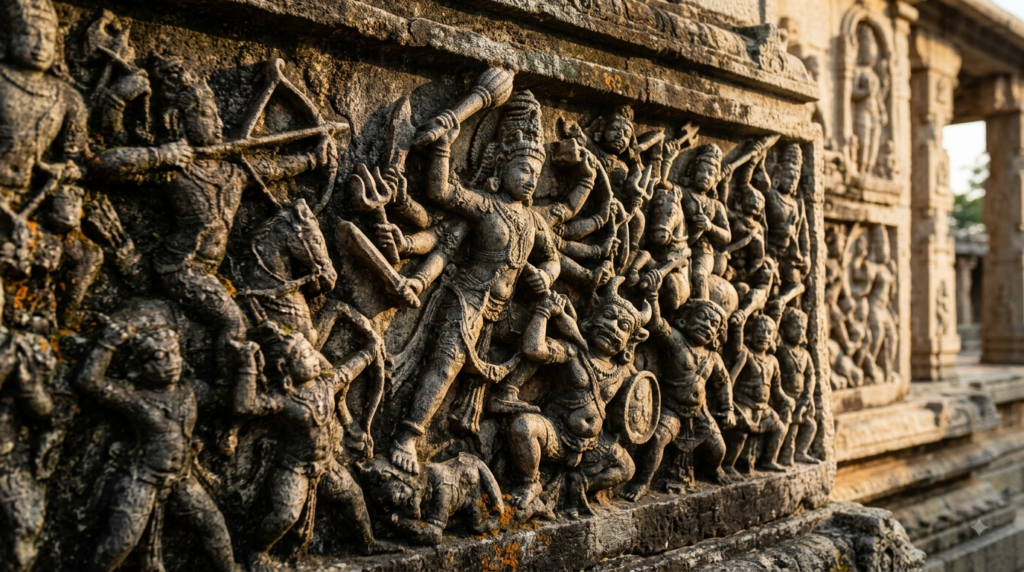
Mahishasura could shift between human and buffalo form, and no male god could defeat him. His tyranny forced the devas to pool their energies into a single goddess, Durga. After a fierce battle, she slew him, an event still celebrated across India during Dasara Navaratri.
His name even survives in the city of Mysuru (Mysore). Devotees honour this victory at the Maddur Mahishasura Mardhini Temple.
Ravana: King of Lanka
Ravana is the most iconic name here, though he is a rakshasa by birth rather than a Daitya. He was a Brahmin son of sage Vishrava, a master of the Vedas, and a fierce devotee of Shiva. Still, his ego and his abduction of Sita sealed his fate. Rama, an avatar of Vishnu, defeated him, and Dussehra marks that victory each year.
Narakasura: The Tyrant of Pragjyotisha
Narakasura ruled Pragjyotisha, a kingdom linked to present-day Assam. He grew cruel and imprisoned thousands of women, so Krishna and his wife Satyabhama rode out and killed him. His defeat is remembered on Naraka Chaturdashi, the day before Deepavali in much of India. Note the common mix-up: Narakasura the king is not “Naraka,” the concept of hell.
Bhasmasura: The Ash-Making Asura
Bhasmasura won a boon that let him reduce anyone to ashes by touching their head. Drunk on power, he even tried to test it on Shiva. Vishnu then appeared as the enchantress Mohini and lured him into a dance. When Bhasmasura mirrored her and touched his own head, his boon destroyed him, a sharp lesson in how unchecked power turns on its owner.
Tarakasura: The Invincible Warrior
Tarakasura earned a boon that only Shiva’s son could kill him, which felt safe since Shiva was deep in mourning and celibate. His terror of the gods is exactly why Kartikeya, also called Skanda or Murugan, was born. The young war-god led the divine armies and destroyed him. Tamil tradition celebrates a related victory over Surapadman during Skanda Sashti.
Andhaka: The Blind Demon
Andhaka’s name means “the blind one,” and his myth is darker than most lists admit. Born from Shiva’s own energy yet raised among the Daityas, he later lusted after Parvati, his own mother-figure. That transgression sealed his doom.
Shiva impaled him on his trident, and when the demon’s blood spawned countless clones, the Matrika goddesses drank it to end him. His tale warns against ego and desire, not merely pride.
Vritra: The Drought Serpent
Vritra is one of the oldest names on the Hindu mythological demons list, appearing right in the Rig Veda. This Danava serpent hoarded the world’s waters and caused a terrible drought. Indra, king of the gods, struck him down with the vajra, a thunderbolt forged from the bones of sage Dadhichi. The clash reads as a nature myth about monsoon rains breaking free.
Bali: The Righteous Asura King
Bali, also called Mahabali, shows why the Hindu mythological demons list resists easy labels. He was a generous, just, and devout Daitya ruler whose power still worried the gods. Vishnu came as Vamana, a dwarf, and begged for three paces of land.
Bali agreed, so Vamana grew cosmic and covered the worlds in two strides. For the third, Bali offered his own head. His humility earned him lordship of the netherworld, and Kerala still welcomes him home each Onam.
Shumbha and Nishumbha: The Blood-Born Army
The brothers Shumbha and Nishumbha drove the gods from heaven, so the Devi Mahatmya sends the goddess to answer them. Their general Raktabija carried a fearsome boon: every drop of his blood that hit the ground became a new clone. To stop the endless army, Kali spread her tongue across the battlefield and drank the blood before it fell. The brothers followed soon after.
Are All Asuras on the Hindu Mythological Demons List Evil?
No, and this is the biggest correction to make. Several asuras are honoured as models of virtue, even in temple worship. Their stories show that lineage never decides character in Hindu thought.
Prahlada, though born to the tyrant Hiranyakashipu, was a pure devotee of Vishnu and later a wise king. Mahabali gave away everything he owned out of duty and truth. Vibhishana, a rakshasa and Ravana’s brother, chose dharma over blood and sided with Rama.
Because of them, the moral of the Hindu mythological demons list is clear. Good and evil rest on conduct, not on the clan you are born into.
Asuras vs Rakshasas in the Hindu Mythological Demons List
Many readers use “asura” and “rakshasa” as if they mean the same thing, yet the texts keep them apart. Asuras are the cosmic rivals of the devas, usually Daityas or Danavas by birth. Rakshasas are a distinct race of shape-shifters tied to the epics, often shown as night-wandering flesh-eaters.
The overlap happens because both oppose the gods in many stories. Even so, the categories differ in origin and role.
A quick memory aid helps here. If a being battles Indra or Vishnu in a Purana, think asura. If it shape-shifts through the Ramayana forest, think rakshasa.
Common Myths About the Hindu Mythological Demons List
Studying asura lore online is easy, but the same errors repeat across websites. Watch for these traps before you trust any single retelling.
- “All asuras are evil.” Prahlada, Bali, and Vibhishana disprove this outright.
- “Asura means non-god.” The word began as an honorific for the mighty, including Vedic devas.
- “Asuras and rakshasas are identical.” They share enemies but differ in birth and nature.
- “Every text tells the same story.” The Puranas often disagree on a demon’s origin and end.
- “Ravana was an asura by clan.” He was a rakshasa of Brahmin descent, not a Daitya.
How to Study the Hindu Mythological Demons List
Approaching the Hindu mythological demons list well takes a little care, since the sources sprawl across thousands of years. A few habits keep your reading accurate and rewarding.
- Read more than one version, because the Shiva Purana, Devi Mahatmya, and epics often differ.
- Ask what each demon represents — ego, greed, ignorance, or disorder — rather than just who won.
- Trace the festival links, since Deepavali, Navaratri, and Dussehra all grow from these battles.
- Check temple sculpture and regional art, which preserve local versions the texts may not record.
- Treat online lists as starting points, then cross-check names against a broad reference such as the catalogue of asuras and the primary texts.
Because these stories shaped festivals, art, and even place names, they remain living culture rather than dead history. That is exactly why an accurate reading matters.
Hindu Mythological Demons List: Final Thoughts
The Hindu mythological demons list is really a mirror of the human mind, where pride, desire, and ambition wrestle with truth and restraint. Each asura falls the moment ego overtakes wisdom, and each divine victory restores balance. Yet the righteous asuras remind us that no one is doomed by birth alone.
If you take one idea away, let it be this: these are moral stories first and monster stories second. For deeper reading, turn to primary translations of the Puranas rather than second-hand summaries.
Frequently Asked Questions About the Hindu Mythological Demons List
Who are the asuras in Hindu mythology?
Asuras are a class of powerful beings who oppose the devas (gods) in Hindu myth. They are usually Daityas or Danavas, both fathered by sage Kashyapa. Though often called demons, they represent ego, ambition, and disorder rather than pure evil.
Are all asuras evil?
No. While many asuras are tyrants, several are righteous and even worshipped. Prahlada, Mahabali, and the rakshasa Vibhishana are honoured as devotees and models of dharma. In Hindu thought, character depends on conduct, not on the clan of one’s birth.
What is the difference between asuras and rakshasas?
Asuras are the cosmic rivals of the devas, usually Daityas or Danavas by lineage. Rakshasas are a separate race of shape-shifters, most prominent in the Ramayana and Mahabharata. They overlap because both often oppose the gods, but their origins and roles differ.
Who is the most powerful asura in Hindu mythology?
Several claim the title, depending on the text. Hiranyakashipu, Ravana, and Mahishasura are among the strongest, each needing a special divine form to defeat. Bali is arguably the most virtuous and, before Vamana, one of the most powerful rulers of all three worlds.
Which gods defeated the major asuras?
Vishnu’s avatars handled several, including Varaha against Hiranyaksha, Narasimha against Hiranyakashipu, and Vamana against Bali. Durga slew Mahishasura, Kartikeya killed Tarakasura, Shiva destroyed Andhaka, and Indra struck down Vritra. The pattern shows how each demon required a specific divine answer.
Is Ravana an asura or a rakshasa?
Ravana is a rakshasa, not an asura by clan. He was the son of the sage Vishrava and the rakshasi Kaikesi, making him half-Brahmin. Many online lists wrongly group him with the Daitya and Danava asuras, which blurs an important distinction.
Where can I read authentic stories about these asuras?
The primary sources are the Vedas, Puranas, Ramayana, and Mahabharata. For reliable translations, digital libraries that host Puranic texts are far better than casual blog summaries. Reading the source directly helps you spot the regional variations these myths carry.
Why do asuras keep winning boons from the gods?
Asuras were famous for intense tapas, or penance, which the gods reward regardless of the seeker’s nature. This is why figures like Hiranyakashipu and Bhasmasura gained near-invincibility. The stories then explore how such power corrupts, and how the divine finds a lawful way around each boon.