
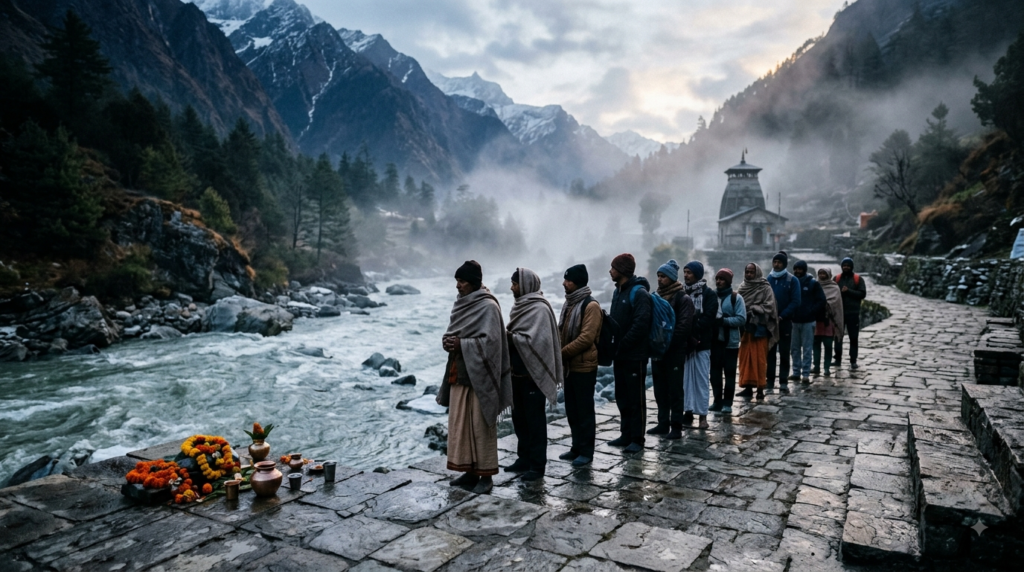
Gangotri Temple Darshan Timings run in two separate sessions each day, and the gap between them trips up more first-time pilgrims than any other detail. The shrine opens around 6:15 AM, closes for roughly an hour at 2:00 PM, then reopens at 3:00 PM until about 9:30 PM. So if you reach the roadhead at 2:30 PM after a long drive from Uttarkashi, you wait. This guide covers the current season hours, the entry-fee reality, the mandatory state registration, and the road and altitude factors that decide whether you reach the temple at all.
Go Kshetra is an independent pilgrimage guide. We are not affiliated with, endorsed by, or the official website of the Gangotri Temple Committee or the Uttarakhand government. We do not accept bookings, donations, or payments of any kind. Use the official state portal linked below for registration and official notices.
Gangotri Temple Darshan Timings at a Glance
Gangotri sits in Uttarkashi district at roughly 3,100 metres above sea level, on the bank of the Bhagirathi. Because the shrine closes for six winter months, every planning decision starts with the calendar. The table below sets out the Gangotri Temple Darshan Timings and the other essentials in one place.
| Detail | Current position |
|---|---|
| Morning darshan | About 6:15 AM to 2:00 PM |
| Midday break | Roughly 2:00 PM to 3:00 PM (sanctum closed) |
| Evening darshan | About 3:00 PM to 9:30 PM |
| Aarti | Morning around 6:00 AM; evening Ganga aarti at dusk, commonly around 7:45 PM |
| Entry fee | Free — no ticket counter, no paid darshan queue |
| Registration | Char Dham Yatra registration, free and mandatory |
| 2026 season | Opened 19 April 2026; expected to close around 10–11 November 2026 |
| Weekly closure | None — open every day through the season |
These Gangotri Temple Darshan Timings are the pattern the shrine has followed for several seasons. Still, festival days, special abhishekams and bad weather can shift them. So treat the schedule as reliable rather than guaranteed.
Gangotri Temple Darshan Timings for the 2026 Season
The portals opened on 19 April 2026, on Akshaya Tritiya. Chief Minister Pushkar Singh Dhami announced the opening alongside Yamunotri. Since then the shrine has kept its usual Gangotri Temple Darshan Timings daily, with no weekly rest day.
Morning darshan begins at roughly 6:15 AM. That first hour is the quietest slot of the day, because most pilgrims drive up from Uttarkashi or Harsil. They cannot reach the roadhead before mid-morning. So if you stay overnight in Gangotri, you reach the gate before any queue forms.
The sanctum then closes for about an hour from 2:00 PM for bhog and cleaning. Evening darshan runs from 3:00 PM until roughly 9:30 PM, when the shayan aarti ends the day. That midday hour is the most misread part of the Gangotri Temple Darshan Timings.
How Aarti Fits Into the Gangotri Temple Darshan Timings
The morning mangala aarti takes place around 6:00 AM, and it is traditionally performed behind closed doors before general darshan opens. Evening aarti is the one visitors remember, since priests carry it down to the riverbank as dusk settles over the Bhagirathi valley.
Reported evening aarti times vary between roughly 6:30 PM and 7:45 PM, depending on the month and the light. Because aarti sits inside the published Gangotri Temple Darshan Timings, ask at the temple office when you arrive. One fixed figure copied off a travel page is not enough.
Do the Gangotri Temple Darshan Timings Include an Entry Fee?
Entry to Gangotri Temple is completely free. Nothing inside the Gangotri Temple Darshan Timings sits behind a payment. There is no ticket counter, no paid queue and no official special-darshan slot, unlike Tirumala or several large South Indian shrines where tiered darshan is genuine.
The widely repeated ₹500 “special darshan” figure is simply wrong. It circulates across travel pages, and older versions of this guide repeated it too. No temple authority charges it, so anyone collecting money near the shrine for faster access is a private operator rather than the temple committee.
Your real costs are transport, accommodation, food, and optional pooja items bought from local shops. If you want a sankalp or a specific ritual performed, arrange it directly with the Semwal-family priests who serve the shrine, and agree the dakshina before the ritual starts.
Char Dham Registration: The Only “Booking” You Need
No darshan ticket exists for Gangotri, so people search for online booking and find nothing. You simply arrive within the Gangotri Temple Darshan Timings and join the queue. What genuinely exists is Char Dham Yatra registration, run by the Uttarakhand government, and it is mandatory for every pilgrim.
Registration is free. Anyone charging you a fee for the registration itself is not an official channel.
How to register before you travel
- Open the official portal at registrationandtouristcare.uk.gov.in and create an account with your mobile number.
- Enter traveller details and Aadhaar information, which the state has made compulsory.
- Select Gangotri, plus any other dhams on your route — one registration covers all four.
- Pick your intended travel dates, since daily pilgrim numbers are capped at each shrine.
- Download the QR-coded yatra letter and print at least two copies.
Alternatives exist if the website struggles. You can message “Yatra” on WhatsApp to 8394833833, use the Tourist Care Uttarakhand mobile app, or call the state helpline on 0135-1364. Offline counters also operate at Haridwar and Rishikesh, and on the Gangotri route at Hina and Pankhi.
Carry printouts, because mobile networks above Uttarkashi are patchy and your QR code gets scanned at checkpoints. Drivers bringing private vehicles also need a separate Green Card or Trip Card from the Uttarakhand transport department.
How to Reach Gangotri
By air
Jolly Grant Airport in Dehradun is the nearest airport, about 275 km away, with flights from Delhi, Mumbai and other metros. Taxis run from there towards Uttarkashi, though nobody sensibly drives the full distance in one day.
By train
Rishikesh is the practical railhead, roughly 300 km short of Gangotri, since no line reaches the upper Bhagirathi valley. Haridwar works equally well and has far better long-distance connections.
By road
The standard route runs Rishikesh to Devprayag to Uttarkashi, then a further 100 km through Bhatwari and Harsil. Buses and shared taxis cover the stretch, while private taxis give you the flexibility that mountain schedules demand.
Unlike Kedarnath or Yamunotri, Gangotri needs no trek at all. The road ends within a few hundred metres of the temple, which makes this the most accessible of the four Uttarakhand dhams. Compare that with the Kedarnath darshan schedule and its 16 km climb from Gaurikund.
When Road Closures Override Gangotri Temple Darshan Timings
Most Gangotri guides skip this section, yet it decides your trip. Knowing the Gangotri Temple Darshan Timings helps nothing while the highway is shut. The Gangotri National Highway is weather-sensitive, so short closures happen every monsoon.
In August 2025 a flash flood at Dharali, between Harsil and Gangotri, submerged a key stretch of the highway. Vehicle movement resumed after 24 days of repair work by the Border Roads Organisation. The yatra restarted on 10 September 2025 under a shuttle arrangement. Through the 2026 monsoon, rain has again triggered short blockages around Dharasu, Nalupani and Gangnani.
None of that cancels a pilgrimage. It does mean you plan differently:
- Build one buffer day into any Gangotri itinerary between July and September.
- Leave Uttarkashi before 7 AM, because clearance work and traffic both worsen later.
- Never drive this road after dark, even when it is officially open.
- Check the day’s status with Uttarakhand Police or your hotel before you set off.
- If a slide blocks the road, stay where you are rather than pushing through an unstable stretch.
If your dates collapse entirely, there is no alternative access to the shrine — no helicopter service lands at Gangotri and no other road exists. Plan for the next clear day instead.
Best Time to Visit Gangotri Temple
The season runs from the April or May opening until closure in late autumn. Within that window, two stretches stand out.
May and June bring stable roads, clear skies and the heaviest crowds. Volume changes how the Gangotri Temple Darshan Timings feel on the ground. September and October are the quieter reward, because the monsoon has eased and queues thin noticeably before the portals shut.
July to early September is monsoon, with mist, waterfalls and real landslide risk. Some pilgrims prefer the atmosphere, but the schedule must stay flexible.
For 2026, the temple is expected to close around 10–11 November, during the Diwali and Bhai Dooj period. Sources differ by a day, and the temple committee confirms the exact muhurat closer to the date, so verify before booking late-season travel. The idol then moves to Mukhba village near Harsil, where worship continues through winter.
Altitude, Health and Safety
At roughly 3,100 metres, Gangotri is high enough that altitude sickness is a genuine risk, particularly if you drive up quickly from the plains. Headache, nausea, breathlessness and disturbed sleep are the common early signs.
Break the journey with a night at Uttarkashi or Harsil so your body adjusts. Drink water steadily, eat light, and skip alcohol entirely on the ascent.
Anyone with heart disease, asthma, uncontrolled blood pressure or diabetes should consult a doctor before committing to this route. Keep regular medication in hand baggage rather than the vehicle boot. Uttarakhand runs medical relief posts along the Char Dham corridor, although response times in the upper valley are naturally longer.
Bathing in the Bhagirathi is part of the tradition here, yet the water is glacial meltwater and the current is strong. Use the designated ghat steps, keep the dip brief, and supervise children and elderly relatives closely.
Gaumukh Trek: The Permit Most Guides Ignore
Gaumukh, the glacier snout where the Bhagirathi emerges, lies about 18 km upstream from the temple. Reaching it means entering Gangotri National Park, which requires a permit. Many visitors discover that rule far too late.
The forest department caps entry on the Gaumukh trail at 150 trekkers per day to protect the Bhagirathi eco-sensitive zone. Permits cost around ₹150 for Indian nationals and ₹600 for foreign nationals, and remain valid for two days.
Since September 2024, a registered guide, trekking insurance and a medical fitness certificate have all been compulsory for this trek, whether you travel solo or with an operator. Apply at the DFO office in Uttarkashi or the forest office at Gangotri; the park itself operates from 1 April to 30 November.
Camping at Gaumukh is banned, so trekkers stay at Bhojbasa, 14 km along the trail. Confirm current permit rules with the forest office before you travel, because the requirements have tightened more than once.
Nearby Attractions With Distances
- Bhagirath Shila — about 0.5 km. The rock where King Bhagirath is believed to have performed his penance.
- Surya Kund and Gauri Kund — within walking distance. Waterfalls where the Bhagirathi drops through a narrow gorge.
- Jalmagna Shivling — a natural rock formation submerged through summer, visible only when the water drops.
- Gaumukh — about 18 km on foot. Permit required, as above.
- Harsil Valley — roughly 25 km. Apple orchards and deodar forest, and the usual overnight halt.
- Gangnani hot springs — about 50 km en route, with a thermal bath beside the road.
- Uttarkashi — around 100 km. The district base town, with Vishwanath Temple and the last reliable ATMs and pharmacies.
What Pilgrims Get Wrong About Gangotri Temple Darshan Timings
Three assumptions about the Gangotri Temple Darshan Timings cause most of the disappointment here. All three are easy to avoid.
The first is treating the 2:00 PM to 3:00 PM break as flexible. It is not, and arriving inside that hour after a five-hour drive is a genuinely common mistake.
The second is assuming darshan takes minutes. On peak May and June days the queue can absorb well over an hour. A day trip from Uttarkashi therefore leaves almost no margin.
The third is packing for the plains. Even in June, evenings at this altitude turn cold fast. The stone floor is freezing underfoot once you remove your shoes, so carry a fleece, thick socks and a torch for the evening aarti.
One more practical point: eateries thin out sharply beyond Uttarkashi, so carry water and snacks. Cash matters too, because card acceptance at Gangotri is limited and the nearest dependable ATMs are back down the valley.
Before You Go: Planning Around Gangotri Temple Darshan Timings
Gangotri rewards pilgrims who plan around the Gangotri Temple Darshan Timings rather than against them. Complete the free Char Dham registration at home, then reach the town the evening before. Take the 6:15 AM slot, when the shrine is at its quietest.
Budget nothing for entry, because there is none, and treat any fee demand near the temple with suspicion. Add a buffer day if you travel in monsoon, and verify road status on the morning you drive. If you are building a wider Uttarakhand circuit, the Badrinath darshan timings and the Neelkanth Mahadev guide pair naturally with this route.
Frequently Asked Questions
What are the current Gangotri Temple Darshan Timings?
Darshan runs from about 6:15 AM to 2:00 PM, and again from 3:00 PM to roughly 9:30 PM. The sanctum closes during the midday hour for bhog and cleaning. Timings can shift slightly on festival days, so confirm locally on arrival.
Is there an entry fee at Gangotri Temple?
No. Entry is free and no ticket counter operates at the shrine. Reports of a ₹500 special darshan fee are inaccurate — the temple runs no paid darshan tier. Any money collected near the temple for faster access comes from private operators.
Do I need to book darshan online?
There is no online darshan booking for Gangotri. However, Char Dham Yatra registration on the Uttarakhand government portal is free and mandatory for all pilgrims. Your QR-coded yatra letter gets scanned at checkpoints and at the shrine.
When does Gangotri Temple close in 2026?
Closure is expected around 10–11 November 2026, during the Diwali and Bhai Dooj period. The temple committee announces the exact muhurat closer to the day. The idol then travels to Mukhba village for the winter months.
Can I visit Gangotri during the monsoon?
Yes, though the Gangotri highway sees rain-triggered landslides and short closures between July and September. Keep a buffer day, avoid driving after dark, and check the road status each morning before leaving your hotel.
Do the Gangotri Temple Darshan Timings Apply Every Day?
Yes. Through the yatra season the Gangotri Temple Darshan Timings apply daily, including Sundays and public holidays. No weekly rest day exists, so only the annual winter closure interrupts darshan.
How difficult is the altitude at Gangotri?
At around 3,100 metres, altitude sickness is possible, especially on a fast ascent from the plains. Spend a night at Uttarkashi or Harsil to acclimatise, stay hydrated, and consult a doctor first if you have heart or respiratory conditions.
Do I need a permit for the Gaumukh trek?
Yes. Gangotri National Park issues 150 permits a day for the Gaumukh trail, costing roughly ₹150 for Indians and ₹600 for foreign nationals. A guide, trekking insurance and a medical fitness certificate have been compulsory since September 2024.
Where is Goddess Ganga worshipped in winter?
At Mukhba village near Harsil, the winter seat of the deity. The idol moves there after the temple closes and returns to Gangotri when the portals reopen on Akshaya Tritiya.