
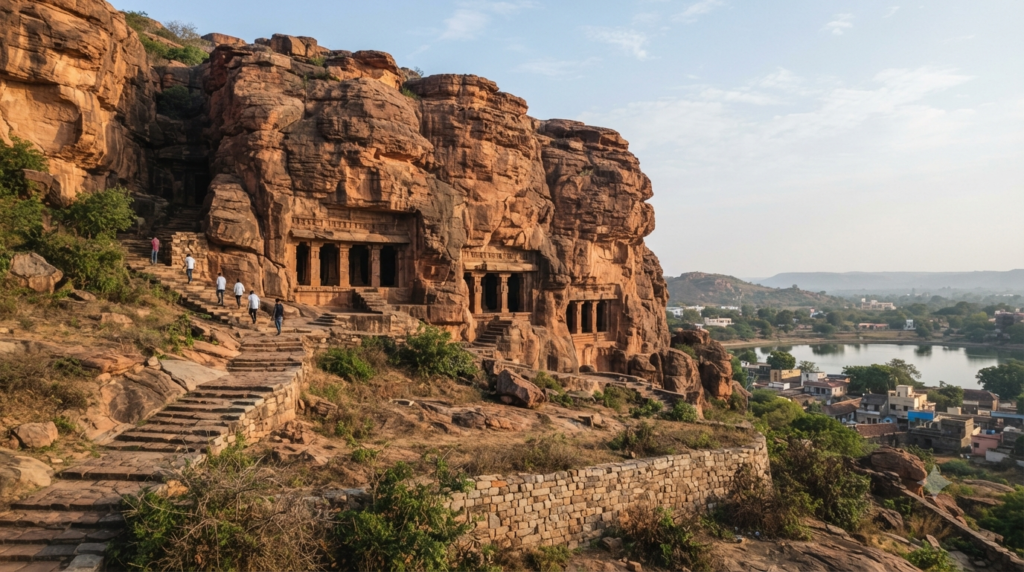
Badami Cave Temples are four rock-cut sanctuaries carved into the red sandstone cliffs of Badami in Karnataka’s Bagalkot district. They are protected heritage monuments, not a modern temple complex with daily pooja schedules. The visit is mainly about Chalukya art, architecture, inscriptions, and the view over Agastya Lake.
Go Kshetra is an independent pilgrimage and heritage travel guide. We are not affiliated with the Archaeological Survey of India, Karnataka Tourism, or any temple authority. We do not sell tickets or accept bookings or payments.
Badami Cave Temples at a Glance
| Detail | What to know |
|---|---|
| Location | Badami, Bagalkot district, Karnataka. |
| Main complex | Four rock-cut caves: three Hindu and one Jain. |
| Period | Mainly late 6th to early 7th century CE. |
| Published timings | Official tourism sources currently conflict. See timing section below. |
| Published entry fee | Karnataka Tourism currently lists ₹40 for Indians and ₹600 for foreign visitors. Confirm before travel. |
| Time needed | About 2 to 3 hours for an unhurried cave visit. |
| UNESCO status | On India’s UNESCO Tentative List as part of the Aihole-Badami-Pattadakal proposal. It is not an inscribed World Heritage Site. |
| Best season | October to February for cooler walking conditions. |
The most important planning point is that government sources do not currently agree on the opening hours. Karnataka Tourism lists 6:00 AM to 6:00 PM, while Incredible India lists 9:00 AM to 5:30 PM. If your schedule is tight, confirm the same-day hours before travelling and avoid planning an arrival close to either published closing time.
Why Badami Cave Temples Matter in Chalukya Architecture
The Badami Cave Temples sit in the former Chalukya capital of Vatapi, now Badami. Karnataka Tourism dates the main complex to roughly 578-610 CE. UNESCO places Badami within the wider Early Chalukya experiment across Aihole, Badami, and Pattadakal.
That wider context matters because the caves are not isolated monuments. The Early Chalukyas tested layouts, pillars, sanctums, sculptural programmes, and architectural forms here before those ideas matured at nearby Pattadakal. UNESCO therefore describes the Aihole-Badami-Pattadakal landscape as an important record of the evolution of temple architecture in the Deccan.
For official background, see Karnataka Tourism’s Badami guide and the UNESCO Tentative List entry.
What to See in Each of the Four Caves
The four main Badami Cave Temples rise one above another on the sandstone cliff. The climb is part of the experience, because each terrace opens wider views of Agastya Lake and the opposite hill. Take time between caves rather than treating the visit as a quick photo stop.
Badami Cave Temples Cave 1: Shiva and the 18-armed Nataraja
Cave 1 is associated with Shiva and is famous for its large Nataraja relief. Karnataka Tourism describes the figure with 18 arms and also notes carvings of Ardhanarishvara and Mahishasura Mardini. The cave gives an immediate sense of how sculpture, pillar design, and sacred space were combined inside living rock.
Look beyond the largest panel because smaller ceiling and pillar details are easy to miss. Morning side-light can make the relief depth easier to read, while harsh midday light can flatten the surface visually.
Cave 2: Vishnu as Trivikrama and Varaha
Cave 2 shifts strongly toward Vaishnava imagery. The best-known reliefs include Trivikrama, the giant-striding form of Vishnu, and Varaha, the boar incarnation. These large panels are useful for seeing how Chalukya sculptors turned mythological scenes into architectural focal points.
The cave also rewards a slower look at the ceiling panels and decorative bands. Since the spaces are partly open to daylight, exposure changes quickly for photography as you move between the veranda and the inner chamber.
Cave 3: the largest and most elaborate cave
Cave 3 is the largest of the four and carries some of the complex’s richest Vaishnava sculpture. Karnataka Tourism highlights images of Anantashayana Vishnu, Harihara, and Narasimha, while faded early paintings survive in parts of the interior.
This is also one of the best terraces for a broad view across Badami. Because the cave contains several major panels, allow more time here than in the smaller caves. Rushing through Cave 3 is one of the easiest ways to miss the site’s strongest artistic details.
Badami Cave Temples Cave 4: Jain Tirthankaras
Cave 4 is Jain and includes Tirthankara imagery, including Mahavira. Its mood differs from the large Hindu narrative panels below, yet it belongs to the same architectural landscape. That religious range is one reason Badami is so useful for understanding the plural artistic world of the Early Chalukya period.
Do not treat Cave 4 as an optional final stop. It completes the sequence and shows that Chalukya patronage extended beyond one religious tradition.
Badami Cave Temples Timings: Why Official Sources Conflict
There is no single timing figure that can be presented responsibly without a warning. Karnataka Tourism currently lists 6:00 AM to 6:00 PM, while the Government of India’s Incredible India cave-temples page lists 9:00 AM to 5:30 PM.
Because both are government tourism sources, the safest advice is to confirm the current gate timing before a long drive. If you cannot verify it on the day, plan your visit within the common overlap of 9:00 AM to 5:30 PM. That reduces the risk of arriving before ticketing opens or too close to closing.
The nearby Archaeological Museum follows a separate schedule. Incredible India currently lists 9:00 AM to 5:00 PM and says the museum is closed on Fridays. So do not assume the museum and caves share identical hours.
Badami Cave Temples Entry Fee and Ticket Advice
Karnataka Tourism currently publishes an entry fee of ₹40 for Indian visitors and ₹600 for foreign visitors. Older pages still circulate ₹25 and ₹300 figures, so those amounts should not be treated as current without checking the monument counter or the Archaeological Survey of India ticketing system.
ASI rules state that protected monuments may be ticketed. Visitors should buy tickets only from ASI counters, kiosks, the official online system, or the QR code displayed at the monument. Children aged 15 or below are outside the paid-admission rule in the published Ancient Monuments and Archaeological Sites and Remains Rules, though staff may still verify age.
Do not pay a private website to “reserve” a preferred darshan time. The caves are heritage monuments, and entry is not a temple darshan slot. The old Go Kshetra article overstated the value of advance booking by implying that it secures a preferred date or time. Use the official ASI channel only when online ticketing is available, or buy at the authorised counter.
What if Badami Cave Temples Online Ticketing Does Not Work?
An online ticket is not a guarantee that every access area will remain open. ASI can restrict vulnerable sections, close a monument temporarily, or change visitor controls when conservation or safety requires it.
If the online system fails, check the ASI instructions linked from asi.nic.in and use the authorised monument counter or on-site QR code if available. If the site itself is closed, there is no legitimate third-party workaround. Shift the cave visit and use the time for Agastya Lake, Bhutanatha Temple, or another open heritage site.
Are Badami Cave Temples a UNESCO World Heritage Site?
No. The Badami cave complex is not currently an inscribed UNESCO World Heritage Site. Badami and Aihole appear on India’s UNESCO Tentative List as a proposed extension connected with the already inscribed Group of Monuments at Pattadakal.
This distinction is worth making because many travel pages call Badami a UNESCO World Heritage Site outright. The correct wording is that Badami forms part of the “Evolution of Temple Architecture – Aihole-Badami-Pattadakal” Tentative List proposal. Pattadakal itself holds World Heritage status.
If you want to understand the architectural sequence, pair Badami with the Durga Temple complex at Aihole. The three-centre circuit makes far more sense when you see how experimental forms at Aihole and Badami relate to the mature temples at Pattadakal.
Are Badami Cave Temples Active Worship Temples?
Visitors should approach the Badami Cave Temples as protected heritage monuments rather than as regular temples with scheduled aarti, pooja, prasadam, or paid sevas. Some web pages publish “morning aarti” and “special ritual booking” tables, but government visitor pages do not publish such a schedule for this protected cave complex.
The sculptures remain sacred to many visitors, so respectful behaviour still matters. Keep voices low, follow signs, and do not touch or lean on carvings. ASI guidance also asks visitors to stay on designated paths and respect any active customary practice where it exists.
How to Reach Badami Cave Temples
The Badami Cave Temples lie in northern Karnataka’s Bagalkot district. The cave complex sits beside Agastya Lake and is close to the historic core of town, so local auto-rickshaws and taxis can handle the final approach.
By train
Badami has its own railway station. Train frequency and direct connections change by timetable, so check Indian Railways or IRCTC for your travel date rather than relying on a static list of trains. From the station, take a local auto or taxi to the cave area.
By air
Hubballi is the most practical major airport for many travellers, although exact road distance varies by route. Karnataka Tourism and Incredible India both list Hubballi among the main air gateways for Badami. A pre-arranged taxi or road connection from Hubballi is usually the simplest onward option.
By road
Badami is connected by road with Hubballi, Bagalkot, Pattadakal, and Aihole. If you are building a heritage circuit, a car gives the most flexible schedule because the major sites lie outside one compact town centre.
Karnataka Tourism currently places Pattadakal about 21 km from Badami and Aihole about 36 km away. Those distances make a Badami-Pattadakal-Aihole circuit practical, but trying to study all three deeply in one rushed day can feel compressed.
How Much Time Do Badami Cave Temples Need?
Allow about two to three hours for the Badami Cave Temples if you want time for carvings, views, and rest stops. A fast visitor can move through sooner, but the stone steps, heat, and visual detail make speed a poor strategy.
For a fuller Badami day, add Agastya Lake, Bhutanatha Temple, and the Archaeological Museum. The museum is especially useful after the caves because it gives archaeological context for sculpture and inscriptions from the region.
If architecture is the main reason for your trip, stay long enough to add Aihole and Pattadakal on a second day. You can also compare the style with Go Kshetra’s Halebidu temples guide, which covers a much later Karnataka temple tradition.
Best Time to Visit Badami Cave Temples
October to February is the easiest season for walking the cave steps because conditions are generally cooler. Karnataka Tourism also recommends early morning or late afternoon for more comfortable light and temperatures.
Summer can become very hot on exposed stone. If you visit in hotter months, reduce your midday walking, carry water, and use sun protection. During the monsoon, wet stone can become slippery, so footwear with good grip matters more than photographic convenience.
Safety and Accessibility Tips Most Guides Miss
- Wear shoes with grip because the route includes stone steps and uneven surfaces.
- Carry drinking water, especially outside the coolest months.
- Keep food packed away because monkeys can approach visitors around the hill area.
- Do not climb on railings, ledges, sculptures, or closed sections for photographs.
- Keep extra time for elderly visitors and anyone with knee, balance, or mobility problems.
- Follow ASI signs on photography, restricted areas, and conservation-sensitive interiors.
The first cave requires a climb, and the later caves rise higher. Visitors with heart, joint, balance, or mobility concerns should pace the ascent and stop when needed. If strenuous climbing is medically difficult for you, seek professional advice before attempting the full route.
A Practical Badami Heritage Plan
- Start with the caves. Use the coolest confirmed opening window and allow two to three hours.
- Continue around Agastya Lake. The lake helps you understand how the cave cliff and Bhutanatha Temple relate to the old town landscape.
- Visit the Archaeological Museum if open. Remember that the current government listing says Friday closed.
- Use a second day for Pattadakal and Aihole. This gives the Chalukya architectural story enough time to make sense.
This sequence is more useful than treating Badami as a single monument stop. The caves show rock-cut experimentation, while Aihole broadens the range of early temple forms and Pattadakal shows their mature expression.
Before You Go
The strongest reason to visit Badami Cave Temples is not simply their age. It is the chance to see early Chalukya architecture, Hindu and Jain sculpture, landscape, and temple experimentation together in one compact setting.
Confirm the gate timing because official tourism sources currently disagree. Check the current ticket price through ASI or the authorised counter, and ignore private “darshan booking” claims. Above all, remember that Badami is on UNESCO’s Tentative List, while Pattadakal is the nearby inscribed World Heritage Site.
Badami Cave Temples Frequently Asked Questions
What are the Badami Cave Temples timings?
Official sources currently conflict. Karnataka Tourism lists 6:00 AM to 6:00 PM, while Incredible India lists 9:00 AM to 5:30 PM. Confirm before travel; if you cannot, a visit within 9:00 AM to 5:30 PM falls inside both published windows.
What is the Badami Cave Temples entry fee?
Karnataka Tourism currently lists ₹40 for Indian visitors and ₹600 for foreign visitors. Older ₹25 and ₹300 figures still appear online, so confirm the current amount through ASI or at the authorised monument counter before paying.
Can I book Badami Cave Temples tickets online?
ASI operates official ticketing for protected monuments, but the available booking route can change. Use only the ticket link reached from ASI’s official website, an authorised counter, kiosk, or the on-site QR code. Do not pay a private site for a supposed darshan slot.
Are Badami Cave Temples active temples with pooja or aarti?
They function primarily as protected heritage monuments, not as regular temples with public daily aarti, seva, or prasadam schedules. Respect the religious imagery, but do not expect a normal temple darshan system.
How many Badami Cave Temples are there?
The main visitor complex has four rock-cut caves. Caves 1 to 3 carry Hindu imagery, while Cave 4 is Jain. The four-cave sequence is the core heritage attraction described by UNESCO and government tourism sources.
Are Badami Cave Temples a UNESCO World Heritage Site?
No. Badami is part of India’s UNESCO Tentative List proposal for the Aihole-Badami-Pattadakal architectural landscape. Pattadakal is the nearby site that already has full UNESCO World Heritage status.
How long should I spend at Badami Cave Temples?
Plan about two to three hours for all four caves at a comfortable pace. Add more time if you enjoy architecture or photography, or if your group needs frequent rests on the steps.
Are Badami Cave Temples suitable for elderly visitors?
Some visitors can comfortably reach the lower cave and stop there, while others complete all four. The route includes many stone steps and uneven surfaces, so mobility, balance, heat, and personal health matter more than age alone.
What should I combine with Badami Cave Temples?
Pattadakal and Aihole are the most important additions because they complete the Early Chalukya architecture story. In Badami itself, add Agastya Lake, Bhutanatha Temple, and the Archaeological Museum if your schedule allows.