
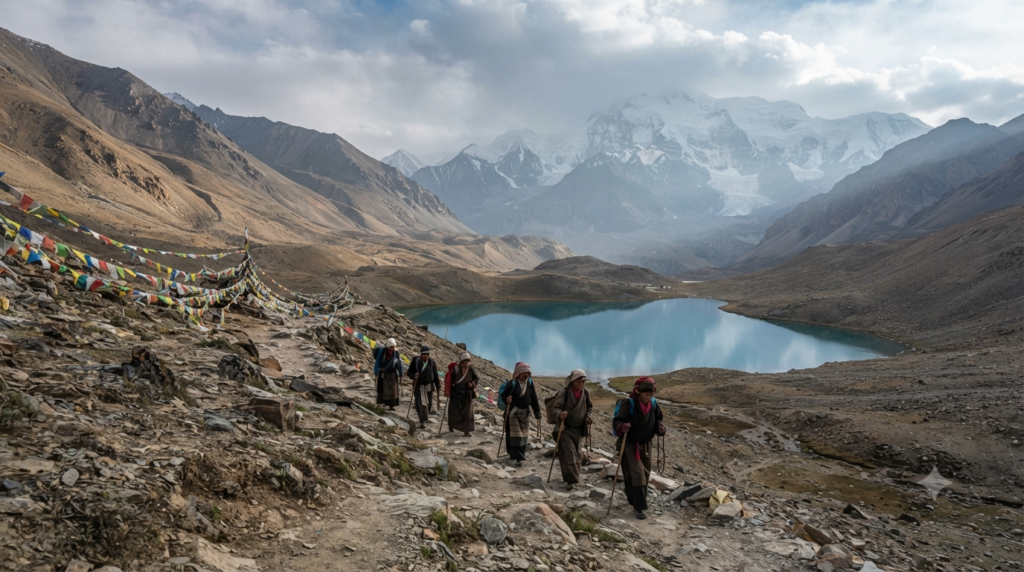
Kailash Manasarovar Darshan is a sacred pilgrimage to Mount Kailash and Lake Manasarovar in Tibet, but it is also a demanding high-altitude journey with strict permits, medical checks and route rules. Indian pilgrims using the Government of India programme must follow the Ministry of External Affairs process, not a private “official booking” website. This guide explains the current routes, costs, eligibility, application process, safety checks and the separate rules for travel via Nepal.
Go Kshetra is an independent pilgrimage guide. We are not affiliated with the Ministry of External Affairs, the Government of India, Chinese authorities, or any tour operator. We do not accept applications, bookings, fees, donations or payments. For the Government of India yatra, use only the official Kailash Manasarovar Yatra portal.
Current status: the official 2026 application deadline was 19 May 2026, and the scheduled Government of India batches ran from June through August. As of 2 September 2026, the official portal still shows the 2026 cycle, so new applicants should wait for the next Ministry of External Affairs notification rather than pay a site claiming to sell a future government slot.
Kailash Manasarovar Darshan at a Glance
The Ministry of External Affairs organizes the Government of India Kailash Manasarovar Yatra in coordination with Chinese authorities. For 2026, the programme used two routes: Lipulekh Pass in Uttarakhand and Nathu La Pass in Sikkim. Each route had 10 batches of up to 50 yatris.
- Sacred destination: Mount Kailash and Lake Manasarovar in the Tibet Autonomous Region of China.
- Official Indian organizer: Ministry of External Affairs, Government of India.
- Lipulekh route: about 22 days; estimated official cost ₹2.09 lakh per person for 2026.
- Nathu La route: about 21 days; estimated official cost ₹3.31 lakh per person for 2026.
- 2026 application deadline: 19 May 2026.
- Selection: computerized, random and gender-balanced draw; selection is not guaranteed.
- Eligibility: Indian citizen, valid Indian passport, age 18 to 70, required medical fitness and current eligibility conditions.
- Subsidy: the Ministry of External Affairs states that it gives no subsidy or financial assistance to yatris.
For the Government of India route, apply only through kmy.gov.in. For travel via Nepal, verify permits, weather and current border conditions before departure.
What Is the Current Application Status?
The official deadline of 19 May 2026 closed the 2026 government application window. The Ministry of External Affairs announced that the 2026 yatra would run from June to August, with 20 batches across both routes. Therefore, a website advertising a fresh Government of India “2026 booking slot” after the official deadline is not the MEA application channel.
Check the next government cycle only when the Ministry publishes a new notice. At the time of this refresh, the official KMY portal had not yet replaced the 2026 application notice with a later cycle. Bookmark the official KMY homepage instead of paying an intermediary to “pre-register” you.
Kailash Manasarovar Darshan Routes Compared
For Kailash Manasarovar Darshan, the two official routes reach the same pilgrimage region, yet their approach, cost and physical demand differ. Lipulekh is cheaper in the current official estimate, while Nathu La has a more motorable approach. However, neither option removes the high-altitude Kailash parikrama or the medical risk.
| Factor | Lipulekh Pass | Nathu La Pass |
|---|---|---|
| Indian state | Uttarakhand | Sikkim |
| 2026 batches | 10 | 10 |
| Batch size | Up to 50 yatris | Up to 50 yatris |
| Approx. duration | 22 days | 21 days |
| 2026 estimated cost | ₹2.09 lakh | ₹3.31 lakh |
| Approach character | More high-altitude trekking and staged acclimatization | More motorable approach; parikrama still involves trekking |
The Ministry labels these figures as estimated costs, so do not treat them as permanent tariffs. Final payments, medical charges, personal expenses and optional support can change. Always use the live fee and offer-letter instructions after selection.
What should you expect on the Lipulekh route?
The 2026 Lipulekh itinerary begins with several days in Delhi for medical tests, briefing and documentation. It then moves through Uttarakhand via Tanakpur, Dharchula, Gunji and Nabhidhang before crossing Lipulekh Pass. The schedule includes acclimatization because the route climbs rapidly into very high terrain.
On the Tibet side, the itinerary proceeds through Purang and the Kailash region before the parikrama. The route is physically demanding, so a lower price should not be the only deciding factor. Pilgrims who have not trained for prolonged walking and altitude should discuss fitness with a doctor before applying.
What should you expect on the Nathu La route?
The Nathu La route also starts with mandatory formalities and medical testing in Delhi. It then approaches Tibet through Sikkim and uses a largely motorable route. The Ministry’s FAQ says the major walking element is the Kailash parikrama, roughly 35 to 40 km.
That does not make the journey easy. High altitude, cold, wind and low oxygen remain major risks, while weather can alter plans. Pilgrims comparing Himalayan journeys may also find our Kedarnath pilgrimage guide useful for understanding how mountain weather changes travel plans quickly.
Who Can Apply for Kailash Manasarovar Darshan?
For the Ministry of External Affairs programme, the current eligibility page requires an Indian citizen with an ordinary Indian passport, age 18 to 70, and the required medical fitness. It also lists a BMI of 25 or less. Foreign nationals and OCI card holders are not eligible for this Government of India route.
- The MEA programme accepts only Indian citizens.
- The passport must meet the validity rule stated for that year’s application cycle.
- Age must fall within the official 18 to 70 range on the stated cut-off date.
- Applicants must satisfy medical and physical fitness requirements.
- The current eligibility page lists BMI 25 or less, although the FAQ notes that doctors assess overall fitness.
- Foreign nationals and OCI card holders cannot use this MEA application route.
Eligibility on paper does not guarantee travel. The computerized draw must first select applicants, who then need to pass the prescribed medical examinations. Read the latest official eligibility page before every application because cut-off rules can change.
How to Apply for Kailash Manasarovar Darshan
For Kailash Manasarovar Darshan, applicants file for the Government of India yatra online when the official window opens. The process then moves through computerized selection, confirmation, medical screening, visa formalities and route-specific preparation. There is no legitimate reason to send a private website your payment for an MEA “guaranteed selection.”
- Check the official notification. Confirm that applications are actually open on kmy.gov.in.
- Review eligibility first. Do not pay for travel arrangements before checking age, passport and health conditions.
- Prepare the required scans. The 2026 application page requested a passport-size JPG up to 300 KB and specified passport pages in PDF up to 500 KB.
- Submit the online application. Choose route preferences according to the current form.
- Wait for the computerized draw. Selection is random under the official process and is not guaranteed.
- Confirm participation if selected. Follow only the payment instructions in the official offer and service-provider guidance.
- Report to Delhi as instructed. Medical tests, passport handling, visa work and briefing take place before departure.
The official application instructions should always override screenshots, old YouTube videos or copied blog posts. The portal changes by cycle, so save the official URL rather than a third-party registration page.
Is selection guaranteed after you apply?
No. The Ministry uses a computerized random selection process, and a route or batch depends on availability. Selected and wait-listed applicants receive official status updates. If you miss the cycle, the practical fallback is to wait for the next MEA notification rather than buy a supposed “government quota” from a private seller.
What if you fail the medical test?
You cannot continue on the government yatra if the competent medical authorities declare you unfit. The Ministry’s FAQ also says it will not move a medically unfit applicant to a later batch after recovery during that year. Some payments and medical expenses can be non-refundable, so read the current fee rules before confirming.
Kailash Manasarovar Darshan Safety at High Altitude
Kailash Manasarovar Darshan reaches extreme altitude, and the Ministry’s advisory warns that the yatra can be hazardous for people who are not medically fit. Its FAQ explains that lower oxygen can trigger acute mountain sickness and more serious complications. Passing a medical examination does not guarantee that a pilgrim will remain symptom-free at altitude.
Selected yatris undergo medical checks in Delhi, including screening at the Delhi Heart and Lung Institute and the Indo-Tibetan Border Police Base Hospital. Additional high-altitude checks can also occur on the route. Reports from another hospital do not replace the prescribed government medical assessment for qualification.
- Train gradually for walking endurance before the yatra, but do not self-clear a medical condition.
- Carry regular prescription medicines in adequate quantity and discuss the journey with your treating doctor.
- Respect every acclimatization halt because rushing ascent increases risk.
- Report headache, unusual breathlessness, confusion, severe weakness or other concerning symptoms promptly to the medical team.
- Do not assume helicopter evacuation will be immediate; weather can delay or prevent it.
- Avoid cold-water ritual immersion if your health, local conditions or medical advice make it unsafe.
This is a pilgrimage guide, not medical advice. Older pilgrims and people with heart, lung, blood-pressure, diabetes or other significant conditions should get individualized medical advice before applying for such a strenuous high-altitude journey.
Why the Kailash Parikrama Is the Hardest Part
For many pilgrims, Kailash Manasarovar Darshan becomes most demanding during the parikrama, also called the kora, around Mount Kailash. Even pilgrims using the more motorable Nathu La approach still face prolonged walking at very high altitude. Therefore, “Nathu La means no trekking” is a misleading shortcut that can leave people underprepared.
The official route schedule includes staged halts around the Kailash region rather than a quick sightseeing stop. Weather, oxygen levels and personal fitness matter more than normal walking speed. If you are new to Himalayan pilgrimages, our Madhyamaheshwar trek guide gives useful context on why acclimatization, pacing and weather margins matter in mountain travel.
Government KMY vs Travel via Nepal
The Government of India routes through Lipulekh and Nathu La are not the same as commercial Kailash tours that travel through Nepal. The Ministry’s FAQ explicitly says private agencies do not conduct the official Lipulekh or Nathu La routes. A Nepal itinerary is a separate travel arrangement with different permits, logistics and risks.
The Embassy of India in Kathmandu updated its Kailash Mansarovar via Nepal advisory on 1 September 2026. It tells Indian pilgrims to secure the appropriate Chinese visa and Tibet travel permit before travel. It also tells Indian pilgrims to obtain the Chinese visa from the Embassy of China in New Delhi, not Kathmandu.
The same advisory warns that weather can strand pilgrims on air-dependent Simikot and Hilsa sectors for days. It recommends adequate insurance, medicines, cash reserves and full acclimatization halts. Because flash floods affected Nepal in late August 2026, check current embassy and local travel advisories immediately before any Nepal-route departure.
Common Kailash Manasarovar Darshan Mistakes to Avoid
The biggest planning errors are usually procedural, not devotional. Pilgrims lose money or create safety problems when they rely on stale dates, copied price tables or agents who blur the line between the government yatra and a private tour. A few checks prevent most of these problems.
- Do not use a Tirumala or TTD portal. Kailash Manasarovar is not a TTD booking and has no connection with Tirumala reservations.
- Do not treat “registration open” claims as official. Check kmy.gov.in for the live cycle.
- Do not assume a private Nepal tour is the MEA route. The two systems are separate.
- Do not choose only by price. Route difficulty, altitude exposure, medical needs and weather resilience matter.
- Do not skip buffer days. Border, weather and transport delays can change the schedule.
- Do not hide health information. False application information can lead to disqualification and serious medical risk.
What to Pack and Plan Before Departure
Pack for cold, wind, sun and rapid weather changes rather than ordinary summer travel. Layered clothing, broken-in walking shoes, gloves, sun protection and a simple personal medical kit are more useful than heavy devotional luggage. Keep documents and medicines in a waterproof day bag.
For Kailash Manasarovar Darshan, build a time buffer after the scheduled return because Himalayan weather can interrupt transport. Also keep family members informed about the official itinerary and emergency channels. If you are planning other mountain pilgrimages, the site’s Vaishno Devi travel guide can help with general pilgrimage packing and pacing, although Kailash involves much higher altitude.
Before You Plan the Yatra
Kailash Manasarovar is spiritually important to Hindus, Buddhists, Jains and followers of Bon, yet devotion does not remove the practical demands of the journey. Start with the official route notice, then check eligibility, medical fitness, cost and permit rules. For Indian citizens using the government programme, kmy.gov.in should remain the primary action point.
After the official application window closes, wait for the next notice. If you choose a Nepal route, treat it as a separate travel arrangement and verify permits with current embassy guidance. Above all, keep enough flexibility for weather and health decisions, because the Ministry cannot guarantee selection or successful completion.
Kailash Manasarovar Darshan FAQs
How much does Kailash Manasarovar Darshan cost?
For 2026, the official KMY portal listed an estimated ₹2.09 lakh per person for Lipulekh and ₹3.31 lakh for Nathu La. MEA labels these route costs as estimates, not permanent tariffs. Check the live fee structure and offer-letter instructions for the year in which you actually travel.
Is the Government of India Kailash yatra open now?
The 2026 application window is closed because the deadline was 19 May 2026. As of 2 September 2026, the official portal still displays the 2026 cycle. New applicants should wait for the next Ministry of External Affairs notification instead of paying a private “pre-registration” fee.
Can OCI card holders apply for the government yatra?
No. The current official eligibility page says foreign nationals and OCI card holders are not eligible for the Ministry of External Affairs Kailash Manasarovar Yatra. This restriction applies to the Government of India programme, so other travel routes may have different nationality and permit rules.
Is Nathu La easier than Lipulekh?
Nathu La has a more motorable approach, so it reduces some approach trekking compared with Lipulekh. However, it still includes the high-altitude Kailash parikrama. The MEA FAQ describes roughly 35 to 40 km of trekking for that part, so medical fitness remains essential.
Do I need a medical test before Kailash Manasarovar?
Yes for the Government of India programme. Selected yatris must pass prescribed medical examinations in Delhi, and further altitude checks may take place en route. A private medical certificate does not replace the official qualification process, although consulting your own doctor before applying is sensible.
Can I travel alone to Mount Kailash from India?
Do not plan this as an independent border trek. The Government of India route runs in organized batches, while Nepal-route travel requires permits and organized logistics under current Chinese and Tibetan rules. Verify the exact requirements before travel because border and permit policies can change.
Can I use a private agent for the Lipulekh or Nathu La government route?
No private agency conducts the official MEA Lipulekh or Nathu La programme. Apply through the official KMY portal when the cycle opens. A commercial tour through Nepal is a different product, so never present it as a guaranteed Government of India allocation.
What happens if bad weather stops the yatra?
Delays, route changes or temporary halts can occur because high-altitude weather is unpredictable. The government itinerary is tentative, while the Nepal advisory also warns of air-sector delays that can last days. Keep buffer time, follow local authorities and never pressure a group to move in unsafe conditions.