
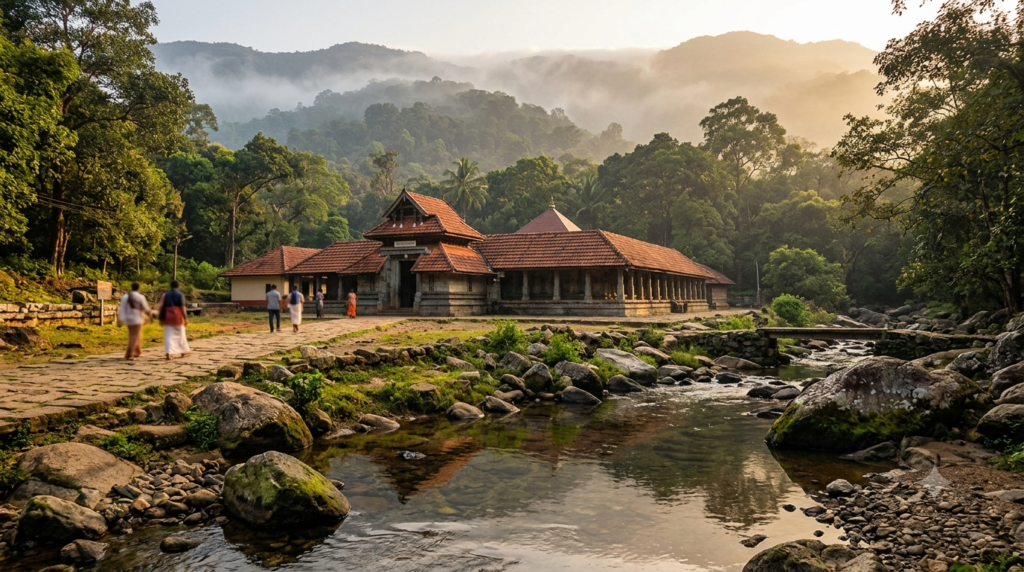
Thirunelli Temple Darshan takes you to one of Kerala’s most unusual pilgrimages, because this ancient Maha Vishnu shrine in the Wayanad forests is a place where devotees pray for the living and the departed. The temple sits deep in the Brahmagiri Hills, close to the Kerala–Karnataka border. Devotees have long known it as the “Kashi of the South.”
Darshan here is free, so the real reason most pilgrims travel is the ancestral rite called Bali Tharpanam beside the sacred Papanasini stream. This guide gives you verified timings, the honest truth about entry fees and online booking, transport options, and the mistakes first-time visitors make.
Go Kshetra is an independent pilgrimage guide. We are not affiliated with the Thirunelli Devaswom or the Malabar Devaswom Board, and we do not take bookings, donations, or payments. Arrange every ritual and offering through the temple or the official Devaswom linked below.
Quick Facts About Thirunelli Temple
Before you plan the route, here is the essential information at a glance. Because the temple lies inside a forest belt, a few of these details matter more than they would for a city shrine.
| Detail | Information |
|---|---|
| Location | Thirunelly, Mananthavady, Wayanad, Kerala 670646 |
| Deity | Lord Maha Vishnu (Chaturbhuja form) |
| Morning timings | 5:30 AM – 12:30 PM |
| Evening timings | 5:30 PM – 8:00 PM |
| Entry fee | Free (no darshan ticket) |
| Managing body | Malabar Devaswom Board |
| Altitude | About 890 m in the Brahmagiri Hills |
| Best season | October to March |
Thirunelli Temple Darshan Timings
The temple is open for Thirunelli Temple Darshan from 5:30 AM to 12:30 PM in the morning. It then reopens from 5:30 PM to 8:00 PM in the evening. It stays shut through the afternoon, so a mid-day arrival means a long wait. These hours can shift slightly during festivals, so confirm locally if your visit falls on a big ritual day.
Early morning is the finest window. The forest is quiet, the air is cool, and the first light strikes the east-facing shrine. Because the temple is remote, plan your travel to reach well inside one of the two sessions.
Why the Morning Session Matters Most
Ancestral rites happen in the morning, so families arriving for Bali Tharpanam should come early. The Papanasini stream and the ritual rock get busy as the morning goes on. A dawn Thirunelli Temple Darshan also feels calm and unhurried. It leaves time for the walk from the parking area and a dip in the stream before the mid-day closure.
Is There an Entry Fee for Thirunelli Temple Darshan?
No, there is no entry fee for Thirunelli Temple Darshan, and general darshan needs no ticket or advance booking. You simply walk in during the open hours and offer your prayers. Costs arise only when you choose a specific vazhipad (offering) or an ancestral rite. Those charges are modest and set by the temple.
This matters because several websites wrongly show the temple as a paid, slot-based darshan like the big city shrines. It is not. Nobody needs to reserve a darshan turn. You should never pay an outside site a “darshan fee” for a temple that offers free entry.
The Truth About Thirunelli Temple Online Booking
Here is the correction most guides get wrong. Thirunelli is a small forest temple run by the Malabar Devaswom Board.
A normal Thirunelli Temple Darshan needs no reservation at all. The shrine does not run the polished online darshan-booking system that TTD or Sabarimala use. Some pages even link visitors to the Tirumala portal, which has nothing to do with this Kerala shrine.
Ancestral rites and poojas are arranged at the temple itself, with the authorised priests, on the day of your visit. So if a third-party website asks you to pay upfront to “book your Thirunelli darshan,” treat it with caution. Verify any booking claim through the temple office or the official Malabar Devaswom Board first. Fake temple-booking sites are a known problem across Kerala.
How Poojas and Offerings Actually Work
When you arrive, you approach the temple counter and request the vazhipad you want. Common offerings include Pushpanjali, Pal Payasam, and Deepasthambham. Families come chiefly for the ancestral package. Because the priests guide each rite in person, the safest plan is to speak to temple-authorised staff on the spot rather than trust an old internet checklist.
Bali Tharpanam: The Heart of the Pilgrimage
Thirunelli is often called the only shrine where a devotee can perform every life-cycle rite in one place, from birth to the rites for the departed. The ancestral rite here is Bali Tharpanam, also known as Pinda Pradanam. Families travel from across India to offer it for departed relatives. They believe the Papanasini stream washes away sins and eases the soul’s journey.
The rite begins with a prayer before the main shrine. Offerings then move to the Papanasini stream and the sacred Pinnappara rock, where pinda (rice-ball) offerings are placed. It closes with prayers to Lord Shiva at the nearby Gunnika cave shrine. Because the sequence covers several spots and needs priest guidance, allow a full morning if this is your purpose.
How To Reach Thirunelli Temple
Thirunelli sits about 32 km from Mananthavady, the nearest town, deep in North Wayanad. The drive itself is part of the experience. It winds through dense forest, bamboo groves, and elephant country. Because public transport thins out near the temple, many pilgrims hire a taxi for the final stretch.
By Air
The two closest airports are Kannur International Airport (CNN), roughly 120 km away, and Calicut International Airport (CCJ), about 130 km away. From either, you can hire a taxi or take a bus toward Mananthavady and then on to Thirunelly. Kannur is often the smoother approach for North Wayanad.
By Train
The nearest major railhead is Kozhikode Railway Station (CLT), around 120 km from the temple. Wayanad has no railway line of its own because of its hill terrain. So you continue by road from Kozhikode via Kalpetta and Mananthavady. Buses and taxis are both available.
By Road
Regular KSRTC and private buses connect Mananthavady and Kalpetta with the Thirunelly area. The last few kilometres are best covered by taxi. Travellers from Bangalore, Mysore, or Coorg can enter through Kutta on the Karnataka side, since the temple lies right on the border. Fuel up before the forest stretch, as options are limited near the shrine.
Best Time for Thirunelli Temple Darshan
The best time for Thirunelli Temple Darshan is between October and March, when the Wayanad weather is cool and the roads are dry. The monsoon months from June to September bring heavy rain and leeches on the forest paths. They also bring occasional road disruptions, so plan carefully if you travel then.
Keep a few practical points in mind, because this is a forest shrine rather than a town temple. Wear sturdy footwear for the uneven walk from the parking area, and carry water and any personal medication.
Elderly pilgrims and anyone with health concerns should take the walk slowly and avoid the wetter monsoon paths. The stream and rocks can be slippery, so step with care during ritual bathing.
What To Expect At The Temple
Your Thirunelli Temple Darshan centres on a simple, classic Kerala shrine rather than a towering gopuram. Inside the complex you will find the main Vishnu shrine and the Panchatheertham pond. The pond holds a stone slab bearing an impression of Vishnu’s feet. Pathways lead on toward the Papanasini stream, and the mood stays calm and forest-quiet.
The main sanctum is traditionally open to Hindus. Others are welcome to visit the surrounding complex and enjoy the natural setting, even though they may not enter the inner shrine. Photography rules vary near the sanctum, so watch the signboards and follow the staff.
Dress Code and Conduct
Dress modestly, as you would at any traditional Kerala temple. Men usually wear a dhoti or trousers, and many remove the shirt before entering the inner sanctum, following local custom. Women wear a saree, salwar kameez, or similar modest clothing. Shorts and sleeveless tops are best avoided.
Footwear is left outside before you enter. Because the temple sits in a reserve-forest zone, keep noise down and carry your litter out. Never feed or approach wildlife on the approach road.
Insider Tips Most Guides Miss
A few things rarely make it into standard temple write-ups, yet they shape the visit. First, reach before 6 AM if you can, since the dawn hour is peaceful and the ritual spots are uncrowded. Second, carry cash, because digital payments are unreliable at local stalls and small transport counters in this remote belt.
Also plan your day around the mid-day closure, since there is little to do on the temple road between 12:30 PM and 5:30 PM. If you intend to perform ancestral rites, phone ahead through the temple or Devaswom to learn what to bring. Do not assume an online booking will handle it. Finally, add a nearby trek only if the weather is clear.
Nearby Attractions With Distances
Thirunelli pairs naturally with the wild beauty of North Wayanad, so many pilgrims add a short nature trip. Here are the closest spots and their rough distances from the temple.
- Papanasini Stream – walking distance, the sacred bathing and ritual spot
- Panchatheertham Pond – within the temple grounds
- Pakshipathalam Bird Sanctuary – about 10 km, a trek-and-nature destination
- Brahmagiri Hills – about 10 km, popular for trekking and views
- Tholpetty Wildlife Sanctuary – about 18 km, for safari and wildlife
- Kuruva Island – about 21 km, a river-island nature spot
Treks in this belt often need forest-department permission and a guide, so check current rules before you set out. Sanctuary timings and safari slots also change with the season.
What If Your Plans Don’t Work Out?
Because Thirunelli is remote, things occasionally go sideways, and the official pages rarely tell you what to do then. Darshan itself is almost never a problem, since entry is free and no slot booking exists. The common snags are transport, weather, and accommodation.
Accommodation near the temple is very limited, with a temple guest house and a few small lodges. If those are full, base yourself in Mananthavady or Kalpetta and drive in for the morning. During heavy monsoon, if forest roads or treks are shut, shift your dates rather than risk the wet paths. For ancestral rites, if no authorised priest is free on arrival, ask at the temple office for the next slot instead of paying an unofficial agent.
Frequently Asked Questions
Is there an entry fee for Thirunelli Temple?
No, the temple charges no entry fee, and general darshan is free for everyone. You pay only if you choose a specific pooja, offering, or ancestral rite. Those temple-set charges are modest. Never pay an outside website a “darshan fee” for this temple.
Can I book Thirunelli darshan online?
General darshan needs no booking at all, so there is nothing to reserve for a normal visit. Poojas and ancestral rites are arranged at the temple with the priests on the day. Be cautious of third-party sites that ask for advance online payment, and verify any claim through the Malabar Devaswom Board.
What are the Thirunelli Temple timings?
The temple is open from 5:30 AM to 12:30 PM in the morning and from 5:30 PM to 8:00 PM in the evening. It closes through the afternoon. Timings may change slightly on festival days, so confirm locally for major ritual dates.
Why is Thirunelli called the Kashi of the South?
Thirunelli earns the name because devotees perform ancestral rites here beside the Papanasini stream, much as pilgrims do at Kashi (Varanasi). It is believed to be one of the few shrines where every life-cycle rite can be performed. This ancestral-rite tradition is the temple’s defining draw.
Are non-Hindus allowed inside the temple?
The inner sanctum is traditionally open to Hindus only, following local custom. Non-Hindu visitors are welcome to explore the temple surroundings, the pond, and the forest setting. Always follow the signboards and the guidance of temple staff.
How long should I plan for a Thirunelli visit?
Allow at least two to three hours for a simple Thirunelli Temple Darshan plus a walk to the Papanasini stream and the pond. If you are performing ancestral rites, set aside a full morning, since the rite moves across several spots. Starting early makes the whole visit smoother.
What rituals can I perform at Thirunelli?
Besides darshan, devotees offer Bali Tharpanam and Pinda Pradanam for ancestors. Poojas such as Pushpanjali, Pal Payasam, and Deepasthambham are also available. The ancestral rites are the main reason most pilgrims travel here. Arrange them with the temple’s authorised priests on arrival.
Is Thirunelli suitable for elderly pilgrims?
Yes, with some care. The main darshan involves a short walk on uneven forest ground, which most people manage slowly. Elderly visitors should avoid the wet monsoon paths and carry water and medication. The stream rocks are slippery, so take the ritual bathing steps cautiously.
Before You Go
Thirunelli rewards pilgrims who plan around its remoteness rather than fight it. Keep the visit simple, and treat your Thirunelli Temple Darshan as free with no booking needed. Reach in the cool October-to-March season, and arrive early in the morning.
Save your caution for online “booking” sites, and route any pooja or ancestral rite through the temple or the Malabar Devaswom Board. Do that, and this quiet forest shrine gives you one of Kerala’s most peaceful pilgrimages. For official details, see the Malabar Devaswom Board and Kerala Tourism. Our guides to the Aranmula Parthasarathy Temple, Vadakkunnathan Temple, and Pandalam Ayyappa Temple also help when planning a wider Kerala pilgrimage.