
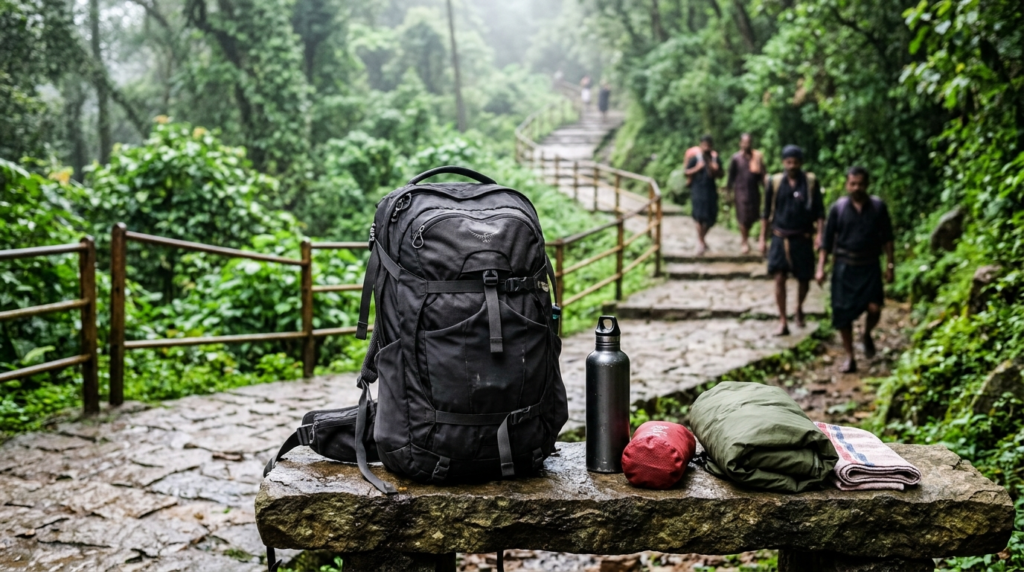
Sabarimala backpack packing works best when your personal bag sits securely, carries only useful items and lets you reach essentials without unpacking on the path. A bag that feels fine at home may shift on steps or press against your shoulders during the climb. The aim is not to fill every pocket. It is to carry a manageable load while keeping the sacred irumudi separate.
Independent-guide notice: Gokshetra is not the official Sabarimala Temple or Travancore Devaswom Board website. We are not affiliated with these authorities and accept no bookings, donations or payments. Check current pilgrimage instructions on the official Sabarimala website.
Sabarimala backpack packing at a glance
- Choose a compact personal bag that stays close to your back and does not swing when you walk.
- Place heavier supplies near your back, then spread the remaining weight evenly from side to side.
- Keep water, prescribed medicines and a small weather pouch accessible without opening the main compartment.
- Use separate dry pouches for documents, electronics and clean first-aid items.
- Do not treat the irumudi as ordinary luggage or change its ritual packing without your guru swami’s guidance.
- Confirm local baggage instructions and security requirements; no universal backpack size or storage guarantee is established here.
Think of the backpack as a tool for the journey, not the centre of the pilgrimage. Good Sabarimala backpack packing reduces searching, fumbling and unnecessary stops. It also makes it easier to follow instructions when the route becomes crowded.
How should a Sabarimala backpack fit?
A suitable backpack should rest close to your back, with straps that hold the load steady without pinching. You should be able to walk, turn and climb a few steps without the bag swinging. Fit matters more than a brand name or an arbitrary capacity figure, especially when the bag will be worn over pilgrimage clothing.
Start with both shoulder straps at a similar length. Tighten them just enough to stop the bag dropping away from your back. If the bag has a chest strap, check that it feels comfortable and does not restrict breathing. A hip belt may help on some designs, but only if it sits comfortably over your clothing.
Check the straps again after you add water and other supplies. A bag can fit well when empty yet lean or rub once full. If it catches your arms or pushes your shoulders forward, remove excess items before adjusting further.
The short walk test before departure
Put on the clothes you expect to wear, then take a short walk with the packed bag. Use a safe set of steps if available. Notice whether you keep pulling a strap, leaning forward or steadying the bag with one hand. Those are signs to rebalance or reduce the load.
Test the bag while turning slowly as well. In a close queue, a bulky bag can brush another pilgrim even when it feels light. Keeping the load narrow and secure helps everyone move more easily.
Sabarimala backpack packing: balance without bulk
In Sabarimala backpack packing, balanced loading means keeping weight close to your back without a pull to either side. In practice, heavy items buried in a distant outer pocket can make a small backpack feel awkward. The same can happen when a full bottle hangs from one side and everything else sits on the other.
- Start with the heaviest useful items. Put them close to the back panel, around the middle of the bag. Pad hard edges so they do not dig into you.
- Fill the remaining space evenly. Use softer clothing or a folded cloth to stop items moving, but do not add things merely to fill gaps.
- Keep the outside tidy. Secure loose cords and avoid dangling containers, hooks or straps that may catch on a rail.
- Compare both sides. If one side pulls harder, move a small item across or reposition the bottle.
- Walk and adjust. A comfortable bag should stay steady without requiring you to hold it in place.
For Sabarimala backpack packing, the ideal load is the lightest one that meets your real needs. There is no reason to copy another pilgrim’s packed weight. Your health, walking ability, weather and route will differ.
Sabarimala backpack packing: easy-access essentials
Quick access is central to Sabarimala backpack packing. Put essentials in a secure pocket you can open after stopping safely. Keep prescribed medicines, drinking water and vital travel details easy to find. However, easy access does not mean leaving valuables in an exposed pocket or trying to retrieve items while moving through a queue.
| Item | Suggested position | Reason |
|---|---|---|
| Safe drinking water | Secure bottle pocket or top section | Reach it during a rest without unpacking |
| Prescribed medicines | Clearly marked inner quick-access pouch | Find them promptly when needed |
| Identification and travel details | Dry zipped inner pocket | Keep documents together and protected |
| Rain protection | Top compartment | Retrieve it when conditions change |
| Small first-aid supplies | Clean sealed pouch near the top | Handle minor issues without searching |
| Spare clothing | Lower or inner section | Keep less urgent items out of the way |
These positions are packing suggestions, not temple-issued baggage rules. Keep cash and any essential valuables secure and under your control. For detailed first-aid contents, see Gokshetra’s Sabarimala first-aid kit guide.
Personal backpack versus irumudi: the essential difference
Sabarimala backpack packing must respect the irumudi kettu, a sacred bundle prepared through the ritual of kettunirakkal. The official Sabarimala rituals page describes it as a two-compartment bundle carried on the head. The same guidance links the irumudi to the traditional observance required for climbing the sacred eighteen steps. A personal backpack has a different purpose: carrying ordinary travel necessities.
Traditions may allow certain journey-related contents within the irumudi, according to customary preparation. Even so, that does not make it a casual spare pocket for your phone, raincoat or loose gear. Follow the instructions of your guru swami for preparation, handling and carrying. Do not untie or rearrange the bundle to make an ordinary packing plan work.
If you expect to carry both, think through the combined load before travel. Ask for guidance when straps, balance or a crowded route make the arrangement difficult. Religious practice and physical safety both deserve care.
Sabarimala backpack packing for the Pamba climb
Sabarimala backpack packing for the uphill approach from Pamba differs from packing for a long train or road journey. A travel suitcase can hold spare outfits and other bulky items, while the walking bag should carry what you actually need on the route. Reduce its contents before setting out instead of assuming you can leave the excess somewhere later.
Government Sabarimala general instructions tell pilgrims to follow queue arrangements, cooperate with security checks and take rest during the climb. These official directions make a secure, easy-to-manage bag especially useful. They do not establish a blanket allowance for every backpack type or an exact permitted bag size.
Before leaving Pamba, close all zips and check for leaks. Put the day’s most useful items near the top, then finish calls and group planning before the final temple approach. Do not stop suddenly on steps to search through your bag.
Choose your bag for the route you will actually walk
Some pilgrims follow different authorised approaches, and walking demands can vary. Check the route and current local instructions instead of packing for an imagined shortcut. Gokshetra’s Sabarimala pilgrimage guide covers wider route planning. If your route is longer or more exposed, review water, weather protection and rest arrangements before departing.
Keep enough room to put a rain layer away when it dries. A bag stuffed to the zip leaves nowhere to place damp gear. Meanwhile, a separate wet-items pouch helps protect documents and medicines.
Sabarimala backpack packing for rain and spills
A rain cover helps with Sabarimala backpack packing, but it does not guarantee dry contents. Water may enter through zips, seams or a bottle cap. Protect the things that matter most inside the bag rather than trusting the outside fabric alone.
Place documents and essential medicines in their own dry, secure sleeves. Keep a small towel or spare cloth separate from clean first-aid supplies. If you carry a phone for travel needs, protect it from moisture and follow instructions about its use near the temple.
The official general instructions say not to use mobile phones on temple premises. That does not establish a ban across every stage of the walk, and it does not promise device storage. Check Gokshetra’s mobile phone guidance before planning around a device.
Water, food and health supplies: pack for access
For Sabarimala backpack packing, start with safe drinking water rather than trusting an unconfirmed tap along the path. The government’s pilgrim facilities page describes water services, yet a published directory cannot promise every outlet will work at your arrival time. Keep a clean, well-sealed bottle where you can retrieve it during a break.
A heavy bottle placed far from your back may pull the bag sideways. Adjust the rest of the load after adding water. If you plan to refill, use a clearly designated safe source and follow staff directions. Gokshetra’s drinking water guide explains the checks in more detail.
Carry your own regular medicines as prescribed and keep them identifiable. People with heart, breathing or mobility concerns should seek medical advice before a strenuous climb. If you develop chest pain, faintness or severe breathlessness, stop and seek medical help rather than pressing on.
Sabarimala backpack packing: what to leave out
Sabarimala backpack packing becomes easier when you leave behind items that add bulk without solving a real need. Extra outfits, large toiletry containers, multiple gadgets and loose accessories make it harder to find essentials. Heavy bags also increase fatigue during an uphill walk, especially when you have other ritual responsibilities.
Avoid sharp or hazardous items. The official general instructions prohibit weapons and explosive substances and require security checks. Do not assume a familiar household object will pass a checkpoint simply because it fitted inside your bag. Follow the current directions of police and Devaswom staff.
Minimise disposable packaging and take your waste to designated bins. The official guidance asks devotees to keep the route clean, while its Mission Green information encourages alternatives to plastic carry bags. A small reusable waste pouch can help you hold litter until you reach a suitable bin.
Do Sabarimala bag-size limits or lockers exist?
A Sabarimala backpack packing plan should not rely on an unverified bag-size limit, weight allowance or guaranteed storage counter. The official pages reviewed for this guide do not establish one universal personal-backpack dimension or a reliable live locker arrangement for every pilgrim. Security officers and local notices may give more specific directions for your visit.
For that reason, a small bag is a sensible comfort choice, not a promise of entry. If staff do not permit an item, ask them for the authorised next step. Never hand valuables to strangers or leave a bag unattended because you expected a cloakroom to be open.
Gokshetra’s separate Sabarimala luggage cloakroom guide explains why older reports of storage services do not guarantee today’s availability. Confirm any counter’s current operation, accepted items and collection procedure directly before relying on it.
Sabarimala backpack packing mistakes to avoid
- Buying a bag at the last moment: The straps and back panel may rub once the bag carries your actual supplies.
- Putting every useful item at the bottom: You then have to unpack in a crowded space to find medicine or water.
- Hanging gear outside: Loose items can swing, fall or snag against other pilgrims.
- Ignoring the bottle’s weight: A full bottle on one side can change how the whole bag sits.
- Trusting a locker without checking: An old description of a counter is not a present-day storage guarantee.
- Confusing the irumudi with a daypack: Ritual contents and handling follow the guidance of your guru swami.
The best correction is often removal, not better organisation. If an item is unlikely to help during the walk, reconsider carrying it uphill. That leaves more attention for the path, the queue and your companions.
A final Sabarimala backpack packing check
- Put on the fully packed bag and test it on a short walk.
- Adjust both shoulder straps, then check comfort with your actual pilgrimage clothing.
- Move heavier items close to your back and correct any sideways pull.
- Put water, medicines and key documents in secure places you can reach while stopped.
- Seal rain-sensitive supplies and tighten every zip, cord and external strap.
- Discuss irumudi preparation and carrying with your guru swami; keep ordinary packing separate.
- Review current official security, route and baggage directions before departure.
- Make a backup plan if a storage counter is closed or your bag needs to be reduced.
A good Sabarimala backpack packing routine ends with a simple question: can you manage this load without rushing or constant adjustment? If not, remove something before the climb. Comfort and easy access matter more than filling a particular bag size.
Before you set off
The safest personal bag is steady, light and easy to manage when the route gets busy. Keep heavier supplies close, protect essentials from moisture and plan retrieval for rest stops. Above all, respect the distinction between a practical backpack and the sacred irumudi. Check official notices again before travel because local instructions can change.
Frequently asked questions
Can I carry a backpack to Sabarimala?
A personal backpack may be useful for travel supplies, but this guide cannot guarantee its acceptance at every checkpoint. Follow current signs, security checks and official instructions. Choose a modest, manageable bag rather than relying on an invented permitted size.
What size backpack is allowed at Sabarimala?
No universal bag-size limit was confirmed in the official pages reviewed for this guide. Therefore, do not treat any online litre figure as a temple rule without a current notice. Pack light and confirm restrictions with authorised staff.
Is a backpack the same as an irumudi?
No. A backpack carries personal travel necessities, while the irumudi is a sacred ritual bundle prepared under customary guidance. The official Sabarimala rituals page describes it as a two-compartment offering bundle carried on the head. Ask your guru swami about its proper handling.
Where should I keep medicines in my backpack?
Keep essential prescribed medicines in a clearly marked, secure pouch that you can reach after stopping. Protect them from moisture and carry them according to your clinician’s instructions. Do not bury urgent medicine below spare clothing.
Should heavy items go at the bottom of the bag?
Not by default. Keeping heavier items near your back, around the middle of the pack, often feels steadier than placing them far from your body. Test the loaded bag and adjust it for your comfort.
Can I leave my backpack in a Sabarimala locker?
Do not assume a locker or cloakroom will be open, have space or accept your bag. Check the authorised service’s current conditions and collection process before leaving anything. If no suitable arrangement exists, reduce your load through a secure plan made earlier.
Where should I keep water for the Sabarimala trek?
Keep a sealed bottle in a secure place that you can reach during a safe rest stop. Balance its weight against the rest of your supplies. Use designated drinking-water points when available, but do not assume a particular outlet will be open.
Can I keep my phone in the backpack during darshan?
The official general instructions prohibit mobile phone use on temple premises. A phone in your bag does not override security directions or guarantee permission at every checkpoint. Keep it unused where required and follow the instructions of officers on duty.