
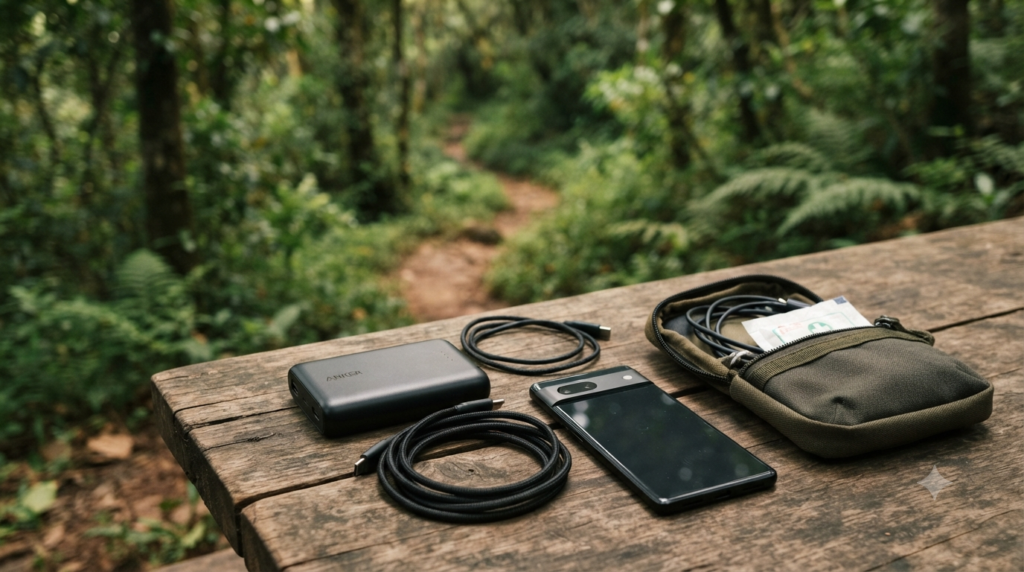
A Sabarimala power bank is most useful when you charge it fully before the journey and test it with your actual phone. The small things matter more than a large capacity label: a working cable, dry storage and enough reserve for the return trip. Here is a practical way to plan without relying on an unconfirmed charging counter.
Independent-guide notice: Gokshetra is not affiliated with Sabarimala Temple or the Travancore Devaswom Board. We accept no bookings, payments or donations. For entry instructions, follow the official Sabarimala guidance and authorised staff.
Sabarimala power bank: the simple charging plan
Prepare the charging kit before you leave home. A portable battery is a backup for travel communication and other permitted device use, not a substitute for checking current temple instructions. A full battery also cannot fix a damaged cable or incompatible port.
- Charge your phone and power bank fully with suitable equipment before departure.
- Test the bank with the same cable and device you will take.
- Keep one working cable accessible and a second cable as a compact fallback.
- Save travel details and agree on a meeting point before phone use becomes restricted.
- Protect the battery from water, crushing, direct heat and loose metal objects.
- Do not count on finding a socket or an authorised charging service along the trek.
Kerala Tourism describes the uphill journey from Pamba to the shrine as roughly 5 km. That makes the return and possible waiting time part of your charging plan, not an afterthought. The official route details appear on Kerala Tourism’s Sabarimala travel page.
Pre-charge before leaving for Pamba
A Sabarimala power bank should leave your accommodation charged and ready, rather than waiting for a socket near the hill. Charge it on a firm, clear surface using the manufacturer’s recommended charger. Keep it where you can notice unusual heat or swelling.
- Inspect first. Look for cracks, a swollen case, bent connectors or a damaged cable. Stop using a suspect unit.
- Charge the bank. Use its designated input port and a compatible wall charger. Follow the product’s charge indicator and instructions.
- Top up the phone. Start with a charged handset so the battery pack remains an emergency reserve.
- Perform a real test. Connect the phone to the bank for a short period. Check that the phone shows charging, not merely that the bank lights up.
- Disconnect and pack. Allow warm equipment to cool before placing it in its pouch.
The Australian Competition and Consumer Commission advises charging power banks on non-flammable surfaces and away from bedding. It also warns against using a damaged, swollen or overheating unit. Read its power-bank safety advice before packing.
How much backup battery do you actually need?
Start with your planned phone use, not the biggest number printed on a box. Navigation, travel messages and long periods away from your normal charger create different needs. Keep enough reserve for the journey back, especially if a travel delay changes your plan.
| Trip pattern | Main power need | Practical plan |
|---|---|---|
| Short, direct visit | Communication and essential travel details | Charge the phone first; carry a tested reserve if useful. |
| Long road or rail journey | Phone use before and after the climb | Plan for both travel legs, not only the uphill walk. |
| Several devices in a group | Different cables and batteries | Check each device and avoid one shared point of failure. |
| Rechargeable trek light | Separate lighting power | Test compatibility; carry an independent light backup. |
A smaller tested bank may suit someone who hardly uses a phone. However, a group sharing one bank may run out sooner. The safest comparison uses the energy rating, device needs and actual test results rather than a claimed number of full charges.
Why 10,000 mAh does not mean two guaranteed phone charges
Power-bank labels often describe the internal battery’s nominal capacity, not the energy delivered through a USB port. Conversion inside the bank and phone uses some energy. Therefore, dividing one mAh label by another does not guarantee a number of charges.
For example, manufacturer Anker explains why one 10,000 mAh model class might show roughly 6,000 mAh of rated output at 5 V. That figure illustrates conversion losses; it is not a promise for every product. See Anker’s capacity explanation and check your own label.
Sabarimala power bank: check the cables and ports
A full Sabarimala power bank is no help if the connector does not fit. Before packing, identify the charging port on each device and the output port on the bank. A cable with the right ends should also support the charging method your devices use.
- USB-C to USB-C: common on newer phones and banks; test both ends and the bank’s output function.
- USB-A to USB-C: useful when the bank has a rectangular USB-A output and the phone has USB-C.
- Lightning cable: relevant for compatible older iPhones; inspect the exact phone connector.
- Special torch lead: carry it only if your rechargeable light requires that specific lead or connector.
The USB Implementers Forum explains how USB Power Delivery allows compatible equipment to negotiate power. However, a USB-C shape alone does not prove that every device supports the same fast-charging features. Testing your exact pair avoids last-minute surprises.
Test the power-bank output, not just its charging input
Some ports work differently depending on the product. Therefore, read the input and output markings rather than assuming any opening will charge your phone. Check whether you must press a button to start charging, and whether a small device needs a special low-current mode.
Try the complete setup before travel. If charging starts and stops, inspect the connector and follow the manufacturer’s troubleshooting advice. Do not force a loose plug or rely on a cable that only works when bent.
Keep the charging kit dry and easy to reach
Store the bank in a protective pouch within your ordinary personal belongings. Keep charging ports dry, and separate the pack from keys and loose coins. Do not bury it under heavy objects that could crush or deform the case.
Rain and humidity are relevant on a forested hill journey. A water-resistant outer bag can help, but it does not make an electrical connection safe to use when wet. If water reaches a port, stop and follow the manufacturer’s advice before connecting anything.
For rainwear and safe handling of personal items, see Gokshetra’s Sabarimala raincoat preparation guide. Keep electronics separate from the irumudi, the sacred offering bundle. Ask your guru swami about its proper handling rather than treating it as a gadget pouch.
Are Sabarimala power banks allowed near the temple?
The official public pilgrim instructions reviewed for this guide do not establish a general permission or ban for power banks at every checkpoint. They do require security checks and cooperation with staff. Therefore, carrying a Sabarimala power bank for travel does not guarantee entry with it into a controlled area.
The Kerala Tourism dos and don’ts also state that pilgrims must not use mobile phones inside the temple premises. That is a phone-use rule, not a verified power-bank rule. Follow current signs and authorised police or Devaswom directions on site.
Our separate Sabarimala mobile phone rules guide explains that difference. Do not treat an online packing suggestion as an exemption from a security check.
Can you charge devices at Pamba or Sannidhanam?
No dependable public charging-counter location, availability guarantee or fee was established by the official sources checked for this article. Do not build your trip around a claimed socket, paid charging booth or deposit service. If you need current assistance, ask authorised personnel rather than following an unsourced online listing.
The practical fallback is simple: leave with charged devices and reserve power. If the bank runs low, reduce non-essential phone use while you travel through areas where phone use is permitted. Do not run a cable across a crowded path or use a visibly damaged outlet.
What if your Sabarimala power bank stops charging?
Stop at a safe place before checking the device. A loose cable, wrong port, flat bank or damaged connection can all look like the same failure. A Sabarimala power bank is a convenience, not a guaranteed charging service, so your plan must still work if it fails.
- Check the phone’s battery display and the bank’s indicator without repeatedly reconnecting a hot device.
- Try your tested spare cable or another labelled output port if the maker supports it.
- Disconnect immediately if you notice swelling, unusual heat, smoke or a strange smell.
- Save remaining phone power for permitted essential use. Use offline details and your agreed meeting point.
- Ask police or authorised route staff for help if you become separated or face a safety problem.
Never dismantle a lithium battery or attempt a repair during the climb. For a lighting failure, see the separate Sabarimala headlamp and backup torch guide. A power bank cannot replace a working independent light.
Flying to Kerala with a power bank
If you fly to Kerala, check your airline’s current lithium-battery policy before packing. The International Air Transport Association treats portable power banks as spare batteries for baggage handling and directs travellers to carry them in hand baggage, not checked luggage. Airline-specific size and use limits may differ.
See IATA’s lithium-battery travel guidance and your airline’s own instructions. An airline allowance does not establish permission for a separate Sabarimala security checkpoint. Those are distinct decisions.
A final Sabarimala power bank checklist
- Bank charged; phone charged; indicators checked.
- Phone charged successfully from the bank during a real test.
- Correct main cable plus a small, tested spare.
- Input and output ports identified on the actual bank.
- No cracks, swelling, heat damage or exposed wire.
- Dry protective pouch; no loose keys pressing against the unit.
- Travel details available offline and a group meeting point agreed.
- Official Sabarimala instructions checked; no charging counter assumed.
Remember that battery planning is only one part of pilgrimage safety. The climb requires attention to weather, footing and crowds, so take rest when needed. If you have health concerns, seek medical advice before a strenuous journey and carry prescribed medication.
Before you begin the climb
Choose a charging plan that still works when a cable fails or no outlet appears. Charge ahead, test the exact device pair and keep a modest reserve for the way back. At temple-controlled areas, follow official instructions rather than assumptions about what electronics may enter.
The best Sabarimala power bank setup is not necessarily the largest. It is the one you understand, have already tested and can carry without creating an extra problem on the route.
Frequently asked questions
Should I take a power bank to Sabarimala?
A power bank may be useful for travel and permitted phone use, especially if you will be away from your usual charger. However, you must follow current security directions at the temple. Bringing one is a personal preparation choice, not a verified temple requirement.
Is a 10,000 mAh power bank enough for Sabarimala?
It depends on the phone, its starting charge, your travel time and how much you use it. The advertised mAh rating does not equal energy delivered to the phone. Test the exact bank and carry a reasonable reserve rather than assuming a set number of recharges.
Can I charge my phone during the Sabarimala trek?
Portable charging may be technically possible where device use is permitted and conditions are safe. However, do not handle cables while walking or charging equipment in rain. The temple’s published instructions restrict mobile-phone use within temple premises, and on-site directions take priority.
Are there official power-bank charging counters at Pamba?
No specific counter, timetable or price could be verified from the official sources reviewed here. Therefore, do not rely on a supposed charging service before you arrive. Ask authorised staff for current information if you need help.
Which cable should I carry for a power bank?
Carry the cable that fits your bank’s output port and your phone’s charging port. Test it before leaving. If you have a second device with a different connector, carry its own compatible lead rather than assuming one cable fits everything.
Does a power bank charge a rechargeable headlamp?
Only if the headlamp’s manufacturer supports charging from that kind of USB output and the connectors match. Check its manual and test the pairing. Keep a separate working torch because a power bank and cable can fail together.
What if my power bank becomes hot or swollen?
Stop using or charging it and keep it away from people and flammable items, without handling a smoking or burning unit. Seek local emergency help if there is a hazard. Never puncture, open or continue charging a swollen battery.
Can I put my power bank in checked luggage on a flight?
No. IATA guidance says power banks belong in hand baggage, not checked baggage. Airlines may also impose specific size, quantity and onboard-use conditions, so check your carrier before flying.