
Most planning guides get the basics of Mahanandi Temple Darshan wrong before you even leave home, because they name the wrong railway station and the wrong airport. The Nandyal district administration lists Gazulapalli as the closest railhead at about 5 km, not Nandyal Junction. That single correction changes how you plan the last leg of the trip. Below you will find verified timings, the seva and ticket reality, the Pushkarini rules, the Nava Nandi circuit and the festival calendar.
Go Kshetra is an independent pilgrim guide. We are not affiliated with, endorsed by, or the official website of Sri Mahanandeeswara Swamy Vari Devasthanam or the Andhra Pradesh Endowments Department. We do not accept bookings, donations or payments. Use the official channels linked in this guide for tickets and confirmations.
Mahanandi Temple Darshan at a Glance
Sri Mahanandeeswara Swamy Temple sits in Mahanandi village, Nandyal district, Andhra Pradesh. The Nandyal district administration dates the shrine to the 7th century AD and places it about 14 km east of Nandyal town, at the edge of the Nallamala hill range.
- Presiding deity: Sri Mahanandeeswara Swamy, worshipped as a Swayambhu Shiva Linga, with Sri Kameswari Devi as consort.
- Managed by: Andhra Pradesh Endowments Department.
- General darshan: free, no advance booking needed.
- Signature draw: perennial spring water that stays crystal clear year-round.
- Main festival: Maha Shivaratri Brahmotsavam, February–March.
- Nearest railhead: Gazulapalli, roughly 5 km away.
| Detail | What to expect |
|---|---|
| Location | Mahanandi (V&M), Nandyal district, Andhra Pradesh |
| Distance from Nandyal | About 14 km direct; 17 km by the Thimmapuram road route |
| General darshan fee | Free |
| Special sevas | Paid; tickets issued at the temple counter |
| Sacred tanks | Brahma Gundam, Vishnu Gundam and the inner Rudra Gundam |
| Official authority | AP Endowments Department |
Mahanandi Temple Darshan Timings You Can Actually Rely On
Published timings for this shrine genuinely conflict, so treat any single figure with caution. Some sources describe continuous opening from about 5:30 AM to 9:00 PM. Others list a split schedule of roughly 4:30 AM to 1:00 PM and 2:00 PM to 9:30 PM.
Both patterns appear in circulation, and no government page carries either one as a fixed notice. Because seasonal and festival adjustments happen often, plan around the safest window instead. Arrive between 5:30 AM and 11:00 AM and you will find the temple open under either schedule.
If your visit depends on an exact ritual slot, confirm it locally on the day before. Ask at the temple office, or check the Andhra Pradesh Endowments portal for the current notice.
Morning rituals worth timing your visit around
Suprabhata seva and the early Sthanika Abhishekam happen in the first hour after opening. Mahamangala Harathi follows shortly after. Regular pilgrims consistently recommend the 4:30 AM to 7:00 AM window, since Sparsha Darshan is easiest then and the sanctum stays quiet.
Abhishekam sequences run through the morning and again in the evening. Exact start times shift, so ask at the counter when you buy a ticket rather than trusting a printed schedule online.
The Pushkarini: What Makes Mahanandi Temple Darshan Different
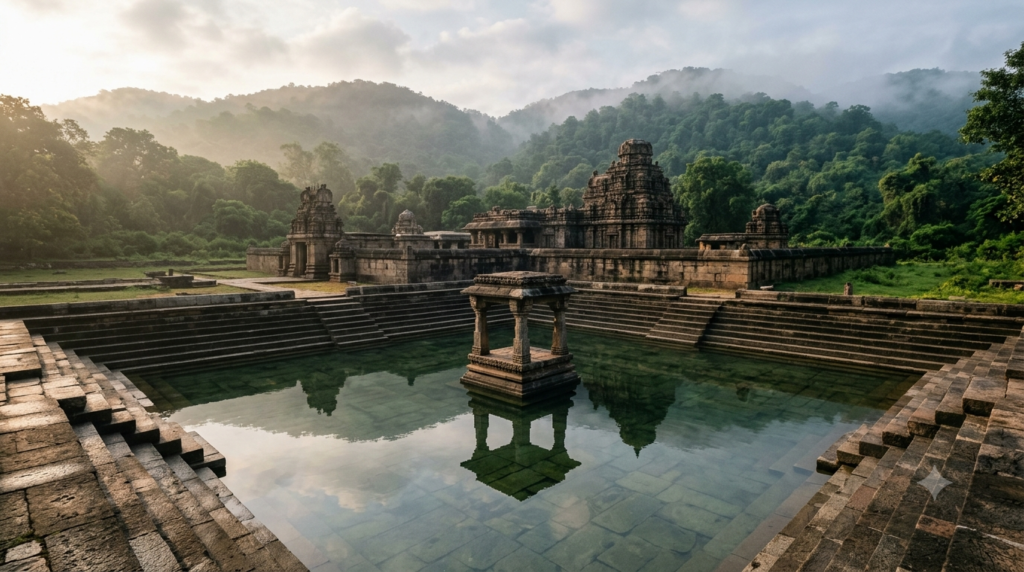
The water is the reason this temple stands apart from every other Shiva shrine in Rayalaseema. Three tanks sit in the complex: Brahma Gundam and Vishnu Gundam near the approach, and Rudra Gundam inside the temple itself.
The inner tank draws its supply from beneath the sanctum, directly below the Shiva Linga. Its inlets and outlets hold the level steady at roughly five feet. The Nandyal district administration notes the water stays clear enough that objects on the floor of the tank remain visible.
Devotees bathe here before darshan. You can also touch the water flowing beneath the Linga inside the sanctum, which is rare and a large part of the shrine’s appeal.
Safety notes before you step into the water
The spring water runs cool throughout the year, even in May. Steps into the tank get slippery, and there is no lifeguard supervision. Keep a firm hold on children, since a steady five-foot depth is still above the head of a small child.
Many articles describe this water as curative. That belief belongs to local tradition and devotee experience, not to medical evidence. Treat a dip as a spiritual practice, and never as a substitute for treatment. If you have a heart condition or reduced mobility, skip the immersion and take theertham instead.
Sevas, Tickets and What Mahanandi Temple Darshan Costs
General darshan is free. You walk in, join the queue and proceed. No ticket, no registration and no advance payment applies to ordinary darshan on a normal day.
Paid sevas are a separate matter. Sparsha Darshan, various Abhishekam formats including Ekadasa Rudrabhishekam, Archana and Kalyanam are all offered against counter tickets. Reported amounts for Sparsha Darshan hover around ₹100, while a Rudrabhishekam for a couple is often quoted near ₹1,000.
Treat those figures as indicative rather than fixed. Endowments-managed temples revise rates periodically, and this shrine publishes no current rate card online. Confirm the exact amount at the counter before you pay, and always collect a printed receipt.
Is online booking available for Mahanandi Temple Darshan?
There is no widely available online booking for Mahanandi Temple Darshan. General darshan is free and needs no booking at all, while the temple counter issues seva tickets on the day. The only legitimate online channel for Andhra Pradesh endowment temples is the state portal at tms.ap.gov.in, so check there first if you want to verify availability.
How to spot a fake Mahanandi booking site
Several private sites rank for “Mahanandi darshan booking” and collect payments or personal details. The Endowments Department states plainly that it authorises no agents or third-party agencies for online booking of its services. It also warns devotees never to share card numbers, PINs, passwords, CVV or OTP with anyone claiming to represent it.
So apply a simple test. If the site is not a gov.in address, it cannot issue you a genuine ticket. Anything charging a “processing fee” or “confirmation charge” for a free darshan is a red flag.
How to Reach Mahanandi Temple Darshan Without a Wasted Detour
Most guides send readers to Nandyal Junction or Hyderabad airport by default. The Nandyal district administration lists different answers, and following the official version saves both time and money.
By train
Gazulapalli railway station is the nearest railhead at about 5 km from the temple. Nandyal Junction is the larger station with far better connectivity, roughly 14 to 17 km away, so most travellers still route through it. Choose Gazulapalli only if a convenient train actually halts there.
By road
Two routes run from Nandyal. The shorter one goes via Thimmapuram and covers about 17 km from the Nandyal bus stand. The alternative runs along the Giddalur road with a left diversion at Boyalakuntla cross, adding up to roughly 24 km. APSRTC operates regular services, while autos and taxis handle the last mile.
By air
Orvakal Airport near Kurnool is the closest at about 71 km from Nandyal, though its schedule is limited. Rajiv Gandhi International Airport in Hyderabad remains the practical choice for most flyers, at roughly 230 to 250 km, followed by a road or rail transfer.
The Nava Nandi Circuit Around Mahanandi
Nine Nandi shrines lie within about a 15 km radius, and Mahanandi is the foremost among them. The set comprises Mahanandi, Shivanandi, Vinayakanandi, Somanandi, Prathamanandi, Garudanandi, Suryanandi, Krishnanandi (also called Vishnunandi) and Naganandi.
Tradition holds that a devotee should complete all nine before sunset in a single day. That is achievable with a hired vehicle and an early start, although several of the smaller shrines are modest village temples with limited facilities. Carry water and food, because roadside options thin out quickly.
Inside the main complex you will also find the Kodanda Ramalayam and the Sri Kameswari Devi shrine. The district administration lists both among the sites worth seeing.
Maha Shivaratri Brahmotsavam and the Festival Calendar
The temple’s biggest event is the Maha Shivaratri Brahmotsavam, listed on the Government of India’s cultural events portal as Mahanandi Maha Sivaratri Bramhostavalu. It falls in February or March each year, following the lunar calendar.
The festival runs across several days rather than one night. A typical sequence includes an invitation procession to Nandyal, Dhwajarohanam, and successive vahana sevas on the Suryaprabha, Vyagra, Aswa, Gaja, Ravana, Vrushabha, Simha, Pushpa and Mayura vahanams. Lingodbhava Maharudrabhishekam, Kalyanam, Rathotsavam and Teppotsavam close the cycle.
Karthika Masam in October and November brings deepam offerings and heavy Monday footfall. The temple also observes Ugadi and Dasara. During Shivaratri, Nandyal district shrines including Mahanandi and Yaganti draw very large crowds alongside nearby Srisailam, so expect multi-hour queues.
Where to Stay Near the Temple
Mahanandi village itself has minimal commercial accommodation. Most pilgrims planning a Mahanandi Temple Darshan trip base themselves in Nandyal town, which offers budget lodges and mid-range hotels across a wide price band. Rooms there generally fall in the indicative ₹800 to ₹3,000 range, though rates climb sharply during Brahmotsavam.
The Devasthanam operates limited cottages and choultry rooms for pilgrims. Availability is not consistently published, so enquire directly at the temple office or through the AP Endowments portal instead of a third-party site.
Book Nandyal accommodation weeks ahead if you are travelling around Maha Shivaratri. Otherwise a same-week booking is usually fine.
Best Time to Visit for Mahanandi Temple Darshan
October to March is the comfortable season, with cooler days and low humidity. February and March add festival energy, although crowds swell considerably. April to June turns genuinely hot in this part of Rayalaseema, and queue waits become uncomfortable.
Monsoon months bring greenery to the Nallamala foothills and stronger spring flow. Roads through the forest edge can be slick after heavy rain, so drive carefully.
Weekday mornings remain the single best choice. Sunday and public-holiday crowds are noticeably heavier, especially on Kartika Mondays.
What Most Mahanandi Temple Darshan Guides Get Wrong
- The TTD confusion. Mahanandi has no connection to Tirumala Tirupati Devasthanams. Several guides link readers to the TTD site for “official information”, which is simply the wrong authority.
- Phone numbers that no longer hold. Old office numbers circulate widely across aggregator pages. Rather than dialling a stale number, use the official Endowments channels.
- Photography assumptions. Visitors frequently report that mobile phones are restricted inside the temple. Use the lockers near the entrance and do not count on carrying your phone to the sanctum.
- Ticket pressure at the gate. Some devotees describe being urged to buy paid darshan tickets even though free darshan exists. You are entitled to the free queue.
- Carry cash. Counter payments and small purchases run on cash, and ATMs in temple towns empty out during festivals.
Planning a Two-Temple or Three-Temple Trip
Mahanandi works well as part of a Nandyal district circuit rather than a standalone stop. Yaganti Uma Maheswara Temple lies roughly 65 km away and pairs naturally with a Mahanandi morning.
Add Srisailam if you have a second day, since the Jyotirlinga shrine sits about 160 km from Nandyal through the Nallamala forest. Ahobilam is closer at around 63 km and suits a Vaishnava detour.
A sensible two-day plan looks like this. Day one covers Mahanandi at dawn, then Yaganti by afternoon. Day two takes the forest road to Srisailam.
Before You Go
Reach the temple before 7:00 AM if you want an unhurried Mahanandi Temple Darshan, because the sanctum genuinely empties out early. Keep general darshan free, buy seva tickets only at the counter, and confirm the rate before paying. Carry a change of clothes if you plan to bathe in the Pushkarini, plus cash for tickets and transport. Verify timings locally the day before, since published schedules disagree with each other.
For official information, refer to the Andhra Pradesh Endowments Department and the Nandyal district administration.
Mahanandi Temple Darshan FAQ
Is there an entry fee for Mahanandi Temple Darshan?
No. General darshan at Mahanandi is free for everyone, with no ticket or registration required. Fees apply only to special sevas such as Sparsha Darshan, Abhishekam formats and Archana. The temple counter sells those tickets, so confirm the current amount there.
How far is Mahanandi from Nandyal?
The Nandyal district administration places Mahanandi about 14 km east of Nandyal. By road it is roughly 17 km via the Thimmapuram route from the Nandyal bus stand, or about 24 km via the Giddalur road with a diversion at Boyalakuntla cross.
Can I take a bath in the temple pond?
Yes. Devotees regularly bathe in the Pushkarini before darshan, and the water level stays around five feet. Bring a change of clothes and follow the posted rules. Supervise children closely, because the steps are slippery and no lifeguard is on duty.
What is the dress code at Mahanandi?
There is no strictly enforced dress code, though modest traditional attire is expected. Men commonly wear a dhoti, and women wear a saree or salwar. Cover shoulders and knees as a mark of respect, particularly if you are entering for a paid seva.
Are mobile phones and cameras allowed inside?
Visitors frequently report that phones are not permitted inside the temple, and photography in the sanctum is restricted. Lockers are available near the entrance. Ask the staff on the day, since enforcement tightens during festival periods.
What are the Nava Nandis and can I see them all in one day?
The Nava Nandis are nine Shiva shrines within about 15 km of Mahanandi. Tradition says all nine should be visited before sunset on the same day. With a hired vehicle and a 5:00 AM start, the circuit is comfortably achievable.
How crowded does Mahanandi get during Maha Shivaratri?
Very crowded. Mahanandi is among the Nandyal district shrines that draw heavy Shivaratri footfall alongside Srisailam and Yaganti. Expect long queues, restricted parking and slower movement at the Pushkarini. Arriving a day earlier or later is far more comfortable.
Which is the nearest railway station to Mahanandi?
Gazulapalli is the nearest station at about 5 km, according to the Nandyal district administration. Nandyal Junction is larger and better connected at roughly 14 to 17 km, so most pilgrims arrive there and continue by road.