
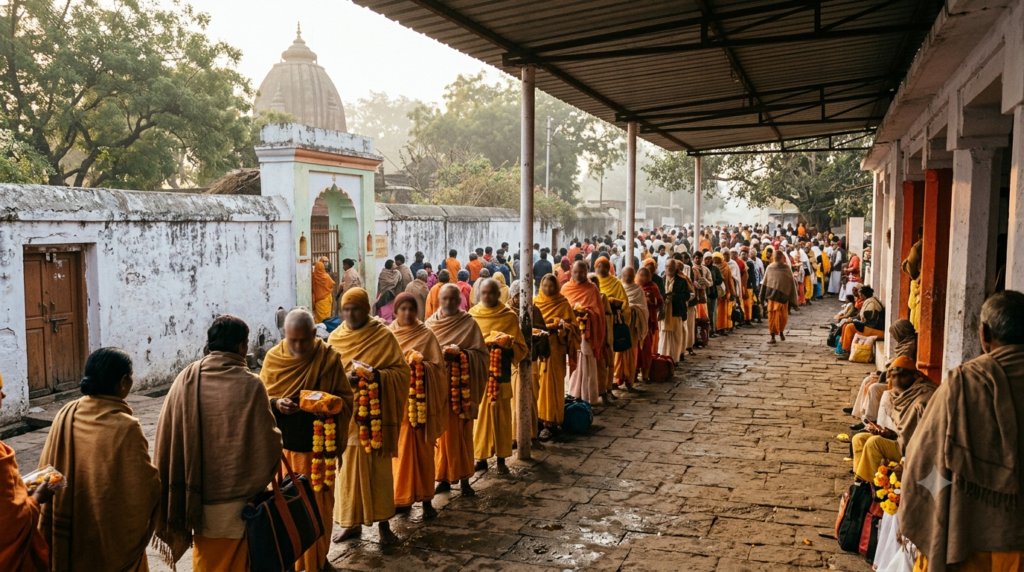
Baglamukhi Pitambara Peeth Datia surprises most first-time visitors, because the shrine accepts no money offering at all. In fact, there is no ticket counter and no paid queue. Yet dozens of websites sell “online pooja booking” for this temple. That gap between what the Peeth actually does and what the internet claims is why so many devotees arrive confused.
Go Kshetra is an independent pilgrimage guide. We are not affiliated with, endorsed by, or the official website of Shri Pitambara Peeth or its trust. Also, we take no bookings, donations or payments. Use the official Shri Pitambara Peeth website for all temple communication.
Baglamukhi Pitambara Peeth Datia at a Glance
Baglamukhi Pitambara Peeth Datia is a walled ashram complex in Datia town, Madhya Pradesh. Specifically, it is dedicated to Goddess Baglamukhi, the eighth of the ten Mahavidyas. Devotees worship her for stambhana, the power to stop an opponent. Because of that, litigants and politicians have visited for decades.
- Deity: Baglamukhi, also called Pitambara Devi, with a separate Dhumavati Mata shrine
- Entry fee: none, since darshan is free
- Founded by: Shree Swami Ji Maharaj, who first reached Datia in July 1929
- Busiest day: Saturday, so expect long queues
- Cameras and phones: not allowed inside, so use the cloakroom
- Nearest station: Datia, roughly 2–3 km away, so take an auto
One line is worth remembering before you plan anything else. In fact, the temple does not take money offerings from visiting devotees. Therefore any site charging you to “book darshan” here is not the temple.
Darshan Timings at Baglamukhi Pitambara Peeth Datia
Darshan at Baglamukhi Pitambara Peeth Datia runs from early morning until about 9 PM, with a midday break. Published timings differ between sources, and some list 5 AM to 9 PM. Visitors more often report roughly 7 AM to 9 PM, when the sanctum shuts around noon. Confirm the current schedule before you travel.
| Slot | Approximate timing | Note |
|---|---|---|
| Morning darshan | Around 5–7 AM onwards | Quietest window on weekdays |
| Morning aarti | Around 7 AM | Crowd builds sharply |
| Dhumavati aarti | Around 8 AM | Short window, see rules below |
| Midday break | Around 12 PM–2 PM | Sanctum usually closed |
| Evening aarti | Around 8 PM | Last main aarti of the day |
| Closing | Around 9–9:30 PM | Varies on festival days |
Timings shift during Navratri and on Baglamukhi Jayanti. So treat this table as a planning guide, not a guarantee. Reach thirty minutes early if a specific aarti matters to you.
Dhumavati Mata Darshan at Baglamukhi Pitambara Peeth Datia
Inside the same complex stands a Dhumavati Mata temple, and its access rules are unusual. In particular, married women are traditionally restricted from this shrine. Instead, widowed women and men are the usual worshippers here.
The shrine also stays shut for most of the day. On ordinary days devotees see Dhumavati Mata only during the aarti windows. Those windows fall roughly at 8 AM and 8 PM, so each one is short. Saturday is the exception, when the shrine opens for longer morning and evening periods.
Plan around this if Dhumavati darshan is your reason for travelling. For example, arriving at 11 AM on a Tuesday will simply mean a closed door.
Who Goddess Baglamukhi Is
Baglamukhi appears in yellow, seated in a golden setting. Also, she holds a club in one hand and a demon’s tongue in the other. The image carries a specific meaning, since hostile speech falls silent rather than dying. Devotees therefore link her with court cases, disputes and public confrontation.
The name Pitambara comes from pit, meaning yellow, as well as ambara, meaning cloth. So devotees wear yellow and offer turmeric, yellow flowers and chana dal. Of course, these are matters of faith and Vedic tradition rather than verified outcomes. In addition, no ritual replaces legal or medical advice.
Her worship also differs from the wider Devi tradition, where paid sevas are routine. For instance, our Kolhapur Mahalakshmi seva booking guide shows that contrasting model.
At Datia, devotees view the idol through a small window instead of an open sanctum door, and nobody touches it. Many also describe the goddess appearing different across the three prahars of a day, which tradition treats as a wonder.
Who Actually Founded Baglamukhi Pitambara Peeth Datia
Several online guides credit a Datia maharaja with founding the shrine after a divine instruction. Yet that claim is wrong, and it spreads widely. Both the Datia district administration and Madhya Pradesh Tourism credit Swami Ji Maharaj instead. Specifically, he established Baglamukhi Devi and Dhumavati Mai at this site.
Swami Ji reached Datia on 9 July 1929 after years of travel. Yet he never disclosed his name, family or birthplace. The main Baglamukhi deity followed in 1935, although some accounts date the ashram’s beginnings to the 1920s. He then stayed in penance for roughly fifty years, until his samadhi on 2 June 1979.
The Bundela rulers of Datia belong to a much earlier era. In fact, their famous seven-storey palace is older than Baglamukhi Pitambara Peeth Datia by about three centuries. Royal patronage and temple founding are not the same thing, so the two stories should stay separate.
The 1962 yagna: what is tradition and what is record
The Peeth’s best-known modern story concerns the 1962 Sino-Indian war. Temple tradition holds that Prime Minister Jawaharlal Nehru came here, and that priests then performed a mahayagna for the nation. However, retellings differ on the detail. Some describe nine havan kunds over nine days, while others describe a 51-kund yagna.
What the historical record independently confirms is narrower. China declared a one-sided ceasefire and then began pulling back in late November 1962. Still, the link between the two remains a matter of devotional belief, not documented cause. An honest guide should say so plainly.
Vankhandeshwar Shiva and the Other Shrines Inside the Complex
Most visitors arrive for the goddess, so they miss the older shrine. The Vankhandeshwar Shiva temple stands within the Peeth. Notably, the Datia district administration describes it as a Mahabharata-period temple of Shiva. Consequently, devotees crowd it on Shravan Mondays and Mahashivratri.
The ashram grounds also hold shrines to Parashuram, Hanuman and Kal Bhairav. Meanwhile, the samadhi temple of Swami Ji sits nearby. There is a Sanskrit library too, which holds works on sadhana as well as tantra. Furthermore, the ashram teaches Sanskrit to local children and runs debates.
Give yourself an unhurried ninety minutes if you want all of it. If you rush, you will queue for the main darshan and leave without noticing the rest.
Rituals, Anushthan and What the Temple Will Not Accept
Baglamukhi anushthan, havan as well as Pitambara pooja are the rituals people travel here for. An anushthan is a long ritual observance, so priests often run it across several days. Therefore devotees arrange it in person at Baglamukhi Pitambara Peeth Datia, through the Peeth’s own priests and office.
Two practical rules catch visitors off guard. First, the temple generally does not accept outside prasad, although flowers are the usual exception. Instead, a stall inside sells packaged prasad at a low cost. Second, and more importantly, the shrine takes no cash offerings from devotees.
The fake booking problem, in the temple’s own words
Search “Pitambara Peeth booking” and you will find pandit services, aggregators as well as lookalike domains. Many of them offer paid poojas “at” the Peeth, although the Peeth itself is not involved. The temple’s own website carries a blunt warning to beware of other websites running under the same name. Clearly, that notice is the most useful line on the internet about this temple.
- The official domain is shripitambarapeeth.in, and its contact page lists the Peeth’s own landline numbers
- No verified public online seva-booking system exists for general darshan here, as of now
- If a site asks for an advance “processing fee” for temple darshan, it is not the temple
- Private pandit services may be genuine businesses, yet they are not the Peeth
Temple Rules and Dress Code at Baglamukhi Pitambara Peeth Datia
Discipline here is stricter than at most Devi temples, and staff enforce it. Leave phones and cameras at the cloakroom or in your vehicle, since the premises do not permit them. Furthermore, photography of the sanctum is banned outright.
Dress conservatively, so men should wear modest clothing and women a saree or salwar-kameez. Yellow is customary, although it is not required. Besides that, leather items traditionally stay out, and footwear stays outside. Rules vary widely between Devi shrines, as our Chandi Devi temple darshan guide shows.
Finally, regular visitors describe three darshan lines. One passes directly in front of the deity, one runs a few feet back, and the third offers a distance darshan. The distance line usually has little or no queue, so it moves fastest.
How to Reach Baglamukhi Pitambara Peeth Datia
Reaching Baglamukhi Pitambara Peeth Datia is straightforward. Because the complex sits near the entrance of Datia town, it is easy to find from the Gwalior–Jhansi corridor. Datia also lies on National Highway 44, so road access from either direction is simple.
| From | Approximate distance | Best option |
|---|---|---|
| Datia railway station | 2–3 km | Auto-rickshaw, roughly ₹30–50 |
| Datia bus stand | About 1 km | Auto or short walk |
| Jhansi | About 25–30 km | Taxi or bus, under an hour |
| Gwalior (nearest airport) | About 75 km | Taxi or train |
| Bhopal | About 360 km | Train to Datia or Jhansi |
| Delhi | About 440 km | Train to Jhansi, then road |
Gwalior has the nearest airport, about 75 km away, with flights from Delhi, Mumbai, Indore as well as Bhopal. Datia station sits on the busy Delhi–Bhopal trunk route. However, several fast trains halt only at Jhansi Junction. Check halts on the IRCTC portal before you book.
Combining the visit with nearby sites
First, Datia Palace, the seven-storey Bundela structure raised by Raja Bir Singh Deo, is about ten minutes away. Next, Sonagiri, a major Jain pilgrimage hill, lies a short drive north. Similarly, Unao Balaji Sun Temple sits roughly 15 km from town. Pilgrims extending the trip often add Ujjain, and our Mahakal aarti timings guide explains a far more structured ticketing system.
Where to Stay Near the Temple
Datia is a small town, so expect simple rooms rather than resorts. Dharamshalas as well as budget lodges cluster along Station Road and the temple approach. Many pilgrims instead base themselves in Jhansi or Gwalior, where the hotel choice is far wider.
| Stay type | Typical nightly range |
|---|---|
| Dharamshala | ₹300 – ₹800 |
| Budget hotel in Datia | ₹800 – ₹2,000 |
| Mid-range hotel in Jhansi or Gwalior | ₹2,000 – ₹4,000 |
These ranges are only a guide, and they rise steeply during Navratri. Book directly with the property or a trusted platform, because rates move fast. After all, Baglamukhi Pitambara Peeth Datia does not run a public room-booking service.
Best Time to Visit, and What Can Go Wrong
October to March is the comfortable window, since Bundelkhand summers routinely cross 43°C. Meanwhile, Navratri brings the biggest crowds of the year. Saturday also stays heavy every single week. Therefore a weekday morning outside festival season gives the easiest darshan.
Next comes the part official pages skip. These are the ways a trip to Baglamukhi Pitambara Peeth Datia goes wrong, with what to do instead.
- You arrive on Saturday and the queue is enormous. Switch to the distance-darshan line, since it usually moves in minutes.
- You reach at midday and find the sanctum shut. Use the break for Vankhandeshwar, the samadhi shrine and the library, then return for the evening aarti.
- You wanted Dhumavati darshan on a weekday. Only the short aarti windows open, so either wait for one or shift your trip to a Saturday.
- You are a married woman planning Dhumavati darshan. Entry is traditionally restricted, so plan around the Baglamukhi and Shiva shrines.
- Your phone is with you and the cloakroom is full. Leave it in the vehicle, because the queue will not admit you with it.
- You wanted a same-day anushthan. Priest availability decides this, so contact the temple in advance through its official site.
A brief health note, because queues here run long and largely uncovered. Carry water and any regular medication before you join the line. Similarly, elderly or unwell pilgrims should avoid Saturdays and Navratri entirely. Fasting in hot weather needs care, and anyone with a medical condition should consult a doctor before a strict vrat.
Insider Tips Most Datia Guides Get Wrong
Three claims circulate widely, so they mislead first-time visitors to Baglamukhi Pitambara Peeth Datia. Naturally, correcting them is the practical value of arriving well informed.
- “Tuesday and Thursday are the days to visit.” While those days matter in general Baglamukhi worship, the tradition at Datia is overwhelmingly Saturday.
- “The railway station is one kilometre away.” The district administration lists roughly 2 km, while the temple’s own site says 3 km. Budget for a short auto ride, then.
- “You can book pooja online.” No verified official online booking exists for darshan here, so third-party sites selling it are not the temple.
Finally, one more mistake costs people their morning. Baglamukhi Jayanti falls on Vaishakha Shukla Ashtami, so it lands in late April or May. Because it follows the lunar calendar, last year’s date never carries forward. Check a reliable panchang for the current year before planning around it.
Before You Go
Baglamukhi Pitambara Peeth Datia rewards a visitor who plans around its rules before arriving. Free entry, no cash offerings, no phones, a strict Dhumavati schedule as well as a Saturday rush shape every trip here. Reach on a weekday morning if you can, and allow ninety minutes for the wider complex.
Confirm timings with the Peeth before travelling. Then treat any site selling paid darshan booking as unrelated to the temple. That single habit protects both your money and your plan.
Frequently Asked Questions
Is there an entry fee at Baglamukhi Pitambara Peeth Datia?
No. Darshan is free, and the shrine also takes no cash offerings from visiting devotees. That said, a stall inside the complex sells prasad at a low cost. If a website charges you for entry or darshan booking, it has no connection to the temple.
Why can married women not enter the Dhumavati temple?
Dhumavati appears in a widow form, so she is shown seated on a crow in a white saree. By long-standing tradition at Datia, men and widowed women visit this shrine, while married women are restricted. Still, this is a custom of the Peeth rather than a rule set by any authority.
Which day is best to visit Baglamukhi Pitambara Peeth Datia?
Saturday is the traditional day at Datia, so lakhs of devotees come on major Saturdays. For a quick, calm darshan, choose a weekday morning instead. Meanwhile, Navratri remains the most crowded period of the year.
Can I carry my mobile phone inside?
No. The premises do not permit mobile phones or cameras, so photography is not allowed. Deposit them at the cloakroom near the entrance, or leave them in your vehicle before joining the queue.
How far is the temple from Jhansi?
Datia is roughly 25–30 km from Jhansi, which is under an hour by road. Madhya Pradesh Tourism lists 25 km, while other official sources list about 30 km. Many visitors therefore stay in Jhansi and travel over for a morning darshan.
Can I book a pooja online at Baglamukhi Pitambara Peeth Datia?
So far, no verified official online booking system exists for poojas at this Peeth. Instead, devotees arrange anushthan and havan in person at the temple, through its priests and office. Notably, the temple’s own website warns devotees about other websites operating under a similar name.
Who established the temple?
Shree Swami Ji Maharaj established the shrine after arriving in Datia on 9 July 1929. Then the main Baglamukhi deity was installed in 1935. He never revealed his name or origins, and he remained at the Peeth until his samadhi in June 1979.
How much time should I plan for a visit?
A weekday darshan can take fifteen to thirty minutes with a short queue. By comparison, Saturdays and festival days stretch to an hour or more in the front line. Allow around ninety minutes if you also want the wider complex.
Are there other places worth visiting in Datia?
Yes. Datia Palace is about ten minutes away, while Sonagiri’s Jain temple complex is a short drive north. Similarly, Unao Balaji Sun Temple lies roughly 15 km out. Ratangarh Mata Mandir, about 55 km away, also suits devotees with a full day.